
Editorial
Small schools and bigger picture


Wednesday 7th July, 2021
The government has decided to reopen the state-run schools on a staggered basis after inoculating all teachers and school workers against Covid-19. The schools with fewer than 100 students each on roll will be reopened first, and they number 2,962, the Education Ministry has said. Teachers’ trade unions inform us that there are 10,165 government schools in the country, and of them 373 are the so-called national schools under the government; the others are under the Provincial Councils. Worryingly, 1,468 schools have fewer than 50 students each.
The manner in which the government is planning to reopen schools has attracted criticism from some quarters, but we believe that it was a wise decision on the part of the education authorities to refrain from biting off more than it could chew. The progress of the school reopening programme should be monitored carefully, flaws therein rectified and remedial measures adopted before schools with large numbers of students on roll are allowed to recommence their academic activities. This will help prevent the formation of Covid-19 infection clusters in schools. The police and the health authorities will have to keep a watchful eye on the so-called school vehicles, whose operators obviously have no concern for students’ convenience or health. These contraptions with students shoehorned into every conceivable space lack proper ventilation and could, therefore, be hotbeds of viral infections.
The task of reopening schools could be far more formidable than it looks, given its complexity. There are two quondam Vice Chancellors in charge of the education sector—Education Minister Prof. G. L. Peiris and Secretary to the Education Ministry Prof. Kapila Perera. We hope they will succeed in their endeavour.
Meanwhile, the above-mentioned statistics are really disconcerting. The small schools that do not have more than 100 students on roll cater to the marginalised sections of society, and many of them face the prospect of closure. During the last decade alone, about 300 such schools have been closed down. The political authority does not want to keep the schools with only several dozens of students each open. These seats of learning are being closed under what has come to be known as the ‘school rationalisation programme’, we are told; the education authorities inform us that the idea is to make the best use of the scarce resources allocated for school education. This newspaper has, over the years, carried quite a few pictures of abandoned school buildings overgrown with tall, rank weeds. One hopes and prays that the same fate will not befall the small schools to be reopened soon.
The geographic proximity of schools to poor communities is of crucial import where the education of the underprivileged children is concerned. Trapped in the vicious cycle of poverty and semiliteracy, these children tend to stay away from the schools located far away from their homes, thereby causing the school drop-out rate to increase significantly. The need to keep the small schools open, regardless of the number of students on roll, and develop them cannot be overemphasised.
School closures are due to several factors. Public transport has improved relatively over the decades and rural students can now travel to urban and suburban schools with better facilities, and many poor students drop out before completing primary education, thereby bringing down the number of pupils in underprivileged schools drastically.
The closure of small schools is also due to what is known as the exit phenomenon; when the influential sections of society leave a state institution/service, the latter deteriorates because only the voiceless people become dependent on them. The state-owned bus and train services serve as examples. This is why we keep arguing in this space that the people’s representatives, especially the MPs, must be made to use public transport as far as possible, seek treatment at government hospitals and send their children to the schools in their electorates so that there will be pressure on the governments they represent to improve those institutions and services. Countering the ill-effects of the exit phenomenon is half the battle in improving the lives of the underprivileged people and their children.
The State should seriously consider providing the students in the underprivileged schools with midday meals besides free textbooks and free uniforms so that their nutritional and educational needs could be taken care of simultaneously. This, we believe, should be a main prong of the government’s poverty alleviation strategy. Education is the most potent antidote to poverty, as is public knowledge. The State is duty-bound to ensure the right of every child to access a full cycle of, at least, basic education. Developing the small schools on the verge of closure and attracting more students thereto will be the first step towards achieving this noble goal.



Monday 25th May, 2026
Governments never postpone elections they are confident of winning. They devise ways and means of postponing elections and concoct various excuses for such shameful action only when they realise that their luck has run out and they cannot muster enough popular support to secure victory. The Yahapalana government postponed the Provincial Council (PC) elections in 2017 for fear of losing them, but badly lost the Local Government (LG) polls it had to conduct the following year. Its constituents have not yet recovered fully from that electoral debacle. The SLPP government also postponed the LG polls in 2022 and 2023. Now, the JPV-NPP government with a two-thirds majority in Parliament is doing everything possible to avoid the PC polls.
JVP General Secretary Tilvin Silva has said it will not be possible to hold the PC elections this year. He is reported to have claimed, at the opening of an NPP coordination office in Jaffna, over the weekend that budgetary allocations were made for conducting the PC elections, but due to Cyclone Ditwah, the government was compelled to allocate Rs. 500 billion for disaster relief, and therefore it will not be possible to hold the PC elections this year. Electoral reform has also stood in the way of the PC polls, he has said.
The JVP-NPP government has reneged on another election promise. The NPP’s election manifesto, Thriving Nation: A Beautiful Life, makes a solemn pledge to hold the PC polls within one year of the formation of an NPP government. “Provincial Council and local government elections, which are currently postponed indefinitely, will be held within a year to provide an opportunity for the people to join the government” (p. 127).
The government boasts that the state coffers are overflowing, unlike in the past. If so, allocating funds for the PC polls should be child’s play. The government’s claim that it cannot allocate funds for the PC polls due the ongoing disaster relief programme is similar to the SLPP-UNP government’s absurd excuse for postponing the LG polls in 2023. The Election Commission was ready to hold elections, and the Supreme Court ordered the UNP-SLPP government not to withhold funds allocated from Budget 2023 for the LG elections, but the then President Ranil Wickremesinghe claimed that financial difficulties had compelled his government to prioritise expenditure on essential supplies required to meet the basic needs of the population over conducting elections. The JVP/NPP leaders seem to have taken a leaf out of Wickremesinghe’s book.
The JVP finds itself in a situation replete with irony. It went on a spree of violence to sabotage the first PC polls in 1988, but without success, and vowed to scuttle the PC system. But today a JVP-led government has undertaken to hold the PC polls albeit with some delay. The JVP vehemently opposed the postponement of the LG polls in 2023. But it has done exactly what it opposed tooth and nail about three years ago.
All political parties represented in the current Parliament, save a few, are responsible for the indefinite postponement of the PC polls. They either backed or refrained from opposing an amendment to the Provincial Council Elections Act, presented by the Yahapalana government in 2017 to put off the PC elections. They included the SLFP, the UNP, the JVP, the SLMC, the TNA and the current SLPP leaders, who were in the Joint Opposition at that time. The bill was stuffed with new sections, at the committee stage, to pave the way for postponing the PC elections; most of those additions were widely considered inconsistent with the underlying principles of the original bill, which was passed.
Electoral reform has necessitated the delimitation of electorates in view of the new mixed proportional system, and the process of redrawing the boundaries of constituencies is expected to take about one year. Parliament could have resolved this issue a long time ago. The JVP-NPP government has also dragged its feet on it for obvious reasons. Parliament can decide to hold the PC elections under the Proportional Representation system, pending the completion of the delimitation process. The Opposition is reportedly planning to push for this option. Hence, the government has come out with another excuse—funding constraints caused by disaster relief needs. It has unwittingly revealed its fear of elections.

Republicans on Thursday postponed a vote on a Democratic-sponsored war powers resolution to rein in President Donald Trump’s military campaign in what could be seen as a missed opportunity to pave the way for a negotiated settlement of the Iran conflict. They did so as it became clear that the GOP would not be able to muster a majority to defeat the resolution which, if passed, would have compelled Trump to stop the Iran war. Republicans hold slender majorities in both chambers of Congress. They are doing everything in their power to scuttle the war powers resolution. However, they cannot go on postponing the vote on it indefinitely.
Some of the US legislators who voted to scuttle a previous war powers resolution have changed their position and expressed willingness to put Trump in a straitjacket to save lives, funds and America’s international image. This is believed to be the main reason for Trump’s decision to postpone US withdrawal from the current ceasefire and resume strikes on Iran. Three Republicans voted for the previous war powers resolution which was almost passed.
Trump’s decision to postpone military operations has also been attributed to the depletion of a substantial portion of America’s advanced missile defence inventory during the conflict with Iran, according to a report published by The Washington Post. This revelation is reported to have caused serious concerns in Washington over its capacity to sustain military commitments vis-a-vis multiple theatres simultaneously, particularly in the Indo-Pacific, where allies such as Taiwan, Japan and South Korea remain heavily dependent on the American security umbrella. Military inventories take years to replenish. US arms sales to Taiwan have already been paused to ensure that the Pentagon has enough munitions for the Iran war, according to media reports. Ukraine is likely to face a similar fate.
Congress members are becoming increasingly disillusioned with Trump’s war, which has driven domestic fuel prices up. Even the patience of Republicans who wholeheartedly backed Trump’s military campaign have had a change of heart due to the prolongation of the war and the unexpected consequences of it, such as Iran using the Hormuz Strait as a strategic lever to shift the war to the economic front. Besides, Iran has demonstrated remarkable resilience and a mindset that it is unconcerned about the consequences of its counterattacks. It has warned Washington that the Gulf of Oman could become a ‘graveyard’ for US Navy ships deployed in the region if it continues its military aggression. Tehran has so far sprung several surprises for the US and Israel, and its aforesaid warning cannot be dismissed as mere rhetoric.
It will be in the interest of global peace for Congress itself to step in to curb Trump’s war powers and de-escalate the West Asia conflict, without letting it spiral out of control.
An early end to the Iran conflict will benefit the entire world tremendously. Besides the colossal loss of lives and the destruction of assets, including oil infrastructure, the war has taken a heavy toll on almost all countries, and the developing nations are the worst hit. Economies around the world are reeling from massive oil price increases.
The war powers resolution is based on a law passed during the Vietnam war to enable Congress to regain power over external conflicts, but Trump has publicly called it unconstitutional. He has undermined vital US systems and institutions. When he failed to secure a consecutive second term, he claimed the election had been stolen by his political opponents and allegedly provoked the Capitol attacks in 2021. Now, he is trying to arrogate to himself some congressional powers related to war.
If the GOP continues to support Trump’s military campaigns, it will do so at the risk of losing its hold on Congress, for Trump’s popularity ratings are trending downward, with midterm elections drawing near. Even when the President is popular, his party tends to lose seats in midterm elections. Trump’s approval rating has plummeted to 35%, according to Forbes. Several polls have also found that 64% of US voters think it was wrong for Trump to go to war with Iran. Both the US and the rest of the world will gain if the war powers resolution is passed and Trump made to act with restraint.

Saturday 23rd May, 2026
SJB MP Mujibur Rahman has alleged in Parliament that on the eve of the announcement of a 50% customs duty surcharge on vehicle imports, Letters of Credit (LCs) for 1,782 vehicles had been opened by three close associates of President Anura Kumara Dissanayake. Previously, the Opposition claimed that the number of LCs opened on that day exceeded 4,000.
Rahman said the number of LCs opened during the week prior to the announcement of the surcharge mounted to 4,000. The government and the Opposition have locked horns over the issue. It has also been claimed in some quarters that some other vehicle importers also benefited from inside information.
It may not be fair to level sweeping allegations against all vehicle importers. They watch foreign exchange rates, particularly the depreciation of the rupee, global issues and trends, and respond accordingly without the benefit of inside information. When the rupee began to tumble, some vehicle importers may have expected the government to resort to drastic measures, such as import restrictions, to manage the situation. It is natural that traders place bigger orders when the rupee shows signs of continuous weakening. Vehicle importers are no exception.
When it became clear that the rupee free fall would last for a while, vehicle importers may have opened more LCs. That is the name of the game in the business world. It is a gamble, though. If the West Asia conflict goes away by any chance, with the global oil markets stabilising and prices returning close to the pre-war levels, the rupee will rally and the vehicles, imported during the rupee depreciation, may not fetch the desired prices and the importers may not get the expected returns on their investment in such an eventuality. Even ordinary consumers react in a similar manner and stock up on goods that are expected to be in short supply. Most filling stations hide their stocks on the eve of monthly fuel price revisions, for the trend is for the fuel prices to increase in this country. They have no need for inside information to do so. They go by market trends and act with impunity to profiteer. Some of them also place bigger fuel orders towards the end of every month, expecting price increases.
However, the possibility of some vehicle importers having benefited from their political connections and received inside information about the customs duty surcharge in advance cannot be ruled out. Even Budget secrets are leaked to some businesses in this country. Financiers of successive governments have earned billions of rupees in profit by hoarding cigarettes in the run-up to Budgets that increased tobacco prices. Political leaders are known to work hand in glove with business leaders.
As for the allegation that the incumbent government leaked information about the duty surcharge to its cronies, what needs to be examined is whether there were unusually large vehicle orders placed in the run-up to the announcement of the surcharge, and whether the importers concerned are known to have links to the ruling coalition. If only a few vehicle importers who backed the JVP-NPP election campaigns placed huge vehicle orders just days before the surcharge was imposed, it could raise questions of favouritism. A graph showing the number of vehicles imported by leading traders, especially the ones with political links, during the past month may reveal unusual patterns, if any.
Now that the Opposition has levelled a very serious allegation against the government and some companies, the burden is on it to support its claim with facts and figures. The government ought to make all necessary information available if it has nothing to hide.

Attacks on Ebola centres intensify in eastern DRC amid outbreak fears

Oil prices fall amid mixed signals on US-Iran peace deal

Kuldeep and Rahul help Delhi Capitals sign off with big win

Trump tells US negotiators ‘not to rush’ into deal with Iran

Showers will occur at times in the Western, Sabaragamuwa and North-western provinces and in Galle, Matara, Kandy and Nuwara-Eliya districts

No PC polls this year, says Tilvin

‘Dates have the highest sugar content to fight Coronavirus’

Sunday Island 27 December – Headlines

#SundayIsland 17th December – Headlines

Sunday Island – 28th March

Sunday Island Headlines – 21 March

Sunday Island – 21st February – Headlines
-
 Features6 days ago
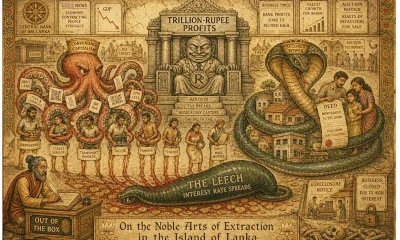
Octopus, Leech, and Snake: How Sri Lanka’s banks feast while the nation starves
-
 Sports6 days ago
Sri Lanka women’s volleyball team ready for Central Asian challenge
-
 Opinion5 days ago
Murder of Ehelepola family, Bogambara Wewa and Sightings of Wangediya
-
 News5 days ago
Steps underway to safeguard Sri Lanka’s maritime heritage
-
 Features2 days ago
The NPP’s pivot to the past
-

 Editorial5 days ago
A play without its protagonist
-

 Opinion4 days ago
The need to reform Buddhist ecclesiastical order
-

 Business4 days ago
Historic launch of CCWE Fashion Week & International Summit 2026