
Business
GLX expands team of ‘Growth Alchemists’ to drive good innovation


Within just 2 short years, GLX has effectively validated its proof of concept and re-established itself as an independent private entity
Good Life X (GLX), the cutting-edge catalyst for startups and SMEs in the food, agriculture, travel and wellness sectors, have announced new members joining their leadership team to drive a new phase of growth. GLX Founder/CEO Randhula De Silva and GLX Programme lead Shenali de Silva are welcoming on board Strategist and Investor Arj Wignaraja and Economist and International Development Consultant Anushka Wijesinha to share the leadership table in GLX’s ‘2.0’ iteration.
Within just 2 short years, GLX has effectively validated its proof of concept and re-established itself as an independent private entity – an innovation management company building the next generation of life-enhancing sustainable companies. With new members joining as GLX’s ‘Growth Alchemists for Good’, GLX stands ready to be a collaborator and co-creator to private and public sector partners looking to evolve, innovate and disrupt their organizations and industries, in anticipation and alignment with the future markets in Sri Lanka, Asia and the world.
Since launching in 2019 within the German development agency GIZ, GLX quickly grew from working with 6 startups to working deeply with 45 SMEs and startups under an umbrella of multiple concurrent programmes. Some of these are cyclical (e.g., GLX Accelerator and GLX Garage) and others were created in response to the COVID crisis (e.g., ‘Stay Good in Business for COVID Tourism Resilience’ and ‘Enterprise Evolver’). GLX Founder/CEO Randhula De Silva remarked, “As application numbers grew with each programme, it was obvious GLX had correctly identified a latent demand in the entrepreneurship and business sector. GLX also drew increased partnership offers from established individuals and organizations in Sri Lanka, Germany, Netherlands, Singapore, Thailand and the USA and others, signaling strongly that businesses, foundations and investors too were inspired by our vision of the future, with an Asia-led and impact-oriented outlook that GLX has”.

Business
Focus on developing the Coconut and Food & Beverage export industries into a USD 3 billion economy within the next two years


A discussion was held on Friday (26) afternoon at the Presidential Secretariat between President Anura Kumara Dissanayake and industrialists in the coconut and food and beverage manufacturing sectors on developing the coconut and food and beverage export industries into a USD 3 billion economy within the next two years.
Accordingly, the objective is to expand the coconut-based export industry into a USD 2 billion sector and the food and beverage export industry into a USD 1 billion sector, and extensive discussions were held on the plans required to achieve these targets.
The President stated that the Government is prepared to provide every possible form of incentive necessary to promote export diversification and encourage value-added products.
Proposals and suggestions aimed at developing these industries were also presented during the meeting, and the President further noted that future plans would be formulated after taking all such proposals and recommendations into consideration.
The President also expressed agreement to provide incentives for establishing industries in the Northern Province and assured that the Government would extend its fullest support for setting up coconut-based manufacturing industries in the region.
Attention was also focused on plans to streamline the importation of raw materials required for export production while safeguarding domestic producers. President Anura Kumara Dissanayake further stated that his Government’s objective is to build the country’s economy into an export-oriented production economy by strengthening domestic supply chains.
Minister of Labour and Deputy Minister of Finance and Planning Anil Jayantha Fernando; Secretary to the Ministry of Finance, Planning and Economic Development, Dr Harshana Suriyapperuma; Secretary to the Ministry of Industry and Entrepreneurship Development, Thilaka Jayasundara; and Chairman of the Export Development Board, Mangala Wijesinghe, were among those present.
The President of the Sri Lanka Food Processors Association, Aruna Senanayake; Vice President Rasika Seneviratne; Managing Director of CBL Group, Shyamali Wickramasinghe; Chief Executive Officer of SriLankan Catering Ltd, Mangala Wijesekera; Managing Director of Ma’s Tropical Food Processing (Pvt) Ltd, Mario D. Alwis; Chairman of the Consumer Foods Sector of John Keells Food Holdings PLC, Daminda Gamlath; together with a number of leading business leaders from the food production sector were also present.
President’s Media Division (PMD)

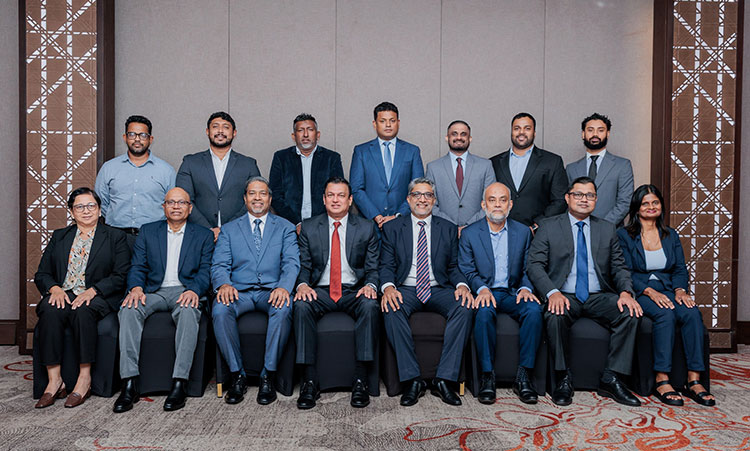
The Sri Lanka Retailers’ Association (SLRA) successfully held its 9th Annual General Meeting (AGM) on 23 June 2026 at Hilton Colombo Residencies, bringing together members of the country’s organized retail sector to review the Association’s achievements over the past year and outline its strategic priorities for the future.
The AGM formally adopted the Annual Report and Audited Accounts for the financial year 2025/26 and elected the Office Bearers and Executive Council for the year 2026–2027.
Infiyaz M. Ali, Director of Healthguard Pharmacy Ltd, was announced as President of the Sri Lanka Retailers’ Association for 2026–2027. He will be supported by Mahesh Wijewardena, Executive Director and Group Chief Executive Officer of Singer (Sri Lanka) PLC, as Senior Vice President, and Kumar De Silva, CEO of SPAR SL Private Ltd, as Vice President.
The newly appointed Executive Council comprises senior representatives from leading retail organizations across Sri Lanka, reflecting the Association’s continued commitment to representing the diverse interests of the retail sector.
Addressing the gathering, President Infiyaz M. Ali emphasized the importance of collaboration, innovation, and industry advocacy in driving the next phase of growth for Sri Lanka’s retail sector.
“Retail continues to be one of the most dynamic sectors of the Sri Lankan economy. As consumer expectations evolve and technology reshapes the industry, the role of SLRA is to create opportunities for knowledge sharing, collaboration, and collective action. We remain committed to supporting our members and contributing to the sustainable growth of the retail ecosystem,” he stated.
The AGM was honoured by the presence of Wasantha Samarasinghe, Minister of Trade, Commerce, Food Security and Cooperative Development, who attended as Chief Guest. In his address, the Minister highlighted the importance of the retail sector as a key contributor to economic development, employment generation, and consumer welfare, while emphasizing the need for stronger public-private collaboration to strengthen the industry’s competitiveness.
Members also had the opportunity to gain insights from the Guest Speaker, Chayu Damsinghe, Head of Macroeconomic Advisory at Frontier Research, who shared perspectives on Sri Lanka’s economic outlook, emerging business trends, and the opportunities and challenges facing the private sector in the years ahead.
A key highlight of the evening was the presentation on the upcoming Sri Lanka Retail Forum 2026, SLRA’s flagship industry event, which will be held under the theme “Retail Without Boundaries – Building the Next Growth Engine.” The forum is expected to bring together more than 500 industry leaders, retailers, entrepreneurs, policymakers, technology providers, and investors to discuss the trends shaping the future of retail.
The Association reaffirmed its commitment to supporting retailers through industry advocacy, professional development initiatives, policy engagement, and knowledge-sharing platforms that foster innovation and business growth.
Since its establishment in 2015, SLRA has played a pivotal role in bringing together retailers from diverse sectors including FMCG, fashion, healthcare, consumer electronics, and digital commerce, creating a unified voice for the industry.
With a renewed leadership team and an ambitious programme of activities planned for the year ahead, SLRA looks forward to working closely with its members and stakeholders to strengthen Sri Lanka’s retail sector and contribute to the country’s economic development.

CSE trading was yesterday driven by month- end profit-takings, market analysts said.Amid those developments both indices moved upwards. The All Share Price Index went up by 2.77 points, while the S and P SL20 rose by 10.91 points.
Turnover stood at Rs 1.91 billion with two crossings. Those crossings were; ACL Cables 2.1 million shares crossed to the tune of 209 million; its shares traded at Rs 100 and Hayleys 100,000 shares crossed for Rs 24.1 million; its shares traded at Rs 240.
In the retail market companies that mainly contributed to the turnover were: Hayleys Rs 141 million (587,000 shares traded), Lanka Realty Rs 105 million (1.8 million shares traded), CIC (Non Voting) Rs 81 million (3.1 million shares traded), HNB Finance Rs 79 million (8.3 million shares traded), Dialog Axiata Rs 56.7 million (1.2 million shares traded), Colombo Dockyard Rs 48.6 million (371,000 shares traded) and Singer SriLanka Rs 46.6 million (586,000 shares crossed).
During the day 63.9 million share volumes changed hands in 18300 transactions.
It is said that manufacturing sector counters, especially Hayleys, performed well while construction related companies, especially ACL Cables, also performed well. Banking sector counters, especially HNB, were also notable on the floor.
Meanwhile, Lee Hedges concluded negotiations with Amana Bank to sell and transfer its land and premises in Kollupitiya for a total consideration of Rs 2.7 billion, with the transaction completed on June 25, 2026.
Lee Hedges shares were trading up 2.52 percent, at Rs.325.75, while Amana Bank was up 1.13 percent at Rs.26.80.
Yesterday the rupee was quoted at Rs 336.90/337.00 to the US dollar in the spot market, from Rs 337.25/35 the previous day, while bond yields were quoted slightly higher, dealers said.
The telegraphic transfer rate for Sri Lanka’s rupee against the US dollar was 332.3416 buying, 342.0372 selling; the euro was 376.2315 selling, 389.9580 buying; and the pound was 436.5994 buying, 451.8110 selling.
By Hiran H Senewiratne

Maliban Biscuits and Peoples Leasing PLC qualify for CDB-MCA T10 Tier B final

Focus on developing the Coconut and Food & Beverage export industries into a USD 3 billion economy within the next two years

Another 1,132 Sri Lankan Personnel to be deployed for United Nations Peacekeeping Missions

Ben Stokes four-for, Ben Duckett hundred as England roar back

Venezuela shaken by magnitude 4.9 tremor days after major earthquakes

US strikes Iran in response to drone strike on commercial ship

‘Dates have the highest sugar content to fight Coronavirus’

Sunday Island 27 December – Headlines

#SundayIsland 17th December – Headlines

Sunday Island – 28th March

Sunday Island Headlines – 21 March

Sunday Island – 21st February – Headlines
-

 Features7 days ago
Nanda Pethiyagoda Wanasundara as three generations of family saw her
-

 Features6 days ago
Sri Lanka developing independent hydrographic capabilities
-

 Opinion5 days ago
Ranasinghe Premadasa: The man who would not take ‘No’ for an answer
-

 Editorial7 days ago
Fuel crisis: Beyond price debate
-

 Latest News6 days ago
Sooryavanshi thumps fastest List A fifty as India A win tri-series
-

 News4 days ago
US Assistant Secretary of State for South and Central Asian Affairs meets President
-

 Opinion4 days ago
Sri Lanka’s national security: Justice, reconciliation, and forward-looking vigilance
-

 Features7 days ago
The Sirisena – Ranil conflict and events leading to MR’s return as PM