
Sports
SLR must put players in a bio bubble

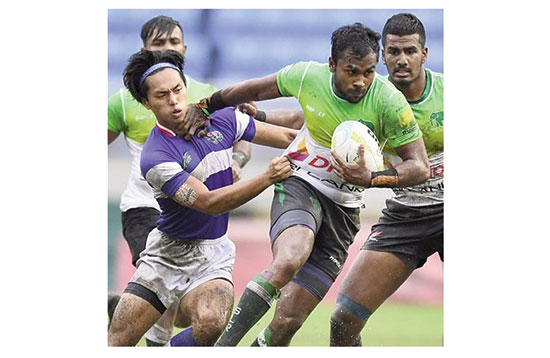
Sri Lanka’s national players haven’t had international exposure at any form of rugby for a long time due to the present pandemic
by a Special Sports Correspondent
Sri Lanka’s sports scene is similar to a hatchling stepping into the world. Like the newborn learning to cope with new territory, Sri Lanka’s sportsmen and women have to carefully tread wherever they go due to the pandemic that’s raging.
Compared to other sports our rugby players have done little to get their training off the ground during this challenging environment. For their ill luck the inter-club rugby sevens tournament became a nonstarter because Sri Lanka Air Force (SLAF), a co host of the event, announced that it wasn’t in a position to go ahead with the tournament because of the pandemic. The tournament was to be organised by SLAF under the supervision of Sri Lanka Rugby (SLR) to celebrate the former’s 70th anniversary. Most club players who committed themselves even went into a bio bubble to prepare for the tournament. But all efforts channeled towards having a much needed rugby event proved futile in the end.
On the administration side of the equation there is SLR President Rizly Illyas who is struggling to kick start rugby events in the island. Just the other day he was quoted in the newspapers stating that Sri Lanka had received hosting rights for two Asian Rugby Sevens tournaments. However what catches the eye of this writer is a comment Illyas made regarding the announcement of the two tournaments. The SLR President says he is aware of the challenges posed by the pandemic to conduct a tournament of such magnitude. But most importantly he adds ‘We can’t sit back and wait’. That thought can create the platform to launch future rugby activities.
To conduct an international rugby tournament SLR needs the support of the Sports Ministry and Ministry of Health. According to informed sources Illyas is not enjoying the best of support from ‘other influential parties’ who can help the first rugby tournament to get off the ground after rugger activities came to a stop several months ago.
Rugby can take a cue from cricket, badminton, table tennis, chess and athletics. The national cricketers are making tours abroad and continue to be reimbursed despite the pandemic developing into a third wave and disrupting human life activities.
According to sources the majority of domestic rugby players are not getting remunerated hence the difficulty in getting them into a bio bubble and have an international tournament. Unlike the national cricketers the country’s best rugby players are owned by the clubs and not by the rugby controlling body. The SLR has to get its first rugby activity off the ground for the year 2021. Compared to rugby, which is starving, the international cricket calendar is chockablock. SLC CEO Ashley de Silva was quoted in newspapers saying that Sri Lanka hosting the Asia Cup would be put back, due to the pandemic, till late as after the 2023 cricket World Cup. This he says is because the national cricket teams of all countries have a packed schedule.
Even sports must be viewed from a human angle. As much as sports administrators use psychology to motivate players these players must be encouraged when sports activities have come to a standstill. They can take a cue from the Sunera Foundation, founded by Sunethra Bandaranaike. The foundation conducts workshops for differently abled persons. Workshops are conducted so that participants are able to feel, be seen and can express themselves in a creative manner. Rugby players must be made to feel that they are wanted and given opportunities to express themselves through sports.
From the perspective of player wellbeing Sri Lanka Badminton conducted an online fitness programme for the players titled ‘keep shuttle fit’. National coaches and players, members of the ‘challenge pool’ and junior players took part in the programme conducted in the mornings on weekdays. Even a sedentary sport like chess has got off the ground and the country’s national players are at present contesting the Asian Continental Chess Championship via online participation. Sri Lanka’s chances are carried at this chess tournament by Ranindu Liyanage, Minul Sanjula, L.M.S.T de Silva and Theekshan Dinuwan. The tournament is held from May 20-30.
All sports draw ‘oxygen’ form the National Olympic Committee (NOC). This is because the NOC facilitates travel of sportsmen and women to events like the Olympic Games, Asian Games and Commonwealth Games. A top NOC official has been quoted in the newspapers that plans are underway to field teams for the Commonwealth Games (UK) and Asian Games (China). The NOC is concerned about how the Sri Lankans will perform, hence the committee has said that it wishes to see two sets of players being sent for the two events to enhance medal prospects and limit injuries.
In any given situation what matters is not how challenging the situation is, but how big the person put in charge of the situation is. All national sports bodies must have an innovative and determined president to make sure their respective sports don’t lose players. Just the other day we read in newspapers that some of our national cricketers are contemplating premature retirement because of reduced payments to them. But the SLC has made alternate plans to reimburse players with the best available paying scheme. The idea is to keep the players in the game during difficult times. Given the present situation this writer hears of a sad story from the south. A known rugby coach is now undertaking home painting contracts in the absence of any money coming his way from rugby coaching. There is another rugby coach, possessing a bike license, who has taken up transporting food and has signed up with a food delivery company.
Going down memory lane to the late 1980s most defence establishments allowed their players to represent domestic clubs in SLR conducted tournaments at a time when the JVP insurgents threatened security forces personnel with death if they didn’t quit their places of employment. Careers of many rugby players were saved as a result of far thinking by the SLR (Sri Lanka Rugby Football Union back then).
The SLR has to come to the fore and sign contacts with players with the motive of putting them in a bio bubble when future international tournaments approach. This is the best time for the SLR to break the monopoly on players by clubs and look to the future and escape from the pandemic blues.


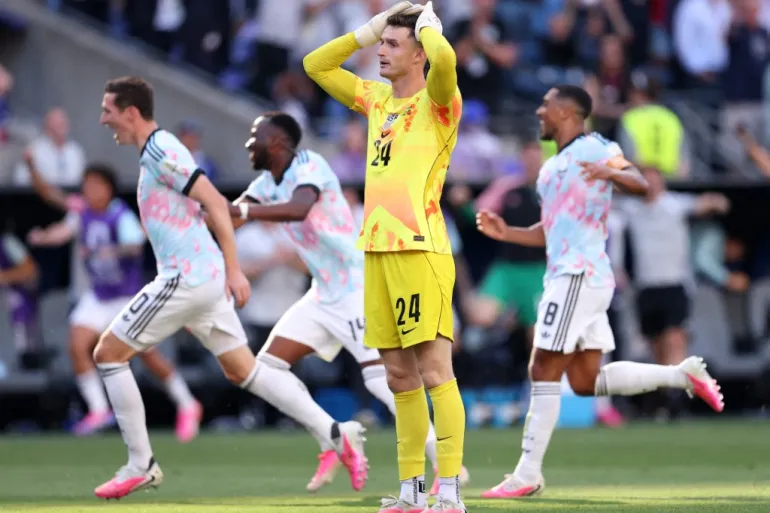
Belgium dumped USA out of their own World Cup on Monday, as Charles De Ketelaere’s brace secured a 4-1 win that was eclipsed by the bitter row over Folarin Balogun’s ban.
Victory means the Belgians face Spain in the quarterfinals, while the USA follow the other World Cup cohosts, Canada and Mexico, out of the tournament with elimination in the round of 16 after a thoroughly flat performance.
All attention pre-game had been on Balogun’s place in the USA starting lineup, after US President Donald Trump had asked FIFA to review the striker’s one-game suspension for a red card, and the governing body controversially obliged.
Belgium’s starting lineup had a few surprises of its own, with Kevin De Bruyne and Jeremy Doku among the heavyweights benched. But coach Rudi Garcia’s gambit proved inspired, with De Ketelaere grabbing an early goal to puncture the feel-good vibes in Seattle.
Malik Tillman grabbed one back from a free kick, but De Ketelaere swiftly restored Belgium’s lead. A catastrophic piece of goalkeeping by Matt Freese and a late Romelu Lukaku goal left the Americans dead and buried.
FIFA’s move to suspend Balogun’s ban after he was sent off in the previous round against Bosnia and Herzegovina has been slammed by football fans, pundits and players around the world, but there were no such misgivings among the Seattle crowd.
A colossal roar greeted the stadium announcement of Balogun’s name in the starting lineup, vastly dwarfing the cheers even for USA talisman Christian Pulisic.
The “USA” thunderclap then echoed around the stadium, utterly drowning out a small corner of chanting Belgium fans in the opening minutes.
But the American party was swiftly silenced. The majority of 67,000 fans fell silent in the ninth minute as De Ketelaere scored, easily tapping home from close range after Nicolas Raskin’s cross evaded some lax defending.
It was the first time the Americans had conceded the opener all tournament. With the atmosphere deflated, no immediate fightback was visible on the pitch either. The midfield was outgunned, and the defence looked nervous.
On the half-hour mark, Balogun drew a foul on the edge of the area and whipped the crowd back to life. He waved his arms frantically as Tillman – fresh from scoring a free kick against Bosnia – lined up the ball.
Tillman’s shot deflected off the Belgian wall and spun into the net, and the stadium shook.
But the joy was again short-lived. In the 33rd minute, De Ketelaere leapt up to meet Leandro Trossard’s cross, and comfortably out-jumped an off-balance Tim Ream to score his second.
The US inched back into the game as the first half closed out, with Balogun blasting over from a long Tillman throw, then narrowly failing to catch a long ball, again from the Bayer Leverkusen midfielder.
US coach Mauricio Pochettino switched formation at half-time, sending Gio Reyna into the number 10 role and pushing Weston McKennie out to the right. The Americans resumed play with more intensity, pushing higher up the pitch.
But self-inflicted disaster struck in the 57th minute. Freese came out to collect a Belgium long ball, turned to evade the charging De Ketelaere, but then hesitated with his pass.
De Ketelaere jabbed the ball to Hans Vanaken, who made no mistake with an open goal from long range.
Pulisic limped off with an injury minutes later, and with him went the US dreams of reaching a first World Cup quarterfinal since 2002.
His replacement, Sebastian Berhalter, flashed an ambitious shot narrowly wide in the 79th minute, and Balogun had a close-range effort saved soon after.
But Chris Richards handed the ball to Lukaku in stoppage time, and the veteran striker did not hesitate to seal the rout.
[Aljazeera]
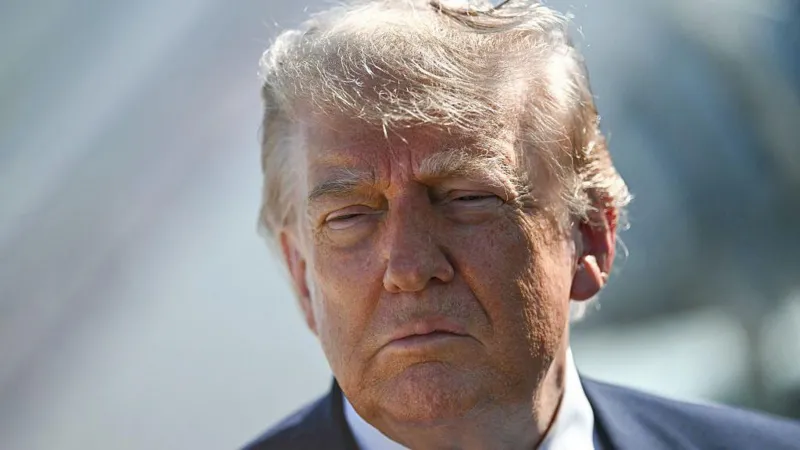
President Donald Trump has confirmed he asked Fifa to review United States striker Folarin Balogun’s one-match suspension at the World Cup.
Balogun, 25, was set to miss his side’s last-16 tie against Belgium after being shown a straight red card for a foul on Bosnia-Herzegovina defender Tarik Muharemovic in the previous round.
But Fifa made the shock decision to suspend the automatic one match ban for 12 months, leading to widespread criticism, including from Uefa, Belgium and England boss Thomas Tuchel.
Fifa’s decision frees US forward Balogun, who has scored three goals at this summer’s tournament, to be selected for the match in Seattle, which kicks off at 17:00 local time (01:00 BST on Tuesday).
The Royal Belgian Football Association (RBFA) says it is “astonished” by the move and has told the United States Soccer Federation it “contests the eligibility” of Balogun playing in the tie after its appeal against the decision was dismissed.
Trump said football’s world governing body “made the right decision”, adding it would have left a “big stain” on the tournament had the ban been implemented.
Speaking at the White House on Monday, Trump said he had asked Fifa to review the decision because he “didn’t think it was a foul”.
He confirmed he had spoken to Fifa president Gianni Infantino but said “all” he did was ask for a review and added he did not tell the Swiss he had to suspend Balogun’s ban.
Trump added: “I think it [the suspension] would have left a big stain. I can’t tell them what to do. I don’t believe they made the decision; I believe it was the commission that made the decision. And it was the right decision.”
However, European football governing body Uefa said it left the integrity of football at stake.
Trump also said referee Raphael Claus’ decision to send off Balogun was “horrible” and called the Brazilian “a little bit suspect”.
In response, the Brazilian football conferdation (CBF) defended Claus’ integrity, stating: “There is nothing in his record that discredits him or gives grounds for any suspicion. He is an exemplary professional.”
In a statement on X, Infantino said that on receiving a call from Trump, he told the US President there was “an ongoing legal process involving Fifa’s independent judicial bodies and that the case would be decided in due course by the competent bodies”.
The Fifa appeal committee deemed Belgium are not an interested party as they were not involved in the original decision and are merely the United States’ next opponents.
“The request was rendered inadmissible on the grounds that the Belgian FA is not a party to the proceedings and, as such, has no standing to appeal the decision,” said Fifa in a statement.
This means Balogun will be free to play against Belgium because there is no party who would appeal against the decision.
The RBFA said it has “still not received any grounds” for the Fifa appeal committee rejecting its appeal and is still awaiting information requested, including the “motivation [for] declearing the player eligible as well as the referee’s report”.
The RBFA added this is a “breach” of Fifa regulations.
When asked by BBC Sport about Trump’s comments and his view on Claus, Fifa said it had “nothing more” to add.
Infantino later stated Fifa’s judicial bodies were “independent” and rulings “must always be respected”.
He added: “I read the decisions of the Fifa Disciplinary Committee when they are issued. Sometimes I am surprised by them. Sometimes I agree with them, and sometimes I disagree.
“What I always do, however, is respect those decisions and the autonomy of the bodies that make them. Whether we personally like a decision or not is irrelevant.
“Respect for independent institutions and the rule of law is what protects the integrity of our competitions and the credibility of Fifa at all times.”
In raising its concerns, the RBFA said: “Regardless of the sporting outcome of this match, the RBFA is deeply concerned by the course of events and will continue to fight in the coming hours, days and months in defence of the fundamental principles of ethics, fair competition, and the interests of football as a whole.”
England head coach Thomas Tuchel said the ruling set a dangerous precedent.
Tuchel had defender Jarell Quansah sent off in a dramatic 3-2 win over Mexico.
“Where to draw the line is the question that I ask,” he said. “I have no answer to that.
“Do we appeal if a yellow card is not a yellow card? Do we think it is not a red card or who thinks it? Where does this start and where does this end? It’s my question. I don’t have an answer.”
Uefa said intervening to effectively cancel a suspension at a tournament “crossed a red line”.
Of the 189 other red cards at the World Cup, only once has a player escaped a suspension.
That was Brazil’s Garrincha in 1962 – before automatic bans were in place, and the failure to impose a sanction was shrouded in allegations of political interference.
Fifa cited article 27 of its disciplinary code, which gives authority to partially suspended disciplinary measures, in announcing Balogun’s one-match ban would be suspended for a probationary period of one year.
In an 871-word statement released later on Monday, Fifa again outlined the process in which article 27 can be used, but gave no further reasoning behind the specific decision to suspend Balogun’s one-match ban.
The Swiss Football Association, whose side face Colombia in the last 16 on Tuesday, called the decision “incomprehensible”, adding it “raises questions and creates uncertainty, particularly regarding the authority of referees’ decisions, especially when the video assistant referee (VAR) is involved”.
[BBC]
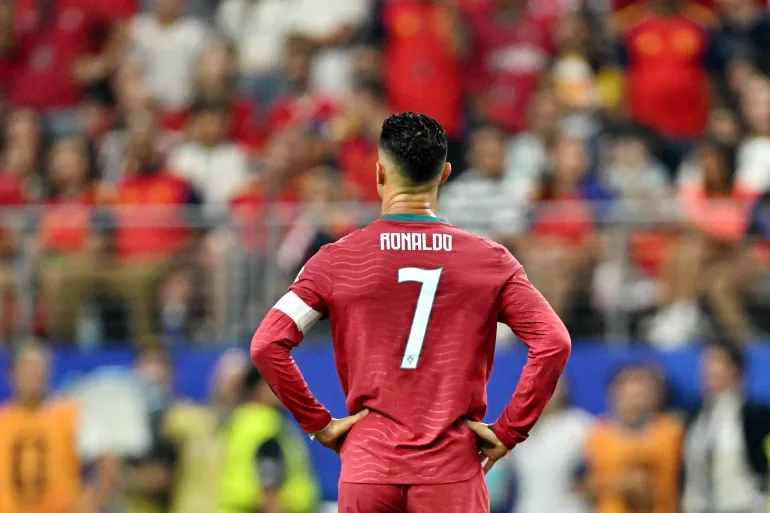
Mikel Merino scored in the first minute of second-half stoppage time, and Spain beat Portugal 1-0 on Monday to likely end the World Cup career of superstar Cristiano Ronaldo.
After being fouled, Merino took a quick free kick, ran towards the goal and fired past goalkeeper Diogo Costa after a pass from Ferran Torres.
Spain advanced to the quarterfinals for the first time since winning its only World Cup title in 2010 in South Africa. La Roja will play either the USA or Belgium on Friday at Los Angeles Stadium.
Ronaldo was trying to get Portugal to the quarterfinals for a second consecutive tournament – something the nation has not achieved before. Instead, his career on the biggest stage is likely over for the all-time leader in international goals (146) and appearances (233).
Merino did not come on as a sub until the 85th minute, and his heads-up play showed some of the versatility that helped Arsenal win its first Premier League title in more than 20 years in May. He had been doubtful to make Spain’s squad because of injuries, which also impacted his Premier League season.
The latest meeting of the Iberian Peninsula rivals – who first played a friendly in Madrid 105 years ago – was quite the contrast to their most recent World Cup match.
It was eight years ago that Ronaldo had his only World Cup hat-trick in a 3-3 draw with Spain, a group-stage opener considered one of the tournament’s best games.
The 41-year-old superstar scored three times in this tournament, but did not have many chances against Spain’s Unai Simon.
La Roja had created better chances, but extra time and possibly penalties loomed until Merino’s late intervention.

Spain broke a World Cup record with its sixth consecutive clean sheet, and goalkeeper Simon extended his record shutout streak to 609 minutes.
Spain broke its tie with Italy (1990) and Switzerland (2006-10) for the most consecutive World Cup matches not allowing a goal. Spain’s streak began with a 0-0 draw in the 2022 round of 16, when Morocco advanced after a penalty shootout.
There was also a surprising scoreless draw against Cape Verde to open group play in this tournament, followed by four consecutive shutout victories to advance to the quarterfinals.
Simon surpassed the previous record of 517 consecutive scoreless minutes during a 3-0 blanking of Austria to open the knockout round on Thursday. Famed Italy goalkeeper Walter Zenga set the standard in 1990 with five consecutive clean sheets in his home World Cup.
Simon’s shutout streak started in 2022 in Qatar, during a 2-1 loss to Japan to wrap up group play.
He came into the Portugal game having made only four saves in this World Cup – Austria had no shots on target – and on Monday in Arlington, Simon had to make two saves in the first half against Portugal, both from shots by Cristiano Ronaldo.
The second of those saves was an impressive diving stop when he was still in midair after reaching back to grab the ball with both hands.

[Aljazeera]

Balogun reprieve in vain as Belgium beat USA to set up Spain quarterfinal

Trump confirms he asked Fifa to review Balogun ban

Late Spain goal eliminates Portugal, ends Ronaldo’s international career?

Nyamhuri and Ngarava stun Bangladesh by defending 141

Sri Lanka try to make a play after Greaves 180, Hope 112

Dry weather except for a few showers in the Western and Sabaragamuwa provinces and in Galle, Matara, Kandy and Nuwara-Eliya districts

‘Dates have the highest sugar content to fight Coronavirus’

Sunday Island 27 December – Headlines

#SundayIsland 17th December – Headlines

Sunday Island – 28th March

Sunday Island Headlines – 21 March

Sunday Island – 21st February – Headlines
-
 News2 days ago
Singapore-based Buddhist monk marks nearly four decades of humanitarian service
-

 News3 days ago
Freedom 250: US Embassy celebrates America’s 250th Independence Day through magic of American cinema
-
 News4 days ago
CIABOC to question Harak Kata on Rs. 200 mn bribery allegation
-
 News4 days ago
SLAF conducts successful rescue mission under UN command in Central African Republic
-

 Midweek Review6 days ago
H’tota port’s strategic status remains focal point of geopolitical scrutiny
-

 News1 day ago
AI concerned over proposed SL military deployment in Haiti
-
 News4 days ago
UNEP support pledged to strengthen Sri Lanka’s Environmental Priorities
-

 Features2 days ago
The NPP’s New Challenge: Balancing Easter Lawfare and Economic Welfare