
News
COVID-19 jabs can take weeks to work, continued vigilance vital says experts

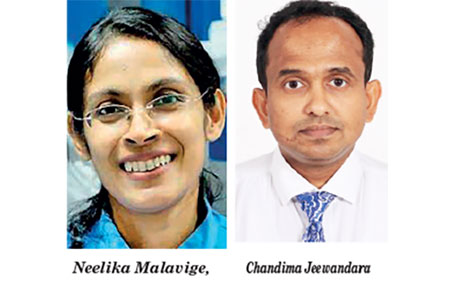
ECONOMYNEXT – Vaccination against COVID-19 will help bring the death rate down and minimize severe disease but the jab can take weeks to be fully effective and vaccinated people can still spread the virus as asymptomatic carriers, a leading Sri Lankan microbiologist said.
Neelika Malavige, Professor in Microbiology at the Department of Immunology and Molecular Medicine, Faculty of Medicine, University of Sri Jayewardenepura, in a Government Information Department interview urged vaccinated Sri Lankans to stick to health protocols such as masking and regular hand washing.
“No one gets immediate protection right after the jab. It takes about 21 days for the body to produce antibodies after the first dose of AstraZeneca (Covishield). One dose does not provide sufficient protection, which is why we give two,” Malavige said.
Sinopharm also provides considerable protection but only two weeks after the second jab, the professor said. Sri Lanka has decided to give the two doses of the Chinese vaccine four weeks apart.
“In the meantime, you can still get infected and infect others,” she warned.
Taking a new wave of COVID-19 in Singapore as an example, Malavige said vaccinated airport employees were found to have spread the highly transmissible Indian strain of the virus in the city state.
“Everyone at the airport had received the Pfizer jab, so even when they tested positive for COVID-19, they didn’t report severe symptoms. But they still got infected and, as asymptomatic patients, carried the virus into the wider Singaporean society,” she said.
Echoing Malavige, Director of the Infectious Diseases Hospital Dr Ananda Wijewickrama said the primary objective of vaccination is to prevent critical conditions and death.
“People who get the jab can still get infected, but they have a lower chance of developing critical symptoms. It is important to follow health guidelines because we can be vaccinated and still spread it,” he said.
A mutated variant that has only been detected in Sri Lanka suspected to have been mutated from the original COVID-19 virus. The virus has been mainly detected in the Batticaloa district and in the Western Province and was the dominant variant before identifying the UK variant.
According to health authorities, this virus has a lower transmissibility and mortality rate making most of the patients asymptomatic.
Director of Allergy Immunology and Cell Biology Unit of the University of Sri Jayawardenepura Dr Chandima Jeewandara told the privately owned ABC media network that all three vaccines have been proven to be effective against the variants present in the country.
“International research has indicated that the efficacy rate can be changed with these mutations. However, any vaccine that shows an efficacy rate more than 50 percent is considered to be a successful vaccine and all three vaccines are proved to have a higher efficacy rate at the moment,” Jeewandara said.
Jeewandara predicted that Sri Lanka’s ongoing wave of COVID-19, with over 2,500 cases reported a day, will likely be contained by August this year.
“The virus has not changed the way it’s infecting people,” he said.
Vaccination and strict adherence to health protocols will contribute chiefly to containing the spread.
“We should provide at least one type of vaccine to the community. If the vaccine is being given in your area get it immediately, Wear the mask, keep social distance and avoid any gatherings,” he said.
“The next moth is crucial to Sri Lanka. We expect this wave to be controlled by August,” he added.
Jeewandara said there is no guarantee the virus will disappear. Vaccination is the one strategy to take control of the situation, he added.

Latest News
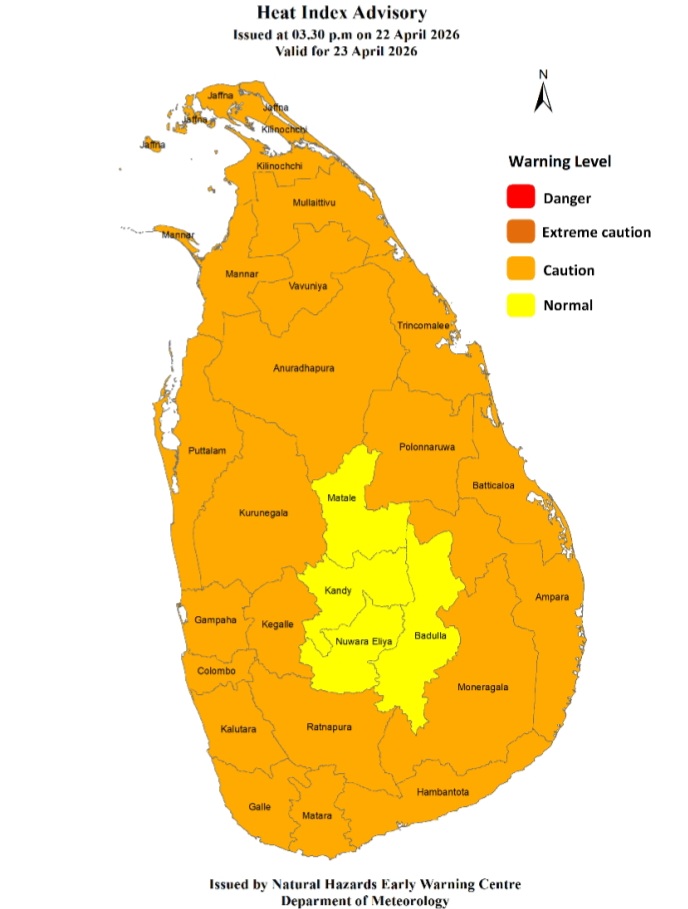
The Heat Index is likely to increase up to ‘Caution level’ at some places in the Northern, North-central, North-western, Western, Sabaragamuwa, Eastern and Southern provinces and in Monaragala district during the day time

Warm Weather Advisory
Issued by the Natural Hazards Early Warning Centre
Issued at 3.30 p.m. on 22 April 2026, valid for 23 April 2026.
The Heat index, the temperature felt on human body is likely to increase up to ‘Caution level’ at some places in the Northern, North-central, North-western, Western, Sabaragamuwa, Eastern
and Southern provinces and in Monaragala district during the day time.
The Heat Index Forecast is calculated by using relative humidity and maximum temperature and this is the condition that is felt on your body. This is not the forecast of maximum temperature. It is generated by the Department of Meteorology for the next day period and prepared by using global numerical weather prediction model data.

Effect of the heat index on human body is mentioned in the above table and it is prepared on the advice of the Ministry of Health and Indigenous Medical Services.
ACTION REQUIRED
Job sites: Stay hydrated and takes breaks in the shade as often as possible.
Indoors: Check up on the elderly and the sick.
Vehicles: Never leave children unattended.
Outdoors: Limit strenuous outdoor activities, find shade and stay hydrated.
Dress: Wear lightweight and white or light-colored clothing.
Note:
In addition, please refer to advisories issued by the Disaster Preparedness & Response Division, Ministry of Health in this regard as well. For further clarifications please contact 011-7446491.
Latest News
Cabinet approves establishment of Activity-Based Learning Centers at Regional Level for Commerce Education

The importance of establishing learning centers at regional level has been identified in order to achieve multiple objectives, including the development of teachers, utilization as a hub for new technology and resource sharing, enhancement of vocational and higher education opportunities, efficient utilization of limited physical and human resources, integration of new technologies with subject-specific knowledge,
sharing of limited resources to ensure equitable access to education, and development of skills in line with regional potential, thereby contributing to the qualitative development of commerce education.
Accordingly, the project to establish 100 activity-based learning centers for the enhancement of commerce education has been included in the Public Investment Programme as a major investment project in general education, with an estimated total cost of Rs. 289 million, to be implemented during the period 2026–2028.
Having considered the proposal submitted by the Prime Minister, in her capacity as the Minister of Education, Higher Education and Vocational Education, Cabinet approval was granted to establish and operationalize 25 regional centres covering all 25 districts.
Latest News
M/s. Resources Development Consultants (Pvt) Ltd appointed to prepare Feasibility Study and detailed plans for the extension of the Kelani Valley Railway Line from Avissawella to Ratnapura
Approval was granted at the Cabinet Meeting held on 21-10-2025 to carry out a feasibility study and prepare detailed plans for the extension of the Kelani Valley Railway Line from Avissawella to Ratnapura.
The calling of expressions for this purpose has been conducted under the national Competitive Procurement Procedure, and 8 bidders have submitted their Expression of Interest in that respect.
Following the evaluation of technical proposals submitted by the short-listed bidders, and financial proposals of the 4 eligible institutions have been opened. Subsequent to the evaluation of the aforementioned financial proposals, the Consultant Procurement Committee has recommended awarding
the consultancy for the feasibility study and preparation of detailed plans for the extension of the Kelani Valley Railway Line from Avissawella to Ratnapura to M/s. Resources Development Consultants (Pvt) Ltd at a total cost of Rs. 356.22 million (exclusive of taxes).
Accordingly, the Cabinet of Ministers has approved the resolution furnished by the Minister of Transport, Highways and Urban Development to award the said procurement in line with the above recommendation.

The Heat Index is likely to increase up to ‘Caution level’ at some places in the Northern, North-central, North-western, Western, Sabaragamuwa, Eastern and Southern provinces and in Monaragala district during the day time

IRGC seizes two vessels in Strait of Hormuz amid US blockade

Cabinet approves establishment of Activity-Based Learning Centers at Regional Level for Commerce Education
M/s. Resources Development Consultants (Pvt) Ltd appointed to prepare Feasibility Study and detailed plans for the extension of the Kelani Valley Railway Line from Avissawella to Ratnapura
Import and Export (Control) Regulations No. 01 of 2026, issued under the Imports and Exports (Control) Act, No. 1 of 1969, to be submitted for concurrence of the Parliament

Cabinet nod to establish ‘Sri Lanka Industrial Transformation and Innovation Authority ‘

‘Dates have the highest sugar content to fight Coronavirus’

Sunday Island 27 December – Headlines

#SundayIsland 17th December – Headlines

Sunday Island – 28th March

Sunday Island Headlines – 21 March

Sunday Island – 21st February – Headlines
-

 News2 days ago
Rs 13 bn NDB fraud: Int’l forensic audit ordered
-

 Business5 days ago
Harnessing nature’s wisdom: Experts highlight “Resist–Align” path to resilience
-

 News5 days ago
Gratiaen Trust announces longlist for the 33rd Annual Gratiaen Prize
-

 Opinion3 days ago
Shutting roof top solar panels – a crime
-

 News4 days ago
From Nuwara Eliya to Dubai: Isha Holdings markets Agri products abroad
-

 Latest News6 days ago
Singapore Zoo’s first Sri Lankan leopard cubs make their public debut
-
 News5 days ago
Heroin haul transported on 50-million-rupee contract
-

 News3 days ago
Church calls for Deputy Defence Minister’s removal, establishment of Independent Prosecutor’s Office