
Opinion
Mindset of Arts Graduates


Hasini Lecamwasam’s article Why are Arts Graduates Unemployable (The Island of 11 May) is an excellent analysis of the topic.
For decades, our universities have turned out Arts Graduates, very well knowing that with most of the basic subjects offered by them, they become unemployable; but what have the authorities done to rectify this waste of government funds which could have been diverted to other educational areas?
In one way, it boils down to falling values, the objective of just obtaining a degree and being a “Upadhi Dharee” being the main purpose. I have come across this myself and have hands on exposure to this.
About a decade ago, the then Government approached some of the large business organisations (Just before a general election) and made an appeal for them to employ at least two graduates, under a special scheme, at a salary of Rs 6,000/= per month. The company I work for, also agreed to consider this, and informed the Ministry concerned accordingly. The Ministry had short listed 12 graduates for us and they were called for interviews. The company wanted me to interview them to see whether we could select two.
All the applicants were Arts Graduates, and seven were over the age of 35 years. Although all our company work is done in English, I made it a point to interview them in Sinhala, just to make them comfortable. All 12 applicants had some avenue of income and some of them were married. There was one who was looking after their own paddy lands (Govithan), another looking after their plots of tea and rubber, selling green leaf and latex, there were two who ran their family grocery shops and businesses, and one other female who had started a small shop (Kade) initially selling eight loaves of bread a day along with other items, and soon ending up selling over 40 loaves of bread and turning the business into a village grocery shop. The others also were engaged in some vocation.
I had one common question for them, that is; why do they want to give up what they were doing at their villages without improving them, and to come to Colombo and get boarded and work for a salary of Rs 6,000.00 per month? You will be surprised that they all had one common answer, ie “Mama Upaadhi Dhaariyek Ne” (Cos I am a degree holder.) My attempt to tell them that the salary would hardly be sufficient to pay for their boarding and food, and that it would be very much more sensible for them to improve what they were already doing, was like pouring water on a duck’s back. This was their mindset.
SARIPUTHRA
Colombo 05
Chief Financial Officer of a
Leading Group of Companies

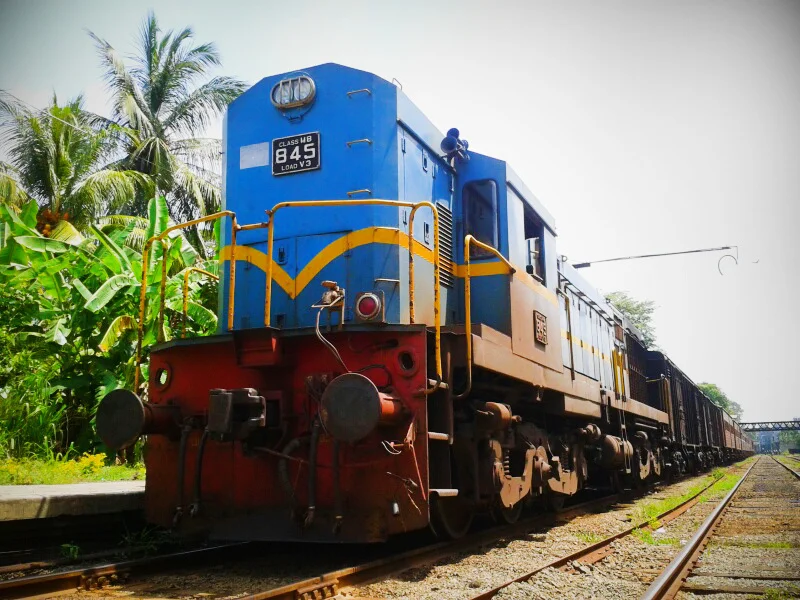
For centuries, many travellers have waxed eloquent about Sri Lanka, the “Resplendent Isle.” They spoke of lush tea estates, golden shores, and a spirit of much-admired spontaneous hospitality that defined our Pearl of the Indian Ocean. But today, the residents of this isle know a different reality; one not of postcards, but of grease, grit, and the grinding misery of a transport system, virtually in terminal collapse. To move from Point A to Point B in modern Sri Lanka is no longer a simple errand; it is a “Herculean effort” of survival against a backdrop of state incompetence, private-sector thuggery, total disregard for human decency and a government that seems to have outsourced its conscience to the highest bidder.
For the millions who call this thrice-blessed island home, the daily reality of navigating it by any form of transport has become a “major catastrophe” of Dickensian proportions. To move from Point A to Point B in 2026 is no longer a simple logistical task; it is a distasteful test of human endurance, a drain on the spirit, and a gamble with one’s own safety. The current transport status of Sri Lanka is not merely “poor”, a terminology that defies even proper definition. It is a monumental systemic failure, a toxic cocktail of state negligence, private-sector extortion, and a total collapse of regulatory oversight.
The Iron Horse in Decay: A Rail Service in Tatters
At the heart of our transit woes is the state-run surface rail service. As the only transport entity exclusively handled by the government, the railways should be the backbone of our economy. Instead, they have become a testament to nonchalant and omnipresent bureaucratic apathy. The carriages, many of which look as though they have not seen a lick of paint or a structural repair since the mid-20th century, are in a state of advanced decay.
The statistics tell a grim story. Derailments have become so frequent that they are no longer headline news but a daily footnote in the lives of commuters. These “accidents” are rarely the acts of God; they are the inevitable results of poor maintenance of tracks and rolling stock. Unacceptable delays are now the standard operating procedure. A journey that should take an hour often stretches into three, leaving students, office workers, and labourers stranded on sweltering platforms while the authorities offer nothing but silence or hollow excuses. While other nations race toward high-speed travel connectivity, our “Queen of Jaffna” and “Udarata Menike” crawl through a landscape of systemic neglect.
The symptoms are visible to any commuter: rusted carriages with leaking roofs, seat upholstery that has not seen a deep clean since the 1970s, and an electrical system prone to sparks and darkness. But the issues run deeper than aesthetics. We are witnessing a terrifying frequency of derailments, often blamed on “technical faults” that are actually the predictable results of poor track maintenance and a lack of spare parts. Accidents at unprotected crossings continue to claim lives, while “unacceptable delays” have become the only predictable feature of the timetable. For the office worker in Colombo Fort or the student in Peradeniya, the train is no longer a vessel of progress; it is a gamble with time and safety.
The Bus “Mafia” and the Ransom of the Commuter
If the rail service is a ghost of a bygone era, the fee-levying bus service is a modern-day war zone. The landscape is split between the state-run Sri Lanka Transport Board (SLTB), burdened by a very poorly maintained fleet of ageing buses and a massive and aggressive fleet of private buses, which outmatch and outperform the state-run flotilla, not by efficiency but by sheer intimidation. It is absolutely crucial to note that neither serves the public. The SLTB really operates a skeletal, poorly maintained fleet that barely scratches the surface of demand. The private buses are a law unto themselves.
At the heart of the private transport sector lies an association that critics have aptly dubbed a “Mafia.” Headed by the influential figure colloquially known as “Bus G”, this association holds the entire nation’s commuters to ransom. At the drop of a hat, they can paralyse the country with “trade union action” that are little more than unsophisticated blackmail. In a telling ransom note, whenever a policy change or a fuel hike threatens their bottom line, the buses disappear from the roads. The result? Thousands of citizens are stranded in the blistering heat, watching their productivity and dignity evaporate while the “association” negotiates with a government that appears to be absolutely terrified of their political muscle.
There is a dark irony in the politics of it all. The kingpins of this “bus mafia” openly boast that they were instrumental in bringing the current political powers into office. Consequently, the government appears not just toothless, but complicit. While the public suffers, the state turns a blind eye to overcrowding, reckless driving, and the use of nasty, addictive drugs by the staff, which turns our highways into graveyards. The powers-that-be do not have the gumption to call a spade, just that, a spade, and rein in the miscreants, using the finest employment of the laws that govern this country.
The Law of the Tuk-Tuk: A Free-for-All on Three Wheels
Descending further into the chaos, we find the omnipresent three-wheeler and taxi services. Once a convenient alternative, the “Tuk-Tuk” has become a law unto itself. In a country where the cost of living is already spiralling, these unscrupulous operators have created a “free-for-all” fare system. There is no central control over rates; instead, passengers are forced to haggle or succumb to whatever arbitrary figure the driver decides upon. For those who can afford to bypass the buses, the totally inconsiderate charges of three-wheelers and private taxis offer no sanctuary. What was once a convenient last-mile solution has devolved into a predatory racket. The tuk-tuk services have become stallions of self-importance, operating without any meaningful oversight of rates or conduct.
Commuters are met with the nonchalant refusal of short-distance hires. Drivers, seeking to “make a fast buck,” prioritise long-distance hauls where they can extort exorbitant, unmetered fares. In the absence of a standardised digital fare system enforced by the state, the passenger is always the loser. The arrogance is palpable, and respect for fellow humans has been thrown out the window. These operators behave as if they own the asphalt, often claiming that their collective vote base was the kingmaker for the current political establishment. This perceived “immunity” has bred a culture of impunity where the commuter is treated as a nuisance rather than a customer.
For the elderly trying to reach a hospital or a worker trying to get home during a rainstorm, the “refusal” has become a standard, insulting rejection. The fee-levying taxi services, though slightly more professional in appearance, operate with a similar mercenary mindset, exploiting the desperation of a public that has no other choice.
The RMV Mess, the Registration Trap and the Police Ambush
For those who have attempted to escape the public transport nightmare by purchasing their own vehicles, a different kind of trap awaits. The government has allowed the mass import of private vehicles, including two-wheelers, but the Registrar of Motor Vehicles (RMV) has become a black hole of inefficiency. Delays in vehicle registration now run into several months. Despite a surge in private vehicle imports, the bureaucracy has ground to a resounding halt. Vehicle owners face “blatant delays” in registration that extend for several months, leaving them in a bureaucratic and legal limbo.
The situation is worsened by the government’s decision to halt the private-sector issuance of number plates, centralising it into a system that is currently a “total mess.” Tens of thousands of vehicles are forced to ply the roads displaying only engine and chassis numbers, a temporary measure born of necessity. Yet for all that, and totally against even a minuscule iota of any consideration, the Police Department seems to have missed the memo and become a set of hungry predators. Officers wait in ambush, charging these owners with hefty fines for being on the road without official number plates; plates that the state itself has failed to provide. It is an avaricious cycle, where the state fails to register your car or motorcycle, and then the state’s law enforcement arm punishes you for that very failure. Rather than focusing on the blatantly reckless bus drivers or the lawless Tuk-Tuks, Police Officers wait in ensnarement to pounce on these “unregistered” vehicles. Even when owners produce documents proving the delay lies entirely with the RMV, they are charged and fined. The message is clear: the citizen must pay for the government’s failure.
The Prohibitive Cost of Mobility
Overseeing all of this is the crushing weight of fuel prices. The government continues to raise the cost of petrol and diesel with scant regard for the downstream consequences. These so-called “cost-reflective” adjustments may look good on a balance sheet in Washington or at the International Monetary Fund, but on the ground in Colombo and Kandy, they are prohibitive. Every hike in fuel prices triggers a “ripple effect” that raises the price of bread, vegetables, and, of course, the very transport that people use to get to work to pay for those goods.
Finally, a Nation at a Standstill
The transport crisis is not just a logistical problem; it is a moral one of utter social degradation. It reflects on a government that has abandoned its primary duty: to provide the infrastructure for a functioning society. We are living on a “glorious isle” where the beauty of the landscape is now obscured by the soot of a broken bus and the stress of an uncertain commute. Going from Point A to Point B has become a major travail of unbelievable misery.
Overseeing this chaos is a government that views the fuel pump as an Automated Teller Machine (ATM). The cost of all fuel types, from petrol to the diesel that powers the nation’s mobility has reached “absolutely prohibitive” levels. With scant regard for the domino effect on the cost of living, the authorities and the powers-that-be continue to raise prices, fuelling a major catastrophe of economic inflation.
For the average Sri Lankan, the “travail of unbelievable misery” is now constant. We are a nation on the move, but we are moving towards a cliff from which we are likely to fall into an abyss of no return. Until the transport sector is stripped of its political “protectors” and returned to the service of the people, this “Resplendent Isle” will remain a beautiful prison for those trying to get from Point A to Point B.
If the current administration continues to protect the infamous “mafias”, ignore the decay of the rails, and profit from the administrative chaos of the RMV, and totally fail to get their act together, they are not failing just the transport sector; they are in fact failing the very heart of the nation for sure. Our Motherland, Sri Lanka, deserves a whole lot better than a state of an ever-present and unending transit catastrophe. All the rhetoric about a rich country and a beautiful life that was promulgated in the not-too-distant past remains only as unbelievable wishful thinking.
By an Aficionado
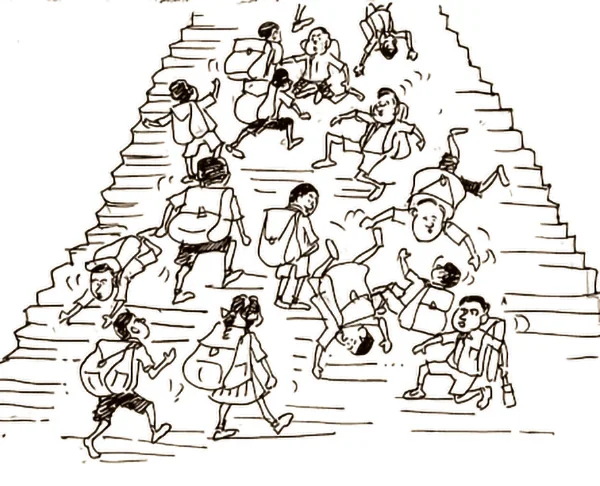
Education is widely recognised as the foundation of a country’s development. In Sri Lanka, free education has provided generations of children with the opportunity to attend school regardless of their economic background. Despite these advantages, many students still leave school before completing their education. School dropout is a significant social issue because it affects not only the lives of young people but also the country’s economic and social progress. Understanding the reasons behind school dropout is essential for finding effective solutions.
One of the main reasons students leave school is financial hardship. Although education in Sri Lanka is free, families still have to spend money on uniforms, stationery, transportation, private tuition, and other school-related expenses. For low-income families, these costs can be difficult to manage. Some students are forced to work to support their families instead of continuing their education. In rural areas especially, children may help with farming, fishing, or family businesses, reducing the time and motivation they have for school.
Another important factor is academic pressure. Sri Lanka’s education system is highly competitive, especially because of major examinations such as the Grade Five Scholarship Examination, the G.C.E. Ordinary Level, and the G.C.E. Advanced Level. Many students feel stressed by the heavy workload and the pressure to achieve high marks. Those who struggle academically may lose confidence and believe they have little chance of success. As a result, some choose to leave school rather than continue facing disappointment and failure.
Family problems also contribute significantly to school dropout rates. Children who experience divorce, domestic violence, alcoholism, or the loss of a parent often face emotional and financial difficulties. Some students become responsible for caring for younger siblings or elderly family members. Without proper support, balancing family responsibilities with education becomes extremely challenging. In such situations, education may become a lower priority.
Another reason is the lack of interest in traditional classroom learning. Every student has different talents and learning styles. However, the education system often focuses mainly on academic achievement rather than practical or vocational skills. Students who are gifted in sports, arts, technology, or technical work may not feel motivated in a classroom that emphasises examinations and textbook learning. Without opportunities to develop their unique abilities, some students become bored and eventually stop attending school.
Bullying and mental health issues are also important causes of school dropout. Some students experience bullying because of their appearance, disability, ethnicity, language, or family background. Others suffer from anxiety, depression, or low self-esteem but do not receive the counseling they need. When students feel unsafe or unwelcome at school, they may begin missing classes and eventually leave school altogether. Schools that lack proper counseling services may struggle to identify and support these vulnerable students.
In some parts of Sri Lanka, long travel distances and transportation difficulties discourage students from attending school regularly. Rural students often travel several kilometers every day, sometimes on foot or using unreliable public transport. During the rainy season, flooded roads and poor infrastructure make travel even more difficult. Frequent absenteeism caused by transportation challenges may eventually lead students to drop out.
For some girls, early marriage and teenage pregnancy become barriers to continuing education. Although these cases are less common than in some other countries, they still affect certain communities. Young mothers often find it difficult to balance childcare with school responsibilities. Social stigma and limited support can further reduce their chances of returning to education.
The COVID-19 pandemic also increased the number of students at risk of dropping out. During school closures, many families lacked internet access, smartphones, computers, or stable electricity for online learning. Students from disadvantaged backgrounds fell behind in their studies, and some never returned to school after classes resumed. The pandemic highlighted inequalities in access to education across the country.
The consequences of school dropout are serious. Students who leave school early often have fewer employment opportunities and may earn lower incomes throughout their lives. They are more likely to experience poverty, unemployment, and social exclusion. School dropout can also contribute to higher crime rates, child labor, and poor health outcomes. For the country, losing educated young people means a less skilled workforce and slower national development.
Several solutions can help reduce school dropout rates in Sri Lanka. The government can strengthen financial assistance for low-income families through scholarships, school meal programmes, and transportation support. Schools should provide counseling services to address mental health concerns and prevent bullying. Teachers can receive training to identify students who are at risk of dropping out and provide timely support. Expanding vocational education and technical training would also give students more opportunities to pursue careers that match their interests and abilities. Finally, parents, schools, communities, and government agencies should work together to encourage regular school attendance and create a supportive learning environment.
In conclusion, school dropout is a complex issue caused by economic difficulties, academic pressure, family problems, mental health challenges, transportation issues, and limited educational opportunities. Although Sri Lanka has made remarkable progress in providing free education, ensuring that every child completes their schooling requires continued effort from all sectors of society. By addressing the root causes of school dropout and supporting vulnerable students, Sri Lanka can build a more educated, skilled, and prosperous future for the next generation.
Saumya Aloysius
saumyaaloysius@gmail.com

by Eng. Parakrama Jayasinghe
El Niño is here! It is now official. With the fear of it being even a super El Niño, the authorities have been summoned by President Anura Kumara Dissanayake for an urgent discussion and instructions have been given on measures to initiate possible mitigation measures. These have spanned a wide spectrum of sectors which are in danger of being gravely affected. While food production and energy have received much attention, even the drinking water supply is expected to be adversely affected.
However, by and large the feeling that an ordinary citizen gets, on listening to the reportage on public media, is that at least on this critical issue there are no cohesive, detailed pragmatic plans and strategies being discussed and promoted.
It may not be impossible to mitigate the possible effects of El Niño fully, but what we can hope for is a degree of mitigation. El Niño is nearly upon us and there is no time for longdrawn discussions or time-consuming plans.
Specific comments on electricity sector
I would like to focus on the electricity sector in particular and its unavoidable links to irrigation and domestic water supply.
We have already discussed in earlier articles, how power cuts are being avoided by using diesel for power generation, with grave impacts on balance of payments as well as the economy. In response to a query, in public media, the Chairman of the National System Operator (NSO) has said he expects a fuel subsidy to continue until September and therefore there will be an increase in cost of diesel and consequently a hike in electricity tariff.
The Proposals for safeguarding the Electricity Supply
An analytical review of our past electricity generation mix records would reveal this eminently feasible and attractive way forward.
At the above public energy committee meeting, it was further noted that while the electricity utility consumed over 900,000 litres of diesel per day for power generation, in April 2026, the amount came down to some 350,000 litres per day in May. It is important to consider and recognise the circumstances which led to this turnaround, even if not adequate to solve the problem.
The Island newspaper reported on 8 June 2026 that to overcome the deficit of some 27 GWh of coal power, caused by substandard coal imports, the gap had to be filled with diesel power once more. Lack of courage to face the problem and declare limited power cuts to overcome it ,is the reason for this state of affairs. The resultant extra cost is said to be Rs 4.5 Billion.
Accordingly, the startling fact is that the unit cost of diesel power generation was Rs 166/kWh, but the utility charges only Rs 100/kWh for consumers with a monthly consumption over 180/kWh since 11 May . Those with lower consumption are charged much less. These figures highlight the unsustainable reliance on diesel.
It is very likely that there would be a call for increasing the consumer tariff once more in September when the next tariff review is due. This is in spite of the lowered world crude oil prices on 17 June 2026, due to a framework for peace signed between the USA and Iran. As per the IMF edicts, the Utility has to recover all its costs from consumers, irrespective of their mode of operation and efficiency or the lack thereof.
Change from April 2026 to May 2026 is illustrated above. (See image 1)
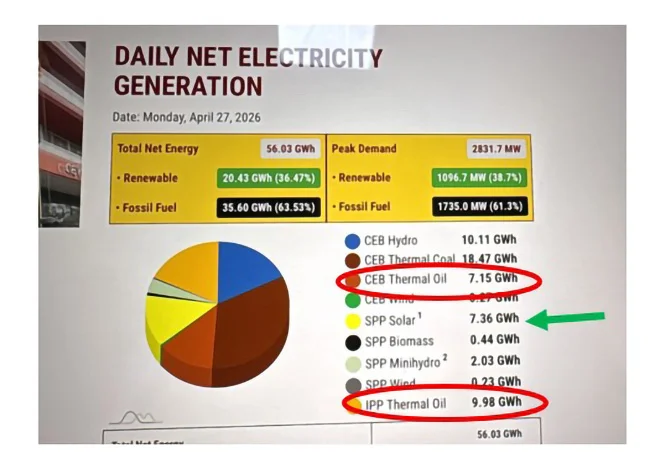
Further the dramatic decline in use of diesel highlights the past scenarios we illustrated earlier with possible increase in the availability of major hydro power in May with the onset of the monsoon. With added increase in ground mounted solar. It is to be noted that the large input from rooftop solar PVs is not recognized here.
Sri Lanka has experienced the most encouraging instances of generating all its electricity without the use of any oil including diesel, furnace oil or Naptha on isolated days, all too infrequent, but it is noteworthy. (See image 2)
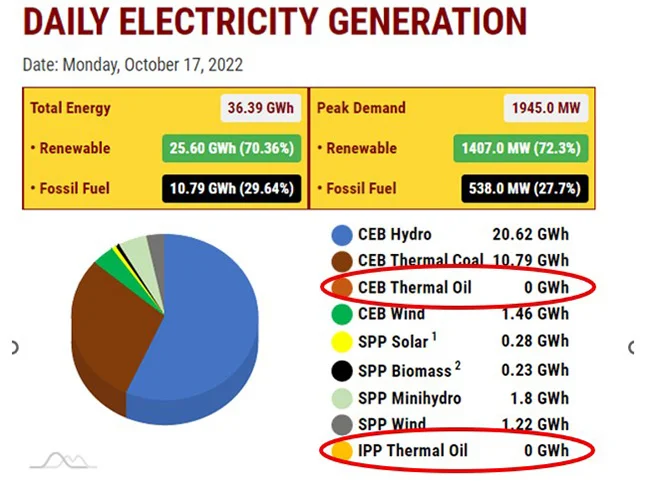
The days of zero or near zero use of oil for power generation listed below, unfortunately did not receive the attention of either the Utility or the Ministries of Power or Finance. Such attention could have resulted in a much more progressive electricity sector and a much lower consumer prices and saving of billions of dollars over the past decade. (See Table 1)
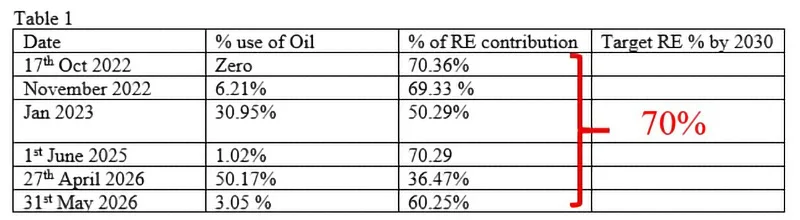
The bottom line is that when there is good May–Dec hydro generation, there is a scant need for oil-based generation. Past records show that in such good hydro years, the CEB was making profits and not in need of Treasury handouts. However, the dry season of January to April results in low hydro generation and generation costs rise. No one bothered to consider the means of filling the gap of lower hydro during the dry months with other available economical and indigenous renewable resources. Instead, the easy solution and perhaps the more profitable solution for some, and obviously not for the country, or the consumer, was the use of oil and even the so-called emergency power at enormous cost to the consumers.
The authorities professed that there was no solution. Slow adoption of mini-hydro, wind, and biomass was making only a small impact. There was a singular lack of support for accelerating development of such projects in spite of the setting up of the Sri Lanka Sustainable Energy Authority in 2007, expressly to facilitate and promote the development of the sector.
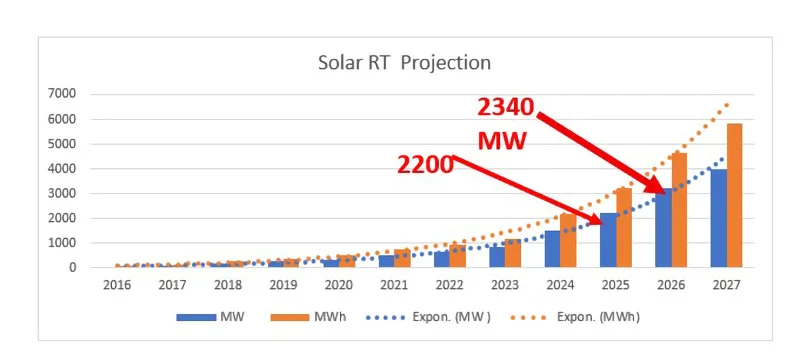
That was the case until the acceleration of solar power development. (See graph 1)
The ignored impact of Surya Bala Sangraamaya
Matters changed in 2010 with the declaration of the Surya Bala Sangramaya, opening the door for smallscale rooftop solar PV development. Further impetus was given by Net Plus and Net Accounting schemes. From 2016, exponential growth in the solar PV sector was recorded, reaching over 2300 MW through 150,000 mostly with sub MW scale domestic rooftop solar PV installations.
The power generation industry was no longer the sole purview of large wealthy corporations. The consumers themselves became generators thus becoming “Prosumers”
However, in 2025, the Surya Bala Sangraamaya suffered a setback, because of the machinations of the utility and others in authority; they did not recognize its true value.
It is necessary to recognise the growing contribution of rooftop solar PV, recognised world over along with its variable nature and not unique to Sri Lanka. An attempt was made to include such strategies in the successive Long-Term Generation Plans, but without much success.
How do we face the El Nino , already with us ?
It is under these circumstances that we have to face El Niño or even a Super El Niño. At least in the electricity sector, the past records point to a way forward.
It does not require much intelligence to discern the fact that
* When there is good hydro we manage without oil and CEB can make good profits
* But when there is low hydro, we have the advantage of much higher Solar energy
* Only intervention that is needed is to provide storage batteries so that solar energy can be stored and used at night as well and thus avoid the need for thermal generation.
* There is now some 2500 MW of rooftop solar and 400 MW of ground mounted solar and 170 MW of wind already installed, just waiting for the batteries to be added.
* The Utility is dragging its feet on adding the large batteries at grid substations and ignoring the fact that much more urgent need for early benefits is by adding batteries at the distribution substations and even individual distribution transformers.
* The Prosumers with 2500 MW of rooftop solar are ready and waiting to add the behind-the-meter batteries, provided that the Utility is willing to accept that option.
Will this happen? Or, will anyone in the government realise this possibility and get cracking.
Electricity and Irrigation
It is argued that as for water allocation in case of drought conditions, priority should be given for drinking water and agriculture. While this is logical, I have never seen any figures related to the actual water needs and water discharge.
Naturally, drinking water is the first priority. But what percentage is needed for this? Have we got logical strategies to maintain a balance between drinking needs and the power generation or Irrigation? Can’t we have the cake and eat it by making sure that the water released for irrigation also generates electricity?
Short-term approach with long lasting advantages
Therefore, it is my contention that the maximum attention should be paid to adding behind-the -meter batteries to get ready in case El Nino results in draughts, even during the conventional high rainfall periods, say June to December. If not, it would give us an opportunity to get ready with the infrastructure needed to make the best use of the basic facilities already built by the Prosumers and also to attract new Prosumers to install solar with batteries. These could then be ready to face the likely dry months from January to May 2027, however severe they are.
My appeal is to the current Prosumers with rooftop solar and the many others, whose requests for grid connections have been rejected out of hand to install rooftop solar and batteries to operate in the off-grid mode and thus reduce their dependence on the grid significantly. This would automatically reduce the peak load demand and the need for diesel based generation and enable the reduced hydro resource to be used to meet the peak load at much lower cost. This is an interim measure and they should be permitted to participate by exporting any excess during peak hours, once the FIT scheme presently being developed is active.
This is not the time and place to quote detailed numbers, but suffice it to say that if 100,000 Prosumers with 5 kWh batteries go off the grid during peak hours, it will help reduce the peak demand by 500 MW. The current peak load is only about 2900MW. This positive contribution could in fact be much greater if there is even the slightest signal of support from the state.
If further evidence is needed the following table illustrates the contribution made by the Renewable Energy Sector to the Country on an annual basis. (See Table 2)
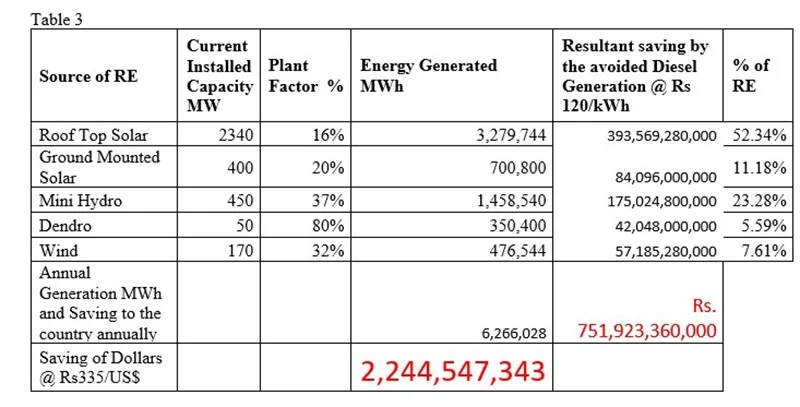
The potential is unlimited. Therefore, the current El Nino scare should be treated as a warning as well as an opportunity to get control of the electricity sector and ensure future energy security.
(The writer can be contacted at
parajayasinghe@gmail.com)

Cabinet Subcommittee on the Development of 25 Technical and Vocational Colleges meets under the Chairmanship of the Prime Minister

Representatives of the Organization of Professional Associations (OPA) of Sri Lanka meet the Prime Minister

District Secretaries’ Conference Chaired by the President

ICC contacts ECB over Stokes retirement video

Greater focus must be placed on strengthening primary healthcare

Morocco dealt huge blow as injured Saibari out of World Cup quarterfinal

‘Dates have the highest sugar content to fight Coronavirus’

Sunday Island 27 December – Headlines

#SundayIsland 17th December – Headlines

Sunday Island – 28th March

Sunday Island Headlines – 21 March

Sunday Island – 21st February – Headlines
-
 News5 days ago
Singapore-based Buddhist monk marks nearly four decades of humanitarian service
-
 News7 days ago
CIABOC to question Harak Kata on Rs. 200 mn bribery allegation
-

 News6 days ago
Freedom 250: US Embassy celebrates America’s 250th Independence Day through magic of American cinema
-
 News7 days ago
SLAF conducts successful rescue mission under UN command in Central African Republic
-

 News4 days ago
AI concerned over proposed SL military deployment in Haiti
-
 News7 days ago
UNEP support pledged to strengthen Sri Lanka’s Environmental Priorities
-

 Midweek Review2 days ago
Unexpected focus on ‘pieces of tin’ worn by military men
-

 Features5 days ago
The NPP’s New Challenge: Balancing Easter Lawfare and Economic Welfare