
News
Work with people to defeat Covid-19


by Jehan Perera
The sudden resurgence of the Covid pandemic in Sri Lanka was totally unexpected by the people at large though it was expected and predicted by those in the scientific and medical communities. The people had been reassured by the political leaders and sections of the media that Sri Lanka was a success story unlike other countries, including more developed ones that had been devastated by the pandemic. However, the country had received an early warning in the second wave which had commenced in October last year with the spread that was believed to have originated in the garment industry. But much before this the country’s top medical associations had been warning that community spread of the coronavirus had already commenced. These warnings were neither heard nor acted upon by the vast majority of the population. The mainstream view, until the shock of the third wave in April, was that Sri Lanka was a success in Covid management.
Sri Lanka enjoyed undoubted success in combatting the first wave of the coronavirus, with the participation of the security forces in implementing the lockdown and tracing of persons infected by the coronavirus. This success seems to have given rise to the misperception that the country was secure enough in terms of Covid control to give priority to the revival of the economy. But there was a big information gap between the appearance and the reality that swayed the governmental decision-makers. There can be no other explanation for their failure to heed the warnings that came from the medical and scientific community in the week, prior to the New Year shopping and holiday season.
Scholars, who have studied disasters that have afflicted human beings over the millennia, have noted that lack of proper information was often at the centre of those tragedies that might have been averted. Famines have taken place in many parts of the world and have led to millions of deaths that need not have happened. There was sufficient food stocks in other parts of the world, sometimes in the country itself, that could have been sent to the areas that did not have food. The Bengal famine of 1943 in British India is an example. The policy failures began with the provincial government’s denial that a famine existed. There was a breakdown in the lines of communication that could have led to food supplies from areas, where food stocks existed, being sent to the areas with short supply. (https://en.wikipedia.org/wiki/Bengal_famine_of_1943)
Since the successful containment of the first wave of Covid by the strict policy of lockdown and curfew adopted by the government, the restoration of the economy has been its first priority. The economy and people’s livelihoods received a severe battering during the two-month long lockdown. The Covid spread was contained but the economy shrank by more than it ever has in the post-independence period. The government gained the appreciation of the general population and the international community for its success in containing Covid. But the downturn in the economy needed to be restored which is what the business advisors of the government set out to do.
Unnecessarily risky
In retrospect,some of the government’s decisions, taken to revive the economy appear to have been unnecessarily risky in terms of containing the Covid spread. One was the partial reopening of tourism industry which led to an influx of tourists from countries that had poor track records of containing the pandemic, most notably Ukraine and India. These tourists were meant to arrive in a “bubble” and depart having toured the country in a “bubble” but even with these most stringent precautions it seems to have paved the way for new Covid variants to have taken root in the country. More recently there was media exposure given to a variety of “quarantine tourism” from badly affected countries from which the wealthier people wished to temporarily take a respite. The actions of government ministers in pouring “sacred water” into rivers to forestall the pandemic and their imbibing of a special “Covid herbal concoction” to protect against the virus was not based on science, professional advice and rationality that the country needs its decisionmakers to follow.
In these circumstances, it seems unfair that the blame for the resurgence of the Covid pandemic should be put on the people themselves who are charged with being negligent in their duties to take care of themselves and of others. Shock and awe treatment of ordinary citizens who were not taking the Covid pandemic seriously was witnessed on a video clip that were released of the police apprehending people who did not wear masks in commando-style. The videoing of the operations was done with precision and widely circulated on the media for maximum impact. The videos show police personnel in Covid protective clothing going into crowded urban areas, apprehending offenders who are not using masks properly, carrying them physically and bundling them inside parked buses to be taken to be charged. Such governmental actions can breed resentments that grow with the passage of time. The danger is also that the security forces may be induced to act similarly in other situations, too.
FRAUGHT TIMES
For the past year, after the success of the government in controlling the first wave of coronavirus, the people at large have been made to believe that the government has everything under control and that Sri Lanka has certain unique conditions that will spare it the fate of other countries. The recent police operations in different parts of the country to apprehend members of the general public who were either not wearing their face masks at all, or improperly by not covering their noses, suggests an intention to instill the importance of following health guidelines in the people. It would have been better if these police actions had been done consistently throughout the period, and by police in the course of their regular duties, such as during the Sinhala and Tamil New Year festivities in different parts of the country.
It needs to be kept in mind that these are very fraught times in which the majority of people are struggling to make ends meet. Due to the economic downturn many of them have lost their jobs or are getting only a part of their salaries. According to the World Bank, “With jobs lost and earnings reduced, especially in urban areas and among private sector employees and informal workers, the $3.20 poverty rate is projected to have increased from 9.2 percent in 2019 to 11.7 percent in 2020.” (https://www.worldbank.org/en/news/press-release/2021/04/09/sri-lankan-economy-recovers) Daily wage labourers find it harder to get daily work as potential employers do not wish to give them work and hire them for fear of Covid infection. Those who are fortunate enough to have their children attending schools with online teaching have all to meet extra expenses such as phone data charges for their children’s education.
At the same time as there is public resistance to a lockdown there is fear and apprehension about contracting Covid and the health consequences in a situation where the hospitals are full and not able to accept more patients. In these circumstances there can be pent up anger within society that can suddenly come to the fore. The government needs to take these tensions within people into account when it designs its responses to the unfolding crisis. Instead of demonstrating the punitive powers of the state machinery there could be an emphasis on messages of care from the government to the people. The government could take the people into its confidence and educate them about the true situation with regard to Covid spread and what can be done in partnership to mitigate it. It needs to come up with economic support schemes, such as the Rs 5000 dole or food coupons for the poor, that will make the people ready for a lockdown. A democratic polity will seek to inform, educate and work with the people to overcome any crisis the country faces.

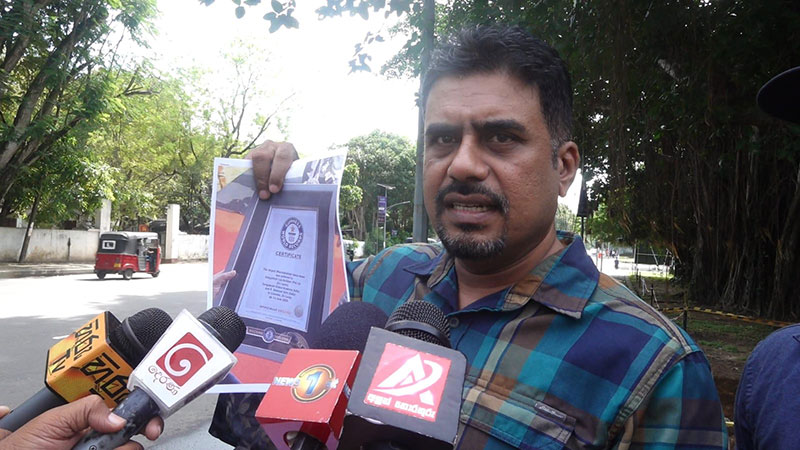
The Jana Aragala Sandhanaya yesterday lodged a complaint with the Commission to Investigate Allegations of Bribery or Corruption (CIABOC), calling for an investigation into Deputy Minister Sundaralingam Pradeep over alleged irregularities related to a Guinness World Record event held in Sri Lanka.
The organisation alleged that state patronage had been extended to a private company for the event and that large sums of money had been collected from around 5,000 families of participating students.
Speaking to the media, after submitting the complaint, Jana Aragala Sandhanaya National Executive Council member and Frontline Socialist Party (FSP) Secretary, Duminda Nagamuwa, alleged that the government had promoted the Bharatanatyam workshop, held on June 14, as an event that secured a Guinness World Record for the participation of the largest number of students.
He said a government politician had taken the lead in organising the event, attended by Deputy Minister Mahinda Jayasinghe.
Nagamuwa questioned the decision to provide state support for an event organised by a private entity, claiming that the Guinness certificate issued for the achievement had been awarded not to Sri Lanka or a state institution, but to a company.
“Why did the government provide state patronage to a private institution’s programme?” he asked.
He alleged that each of the approximately 5,000 participating students had paid Rs. 5,000, resulting in the collection of a substantial amount of money. He claimed that parents were also asked to pay additional amounts of Rs. 3,450 for logos and Rs. 2,350 for certificates.
Nagamuwa alleged that many families, from economically disadvantaged backgrounds, had incurred heavy expenses travelling to Colombo and staying there for several days for the event, with some families spending around Rs. 30,000 each.
News
Opposition MPs sign motion demanding debate on prolonged failure to fill vacancies in superior courts

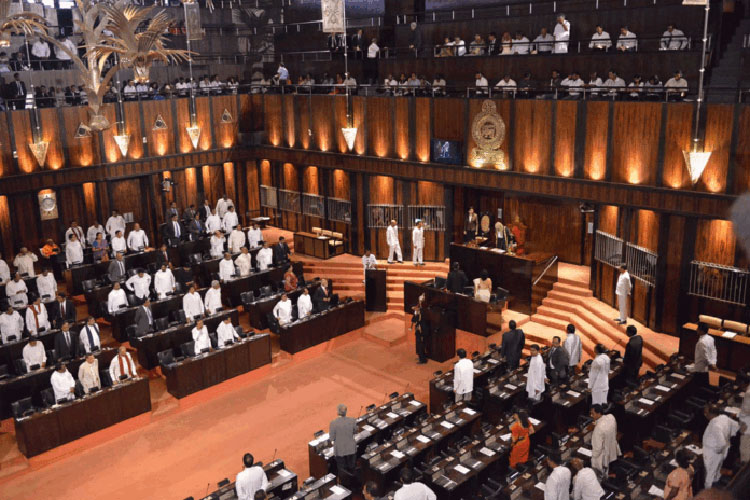
Opposition MPs yesterday signed a motion demanding an adjournment debate in Parliament on the prolonged failure to fill vacancies in Sri Lanka’s superior courts.
The motion, submitted under Standing Order 83(1), calls for a debate on the implications of leaving more than eight vacancies in the Supreme Court and the Court of Appeal unfilled for over six months.
The Opposition said the proposed debate would examine the impact of the vacancies on the administration of justice, the rule of law, the protection of fundamental rights and public access to justice, while urging the authorities to expedite appointments to the vacant posts.
The motion, bearing the signatures of Opposition MPs, is to be forwarded to Speaker Dr. Jagath Wickramaratne, for approval, to schedule the debate.
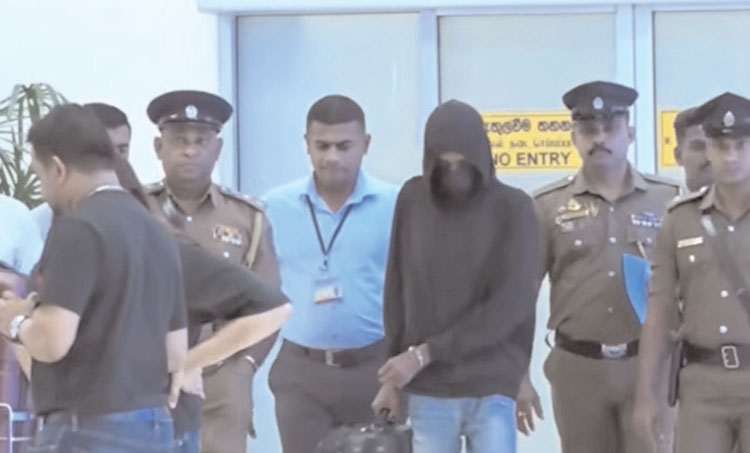
Suranga Sanjeewa Karunaratne, alias ‘Matiya’, an alleged underworld gunman linked to organised crime figure Kehelbaddara Padme, was arrested on arrival at the Bandaranaike International Airport in the early hours yesterday.
Police said the suspect, a resident of Kotugoda, Yagodamulla, had been detained by Malaysian authorities and deported to Sri Lanka. Officers of the CID took him into custody upon his arrival.
Investigators said an Interpol Red Notice had been issued against the suspect.
Karunaratne is wanted in connection with the fatal shooting, near the Gampaha Magistrate’s Court, in July, 2022, in which alleged organised criminal ‘Paspodda’ was killed and several others sustained injuries.
Following preliminary questioning by the CID, the suspect was handed over to the Western Province North Crimes Division for further investigations. Police said a 72-hour detention order had been obtained to facilitate further inquiries.
by Norman Palihawadane ✍️

Ben Stokes four-for, Ben Duckett hundred as England roar back

Venezuela shaken by magnitude 4.9 tremor days after major earthquakes

US strikes Iran in response to drone strike on commercial ship

Jangoo, Chase’s defiant stand takes West Indies close to parity

Heartbreak for Scotland as Sri Lanka clinch thriller to stay alive

Showers will occur at times in the Western, Sabaragamuwa and North-western provinces and in Galle, Matara, Kandy and Nuwara-Eliya districts

‘Dates have the highest sugar content to fight Coronavirus’

Sunday Island 27 December – Headlines

#SundayIsland 17th December – Headlines

Sunday Island – 28th March

Sunday Island Headlines – 21 March

Sunday Island – 21st February – Headlines
-

 Features6 days ago
Nanda Pethiyagoda Wanasundara as three generations of family saw her
-

 Features5 days ago
Sri Lanka developing independent hydrographic capabilities
-
 Opinion4 days ago
Ranasinghe Premadasa: The man who would not take ‘No’ for an answer
-

 Editorial6 days ago
Fuel crisis: Beyond price debate
-

 Latest News6 days ago
Sooryavanshi thumps fastest List A fifty as India A win tri-series
-

 News4 days ago
US Assistant Secretary of State for South and Central Asian Affairs meets President
-

 Business5 days ago
University of West London opens Sri Lanka’s first full UK university branch campus
-

 Features6 days ago
The Sirisena – Ranil conflict and events leading to MR’s return as PM