
Features
‘Why are Arts graduates unemployable?’


By Hasini Lecamwasam
‘Arts people’, since quite some time now, are being pushed to confront this question head-on. Since answers are only as good as the questions that prompt them, my aim here is to first unpack this question, then its proposed solution.
I find this question fallacious on three counts: First, it is underpinned by the assumption that what one studies directly corresponds to what one ends up doing for a living. Second, the label ‘unemployable’ tends to mask the many realities of the job market and ignore the structural conditions that shape the employment preferences of graduates. Third and last, it attempts to interpret the gains of tertiary education, purely in terms of its direct economic yield, demanding that we surrender our cognitive capacity to the narrow confines of market reasoning.
Three fallacies
 Let me take up the first issue, well, first. Even a cursory look at how things function in society should make it clear that there is no strong correlation between one’s academic qualifications and career path, starting with getting hired. I recently ran into a Science graduate, working as the manager of a regional office of a well-known business establishment, specialising in bathware. There are many others of his background, engaged in employment, equally unrelated to their primary degree and its ‘skills’. The many agriculture graduates joining the civil service is another case in point. Throw into this mix all the highly questionable political appointments made in state institutions, and the skills-employment causation starts to seem dubious at best.
Secondly, subsuming all Arts graduates looking for a job, under the category of ‘unemployed,’ is a sweeping generalization which then leads to the conclusion that their degree, therefore, renders them ‘unemployable’. Drawing attention to the highly questionable nature of this conclusion is the general thrust of this piece, and has been the focus of many Kuppi Talks already. However, the premise itself is problematic. All Arts graduates (I am consciously sticking to the Arts, given the purview of this article) looking for a job are not necessarily unemployed. Recall how the President asked a 40-year-old Arts graduate asking for a job; ‘what have you been doing so far?’ Though there was no time for a response as the President was driven away, it stands to reason that this graduate did not remain ‘unemployed’ until 40. Because a government job offers more stability and security, graduates tend to prefer it, which alone qualifies as a ‘proper job’, given family/societal expectations and their own preferences modelled on them. Until then, however, they do other jobs to get by, sometimes in the informal economy, meaning to say they are, in fact, not as ‘unemployable’ or ‘unskilled’ as they are made out to be.
Thirdly, a minimalistic ‘economic’ understanding of education completely discounts its transformative potential. This all-engulfing market ethos eats into the critical capacity of the university, discrediting it as inconvenient, unnecessary noise, thereby further limiting the university’s prospects of being a site of critical reflection and action. Let not ‘critical reflection’ be understood as an overly romanticised notion put forth by universities – particularly their ‘Arts’ wings – to salvage their existence. To reiterate a message from the first Kuppi Talk, education’s objective is as much to instill an in-depth understanding of a subject, as it is to guide students to “come into a knowing of the world around us, known among other things, as social mobility and as an awareness of one’s place in the country, society and the world”. It is this awareness that will enable us to intervene and change it for the better. Education devoid of this intention is but a process of transmitting information that may just as easily be carried out by robots. Our tertiary education seems to already be well on its way there, with the emphasis on ‘skills’ and ‘competencies’ completely crowding out any possibility of focusing on producing graduates who are also able to think.
The skills narrative and STEM as a way out
When the question is framed by such fallacies, it is not in fairness possible to expect sound answers. As such, band aid solutions have been proposed, focusing on ‘skills’ as the cure-all for our unemployment problem, as though there are more jobs hungrily waiting to be filled by those with the necessary competencies than universities could possibly produce graduates for, if only they got the skills part right! The fact that these prescriptions are being made in the context of a pandemic makes them even more ridiculous. It takes no expert to realise that an already collapsing economy, reeling from the additional shock of Covid-19, can hardly even accommodate the existing workforce, let alone absorb additions to it, no matter how marketable their ‘skills’ are.
This ill-informed diagnosis has resulted in a policy package that is alarmingly short sighted. Presented as part of Sri Lanka’s 2020 budget, it has allocated funds to increase the STEM component of education on the national level by levelling out infrastructural differences between schools, establishing technical colleges and vocational institutes, as well as expanding university intakes to these subjects. What would be the result of these policy directives? We need not look beyond India to find actual examples of the cost of skewing the education system without ensuring that the economy is able to absorb all of these ‘skills’. Tamil Nadu, for example, houses more than 3000 colleges for engineering alone, and had in excess of 150,000 engineering graduates unemployed as of 2018, according to The Hindu. If a giant economy like India – that is known as an offshore IT skill market for First World countries – cannot absorb the graduates with the necessary ‘skill set’ produced by its system of education, trusting Sri Lanka to be able to do the job borders on pathological optimism.
Wrong answers to the wrong problems
Let it be unambiguously acknowledged that education (including higher education) is in need of urgent reform. However, reform has to be for the right reasons by those who have both a stake and an interest in the issue. As already discussed, the skills-employment nexus is erroneous on many levels. Therefore, attempting to answer the [un]employment question – which is itself fallacious – primarily through educational reform, rather than focusing on diversifying and expanding employment opportunities, and radically reforming recruitment processes, will yield little fruit.
In all these debates a more fundamental peril may escape our attention, namely that market reasoning is increasingly coming to dictate the terms of our living. Education is but one example of this. What we need to be aware of is that as a Third World country we are simply an underdog economy catering to the whims and fancies of larger economic powers. So, when we attempt to model our education according to what the ‘market’ wants, it is worth asking whose market we are talking about. We obviously cannot operate in isolation, but should it be our aspiration to produce foot soldiers for the global economy? What if, like in the Indian example above (and like in most colonised countries during the late-colonial and immediate post-colonial times), stunting the economy too much in favour of foreign demand worsens our already deep economic crisis, every time there is a problem in the larger economies on which we are almost solely planning to rely?
The ‘unemployable Arts graduate’ would appear very differently in an economy managed very differently. For the economy to be managed differently, we need thinking that transcends market reasoning, and has healthy respect for that which is not of immediate and apparent economic value. So let us stop. And think.
(Hasini Lecamwasam is attached to the Department of Political Science, University of Peradeniya)
Kuppi is a politics and pedagogy happening on the margins of the lecture hall that parodies, subverts, and simultaneously reaffirms social hierarchies.



Tales of Mystery and Suspense 3
The murder, in a private dining room in the house, is of a financier with whom the government was negotiating a loan. When this seemed difficult the Minister of Home Affairs agreed to lead discussions, since he had known Mr Oissel the financier when they were young. Hence the private dinner, but when the Minister stepped out for a vote, Oissel was shot just as the Division Bell rang.
The Brahms and Simon detective novels, the first of which I wrote about last week, were amongst several books by the pair that Robert Scoble gave me when I was in Australia towards the end of last year. Amongst them was another thriller of a very different sort, though that too was written and set between the wars.
Called The Division Bell Mystery, it was set in the House of Commons, the first such book I believe, and was by Ellen Wilkinson, a Labour MP who became Minister of Education in Attlee’s government after the war, having served previously as Parliamentary Private Secretary to several ministers. Her hero Robert West is also a PPS, but a conservative, and his Minister, of Home Affairs, is an old style aristocrat, not much loved by the less orthodox Prime Minister, who nevertheless needs his support on many occasions.
The murder, in a private dining room in the house, is of a financier with whom the government was negotiating a loan. When this seemed difficult the Minister of Home Affairs agreed to lead discussions, since he had known Mr Oissel the financier when they were young. Hence the private dinner, but when the Minister stepped out for a vote, Oissel was shot just as the Division Bell rang.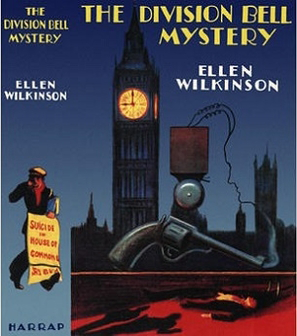
West was just outside the door when the shot was heard, and when he opened it saw only the dead body with a revolver beside it. The assumption that this was suicide was however challenged by Oissel’s grand-daughter Annette, who was his heir, on the grounds that he would never have killed himself. But her view was given greater credence by the Inspector put in charge of the case who said there were no burn marks on the body which would have been the case had Oissel fired the pistol himself.
Matters are complicated by the fact that Oissel’s flat had been burgled while he was at dinner, and Jenks the policeman allocated to him, who had served the Home Secretary and seemed more acceptable to Oissel than someone from the Security Service, had been killed. Matters get even more complicated when Annette says her grand-father’s notebook in which he wrote his secrets in cipher was missing.
That was found in Jenks’ pocket, and then a photographer came to West to say he had been asked by Jenks to photograph this. More worryingly for West, he finds in the Home Secretary’s drawer a few pages from the notebook with what appears to be an interpretation of the cipher.

Ellen
Overwhelmed by all this he confides in a recently created peer who knows all about the business world, who insists that they leave the house party at which they had met over dinner and discuss the matter with the Prime Minister who promptly summons the Home Secretary.
But the Home Secretary had gone to Scotland to launch a ship over the weekend, so the meeting could take place only on the morning of the Monday, when difficult questions were expected on the adjournment motion. He admits at the meeting that he had got Jenks to take the notebook, and also that he knew the code since it had been created by him and Oissel when they were young.
He thought he should resign, and even contemplated suicide, but the Prime Minister told him that that would be even worse for the government, and that he should go home to bed. The Prime Minister said that he himself would handle the question, which he did with aplomb, insisting that confidentiality was needed until the inquest. What had happened would be made clear then, he declared, leaving West and Inspector Blackit and Lord Dalbeattie what seemed the impossible task of solving the murder.
Dalbeattie had suggested that West ask a female Labour MP who was very fond of him to get what information she could from the staff. That there was some involvement there had become clear when West, going back late one night to collect a briefcase he had left in a dining room, found someone lurking in the dark in the corridor outside the private rooms. Room J, where the murder had happened, was meant to be guarded throughout by a policeman, but he had left the room having felt dizzy, and it seemed that his coffee had been drugged. West’s sudden appearance however had prevented anyone else getting into the room.
Dalbeattie decides to recreate the scene of the murder and has a dinner party in Room J on the Tuesday night, inviting West and Annette and the society hostess at whose house he had met, and also Patrick Kinnaird, an MP who was engaged to Annette, as well as the Permanent Secretary to the Home Ministry.
After coffee Inspector Blackit comes in with Grace, the Labour MP who had got the confidence of the staff, and a journalist who had also been helpful, and just as they say they think they are on the track the division bell rings. Grace jumps up and tells the Inspector that that provides the solution and they get a ladder, and sure enough find the revolver in the space where the bell is. Directed at the place where Oissel had sat, it had been primed to go off with the ringing of the bell. The waiter who had helped to set things up made clear who the murderer had been.
The reason for the murder and the confused motives of all those involved made for a fascinatingly intricate mix. But also impressive in the book were the descriptions of the isolation possible in the crowded premises of the house, the forceful characterization of the members – Grace based on the writer, the society hostess based on Nancy Astor, the first female MP – and the laid back nature of senior politicians which West realized had to change in the brave new world of high finance.

 The current outbreak of anti-immigrant protests in Durban, South Africa is bound to have taken many a subscriber to value-based politics or political idealism quite by surprise. After all, this is evidence that despite the historic accomplishments of nation-builders of the stature of the late President Nelson Mandela it cannot be taken for granted that identity politics, including racism in its worst forms, is no more in South Africa.
At the time of this writing details are scarce on the substantive root causes of the protests but it could very well be that economic grievances, particularly on the part of the majority community in South Africa, are contributing considerably to the disaffection. Shrinking employment and material prospects are likely to figure majorly among the factors igniting the unrest.
Fortunately, the local authorities in Durban are losing no time in calling for peaceful co-existence among the relevant communities and are pointing to the vital importance of stepping-up national integration processes. Apparently, immigrants in sizable numbers from neighbouring countries are present in Durban. However, international TV footage of the protests quoted some local authorities as saying that the majority of the immigrants in some centres that housed them were not illegal migrants and had the documents that entitle them to be in Durban.
In the Durban protests the world has fresh proof of the socially divisive consequences of the gathering globe-wide economic disaffection, touched off particularly by the continuing crisis in West Asia. Going ahead, the world would need to brace for increasing identity-based unrest of the kind it is just witnessing in South Africa.
Considering that the material lot of ordinary people everywhere could only aggravate progressively, with the US and Iran showing no signs of negotiating an end to their confrontation any time soon, it will be left to the more democratic and progressive sections of the world community to initiate positive measures collectively to bring a measure of relief to the discontented.
The swiftness with which such relief will be provided would depend crucially on the importance those sections taking up these undertakings attach to value-based politics as opposed to Realpolitik of power politics.
Going by these yardsticks, Italy could be considered to be moving in the right direction. Recently Italy came to the fore in initiating the collective named, ‘Rome Coalition for Food Security and Access to Fertilizer’, which has as one of its aims the swift provision of fertilizer to economically weak African countries.
In a recent statement Italian Minister of Foreign Affairs and International Cooperation, Antonio Tajani, said that a principal aim of the project was to ensure that the farmers of Africa gained easy access to fertilizer, considering that food security is a growing concern among some of Africa’s economically vulnerable countries.
The statement went on to mention that some 30 countries hailing from the Mediterranean region, the Middle East, the Balkans as well as the FAO had been invited to join the coalition. The venture is far-seeing in that food security is main among the reasons for social discontent which in turn could degenerate into endemic political turmoil and bloodshed. Separatist violence and geographical fragmentation of countries wouldn’t be too far behind these developments, as Africa itself has often proved.
It is hoped that more G7 countries would take the cue from Italy and do what they could to ease the hardships of economically distressed countries, particularly of the global South. In these efforts they would need to break rank with the US, which is today brutally indifferent to the consequences of its policy of making ‘America First’, come what may.
Going by current developments, the Trump administration seems to be blithely oblivious to the wider, deleterious effects of its policy course in West Asia. Besides rendering Iran militarily and otherwise impotent nothing else seems to matter to Washington, as regards West Asia. This is policy short-sightedness of an extreme kind. After all, right now West Asia could be said to be sitting on the proverbial powder keg.
On the other hand, Iran is not giving the world the impression that it is doing anything constructive to get out of the policy straitjacket that it wove for itself decades ago. Rather than enter into a policy of ‘live and let live’ in relation to Israel in particular and initiate a process of reconciliation with the latter, it has chosen to operate within policy parameters that continue to damn Israel. This has put Israel always on the ‘defensive’ so to speak and prevented the opening up of space for meaningful dialogue.
That said, Israel is obliged to explore the possibilities of entering into a negotiatory process with the Arab-Islamic world that could lead to a de-escalation of tensions and bloodshed. It cannot continue to look at its neighbours through lenses that distort them as archetypal enemies who should be ‘wiped off completely from the face of the earth.’
In other words, the need is urgent for Realpolitik to give way to value-based politicks. Italy is beginning to prove that the latter approach could be pursued with some success. May be the EU and the UK could throw their weight behind these initiatives as well and establish that international politics could be refashioned on the basis of humane, civilized norms. The UN would need to be fully supportive of these moves and prove an organizational nucleus of the operations that follow.
In fact the time is ripe for people of conscience to collectively stand up on the side of peace and say ‘No’ to war and violence. Organizations such as the ICRC, the WHO and Medicines Sans Frontiers have already taken up this call. Referring to the widespread destruction of health facilities and their dehumanizing results these organizations have said, among other things, that ‘This is not a failure of the law. It is a failure of political will.’
True, ‘failure of political will’ among those powers that matter accounts for the runaway, uncontrollable nature of war and destruction in contemporary times, but more fundamentally it is a failure of the human conscience. It could very well be that the phenomenal levels to which violence and war have been unleashed today have had the effect of deadening consciences. This is a matter for urgent study and wide discussion.

 I would describe Indunil Kaushalya Dissanayaka as innovative and creative, and she operates under the name of Cuteefly.
Indunil always comes up with something novel to celebrate special occasions, and she does it with candles … and that’s her profession.
She was in the spotlight when she created a happening scene, with candles, for Christmas, Sinhala and Tamil New Year, and Valentine’s Day.
As lanterns light up Sri Lanka for Vesak, the Colombo-based candle maker is quietly turning wax and wick into little pieces of the festival.

Candles reflecting Vesak themes
Her candles reflect Vesak themes – light, peace, remembrance, giving, etc., to enable you to fill your Vesak celebration with devotion and beauty.
Among her Vesak creations is a lotus-shaped soy candle, scented with sandalwood, lavender, etc., meant to burn during this Vesak Poya Day.

Indunil Kaushalya Dissanayaka: Customers
praise her for her creativity
These handcrafted Vesak candles are perfect for offering at the temple, she says.
What makes her creations so novel is that they come in different shapes, scents, themes, and all are handmade.
What’s more, her customers have heaped praise on her for her creativity.
According to Indunil, her creations are perfect as a thoughtful gift … to bring beauty, unity, and light into every moment.
Says Indunil: “Our beautifully handcrafted Unity candles are designed with premium detail and love, making them perfect for celebrations, gifts, and meaningful occasions.”
Cuteefly, says Indunil, is available online.
Readers could contact Indunil on 0778506066 for more details.
He Facebook Page is: Cuteefly.

Handmade with love

Tickner five-for wraps up innings win for New Zealand

Ambidextrous spinner Shashini Gimhani in Sri Lanka’s T20 World Cup squad

Pakistan’s famous cheerleader ‘Chacha Cricket’ to retire this year

South Africa Women’s maiden tour to Zimbabwe to feature five T20Is

Navy renders assistance to bring injured fisherman ashore

Applications called to recruit 400 public officers as Digital Champions for the Public Impact Champions Network

‘Dates have the highest sugar content to fight Coronavirus’

Sunday Island 27 December – Headlines

#SundayIsland 17th December – Headlines

Sunday Island – 28th March

Sunday Island Headlines – 21 March

Sunday Island – 21st February – Headlines
-

 News6 days ago
All-New GRAVITE launches at LKR 6.99 Mn
-

 Features6 days ago
The NPP’s pivot to the past
-

 News5 days ago
Police probe underway to ascertain links between criminals deported from UAE and local politicians
-

 News4 days ago
Easter Sunday carnage: Court told Maulana’s statement cannot be accepted without cross-examination
-

 Features6 days ago
End of Peacekeeping
-

 Opinion4 days ago
Undermining the democratic political framework
-

 News4 days ago
UK passport holder hiding here wants to have deportation order rescinded to leave without blemish
-

 News5 days ago
Dickoya double murder suspect arrested