
News
At Delhi’s Kotla ground, bookies employed cleaner to pass on match information during one IPL game: BCCI Anti-Corruption Unit chief


BY S VENKAT NARAYAN
Our Special Correspondent
NEW DELHI, May 5:
The recently-suspended Indian Premier League (IPL) has witnessed potential corruptors plugging an accredited cleaner at Delhi’s Feroz Shah Kotla ground for doing “pitch-siding,” which helps ball-to-ball betting. This was revealed by Shabbir Hussain Shekhadam Khandwawala, Anti-Corruption Unit (ACU) Chief of the Board of Control for Cricket in India (BCCI).
The new modus operandi was observed during one of the IPL games in Delhi, where a designated cleaner was using the time lag between actual match action and live TV coverage to help in ball-by-ball betting, which is also known as court-siding or pitch-siding.
Pitch-siding is the practice of transmitting information from sporting events for the purpose of gambling, or directly placing bets.
“One of my ACU officers caught a person and handed over the details to Delhi Police. While that particular offender managed to flee leaving behind his two mobile phones, ACU lodged a complaint with the Delhi Police,” Hussain, a former Director General of Gujarat Police, told PTI on Wednesday.
“We are thankful to Delhi Police that in a separate incident they caught two other persons from the Kotla on an ACU tip-off.”
The Delhi Police arrested two people with fake accreditation cards during the IPL match between Rajasthan Royals (RR) and SunRisers Hyderabad (SRH) on May 2.
“So, on two separate days, these people managed to get access to Kotla. The one who fled came in the garb of a cleaner. However, we have all his details as he was employed for the tournament. His Aadhaar Card details have been handed over to Delhi Police,” Hussain said.
“I am confident that he will be nabbed in a day or two. He is a small fry working for a couple of hundred or some thousand bucks maybe,” the ACU supremo said.
But he did agree that lower-rung staff might be used by a bigger syndicate since, because of COVID-19, there is no access to hotels given the bio-secure measures.
“…as situations and circumstances change, so does the modus operandi of crime. But we are up for it,” Hussain said.
How did cleaning staff come under the ACU radar?
“The cleaner was standing (inside Feroz Shah Kotla premises) in a secluded area all by himself. So, one of our officers approached him and asked: ‘What are you doing here?’
“He said: “I am talking to my girlfriend”.
“My officer then asked him to dial the number he was talking to and then asked him to hand over the phones. Just when he was going through the contents of his phone, the guy fled from the spot,” Hussain revealed. But he did not divulge during which match the incident has occurred.
The cleaner was wearing the IPL accreditation card which all the class IV staff are given during the tournament from bus drivers, to cleaners, porters, etc.
“It was one of the evening matches in Delhi. He was wearing an I-card. Also, what raised suspicion was he had two mobiles,” he said.
“The information he may be supplying could be to someone more influential among bookmakers. So, we needed to inform the Delhi Police. Delhi Police has responded positively, and thus next instance two people were arrested.”
Hussain also confirmed that the ACU did not receive any complaint of corrupt approaches being made to players or support staff involved in IPL during the 29 games that were held.
“Obviously, with bio bubble and no crowd around, it certainly becomes a bit easier to manage as there is no physical proximity of (face to face meetings with players) questionable characters. When there is a crowd, it becomes difficult to check anyone and everyone,” Hussain said.
He also said that during the Mumbai leg, the hotel in which SunRisers Hyderabad team was staying had three people with questionable past record and whose names were in the ACU database. However, they couldn’t come in contact of the players.
“The moment we had information, we got in touch with Mumbai Police. The Police Commissioner of Mumbai took immediate cognisance and the Mumbai Police got hold of those three,” he added.

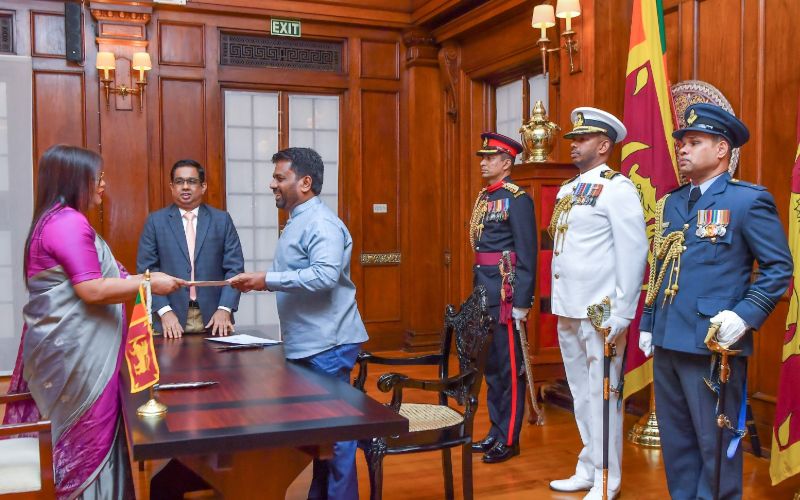
Ms Sajeewani Dilka Lakmali Karunannayake was sworn in as a Judge of the Court of Appeal before President Anura Kumara Dissanayake at the Presidential Secretariat this afternoon (03).
She previously served as an Additional Solicitor General at the Attorney General’s Department.
The appointment has been made to fill a vacancy on the Court of Appeal.
Secretary to the President Dr Nandika Sanath Kumanayake was also present on the occasion.
(President’s Media Division)
Latest News
Sun directly overhead Madampe, Thorayaya, Thotagamuwa, Rattota and Kalavanchikudy about 12.09 noon today (03)


The sun is going to be directly over the latitudes of Sri Lanka from 28th of August to 07th of September due to its apparent southward relative motion.
The nearest places of Sri Lanka over which the sun is overhead today (03) are Madampe, Thorayaya, Thotagamuwa, Rattota and
Kalavanchikudy about 12.09 noon.
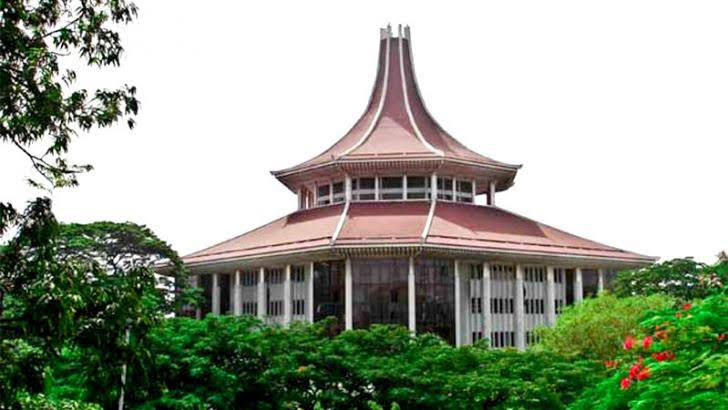
Attorney-at-Law Sugandhika Fernando, on behalf of the Vinivida Foundation, petitioned the Supreme Court yesterday (02), seeking a full bench, excluding Chief Justice Preethi Padman Surasena, to hear the petitions challenging the 22nd Amendment Bill. She also requested that the hearing be suspended immediately until the matter was fully heard and determined.
Among the respondents are Chief Justice Surasena, the first respondent, and Attorney General Parinda Ranasinghe. Justices Yasantha Kodagoda, Shiran Gooneratne, Achala Wengappuli and Priyantha Fernando have also been named as respondents.
The petitioner has sought to have quashed the decision of the first respondent to appoint a five-member bench, which she alleged was made in violation of the norms of public law. She also sought a bench comprising all Supreme Court judges, excluding those cited as respondents, to hear the special determination applications on the 22nd Amendment.
The petitioner further contended that Chief Justice Surasena, who is due to retire on December 1, 2026, would be the main beneficiary of the 22nd Amendment.
The hearing of the petitions continued for a second day yesterday (02) before a five-member Supreme Court bench comprising Chief Justice Preethi Padman Surasena and Justices Achala Wengappuli, Arjuna Obeyesekere, Sampath Abeykoon and Gihan Kulatunga.
The hearing, which commenced on Tuesday morning, continued for nearly 12 hours, until 10:30 p.m.
Solicitor General Viraj Dayaratne, appearing for the Attorney General, submitted yesterday that the Government had presented the 22nd Amendment Bill to the Constitution and the Judicature (Amendment) Bill with the objective of expanding and streamlining the country’s judicial system.
After the Solicitor General’s submissions concluded, counsel representing the petitioners requested an opportunity to respond to the Solicitor General and the intervening petitioners. However, the Chief Justice declined to allow the petitioners’ counsel to make further oral submissions, concluded the determination hearing and directed them to file written submissions instead.

New Court of Appeal Judge Sajeewani Dilka Lakmali Sworn In

India to host inaugural Women’s Champions Trophy in February

Sun directly overhead Madampe, Thorayaya, Thotagamuwa, Rattota and Kalavanchikudy about 12.09 noon today (03)

Afternoon thundershowers in the Northern, North-central, Eastern and Uva provinces in next few days, starting from today (03).

22A: SC urged to suspend hearing, appoint full bench

Govt. seeks NATO assistance

‘Dates have the highest sugar content to fight Coronavirus’

Sunday Island 27 December – Headlines

#SundayIsland 17th December – Headlines

Sunday Island – 28th March

Sunday Island Headlines – 21 March

Sunday Island – 21st February – Headlines
-

 News7 days ago
Eight politicians in drug kingpin probe
-

 Features5 days ago
“Wrap Me Up in My Blazer”— A Gentlemanly Bradby Reminiscence
-

 Business7 days ago
Sri Lanka opens up: A new season of direct connectivity
-

 Features4 days ago
When Sri Lankan stories find their own voice
-

 Features7 days ago
Redefining ageing in Sri Lanka
-

 Editorial7 days ago
The toxic legacy of two lakes
-
 Business7 days ago
Jaffna Teaching Hospital secures lifeline water supply via ADB-funded Thalaiyadi sea water desalination plant
-
 Features5 days ago
JVP/NPP government as seen from outside by Lionel Bopage now domiciled in Australia