
Business
Is Sri Lanka’s fuel retail sector heading towards a crisis?


(Contineued from yesterday)
The argument is that the cost of importing petroleum products into Sri Lanka has increased substantially as a direct consequence of these circumstances, making it difficult for the companies to sell fuel at the prices prescribed by the Government.
In an effort to limit the losses incurred under these conditions, some companies have reportedly restricted the quantities supplied to their dealers rather than fulfilling the full quantities requested.
It is no secret that, over the years, a considerable number of politicians from both the Government and the Opposition have entered the filling-station business. Some others have also invested in the sector as a means of legitimising funds accumulated through various illicit activities.
Large, unused buildings and other structures on certain filling-station premises, which have little connection with the actual fuel business, are sometimes cited as evidence of such investment patterns.
For such operators, a reduction in the dealer margin may not have the same impact that it has on genuine entrepreneurs whose primary source of livelihood is the operation of a filling station. The reasons for this are self-evident.
Nevertheless, if the current situation continues, this group may eventually become disproportionately represented among those who remain in the CPC dealer network.
If that happens, whatever degree of dignity, professionalism and respect the fuel retail sector has built over the years could be diminished.
The fuel retail industry is not merely another commercial activity. It is a critical component of the country’s economic infrastructure. Fuel dealers operate at the final point of contact between the petroleum supply system and the consumer. They must maintain costly infrastructure, comply with numerous regulatory and safety requirements, employ staff, manage environmental risks and provide uninterrupted service to the public.
Therefore, while the efforts being made by the Ceylon Petroleum Corporation to improve profitability, increase storage capacity, modernise infrastructure and expand refining capacity are welcome, equal attention must be given to the sustainability of its dealer network.
It is both the duty and the responsibility of the Corporation to carefully examine all these factors and provide its dealers with the facilities, margins and other necessary benefits required to maintain a healthy and sustainable fuel retail industry.
A financially sustainable dealer network is ultimately in the interest of CPC itself. Without a viable retail network at the end of the supply chain, improvements in storage, transportation, refining and wholesale operations cannot fully translate into a reliable and sustainable service to the consumer.
The question, therefore, is not simply whether Sri Lanka’s fuel retail sector is facing difficulties today. The more important question is whether the present system is being structured in a manner that will allow fuel dealers to remain viable tomorrow.
N. J. Mayadunne
President,
Anuradhapura District Fuel Dealers’ Association



Ceylinco Life’s Ambalantota branch agent AIP Manjula has been named one of three global finalists for the prestigious Insurance Agent of the Year award at the 11th Asia Trusted Life Agents & Advisers Awards (ATLAA) 2026.
The recognition places a Sri Lankan insurance professional among the finalists in a regional field spanning South Asia, Southeast Asia, East Asia and the wider Asia-Pacific region.
Ceylinco Life said the achievement reflected the calibre and customer-focused approach of its agency force, while recognising Manjula’s professionalism and commitment to policyholders.
The award evaluates insurance agents on criteria extending beyond sales performance, including ethical conduct, client service, policy persistency, digital adoption, innovative practices and contributions to the insurance industry and community.
The awards are organised by Asia Advisers Network and Asia Insurance Review, with LIMRA as co-organiser. An independent judging and balloting process is monitored by KPMG as the official scrutineer. The judging panel comprises senior insurance executives, association presidents and industry experts from across the Asia-Pacific region.
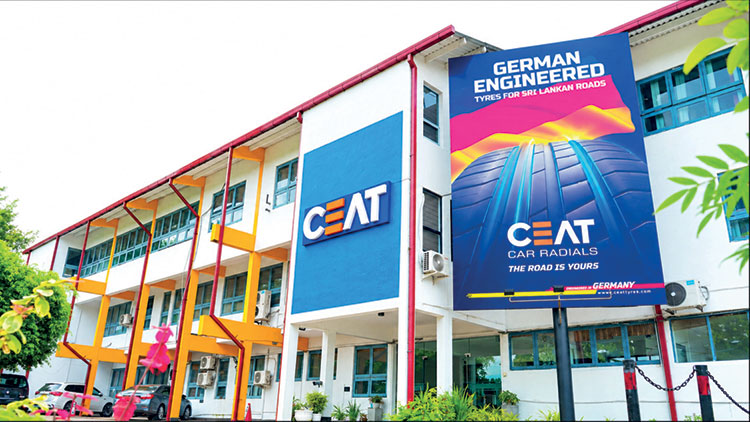
CEAT Kelani Holdings (CKH) has retained its National Long-Term Rating of ‘AA+(lka)’ with a Stable Outlook from Fitch Ratings for the sixth consecutive year, reflecting the company’s financial resilience and leading position in Sri Lanka’s pneumatic tyre market.
The ‘AA+(lka)’ rating, the second-highest on Fitch’s national scale, indicates a very strong capacity to meet financial commitments.
Fitch said CKH’s established market leadership and resilient financial profile remained key strengths, while noting its exposure to price-sensitive, cyclical and highly competitive markets.
The Stable Outlook reflects expectations that the company will maintain its market position despite rising input costs and increasing competition from imported tyres, while preserving adequate credit metrics during periods of weaker earnings and higher investment.
Fitch expects CKH’s established brand, extensive dealer network and adaptive pricing strategies to support its market position. Planned production facility upgrades are also expected to improve product quality, particularly in the radial tyre segment.
The rating agency expects near-term pressure on margins from higher raw material and energy costs but said the company’s low leverage and sound liquidity would provide a cushion.
CKH Chairman Chanaka De Silva said the rating reinforced the company’s focus on disciplined financial management, operational adaptability and long-term investment.

Rivon Agriglobe and Rivon Lanka, affiliated with Celogen Lanka, Assidua Technologies and Kelun Lifesciences, have introduced ZETOR and Agriglobe tractors, the Z-Tukoba power tiller and Rover electric motorcycles to the Sri Lankan market.
The new range was launched at a special event held on September 4 at the Sannasa Hotel in Dambulla, attended by more than 120 dealers from across the country.
The event was graced by Nalin Welgama as Chief Guest, together with Rishi Kumar, Managing Director; WH Roshan, Finance Director; Sadish Kumar, Director; Sumith Nandana, General Manager; Suresh Dhammika, Head of Sales; and Jayasuriya, Operations Manager.
The agricultural machinery range includes the 50-horsepower ZETOR HORTUS 50 and Agriglobe 50 tractors and the Z-Tukoba power tiller, offering what the company described as European-engineered technology for Sri Lankan farmers.
The launch also featured the recognition of Rover E-Bike dealers, highlighting the company’s efforts to expand its island-wide dealer network and promote electric mobility.
The companies said the new models would be available through their growing dealer network across Sri Lanka, providing customers with access to agricultural machinery and electric motorcycles.

Showers will occur in the Western, Eastern, Uva and Sabaragamuwa provinces and in Galle, Matara, Kandy and Nuwara-Eliya districts.

Nor’easter brings flooding as New York and New Jersey declare emergency 2 hours ago

Trump rejects Iran deal to reopen Strait of Hormuz in seven days

Govt plans to hire 121,000 state workers, redistribute tax revenue

Parliament clears 22A amid protests

Sajith likens 22A to ‘Emperor’s New Clothes’

‘Dates have the highest sugar content to fight Coronavirus’

Sunday Island 27 December – Headlines

#SundayIsland 17th December – Headlines

Sunday Island – 28th March

Sunday Island Headlines – 21 March

Sunday Island – 21st February – Headlines
-

 News6 days ago
Hatton youth protest against reported death sentence for Lankan in Saudi Arabia
-

 News4 days ago
Mastermind Naufer Moulavi among 15 found guilty
-
 News5 days ago
Protest against setting up of cement factory in highly populated area near BIA
-
 News6 days ago
Mahaweli rises as heavy rain triggers flood, landslide fears
-

 Latest News7 days ago
Landslide Red Alerts issued to the districts of Kandy, Kegalle and Nuwara Eliya
-
 Midweek Review4 days ago
Thileepan’s fast unto death: An authentic narrative that many missed
-

 Editorial4 days ago
Big Bad Bills
-
Editorial5 days ago
Trouble beginning in earnest