
Features
The Last Cocktail PartyTerry Jonklaas and the Making of Modern Ceylonese Interiors

From the Pathfinder Collection:
By Jennifer Moragoda
Made by Terry
In the 1950s and early 1960s, Terry Jonklaas was Ceylon’s most fashionable and sought-after interior designer. To own a piece of furniture “made by Terry” was to signal modern taste, affluence and social standing. Affluent families commissioned him to furnish the home of a newly married daughter; others acquired a single piece of furniture or a decorative object from his Galle Face Court showroom. Commercially astute, he offered different points of entry while preserving the exclusivity of his name, translating his personality into objects, interiors and a distinctive way of living. Yet this once-famous designer has largely disappeared from Sri Lanka’s history of modern design, even as many of his objects—and the forms he helped popularize, widely imitated from the outset—remain hidden in plain sight.
The Decorators and Furnishers, which Jonklaas headed at No. 1 Galle Face Court, became synonymous with innovative design, fine materials, exceptional workmanship and high prices. Its furniture and imported European glassware and tableware carried considerable social cachet. One grandson recalls his grandmother, whose residence Jonklaas had custom-furnished, becoming anxious whenever he and his brother did their homework at her dining table, fearing they might scratch its teak surface. In another family, a son remembered how unfamiliar Jonklaas’s designs seemed beside the traditional furniture his mother had inherited. After purchasing a modern living-room ensemble, she would proudly inform visitors that the settee on which they were about to sit was a Terry Jonklaas creation.
-
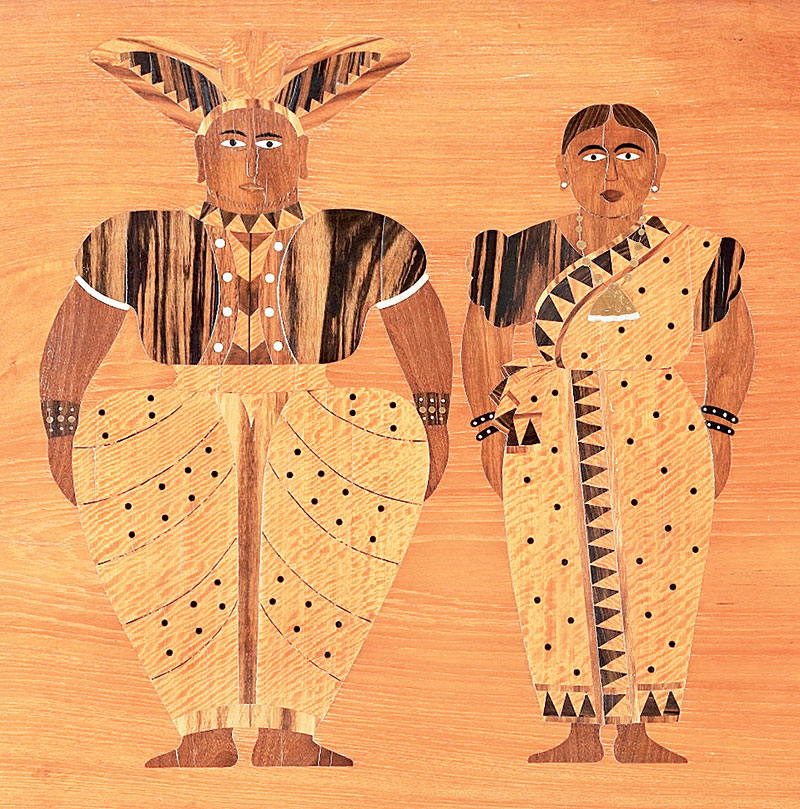
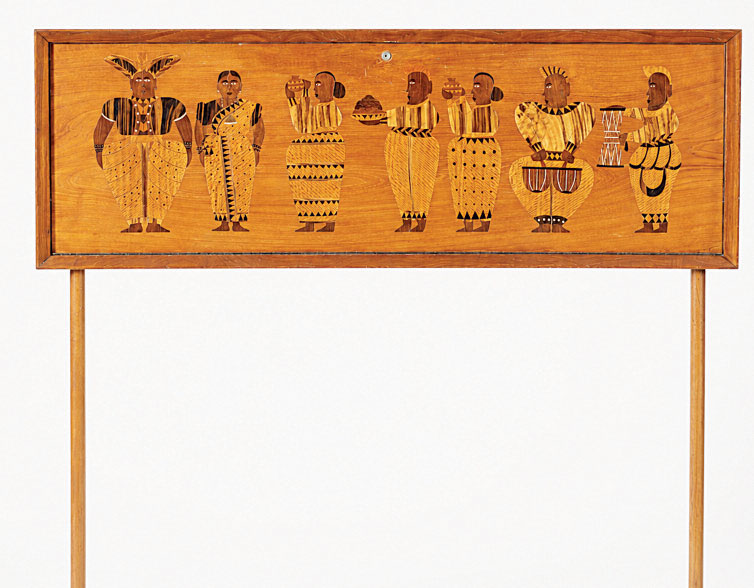
- Jonklaas bar cabinet, its figures rendered in tropical-wood marquetry. c. 1960, N. U. Jayawardena residence (Photo: Luxshmanan Nadaraja)
-
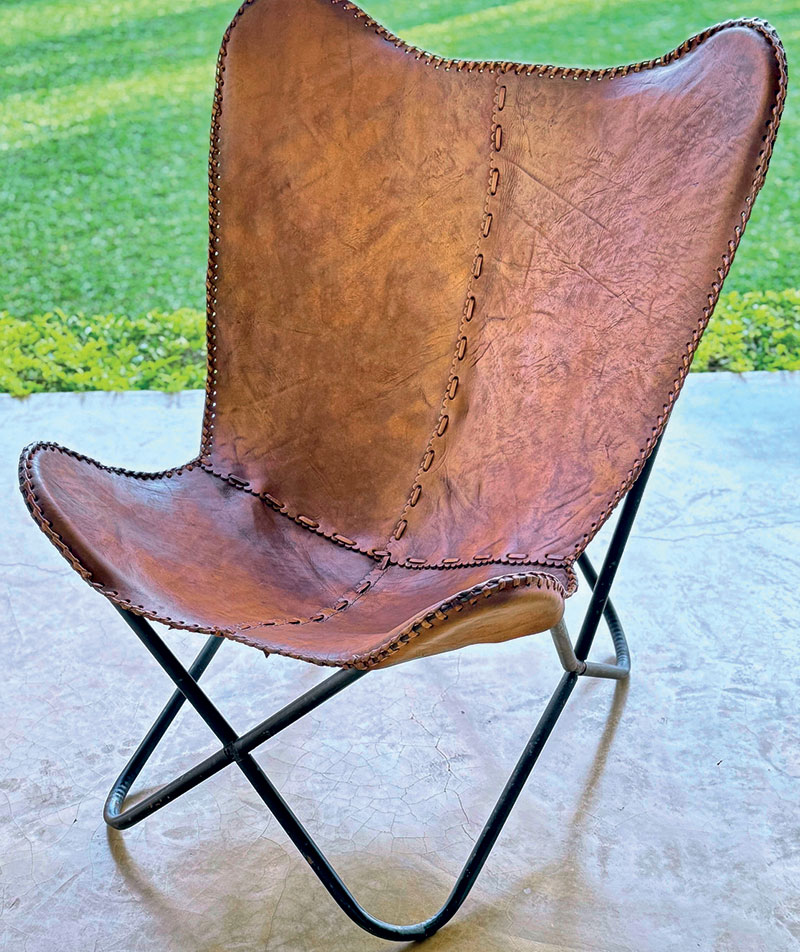
- A contemporary Kandy Road version of the butterfly chair, once known locally as the “Jonklaas chair.” (Photo: Jennifer Moragoda)
-
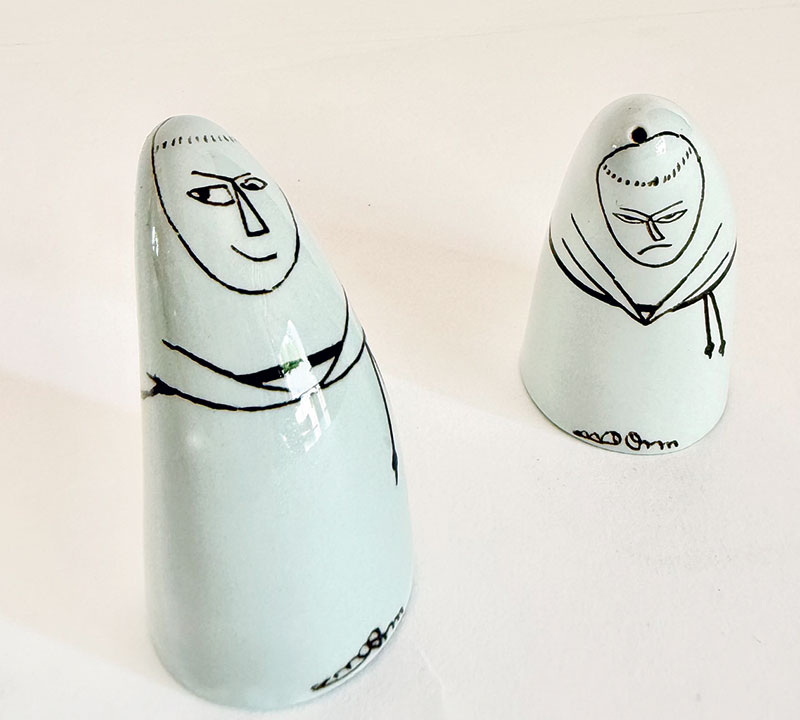
- Salt-and-pepper shakers designed by Jonklaas for the Danish company A/S Rafa and sold under the Nymølle brand. (Photo: Jennifer Moragoda)
The world he inherited
Terence Powell “Terry” Jonklaas was born in Kandy in 1919 and boarded at St. Thomas’ College, Mt. Lavinia, from the age of nine. He excelled at English, swimming and diving, though he “disliked school intensely,” calling it “a journey to another planet.” The youngest of six brothers, ten years younger than the next eldest, he developed a playful, irreverent streak.
Terry Jonklaas belonged to the tenth generation of an established Dutch Burgher family that could trace its ancestry in Ceylon to the earliest Dutch arrivals in the seventeenth century. His family had been based in Kandy for at least two generations and was firmly embedded in the colonial establishment; its members included eminent lawyers, civil servants and planters. This background matters less as genealogy than as an indication of the social position he inherited and the cultural assumptions it fostered. His secure place within this established milieu contrasts with the more hybrid identities of Minette de Silva and Geoffrey Bawa, for whom questions of cultural belonging became more explicit professional concerns.
His maternal cousin George Keyt, a founding member of the ’43 Group, was likewise raised in Kandy and was about ten years older. Between 1946 and 1949, Jonklaas was invited to exhibit with the ’43 Group as a guest artist in four exhibitions, receiving mixed but sometimes revealing notices. One critic detected “a definite bias for the macabre and a certain cynicism,” while another described his technique as “bold and carefree.”
A large oil painting by Jonklaas of a male and female nude still hangs above the bar he designed for his close friend Sir John Kotelawala at Kandawala. It may be The Lovers, listed in the catalogue of the 1946 exhibition.
The catalogue for the ’43 Group’s 1947 exhibition also contains the earliest reference so far located to The Decorators and Furnishers, listing “WOOD CARVINGS by Decorators and Furnishers.” Jonklaas later placed prominent advertisements in ’43 Group exhibition catalogues and in the catalogue for Aubrey Collette’s 1955 Faces exhibition.
After a short stint at the Times of Ceylon as a cub reporter, he joined the Ceylon Tobacco Company, which sent him to Central Java, where he remained until war appeared imminent. He later spent two years at Edwards, Reid & Begg, although the nature of his training there remains unclear.
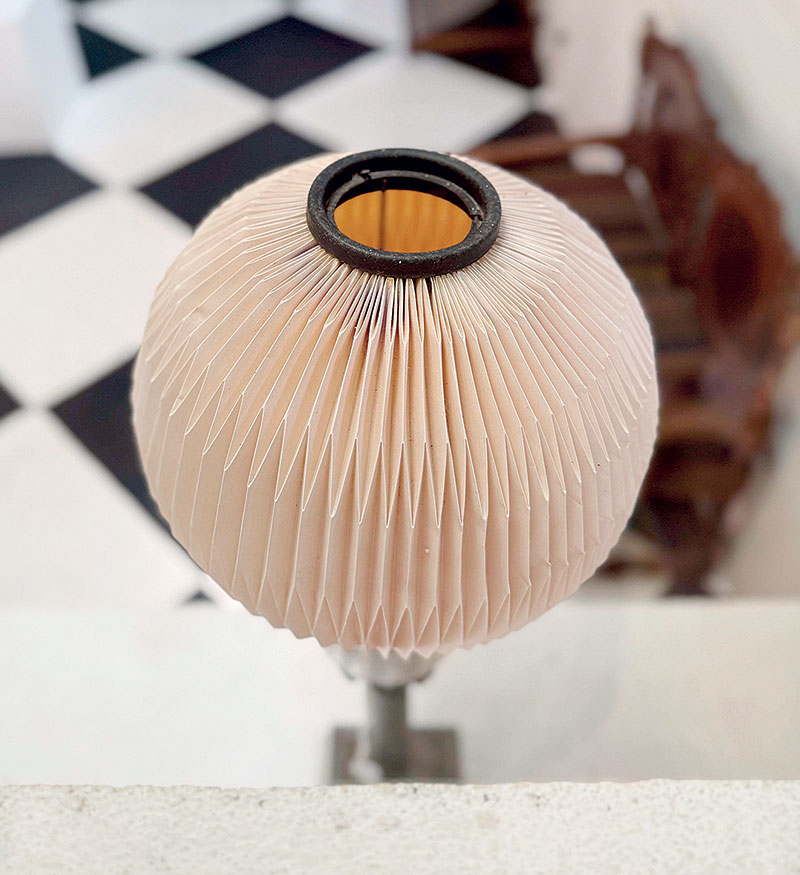
A pleated Le Klint lampshade at Lunuganga. The Danish firm’s lighting was sold by The Decorators and Furnishers from 1957. (Photo: Jennifer Moragoda)
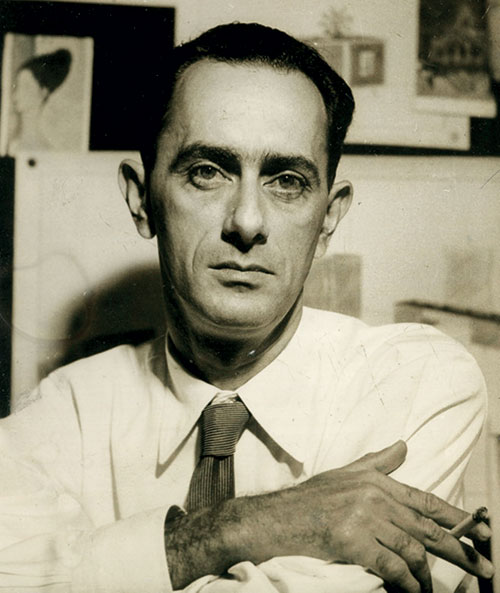
Terry Jonklaas, MBE, interior designer, at work, 1950. (Courtesy of The Observer)
By at least 1947, Jonklaas had established a considerable reputation. Thilo Hoffmann recalled that, after his marriage, he and his wife moved into their first home, a small flat in the Baurs building. It was barely furnished, apart from a few pieces designed by Jonklaas, whom Hoffmann described as “a then leading designer.” By 1951, Jonklaas had been admitted as a Member of the Society of Industrial Artists (SIA), Britain’s first professional body for designers. In 1956, aged thirty-six, he was appointed a Member of the Order of the British Empire (MBE) for his work in interior design.
The business of modern living
Jonklaas served as managing director of The Decorators and Furnishers, founded in 1947. He was its creative engine and public face—in effect, the brand itself. His partners provided the financial backing, connections and social imprimatur needed to sustain the enterprise. Sir Chittampalam Gardiner was chairman, while R. P. Senanayake, N. Sellamuttu, S. Sellamuttu, Sellamuttu Somasunderam and Kurban Adamally served as directors. Notably, the company was the only Ceylonese design firm to be a member of the Design and Industries Association of Great Britain.
Jonklaas travelled regularly to European design exhibitions, including the Milan Triennale, where he cultivated relationships, secured sole agency agreements with prestigious firms and kept abreast of new products, forms and materials.
Many remember visiting the showroom at No. 1 Galle Face Court, whose broad frontage displayed Jonklaas’s furniture alongside contemporary European lighting, glass, tableware and gifts. Modernity could be viewed through the window before it was purchased for the home. Manik de Silva recalled furniture unlike anything he had seen, while Shanth Fernando remembered a black metal vase lacquered orange inside, Clancy glass, Lalique, Steuben and Jonklaas chairs with brass-tipped legs; his mother once had one of the designer’s cane chairs copied.
For contemporary readers, Jonklaas’s influence might be compared—despite differences in period and design vision—to that of Shanth Fernando and Paradise Road. Each changed the visual culture of domestic life in Sri Lanka, making a new form of contemporary living desirable and recognizable. Jonklaas gave material form to the relaxed sociability emerging around Independence: a pre-air-conditioned world of home bars, dining rooms, verandahs and gardens, clubs, race meetings and entertaining, where growing informality coexisted with rituals of dress, status and display.
The Decorators and Furnishers became a destination for prestigious wedding gifts and introduced Ceylonese buyers to European lighting, glass, ceramics and tableware. At a time when interior design was only beginning to emerge as a distinct profession, Jonklaas designed furniture, lighting and furnishings; worked with timber, cane, metal, glass and new industrial materials such as rexine, plastics and Formica; and undertook commissions for offices, exhibitions, kitchens and entire houses. His customized pieces and recurring design flourishes were tailored to the personalities and social lives of his clients.
-

- Advertisement in the catalogue for Aubrey Collette’s 1955 Faces exhibition, with Jonklaas’s name prominently displayed. (Courtesy of Cresside Collette)
-
- Terry Jonklaas as Citizen Perrra and Aubrey Collette as Mandrake the Magician at Havelock Golf Club. (Courtesy of Cresside Collette)
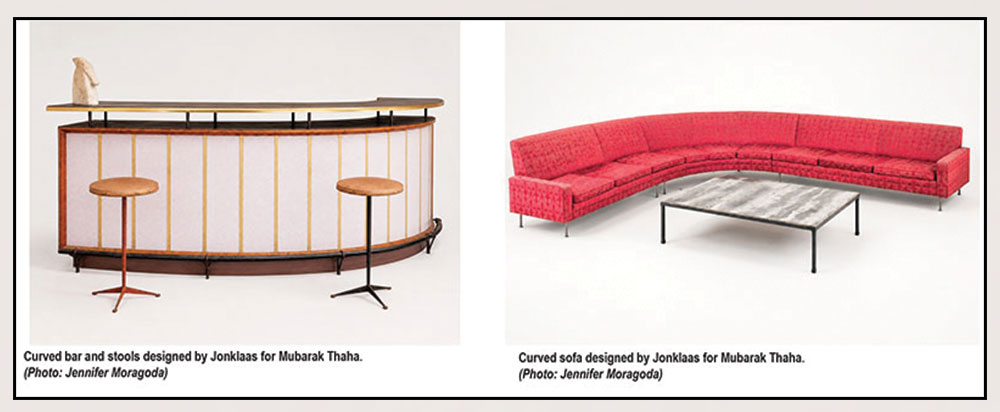
The interiors he designed for Mubarak Thaha offer a vivid example. Thaha was a well-known figure with interests in Colombo clubs and horse-race betting. The eight-foot-long bar occupied the space beneath a staircase. Nearby stood elongated swivel chairs with moulded high backs, upholstered in saffron-yellow corduroy and supported on cast-iron pedestal bases, alongside locally made interpretations of the Barcelona chair. The imposing curved bar was faced with panels of speckled Formica edged in brass; a brass foot rail ran along its base, while the countertop, raised on recessed iron supports, appeared to float above the structure. The bartender’s side was as carefully resolved as the public face, with finely finished solid-teak carpentry. As a final flourish tailored to the owner, Jonklaas designed a plaster-of-Paris horse’s head for the counter-top.
The commission shows how he combined materials, function and character to create an interior suited to the life of the room and the personality of its owner. His advertising was equally integral to the enterprise: in newspapers and exhibition catalogues, Jonklaas’s name received billing equal to that of the firm.
The Jonklaas idiom
Jonklaas’s furniture belonged confidently to international post-war modernism, part of a wider shift away from ornately carved antique furniture that evoked walauwa living and claims to pedigree, status and tradition.
He introduced a lighter, more informal sensibility in which form, proportion and material took precedence over applied ornament. Wall-mounted construction, slender recessed legs, metal stems, splayed supports, rounded corners, cantilevered tops and thin profiles made many pieces appear to float. Sideboards, cabinets, tables and upholstered furniture shed visual weight, allowing space to flow beneath and around them. Curves softened their volumes, while meticulous finishes and the grain of Burma teak, naedun, tamarind, jak, satinwood and ebony provided richness and distinction.
His work drew more strongly on an international modernist vocabulary than on recognizably traditional Ceylonese forms. Yet this break with traditional form did not mean a break with traditional skill. His designs depended upon Ceylonese carpenters, furniture makers, cane-workers, brass workers and ironsmiths, who translated modern ideas into finely finished workshop-made objects.
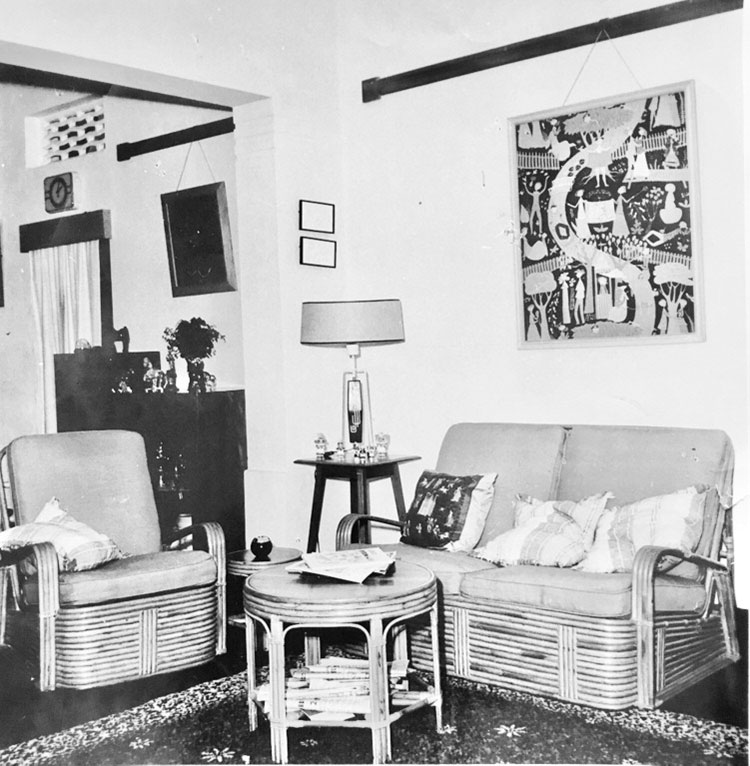
Cane ensemble designed by Jonklaas for Aubrey Collette in the 1950s. (Courtesy of Cresside Collette)
His originality lay in how he made post-war modernism his own: through combinations of local and imported materials, exceptional craftsmanship, practical ingenuity and humour. Machine-made brass-plated edging and industrial fittings became decorative details, while his trademark brass “socks,” capping conical legs, were widely copied. Formica faced bars and sideboards; coloured glass slag was used in garden lanterns; tiles enlivened table surfaces; and imported glass shades became complete lighting designs through locally made fittings.
The limitations of available materials and small workshops often encouraged invention. Jonklaas substituted cast iron for industrially produced chrome and steel, and repurposed ordinary metal washers as feet beneath splayed chair and table legs. Swivel chairs were created by mounting the seat on a central rod inserted into a hollow base.
A teak dressing cabinet designed for N. U. Jayawardena’s Cambridge Place house demonstrates Jonklaas’s fine finishes and playful ingenuity. Closed, its sleek fluted facade and elongated brass handles form a solid floating block. Opened, mirror-faced doors frame a central mirror and reveal a working surface with drawers and a concealed compartment below. The compartment revolves through 180 degrees, bringing its contents within reach before returning them neatly out of sight. A small round stool on castors can be parked beneath the cabinet. Like much of Jonklaas’s best work, it is playful and beautiful, yet governed by function and economy of space.
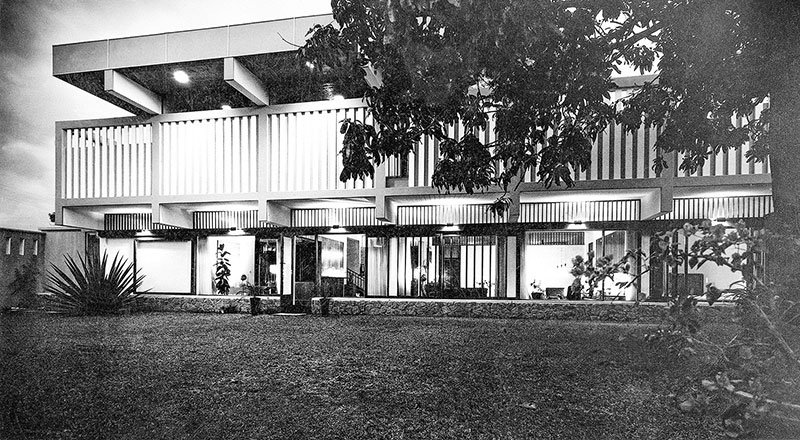
N. U. Jayawardena’s Cambridge Place house, designed by Ulrik Plesner, 1959–60. (Courtesy of Ismeth Raheem)
His irreverent, slightly perverse humour is captured in a pair of ceramic salt-and-pepper shakers from a series he designed for the Danish company A/S Rafa and sold under its Nymølle brand. Two complementary conical forms become hooded monks in cassocks, their toes peeking from beneath their robes. Their shapes allow them to be arranged in different configurations: seen in profile, they appear to proceed solemnly to Mass; only when turned to face the viewer are their true characters revealed. One hunches forward with clasped hands and a disapproving frown; the other, with shifty eyes, sniggers. The joke continues in their use: each figure must be grasped by the neck, inverted and shaken to dispense the salt or pepper.
Modernism at ease
Cane and rattan, comparatively affordable materials, offered another expression of relaxed living and entertaining. Jonklaas helped make cane furniture respectable enough to move from the verandah into the drawing room. The ensemble he designed for his friend Aubrey Collette in the 1950s is a particularly elegant example: thick bands of rattan wrap around the settee and armchairs, forming their bases in place of conventional legs.
The now-ubiquitous leather-and-cast-iron butterfly chair offers another example of Jonklaas’s role in popularizing modern designs. Sharya Scharenguivel, daughter of his client and close friend Chloé de Soysa, recalled that within their circle it was known as the “Jonklaas chair.” Created in Buenos Aires in 1938 and copied worldwide, it became associated in Sri Lanka with Geoffrey Bawa and Ulrik Plesner through published photographs of their interiors. Jonklaas’s possible role in its local circulation is less known. Today, inexpensive versions are sold along the Kandy Road, their popularity owing to their comfort and ease of fabrication.
Furniture finds its architecture
Jonklaas’s furniture found perhaps its most perfect architectural setting in N. U. Jayawardena’s Cambridge Place house, built in 1959–60. Designed by the Danish architect Ulrik Plesner, it was radically modern for Colombo: a rectilinear, strongly horizontal structure with grass-covered roof terraces at a time when pitched roofs were still the norm. The upper storey appeared almost to float above a transparent ground floor, where a broad bank of teak-framed sliding glass doors opened directly onto the garden, revealing the carefully integrated interiors.
The commission brought Jonklaas into contact with an architect who possessed an unusually intimate understanding of furniture and craftsmanship. Plesner had apprenticed in carpentry during his education in Copenhagen and was the stepson of Kaare Klint, a foundational figure in modern Danish furniture design.
During the same period, Jonklaas also designed most of the furniture ensembles for Aelian Kannangara’s residence, designed by Geoffrey Bawa. Its architecture bears striking affinities with the Cambridge Place house.
Hidden in plain sight
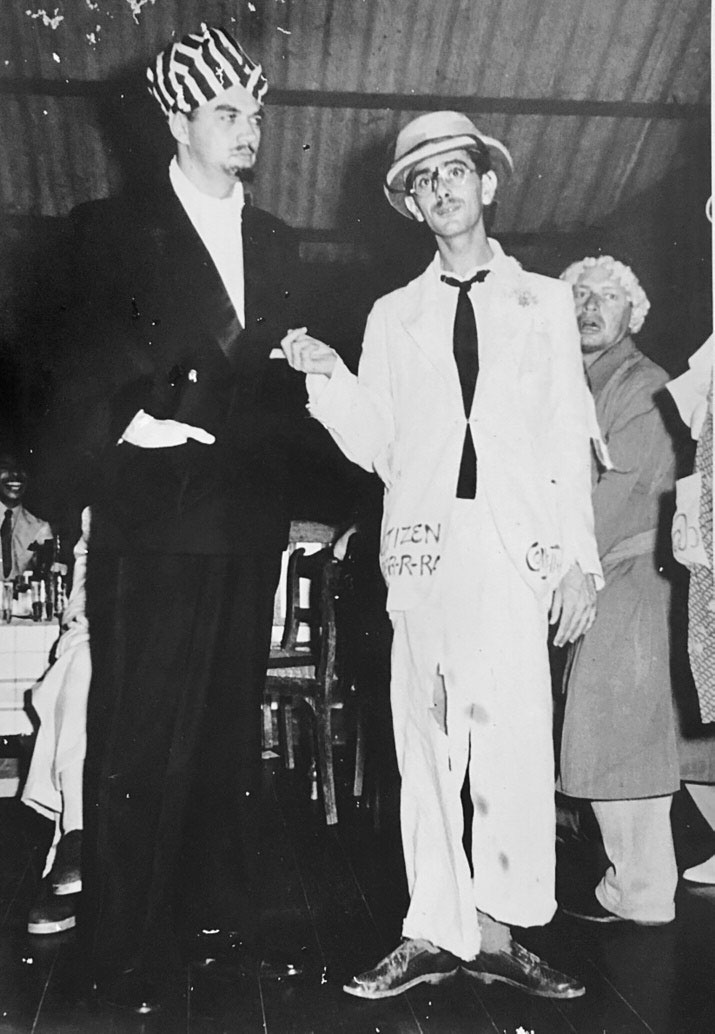
Terry Jonklaas as Citizen Perrra and Aubrey Collette as Mandrake the Magician at Havelock Golf Club. (Courtesy of Cresside Collette)
Jonklaas’s Ceylonese career lasted barely 16 years, from about 1947 to 1963. His interiors and furniture were seldom systematically documented, while ensembles in private houses were divided among descendants or dispersed through auction, often losing their provenance. Yet the simple silhouettes, teak and rattan, and relaxed informality he helped make acceptable have returned to fashion. His pieces blend seamlessly into contemporary settings even as their authorship remains largely unrecognized.
The last cocktail party
The loss of Jonklaas’s name followed the dispersal of the social world that had sustained it.
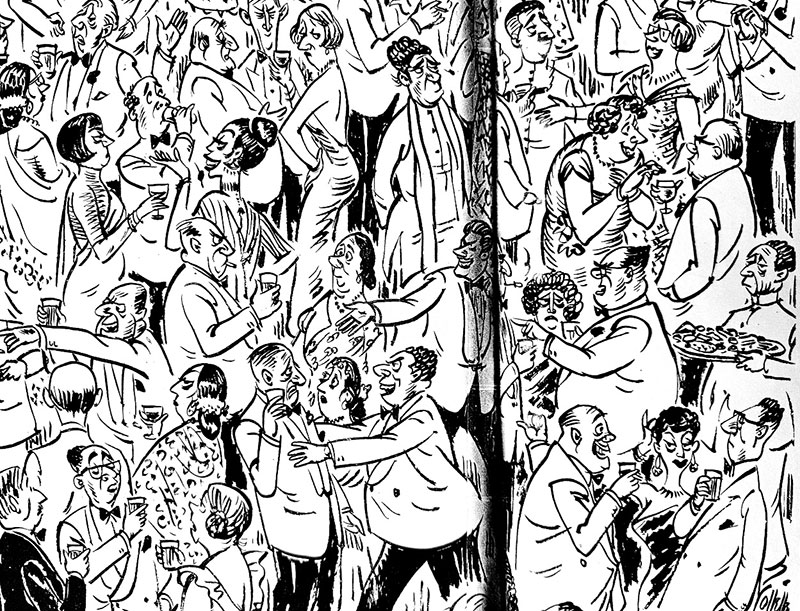
Aubrey Collette, My Very Last Cocktail Party, c. 1961. (From The Times of Ceylon)
He was remembered as gregarious, approachable and mischievous. Very tall and fair, he was an immediately recognizable presence. He bonded with clients over gardens, entertaining, travel and antique hunting, and many were or became close friends. Friends recalled his practical jokes, including an occasion when he scattered vegetables just inside the entrance gate of Cecil and Chloé de Soysa’s home; the family immediately knew who was responsible. He moved easily among prominent Burgher, Sinhalese, Tamil and Bohra families.
These networks were essential to an interior designer whose work depended upon trust and the willingness of clients to admit him into the intimate process of making a home. Access to them, however, was often restricted by class, ancestry and family standing.
One of his closest friends was Aubrey Collette, Ceylon’s best-known political cartoonist and caricaturist. In a photograph taken at a fancy-dress party, Jonklaas appears in a shabby white suit bearing the name “Citizen Perrra,” while Collette is dressed as Mandrake the Magician—both characters from Collette’s cartoons. Jonklaas’s pose captures his position within society: a carefree participant, performer and amused observer.
Collette recognized, as did many around him, that this confident social world was nearing its end. In My Very Last Cocktail Party (c. 1960), he turned Colombo’s fashionable social set into a densely packed satire: British residents and members of the Ceylonese elite mingle as jaded, self-satisfied or faintly condescending figures, while a man in national dress stands visually apart. The old order, shaped by colonial privilege and sustained by narrow networks of class, language and family, could no longer assume its permanence.
This world should not be recalled only through nostalgia. Its intimacy, ease and cultural sophistication coexisted with exclusions and inequalities long ignored by those whom the system served. Political change widened access to power and altered the composition of social and professional networks, although it did not eliminate the importance of personal connections.
Collette left Ceylon in 1961. Jonklaas followed with his family in 1963 and continued working as a designer in Australia. For them, as for many Burghers of their generation, Australia offered another future as the assumptions governing their place in Ceylon began to change.
The last cocktail party was over. The friends dispersed, the houses passed to new owners, and the carefully assembled interiors were divided and sold. The name that had once guaranteed excitement, prestige and modernity gradually faded.
Yet the objects remain: a bar cabinet with intricate marquetry, a teak table floating above an iron frame, a brass-capped leg, a revolving drawer, a cane settee or a pair of mischievous monks. Through them, Jonklaas’s interiors—and Terry Jonklaas himself, once a household name—can begin to be seen again.


 At a time when Sri Lanka’s foreign policy is coming under intense scrutiny by some local sections it is only right that impartial and independent commentators shed some clarity on what fundamental foreign policy directions Sri Lanka ought to take. The extremely fluid and complex nature of current international politics renders such an understanding crucially important.
Given its vulnerabilities in a number of spheres Sri Lanka has no choice but to persist in broadly following the path of Non-alignment. That is, it should be ‘a friend of all and an enemy of none’, to the extent possible. However, it does not follow that in the process it could compromise what is seen as its national interest.
The latter point needs stressing against the backdrop of the criticisms the Sri Lankan government has been attracting from some quarters over what is made out to be some opaqueness in security and defence cooperation agreements it has entered into with India. It remains advisable for the Sri Lankan government to enter into pacts of this nature with India, but the government is obliged to disclose the contents of these agreements to the Sri Lankan people without undue delay in consideration of the uncompromisable sovereign rights of a people in a democracy.
However, there is no denying that the government should make it a central foreign policy premise to always work in cooperation with India. A consideration of what it cost Sri Lanka in the past to be in a disharmonious relationship with India and how such policy missteps worked against Sri Lanka’s best interests ought to dictate to Sri Lanka the advisability of maintaining uninterrupted cordial ties with India. Moreover, common sense ought to drive home to a country the costs of being at loggerheads with one’s closest neighbour who has also proved a ‘ready friend in deed.’
That said, it is the bounden duty of Sri Lanka’s diplomatic community or establishment to ensure that such cooperation does not degenerate into a policy of subservience towards India. That is, finesse and farsightedness in local diplomacy become prime requirements.
While India’s geographical location and physical size, besides her other strengths, contribute towards her centrality in regional and world affairs, her neighbours would be thinking and acting far-sightedly if they not only focus on India and her legitimate interests but also ensure continuous friction-free intra-South Asian relations. That is, for them collective South Asian well being should be of fundamental importance.
Much more than for India perhaps, such harmonious ties are of inestimable importance to India’s neigbours who are up against multiple vulnerabilities which are to a great extent regionally rooted. The latter could never, that is, afford to take their minds off the region’s collective development prospects.
The above are some of the reasons why it could prove highly counter-productive and self-defeating for the ‘South Asian Eight’ to render dormant and ineffective the historic SAARC organization. Rather than ‘dead’ SAARC has been allowed to drift into the ‘Limbo of Forgotten Things.’
The growing inter-dependence of the ‘SAARC Eight’ ought to impress on the collectivity the need to step-up regional cooperation in multiple areas which impinge on its members’ legitimate interests. For instance, the youth-led ‘Cockroach’ revolts, first in India and subsequently outside, should convince South Asia that it is continuing to be plagued in a major way by poverty and equity-linked issues. That is, West-inspired, largely market economics-dictated ways to see an end to poverty are simply not working completely.
Likewise climate-related questions are ravaging South Asia in unimaginable ways; Nepal being just one case in point. The rationale for regional cooperation remains valid and undefeated. It is time for revived and stepped-up SAARC cooperation. That is, the solutions to the region’s development dilemmas need to be found in mainly the region.
This amounts to making a case for a continued sense of ‘Southasianness’ among the SAARC countries. That is the conviction should be firm that they know their developmental challenges best and that answers to these issues must be primarily evolved by the grouping itself in cooperation with concerned sections.
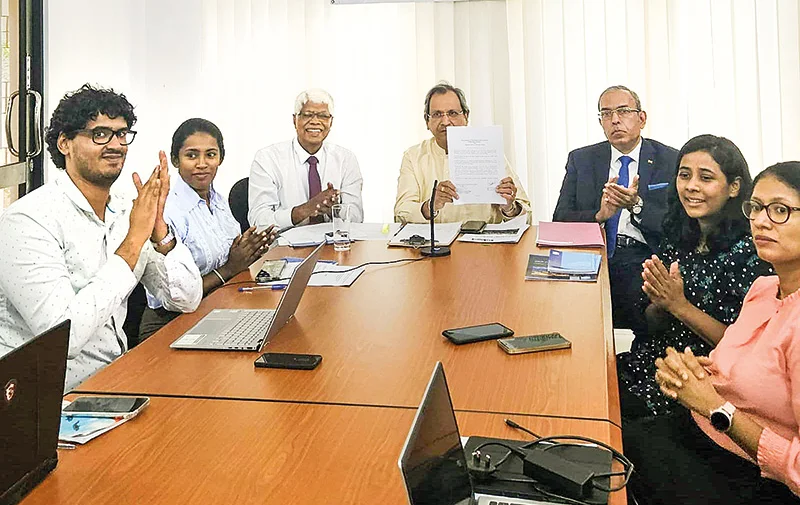
From the above viewpoints the Regional Centre for Strategic Studies (RCSS), Colombo did very well to tie-up with the South Asian University (SAU), India, to increase public awareness on the developmental problems affecting South Asia and for initiating a number collaborative measures that aim at ameliorating them. The relevant agreement was formalized in early September at the RCSS. The sealing of the pact took place under the aegis of SAU President Prof. K.K. Aggarwal and RCSS Executive Director Ambassador Ravinatha Aryasinha.
A press release issued by the organizations said the collaboration aims ‘to foster research networks, partnerships and collaborations for transformative change across South Asia.’ It also mentioned that the partnership marked the first agreement to be signed by SAU with an independent think tank in Sri Lanka.
Among other things, pacts such as the above are bold moves in the direction of fostering a spirit of intellectual independence in those areas of the South facing some of the stiffest developmental challenges. Rather than ‘import’ solutions to these challenges from outside the region, the SAU-RCSS initiative aims at fostering fresh approaches to evolving solutions to problems that are uniquely South Asian.
It is hoped that the SAU and RCSS initiative while leading a to a greater degree of Southern intellectual independence in the area of development thinking would also help in kick-starting the SAARC process all over again in a major way.
What ought to lend fresh urgency to the latter undertakings are fast-breaking current developments in international politics. It ought to be perceived by the most underdeveloped regions of the South that going forward their well being would matter least or not at all to the major powers of both East and West.
For example at the time of writing the foremost among US and Chinese political leaders are meeting in the US in what is made out to be a historic coming together of sorts to address issues of common concern. It is highly unlikely that the parties would be addressing the economic preoccupations of the least developed countries. The same goes for other states that matter from the East and West.
Essentially, the US and China would be looking at ways of strengthening business ties that matter majorly for them. The South and its issues would prove to be of peripheral interest, if at all they happen to matter to the protagonists. Such developments ought to be fresh reminders to the South and their collaborative organizations that there is no escaping self-help and joint solidarity.
by Prof. M.W. Amarasiri de Silva
Adult literacy has for a long time been one of Sri Lanka’s greatest sources of pride, serving as a social indicator that has set the country apart from several of its neighbours in the region. For many years Sri Lanka has been recognised for keeping its literacy rates at a level like those of middle-income countries and even some high-income ones, even though it has faced economic difficulties and political instability. However, since new global research has now shown an unexpected and concerning decline in adult literacy in several high-income countries, it is important to consider what this means for Sri Lanka.
The phenomenon described by Jishnu Das, Yash Dhuldhoya and Ethan Sager, the unexplained fall in functional literacy among adults in wealthy nations. calls for a more thorough examination of the nature of literacy, the pressures exerted by the modern information environment, and the vulnerabilities that Sri Lanka might encounter as it moves towards a more digital, ageing and complex society. Even though Sri Lanka’s basic literacy rates remain high and steady, the global trend acts as a warning that literacy is not a fixed accomplishment but a dynamic capability which must be continually fostered, safeguarded and adapted to changing circumstances.
Decline in functional literacy
The drop in literacy rate in high-income countries is not due to people losing the ability to read or write in the ordinary way. On the contrary, it reflects a decline in functional literacy, which is the capacity to deal with, understand, and apply information in real-life situations. This kind of literacy involves following instructions, comprehending official documents, using digital interfaces, interpreting medical information, and making sense of complicated texts that demand continuous attention.
Researchers stress that the decline cannot be attributed merely to disruptions caused by COVID-19 or the increasing use of smartphones; instead, there is going on something more fundamental: a weakening of the cognitive and informational bases that adults need to function properly in modern society. In countries such as the United States, the percentage of adults regarded as functionally illiterate has increased significantly, indicating that even highly educated societies are having difficulty in keeping up the skills required to handle ever more complex streams of information.
Sri Lanka immune?
At first sight, Sri Lanka seems to be immune from this trend. The country’s adult literacy rate is still above 92 per cent and youth literacy is even higher. According to the 2024 Census, literacy rates exceed 97 per cent among people aged ten and over, with nearly equal levels between the sexes. These figures show the continued strength of Sri Lanka’s system of free education, a system which in the past has guaranteed widespread access to school and has produced generation after generation of citizens who could read and write at a basic level.
There has also been a steady improvement in educational attainment, with an increasing number of adults finishing secondary education and a larger proportion going on to tertiary institutions. Unlike the mysterious drops observed in rich countries, Sri Lanka’s literacy figures demonstrate stability and even a slight improvement.
However, although the surface appearance is reassuring, an even more complicated reality exists. The literacy figures for Sri Lanka only record basic literacy, that is, the ability to read and write simple sentences, and they do not include measures of functional literacy. It is impossible to tell from these statistics whether adults can interpret a bank statement, understand a medical prescription, use an online government portal, or critically assess information that is spreading on social media. As is shown by the global trend, having a high level of basic literacy does not ensure a strong degree of functional literacy. On the contrary, functional literacy can fall even if basic literacy stays the same. This difference is important for Sri Lanka, particularly since the country is currently experiencing rapid digitalization, demographic ageing, and social change.
Major risk factor
A major risk factor is the move towards digital information environments. In high-income countries, researchers believe that the prevalence of smartphones and short-form digital content may be diminishing people’s ability to engage in deep reading. Nowadays, individuals take in information in short, rapid segments by scrolling through social media feeds, quickly reading headlines, and viewing short videos. Such behaviour decreases the opportunity for sustained reading, which is necessary for keeping comprehension, critical thinking, and the capacity to deal with complex information intact.
Sri Lanka is going through a comparable change. There has been a sharp increase in the number of people using smartphones, and social media sites have become the main sources of news, leisure, and communication. Although there are many advantages to having digital access, it also results in a situation where superficial reading becomes the standard approach and could therefore lead to a decline in functional literacy over time.
Demographic ageing as challenge
A further challenge that is coming up is demographic ageing. Sri Lanka is rapidly moving towards becoming an ageing society, with an increasing number of older people who might experience cognitive decline, have less exposure to new information, and enjoy few opportunities for further learning. In high-income countries, ageing populations have led to a fall in functional literacy since older individuals have had difficulty adapting to digital systems and complicated bureaucratic procedures.
The older generation in Sri Lanka, many whom were educated many decades ago under different curriculum standards, could end up becoming increasingly vulnerable in a world in which essential services, such as banking and healthcare, are being moved online. If appropriate support is not provided, the country may witness a growing gap between basic literacy and functional literacy among older adults.
In Sri Lanka, the way in which administration and the workplace are organised has in the past placed greater trust in personal communication and on basic forms of documentation. What in high-income countries would require complex reading is instead carried out through face-to-face contact in Sri Lanka. Nevertheless, this situation is now changing. Government services are becoming available online, banks are introducing digital systems, and in workplaces there is an increasing need for employees to use electronic systems. Since these changes are happening at a faster rate, the demand for functional literacy will increase. Should adults not be able to meet these new demands, Sri Lanka might start to see the kind of decline in literacy that has been seen in other places.
Misinformation and disinformation
Another worry is the spread of misinformation and disinformation. In Sri Lanka, there has already been the quick dissemination of false information via social media, with this having an impact on public health, politics, and social cohesion. Since functional literacy is essential for allowing people to assess sources, doubt the claims made, and tell the difference between reliable information and falsehoods, a lack of functional literacy causes societies to be more open to manipulation, polarisation, and confusion.
The fact that there has been a global drop in functional literacy at the same time as misinformation has increased points to a dangerous feedback cycle: when literacy is low people become more prone to misinformation, and the misinformation in turn damages their ability to think critically about information. Given that the country has a high level of social media use and a lack of digital literacy training, Sri Lanka should take this risk seriously.
Even though there are these risks, Sri Lanka has several advantages which can assist in avoiding a drop in functional literacy. The country’s system of basic education is still strong, showing high enrolment figures and good results in basic literacy.
Families in Sri Lanka still place a great deal of importance on education and reading is still a respected cultural activity. Furthermore, because of its relatively small size and the fact that it has a centralized form of government, it is more efficient than in bigger countries to carry out nationwide literacy campaigns. These strengths offer a firm basis for developing new strategies for protecting and improving functional literacy.
Literacy a process
It should be realised by Sri Lanka that attaining literacy is not a single accomplishment achieved in childhood. In the modern world, literacy must be a skill that is constantly put into practice, kept up to date and adapted to changing circumstances. The fact that adult literacy is declining worldwide shows that even in wealthy countries with well-developed education systems deterioration can occur if adults are not supported in keeping their cognitive and informational abilities. Sri Lanka cannot afford to be careless.
It is necessary for the country to invest in adult education, in programmes concerning digital literacy and in the development of cognitive skills for all age groups. It also needs to establish ways of measuring functional literacy rather than just basic literacy so that policymakers can detect emerging weaknesses and act in advance.
A vital measure is to increase the opportunities for adult learning. Although Sri Lanka has effective literacy programmes based in schools, the country’s infrastructure for adult education is limited. Community centres, libraries, universities, and vocational institutes should take on a more significant role by providing courses, workshops, and reading programmes which are tailored for adults. The programmes should place an emphasis not just on reading and writing but also on digital navigation, critical thinking, and information processing. Adults should be given the chance to practise the skills that are necessary for them to function effectively in a rapidly changing world.
Importance of digital literacy programmes
It is just as important to have digital literacy programmes. Since an increasing number of services are being offered online, adults need to learn how to use digital tools with confidence and in a safe manner. This involves knowing how to fill out online forms, moving around on government websites, using banking apps, and being able to spot misinformation. The digital literacy courses available should be accessible, affordable, and adapted to different age groups, especially older adults who might feel put off by technology. Schools can also contribute by incorporating digital literacy into their curriculum so that future generations acquire good functional literacy skills from an early age.
Sri Lanka should also investigate introducing policies which promote cognitive health among older people. Since cognitive decline can lead to a deterioration of functional literacy, it becomes more difficult for older individuals to deal with information. It is possible to help keep cognitive function by setting up programmes that promote reading, social interaction, physical activity, and continued learning. During regular medical visits, healthcare professionals should include cognitive assessments so that any problems affecting literacy-related skills can be picked up early.
Sri Lanka needs to create tools for measuring functional literacy, since the figures available on basic literacy give an incomplete account of the country’s capabilities. By using assessments of functional literacy like those employed in high-income countries, Sri Lanka would be able to monitor how well its adults can apply their literacy skills in real-life situations.
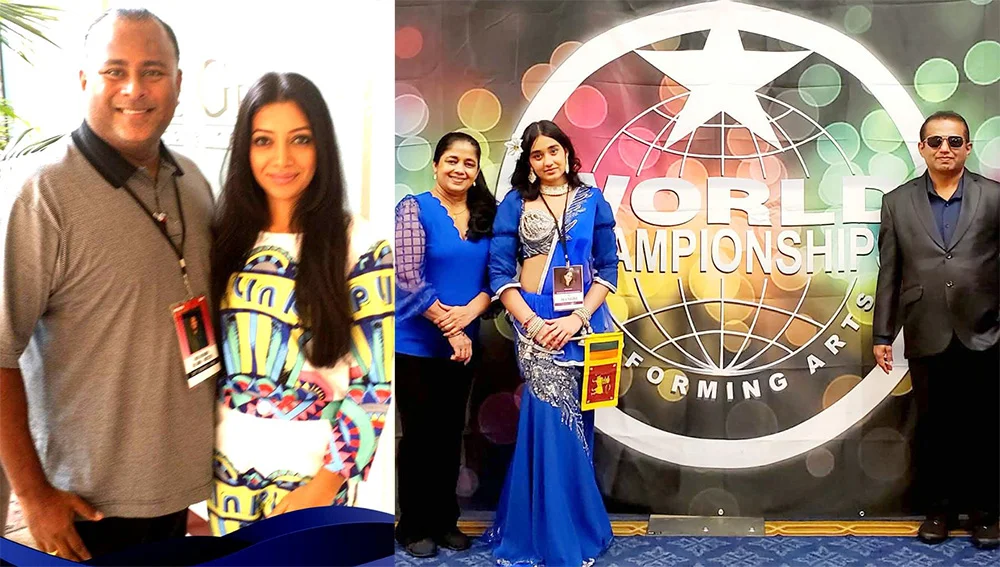
 The World Championships of Performing Arts (WCOPA) is known globally as the Olympics of performing arts, but Sri Lankans came to know of it more closely when Natharie Wickramasinghe, representing Team Sri Lanka at WCOPA 2026, in Las Vegas, earned a Bronze Medal in the Ethnic/Folklore Dance category.
Behind Sri Lanka’s WCOPA journey is Sri Lanka-born Chris Rajendra, who migrated to the United States in 2007, and deserves special congratulations.
Passionate about discovering and promoting talent, Chris has been actively involved in the pageant and performing arts, industry since 2002.
A major milestone came in 2015, when he introduced WCOPA, to Sri Lanka, for the first time, creating an international platform for Sri Lankan performers.
Sachini Ayendra became the very first candidate to represent Sri Lanka at WCOPA, in 2015, marking the beginning of Team Sri Lanka’s journey.
Chris served as National Director for Team Sri Lanka from 2015 to 2018, and has returned to the role for the 2026–2027 term, continuing his commitment to identifying, developing and promoting Sri Lankan talent internationally.
His involvement in pageantry and performing arts includes:
Recruiter, Miss Nevada United States – 2014

Chris Rajendra: National Director – WCOPA Team Sri Lanka
Manager, Miss Colombia Las Vegas – 2013 to 2017
Director for the West Coast and International Divisions of Ms. Latina International and Ms. International World – 2017
National Director for Team Sri Lanka – WCOPA, 2015–2018 and 2026–2027
Co-National Director for Team USA – WCOPA 2026
In the USA, Chris began his career in retail before transitioning into insurance and financial services, where he built extensive experience in sales, marketing, leadership and business development.
He owned and operated a brokerage, affiliated with multiple insurance companies, and later served as Marketing Director with Transamerica and World Financial Group.
As his business expanded across Las Vegas and California, he continued to hone his expertise in sales, marketing and client relations. He now works as a Sales Executive at Hilton Grand Vacations.
Looking ahead, Chris will shortly launch the application process for Team Sri Lanka 2027, giving talented Sri Lankan performers another opportunity to represent the country on the world stage.
The 2027 World Championships of Performing Arts will take place in Las Vegas, USA, in July or August 2027.
Through his work in both the corporate and performing arts worlds, Chris Rajendra continues to combine leadership, networking and talent development — creating opportunities for Sri Lankan performers to showcase their abilities on a global platform.

Kusal, Wellalage star as Sri Lanka defend 322 in Headingley thriller

Muhammad Shahzad smashes fastest first-class hundred by a Pakistani batter

Gul, Kharote spin Afghanistan to victory over Japan in Asian Games opener

Showers above 100 mm are likely at some places in the Western, Sabaragamuwa, Central and North-western provinces and in Galle and Matara Districts

Mirabai Chanu wins Asian Games silver as Ri breaks weightlifting record

Trump greets China’s Xi Jinping on arrival for three-day US

‘Dates have the highest sugar content to fight Coronavirus’

Sunday Island 27 December – Headlines

#SundayIsland 17th December – Headlines

Sunday Island – 28th March

Sunday Island Headlines – 21 March

Sunday Island – 21st February – Headlines
-

 News6 days ago
Shanakiyan urges urgent action over reported death sentence for Lankan in Saudi Arabia
-

 News7 days ago
Bid for Basil’s extradition nears final stage: Police
-

 News5 days ago
Namal Rajapaksa Buddhist gambit fails, bail denied
-

 Features5 days ago
Why the spelling Sri Lankan names in English vary
-

 Features5 days ago
Three bands, a new identity: Sri Lankan wolf snake recognised as distinct species
-
 Business5 days ago
SLIIT holds largest-ever convocation
-

 News5 days ago
Govt monitors reported Saudi death sentence – Foreign Ministry
-

 News5 days ago
Vehicle prices drop by up to Rs. 1 mn, says importers’ body