
Editorial
Bridging vaccine divide


Monday 12th April, 2021
Rich nations make a show of their commitment to defending human rights in the world. They harangue their developing counterparts, at every turn, about the need to protect human rights, and even threaten to meet non-compliance with punitive actions such as sanctions. They, however, do not seem keen to promote and protect humans’ right to vaccination vis-a-vis the prevailing global health emergency. The only way to safeguard this right is to ensure an equitable distribution of COVID-19 vaccines across the world, but the World Health Organisation (WHO) has expressed utter dismay at what it calls a ‘shocking imbalance’ in the distribution of vaccines between the rich and the poor.
This kind of vaccine inequality could be attributed to what WHO Director General Dr. Tedros Adhanom Ghebreyesus has rightly called a ‘catastrophic moral failure’. The COVAX initiative, which alone can ensure a well-coordinated global fight against the virus, has suffered a serious setback, with the high-income countries reportedly holding as many as 4.6 billion doses of vaccines, and the low-middle income nations only 670 million. One in four people have been inoculated in the high-income countries as opposed to one in more than 500 in the low-income countries, according to the WHO.
Unless the COVAX scheme, the most efficacious antidote to what has come to be dubbed ‘vaccine nationalism’, which has put the poorer countries at a distinct disadvantage, goes ahead as planned, a vast majority of the global population, in the developing countries, will be badly hit, and in the long-term, the world’s fight against the virus will be in jeopardy because the pandemic is no respecter of geographical boundaries; no country, however rich and powerful, will be safe in today’s interconnected world dependent on international trade and travel.
‘Vaccine nationalism’ may give the rich nations a sense of security in the short-term, but it will be counterproductive in the long-term, for no vaccine is believed to be able to ensure life-time immunity against COVID-19. The pandemic continues to throw up new challenges. Even if the rich nations achieve their vaccination goals while their poor counterparts are lagging far behind, they will be at the risk of being affected by new variants, against which, the currently available jabs might not be effective. This is why Dr. Ghebreyesus has said no country will be safe until every country is safe.
Some Asian nations are struggling to beat the virus despite some initial success in their battle against the pandemic, according to an Asia News Network article we publish today. The report informs us that India, which is grappling with its second wave of infections, has seen record increases of new cases, with more than 100,000 daily being reported on, at least, five days, last week. This being the predicament of a vaccine-producing nation, with a reasonably efficient vaccination rollout, the vulnerability of other countries is not difficult to guess. Similar unfortunate situations have been reported from other parts of the world as well. The US, which is among the nations with impressively high COVID-19 vaccination rates, is also troubled by a sudden increase in the number of pandemic-related deaths.
If the vaccine rollouts fail to reach a successful conclusion the world over fast, it may not be possible to achieve global herd immunity through vaccination, and the chances of beating the virus may be slim due to its mutations, experts warn. COVAX is scheduled to supply as many as two billion doses of vaccines to 190 countries within one year with 92 poorer nations gaining access to vaccines at the same time as their wealthier counterparts. This is a highly ambitious target, which, however, must be achieved if the world is to get on top of the pandemic. But help from the rich nations is not forthcoming, and it is only natural that the WHO is disappointed.
The WHO is hopeful that it may be possible to change the composition of the existing vaccines to deal with the mutations of the virus, but it is still trying to figure out what kind of impact new variants may have on the effectiveness of vaccines. Reuters reported yesterday that a new coronavirus variant discovered in South Africa had been found to be able to break through Pfizer/BitoNtech’s vaccine to a considerable extent. Some Indian epidemiologists interviewed by BBC yesterday said they feared that the emerging variants might even be able to escape the human immune system!
The need for all nations, which are currently at cross purposes as regards the global battle against the virus, to support and be guided by COVAX, which alone can make them work in unison to beat the virus, cannot be overemphasised.



Saturday 11th July, 2026
The Bar Association of Sri Lanka (BASL) has been urging President Anura Kumara Dissanayake to take action to fill four vacancies each in the Supreme Court (SC) and the Court of Appeal (SC), but in vain. It has renewed its call, in a letter to the President, who however remains impervious to public opinion and fervent calls for filling the judicial vacancies. The BASL has warned that the prolonged delay in filling them could undermine the administration of justice and public confidence in the Judiciary.
The BASL has further noted that it is still awaiting a response to its previous letter to President Dissanayake, objecting to a government proposal to amend the Constitution to increase the retirement ages of the SC and CA judges and warning that such a move could have implications for judicial independence. Is it that the President’s Office has chosen to remain silent on the BASL letter?
The first of the SC vacancies arose following the retirement of Justice Gamini Amarasekera on 20 June 2025, according to the BASL. The other vacancies occurred due to the retirement of Justices S. Thurairaja, Kumudini Wickramasinghe and Priyantha Fernando.
There are no signs of President Dissanayake initiating action to fill the vacancies in the SC and the CA any time soon. Neither he nor his government has been able to offer any plausible explanation either, and it is only natural that an ulterior motive is suspected.
The BASL has rightly reminded President Dissanayake of his constitutional responsibility in this regard. Quoting Article 107 (1) of the Constitution, it has said the President is duty bound to appoint the judges of the SC and the CA, and warned that the continuation of judicial vacancies at issue over a long time is inconsistent with the effective discharge of that vital constitutional function. It is being asked in some quarters whether the President’s failure to fulfil this constitutional responsibility amounts to a violation of the Constitution.
The SC and CA vacancies have impeded the career progression of members of the judiciary, the BASL has argued cogently, insisting that they have placed an additional heavy burden on the two courts, as both of them now have to function with 25% fewer judges than their constitutionally stipulated complements. This situation has severely impacted the administration of justice and the efficient disposal of matters coming before the SC and the CA, according to the BASL. This is a very serious situation, and it defies comprehension why President Dissanayake has chosen to remain silent.
What’s the world coming to when the Head of State of a country keeps 25% of positions each in the superior courts vacant and refuses to heed serious concerns and counsel of professional organisations of lawyers and individual legal experts?
There is no way President Dissanayake can justify his decision to keep judicial vacancies under discussion unfilled. His failure to fill them could give rise to the perception that he is doing so pending the eligibility of certain individuals, as the BASL and other professional organisations have argued. Such perceptions do matter as much as reality in this country, given the manner in which successive governments have interfered with the judiciary to further their political interests.
If President Dissanayake thinks he can wear down his critics and have his own way, where judicial vacancies and the questionable government move to raise the retirement ages of the SC and CA judges are concerned, he will be mistaken. Such obduracy stemming from the arrogance of power is counterproductive, for it compels the critics of the government to harden their position on the issue and erodes public confidence in both the government and the judiciary.
Friday 10th July, 2026
The latest bout of prison violence has brought the appalling conditions of Sri Lanka’s prisons to light once again. Whenever riots erupt in prisons and lives are lost, issues such as prison congestion, squalor, etc., attract the attention of legislators and other policymakers, but hardly any remedial action is taken, and no wonder the status quo remains. Governments only pay lip service to prison reforms, which have become mere political slogans.
Over the past few days, many members of Parliament have been shedding copious tears for the victims of the Negombo prison violence, which claimed about 28 lives, including those of seven officers, but sadly nothing comes of their so-called discussions and debates. Cynics say Sri Lanka has a NATO (No-Action-Talk-Only) parliament, where its members talk the talk, but seldom walk the walk. They ought to sink their political differences and find ways and means of improving the conditions of prisons, which are widely considered hellholes. Haphazard prison reforms won’t do.
Meanwhile, as for remand prisons, there is a crucial issue that needs to be addressed urgently. Even a brief stay in a Sri Lankan remand prison is tantamount to punishment in itself before conviction, as is public knowledge. Suspects are so vulnerable in prisons that they even run the risk of being beaten to death, as we saw the other day in Negombo. Successive governments have abused the PTA (Prevention of Terrorism Act), the Offences against Public Property Act, etc., to have suspects arrested and remanded for prolonged periods.
Many people languish in remand prisons due to politically motivated arrests and selective enforcement that the police have earned notoriety for. The police ought to conduct thorough investigations and gather credible evidence before moving to arrest suspects who are not hardcore criminals posing a danger to society. It defies comprehension why so many suspects are arrested and kept in remand prisons for months on end even when there is no reason to suspect that they will flee the country, interfere with witnesses, suppress evidence, commit further serious offences, or pose a significant danger to the public.
Pretrial arrests, remand or detention should be the exception and not the rule, especially in a country like Sri Lanka, which cannot even ensure the safety of convicts and remand prisoners. The police make arrests swiftly and thereafter drag their feet on investigations while objecting to bail for suspects. Most suspects who are arrested and remanded in this manner are political opponents of the governments in power. There have been numerous such cases during the past several decades. Ruling party politicians use arrests to vilify their opponents and gain political mileage. They abuse their parliamentary privileges to defame suspects in custody and hold social media kangaroo trials with impunity. They apparently presume suspects guilty until proven innocent. When they do so, the police cannot be expected to conduct impartial investigations; the police dare not do anything that might cause the ruling party politicians to lose face. It is no surprise that the police have been accused of fabricating evidence against suspects who have incurred the wrath of ruling party politicians.
Holding a person on remand indefinitely until the conclusion of investigations is not consistent with due process and international best practices. The rule of law demands that the police or other investigators establish reasonable grounds to suspect an offence, collect and preserve evidence, interview witnesses, question suspects and assess the facts objectively before depriving anyone of personal liberty. They must not act according to their whims and fancies or at the behest of their political masters.
Premature arrests risk wrongful detention, reputational damage, hardships and expensive legal challenges for suspects. They could also compromise public confidence in law enforcement and lead to perceptions that investigations are influenced by political pressure or public sentiment rather than facts. When the rule of law is undermined, the justice system becomes weak.

Thursday 9th July, 2026
The latest episode of prison violence has come to an end, after claiming 28 lives and leaving more than 100 others injured. But political battles are still raging over it. The government and the Opposition continue to clash; they traded allegations and insults in Parliament on Tuesday and Wednesday. The Opposition is all out to lay the blame for the prison violence squarely on the government. It is demanding the resignation of Minister of Justice and National Integration Harshana Nanayakkara.
The government has struck back, asking whether any Yahapalana politician resigned over the Easter Sunday terror attacks in 2019. Many of the SJB politicians were in that failed administration. That argument is however self-defeating in that the JVP was a partner of the dysfunctional Yahapalana government in all but name and defended it to the hilt in Parliament.
Moreover, there were devastating terror attacks on military and civilian targets during the Eelam war. A considerable number of military installations, including the Mullaitivu camp and the Elephant Pass base were overrun by the LTTE, which killed hundreds of military personnel, but no politician resigned. There have also been several major incidents of prison violence. As we pointed out yesterday, in 1983, 53 Tamil prisoners were massacred inside the Welikada Prison in two separate attacks. In 2012, about 27 inmates were killed during a riot in the same prison, following a search operation conducted by the STF for weapons, drugs and mobile phones. In 2020, violent clashes in the Mahara Prison left 11 inmates dead. But ministers in charge of prisons did not resign. So, it may be argued that neither the SJB nor the UNP nor the SLPP has any moral right to call for anyone’s resignation over the Negombo Prison riots.
Opposition politicians and their propagandists may go on shouting until they are blue in the face, but their efforts to see the back of Minister Nanayakkara will be in vain. Sri Lankan governments are notorious for shielding politicians and officials loyal to them, no matter what. The incumbent dispensation is no different. One may recall that it went to the extent of bringing two senior CID officers out of retirement, elevating them to high posts in the public security sector and entrusting them with the task of probing the Easter Sunday carnage, which they themselves failed to prevent despite repeated warnings, while they were at the helm of the CID in 2019. So, it is only wishful thinking that the government will ever ask Minister Nanayakkara to resign over the Negombo Prison killings.
Interestingly, an NPP MP’s attempt to distract Parliament and the public from the Negombo Prison violence by bashing the former rulers, boomeranged on the government. Deputy Minister Mahinda Jayasinghe displayed a picture in the House, claiming that it showed Namal Rajapaksa with notorious criminal Julampitiye Amare at a public event. His claim prompted Opposition MP Chamra Sampath Dassanayake to remind the government that it was the JVP that had enabled Mahinda Rajapaksa, accused of shielding the likes of Julampitiye Amare, to win the 2005 presidential election and paved the way for the rise of the Rajapaksa family in national politics.
Worryingly, more often than not, parliamentary debates descend into slanging matches. They cost the public an arm and a leg. A parliamentary sitting costs taxpayers about Rs. 32.2 million, according to research conducted by some civil society organisations. It behoves the government and the Opposition to stop wasting public funds, and use parliament time productively to discuss issues of national importance seriously, manage state funds frugally and make progressive laws.
As for prison violence, the focus of parliamentary debates must be on structural problems in Sri Lanka’s prison system, including overcrowding, delays in court proceedings, gang rivalries, drug peddling, inadequate facilities, corruption and difficulties in maintaining security in large custodial institutions, the causes of the latest prison riots, and what needs to be done to improve prison conditions and prevent violent clashes and human rights violations in prisons. Parliament, maintained at public expense, is not the place for verbal slugfests, which can be staged elsewhere, if at all.

US$ 2.5 mn cyber heist exposes system failures

Opposition signs no-confidence motion against Justice Minister for dereliction of duty over Negombo Prison deaths

AG informs SC of e-visa agreement review

Navy, Coast Guard seize smuggled pharmaceuticals and cosmetics in Puttalam

BASL urges President to fill superior courts’ vacancies

Mariazelle passes away

‘Dates have the highest sugar content to fight Coronavirus’

Sunday Island 27 December – Headlines

#SundayIsland 17th December – Headlines

Sunday Island – 28th March

Sunday Island Headlines – 21 March

Sunday Island – 21st February – Headlines
-

 News6 days ago
Singapore-based Buddhist monk marks nearly four decades of humanitarian service
-
 News1 day ago
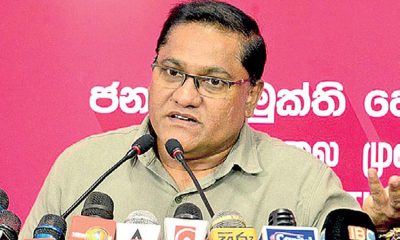
Herath warns prospective migrant workers not to get fleeced by racketeers
-

 News5 days ago
AI concerned over proposed SL military deployment in Haiti
-

 Midweek Review3 days ago
Unexpected focus on ‘pieces of tin’ worn by military men
-

 Latest News4 days ago
Nyamhuri and Ngarava stun Bangladesh by defending 141
-

 Features6 days ago
The NPP’s New Challenge: Balancing Easter Lawfare and Economic Welfare
-

 News2 days ago
Negombo Prison riot: Ensuring protection of prisoners fundamental responsibility of the state – UN
-

 Foreign News6 days ago
Iran promotes message of continuity and revenge at Khamenei commemoration