
Latest News
Taskin, Mustafizur set up famous series win for Bangladesh

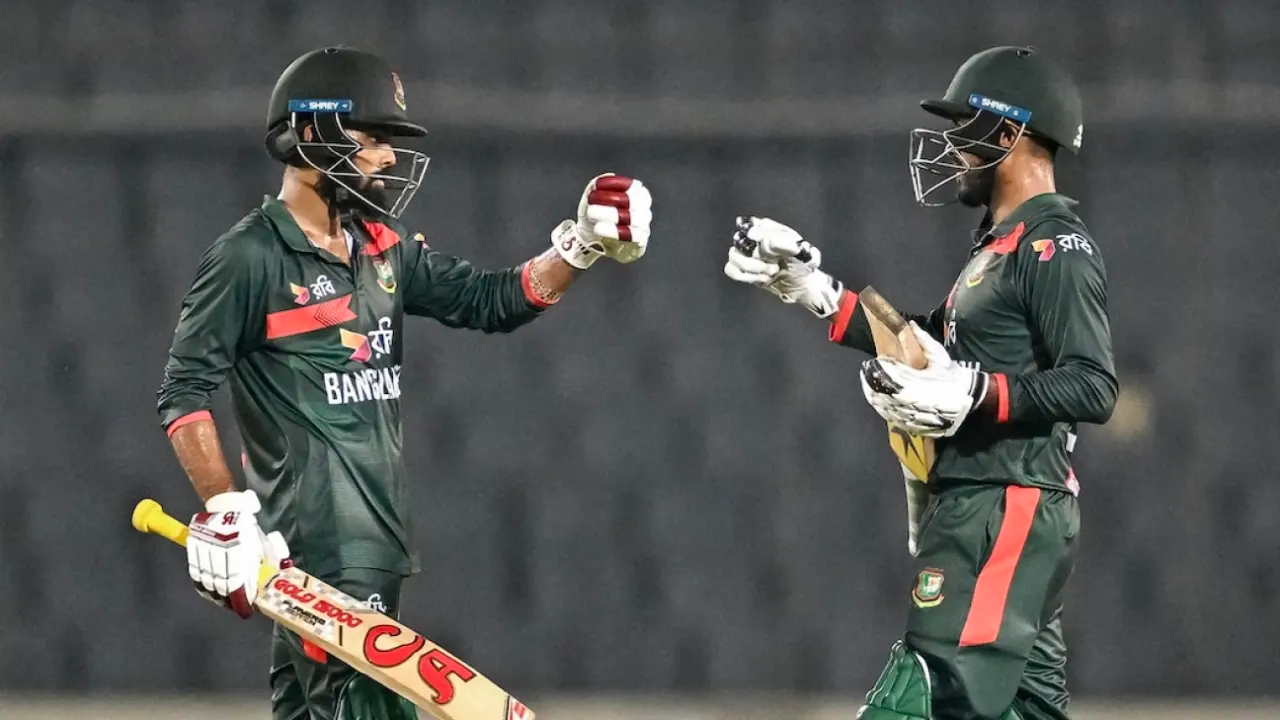
Bangladesh secured their first ODI series victory against Australia after they won the second ODI by five wickets in Dhaka, chasing down a rain-adjusted target of 192 having earlier removed the visitors’ first three wickets before they had scored a run.
Australia reached 187 for 8 in 42 overs when rain came, but had done well to reach that far becoming just the fourth team in ODI history to be 0 for 3. Taskin Ahmed and Mustafizur Rahman did the early damage and finished with three wickets each. Australia hung on through fifties from Marnus Labuschagne and Xavier Bartlett who rescued them with a 103-run seventh-wicket stand.
Buoyed by his maiden half-century, Bartlett bowled an inspired first over when play resumed. A big appeal off the first ball was followed by Tanzid Hasan giving a simple return catch. Bartlett then dropped Najmul Hossain Shanto off the fifth ball, although it was a tough chance, before the umpire raised the finger to an lbw appeal on the last ball but Shanto’s review saved him with the ball missing leg stump.
The recalled Soumya Sarkar got Bangladesh going with a lofted cover drive in the third over. He repeated the dose against Nathan Ellis in the next over then Shanto took consecutive boundaries off Bartlett in the fifth over.
Three more boundaries followed in as many overs, including Soumya hoisting Ellis over square leg for a six. Shanto survived a half chance on 21 when Labuschagne dropped a tough opportunity at short midwicket. Soumya then went after Adam Zampa, climbing into a high six over long-on.
It was the part-timer Matt Renshaw who got Australia the much-needed breakthrough in the 16th over. Soumya’s reverse paddle was poorly executed and he gave Bartlett a simple catch at slip. Shanto followed soon after, caught behind off Riley Meredith, who was returning to the ODI side after five years.
Cameron Green made a further blow when he removed Litton Das with a snorter that took the glove after a brisk 21. Mosaddek Hossain, Bangladesh’s batting hero from the first game, played his shots from the start before giving Cooper Connolly a simple catch at long-off.
At 144 for 5, with a only the bowlers to come, the game was not quite closed out. However, captain Mehidy Hasan Miraz withstood a blow to the side of the head to help Towhid Hridoy in the remaining part of the chase. The game ended up finishing in a rush as Hridoy hooked Meredith for a six followed by a pulled boundary then Mehidy sealed victory with another hook that cleared the boundary.
The opening exchanges of the match were remarkable. Taskin set off one of the most extraordinary starts seen in Bangladesh when he clean bowled Matthew Short for the second consecutive innings, this time the batter leaving the ball from a good length. It meant Short had fallen for a duck three innings in a row, starting from the third ODI against Pakistan in Lahore.
Connolly followed in the next over when he fell first ball to Mustafizur. The delivery was going slightly away from the left-handed Connolly who provided the thin edge. Renshaw fell in a similar way at the end of the same over, and Australia hadn’t opened their scoring.
They were reduced to 25 for 4 in the eighth over when Mustafizur got Alex Carey to drive one uppishly at point, where Shanto took the simple catch. Mustafizur picked up three wickets in the powerplay for only the second time in his ODI career.
Captain Josh Inglis tried to salvage the situation, striking five boundaries including a beautiful square-cut six off the Nahid Rana. He timed the ball well during his 34 but left-arm spinner Tanvir Islam neutralised his threat when Inglis’ miscued inside-out shot found deep cover. Tanvir wasn’t done, removing Green with a caught-and-bowled dismissal in the 22nd over.
Australia’s resistance came in the form of a seventh-wicket stand between Labuschagne and Bartlett. Labuschagne, who had been moved down to No. 7 and should have been run out on 1, struck three fours in his unbeaten 55 off 85 balls. It was just his second ODI fifty since the 2023 World Cup final.
Bartlett, who walked in at 81 for 6, was the aggressor and struck six boundaries including two huge sixes over midwicket in his 52 off 48 balls.
Taskin broke the partnership in the 41st over, cleaning up Bartlett with an in-ducker. Next ball he bowled a big off-cutter to fox Zampa. They were important blows because it meant the DLS target was more in Bangladesh’s favour after a two-and-a-half hour delay.
Brief scores:
Bangladesh 195 for 5 (Soumya Sarkar 42, Najmul Hosain Shanto 42, Towhid Hridoy 40*; Cameron Green 1-09) beat Australia 187 for 8 in 42 overs (Marnus Labuschagne 55*, Xavier Bartlett 52; Mustafizur Rahman 3-27, Taskin Ahmed 3-33, Tanvir Islam 2-45) by five wickets [DLS method]
[Cricinfo]

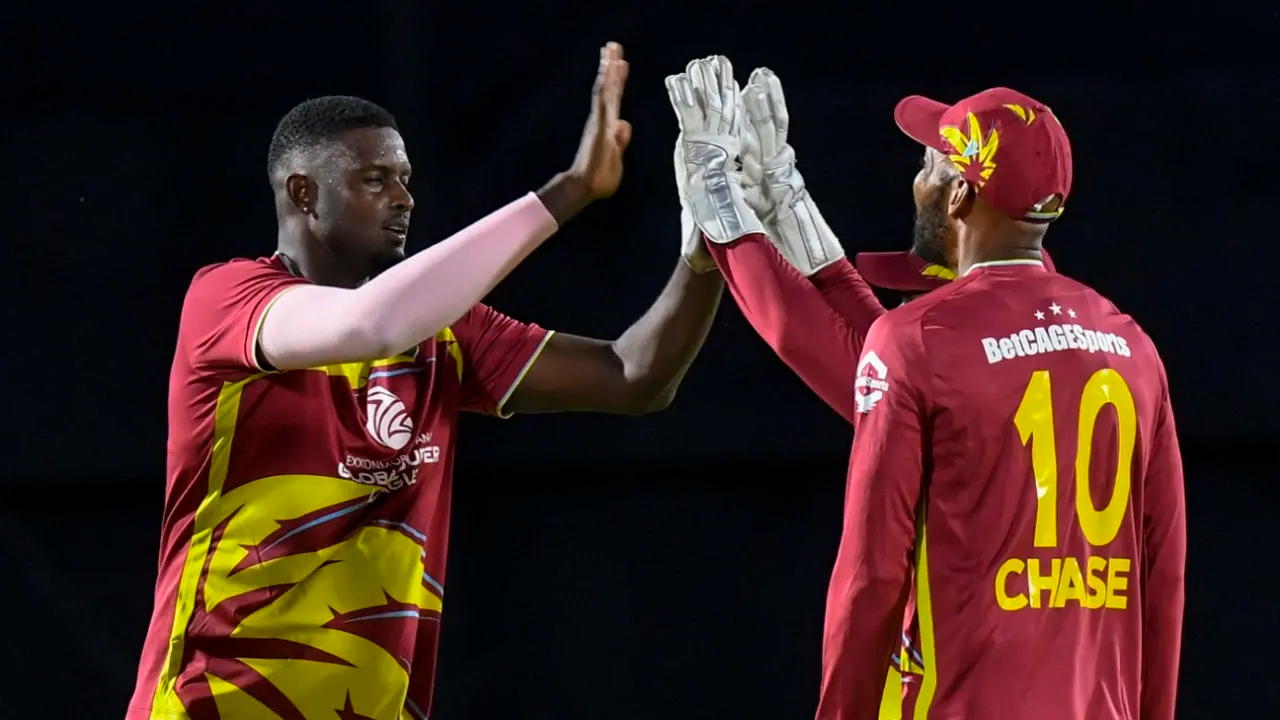
West Indies survived a spirited Sri Lankan defence in chase of a middling target of 148, as they eventually secured a final-over, but ultimately comfortable, seven-wicket victory in the first T20I at Sabina Park. The rain which had been forecast pleasantly stayed away, as a raucous home crowd finally got something to celebrate following the ODI washouts.
A flicked Rovman Powell six over deep midwicket off the expensive Dilshan Madushanka sealed the win, but it was one built on the patience of Shai Hope. The West Indian skipper made it a point to carry his bat through the innings in a 54-ball 65, as ensured there would be no hiccoughs come the crunch.
Hope was part of a rampant 39-ball opening stand of 67 with Brandon King, before shifting gears through the middle to string crucial partnerships of 28, 33 and 21*, with Shimron Hetmeyer, Roston Chase and Powell.
Sri Lanka’s bowlers toiled to drag the game deep in the second half of the chase, buffering a 66-run powerplay to take the game into the final over. Wanindu Hasaranga was the pick of the bowlers with figures of 2 for 32, while Eshan Malinga also impressed with 1 for 26. ‘
But on a wicket that wasn’t necessarily the most conducive to shot-making it was Sri Lanka’s batting that let them down. Kamindu Mendis waged a lone war for much of the innings during a 39-ball 51, and prior that Kusal Mendis had blitzed 36 off 23. But contributions aside from theirs was not nearly enough.
Jason Holder’s 3 for 18 was the catalyst for all the good West Indies managed with the ball, and it earned him a deserved Player of the Match award.
Generally when chasing a middling target on a sticky surface, a fast start in the powerplay when the ball is hard and fielders are in the ring is almost a prerequisite. And on that front the West Indian openers delivered.
The pair of Shai Hope and Brandon King struck 66 in an opening six-over salvo, as Sri Lanka were left ruing a host a missed opportunities – and King was at the centre of each of them.
The first was off Dushmantha Chameera, who rushed the right-hander with a short one that he could only miscue to midwicket. A third umpire no-ball check though offered a reprieve, much to the delight of the home crowd. The following free hit was a yorker squeezed to mid-on for a single that was never on, Sri Lanka again letting a chance slip by with a missed direct hit.
Then off the first ball of the very next over, Madushanka looked to have trapped King leg before, only for the decision to be overturned upon review for having pitched outside leg.
King made the most of his good fortune as he soon after found his timing, racing along to a 22-ball 37 before eventually been knocked over by a Hasaranga googly. Hope at the other end carried on at a similar click, managing 29 off 17 during the stand; he would crucially bat through to the latter stages to see the hosts home.
If West Indies’ start was belligerent, what followed certainly belied that. The 10 overs leading up to the death brought 54 runs and two wickets, as Sri Lanka clawed themselves back into proceedings. Such was West Indies’ early impact, it meant Sri Lanka were always underdogs but it crucially kept them in the game till the latter stages – when anything could happen.
Key to this was the Sri Lankan spin pairing of Maheesh Theekshana and Hasaranga. The latter was more expensive, giving away 32 in his four overs but picking up the wickets of King and Hetmyer. Theekshana meanwhile went wicketless but his four overs went for just 20 runs.
Ably assisting them was Malinga, carrying over his IPL form, mixing up his lengths and pace with a four over spell of 1 for 26. Chameera also responded well from the early tap he was on the receiving end of, landing some crucial yorkers in the death overs.
To put it into context, between the 10th and final over West Indies struck one six and two fours. It meant they need six off the final over. And Powell needed just two deliveries to ensure that very outcome.
Earlier, Kusal Mendis continued his rich vein of form with a with a 23-ball 36 to ensure a near 10-per-over powerplay for Sri Lanka. Twenty-six of those runs came in boundaries, including three sixes – two consecutively off Matthew Forde in a 17-run fourth over. That though would be Sri Lanka’s most profitable of the evening as a flurry of wickets to end the powerplay period reeled in the visitors just as they were looking to build a head of steam.
From 43 for no loss, Sri Lanka found themselves 56 for 3 at the end of the powerplay, and then 65 for 4 midway through the eighth over. A situation made considerably more perilous owing to the fact that their 6-5 combination meant a shorter batting lineup.
Following the sudden loss of their top order, including their in-form skipper, Kamindu and former skipper Dasun Shanaka had their work cut out for them. With only Hasaranga to come in the form of any sort of batting, wickets were at a premium and risks a minimum.
This was reflected in just the eight boundaries scored between the pair – including three sixes – in the eight overs they batted together. That they managed a run rate of 7.37 in this period was a credit to the pair’s running between the wickets. Even so Chase in particular proved hard to get away with his quick off breaks, as he snuck in 13 dots to the pair – pressure which eventually told in Shanaka slicing chase to backward point as he attempted to up the tempo.
That wicket was timely for the Windies, coming just as Sri Lanka would have been eyeing a death overs assault. It meant Hasaranga had little time to get his eye in, and he too would fall two overs later for an inconsequential 3 off 6.
Here the pressure on Kamindu mounted, and the West Indies also did well to starve the set batter of the strike for concerted periods, with him eventually dismissed in the final over looking to retain the strike on an ill-advised double.
Fresh off a run to the IPL final, Jason Holder once more proved his worth – particularly in the shortest format – as he read the conditions quickly and assertively to rein in Sri Lanka after a fast start. Introduced in the fifth over, he induced a miscue over short third first up from Pathum Nissanka, before following up with a well directed full inducker to knock over the dangerous Lankan opener.
Holder then set himself up for a hat-trick with a successful LBW review the very next delivery, to dismiss Lasith Croospulle who was playing just his second T20I. While the hat-trick was not forthcoming, Holder’s intervention had successfully shifted the momentum.
He would then return at the death to pick up his third as part of an outstanding two-run penultimate over, to end with figures 3 for 18. It meant that despite Kamindu and Shanaka’s best efforts at a mid-innings recovery, Sri Lanka were unable to land the finishing blows, managing just 25 for 4 in the death overs as the innings petered to a limp close.
Scores:
West Indies 149 for 3 in 19.2 overs (Brandon King 37, Shai Hope 65*, Shimron Hetmyer 17, Roston Chase 16, Rovman Powell 10*; Eshan Malinga 1-26, Wanidu Hasaranga 2-32) beat Sri Lanka 147 for 9 in 20 overs (Pathum Nissanka 18, Kusal Mendis 36, Kamindu Mendis 51, Dasun Shanaka 22; Jason Holder 3-18, Shamar Joseph 3-29, Roston Chase 1-18) by seven wickets
[Cricinfo]
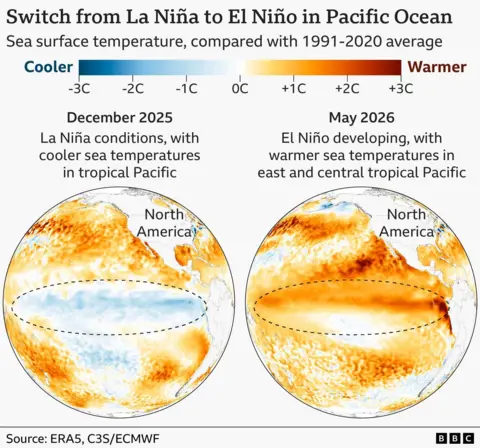
El Niño – the natural Pacific weather pattern that pushes up global temperatures – has officially begun, US scientists say.
The US National Oceanic and Atmospheric Administration (NOAA) has declared that El Niño conditions are now under way in the tropical Pacific, with sea surface temperatures having risen sharply in recent months.
Many forecasts suggest this could end up as a so-called “super” El Niño, and even be among the strongest ever recorded.
Coming on top of decades of human-caused warming, it could bring another record-hot year – most likely in 2027 – with disruption to weather, food supplies and economies running well into that year.
This announcement by NOAA is not a surprise as forecasters have expected this warming phase, after the cooler “sister” pattern, La Niña, ended earlier this year.
Sea surface temperatures in the central and tropical Pacific have now passed the 0.5C-above-average threshold that US scientists use to define an El Niño event.
“El Niño conditions developed over the past month, as shown by above-average sea surface temperatures (SSTs) across the central to eastern equatorial Pacific Ocean,” the agency said.
NOAA has also seen the winds above the equatorial Pacific begin to shift – a sign that the atmosphere is now responding to the warmer ocean, not just the ocean warming on its own.
What has surprised the researchers is how confident the computer models already are about its strength.
El Niño‘s intensity is measured by how far sea surface temperatures rise above average in a key zone of the Pacific.
A strong event is defined as more than 1.5C above average; a very strong one above 2C.
According to NOAA’s June outlook, “there is a 63% chance of a very strong El Niño during November-January, that would rank among the largest El Niño events in the historical record going back to 1950,” the agency said.
The three strongest events since then have been in 1982/83, 1997/98 and 2015/16.
Some of the latest US and European (ECMWF) models go further, showing temperatures in the tropical Pacific potentially climbing more than 3C above average by the end of the year.
But the US agency urged some caution on what their strength prediction implies.
“Even very strong El Niño events do not lead to the expected impact everywhere, but stronger events can more significantly tilt the odds in favour of expected outcomes.”
The bigger concern is that all this is happening on an already much hotter planet.
“We do need to worry about the impacts,” said Prof Adam Scaife, head of monthly to decadal prediction at the UK Met Office.
“The current El Niño is… riding on top of a substantial amount of global warming.
“This means that the actual temperatures in affected regions could well be unprecedented, as the warming from El Niño is being topped up by climate change.”
A very strong El Niño typically lifts global air temperatures by around 0.2C, releasing heat stored in the ocean into the atmosphere. That extra blast now lands on a world that is already setting records.
The year 2024 – the warmest on record – was boosted by an El Niño that was not even especially strong.
And despite the cooling drag of a La Niña event, 2025 still came in as the third warmest year on record, hotter even than the super El Niño year of 2016.
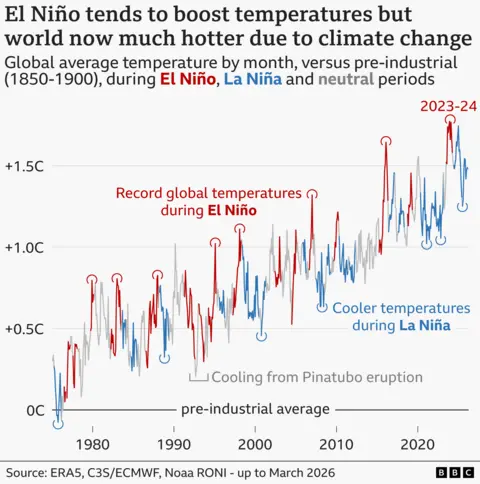
“At the end of this year and into 2027, we’re likely to see very high temperatures globally,” Prof Scaife said.
“In 2027, we’re likely to see excess heat on top of the global warming we’ve already got, and that could easily lead to another year above 1.5 degrees [of warming above late-19th-Century levels].”

No two El Niños are alike, but the disruption is felt most sharply in the tropics.
Flooding is common in northern Peru and southern Ecuador, and can reach parts of East Africa, Central Asia and the southern United States.
At the same time, the risk of drought and wildfire rises across much of Australia, Indonesia and northern South America – hitting agriculture and global food stocks.
El Niño also tends to suppress Atlantic hurricanes, and forecasters already expect a quieter-than-average season.
“While that sounds like a good thing, for Central America that leads to a lot less rainfall and potentially drought conditions,” said Liz Stephens, professor of climate risk and resilience at the University of Reading.
Even the UK feels it, if faintly: El Niño can tilt the odds towards a mild start and cold end to winter, though the links are loose.
For many, the forecast is far from abstract.
“An El Niño declaration is not just another weather forecast – for millions of people it is a deadly siren to be feared,” said Mohamed Adow, director of campaign group Power Shift Africa.
“It means failed rains, dying crops, rising food prices, and families pushed to the edge yet again. In East Africa especially, this will land on communities already battered by droughts and floods in recent years.”
Japan’s Meteorological Agency (JMA) takes a similar view to NOAA, judging that El Niño conditions are present. It adds it is all but certain to last into the autumn.
Not every agency is ready to call it, though. Australia’s Bureau of Meteorology (BoM) uses a stricter criterion, requiring sea surface temperatures to exceed 0.8C above average.
This week it said the tropical Pacific was “approaching El Niño conditions”, with central Pacific temperatures already crossing its thresholds, but it stopped short of formally declaring the event had begun.
It expects El Niño to develop later this year, and says it could be strong.
El Niño occurs every two to seven years and usually lasts about a year.
There is still no conclusive proof that climate change is making these events stronger or more frequent – but a warming world can supercharge their effects.
[BBC]

South Korea came from behind to defeat Czech Republic 2-1 as substitute Oh Hyeon-gyu scored the winning goal in the 80th minute of their World Cup opener.
Son Heung-min and company had dominated the game against the Czechs, who did not have a shot on target until their captain Ladislav Krejci rose to head home a long throw from Vladimir Coufal for the opening goal in the 59th minute.
Former Tottenham forward Son, captaining his nation, had attempted five of South Korea’s eight efforts in the first half, but his biggest chance was blocked by keeper Matej Kovar.
But Feyenoord defensive midfielder Hwang In-beom inspired South Korea’s fightback when he equalised only eight minutes after the Czech opener.
Found inside the box by the lively Lee Kang-in, Hwang deceived Kovar, who had rushed off his line, with a fake shot before scooping the ball over the Czech goalkeeper and into an unguarded goal to make it 1-1.
South Korea thought they had been undone by another Czech set-piece in the 78th minute as Tomas Soucek nodded home a free-kick from the left, but Hong Myung-bo’s side were handed a reprieve as the goal was ruled out for offside.
And their supporters at Estadio Guadalajara were soon celebrating as their side took the lead, with Besiktas forward Oh tapping home a cross from Hwang to complete the turnaround.
But the famous win was only sealed courtesy of keeper Kim Seung-gyu who produced a brilliant low stop to deny Adam Hlozek’s close-range effort in the 82nd minute and also from Michal Sadilek in the stoppage time.
It is the first time in four editions of the World Cup that South Korea have made a winning start to their campaign.
This is South Korea’s eighth all-time win at the FIFA World Cup and the fourth by a 2-1 scoreline. They conceded the opening goal in all four of those matches.
South Korea have lost only one of their last seven opening matches at the FIFA World Cup dating back to 2002 (W4 D2), a 1-0 defeat to Sweden to in 2018.
Son Heung-Min is the second player to appear in four different FIFA World Cups for South Korea (2014-2026), joining current manager Hong Myung-Bo (1990-2002).
Czech Republic will next face South Africa on Thursday, 18 June (17:00 BST) while South Korea take on World Cup co-hosts Mexico, on Friday, 19 June (02:00).
[BBC]

Holder, Joseph set up victory as West Indies go 1-0 up against Sri Lanka

El Niño under way and threatens weather extremes, scientists say

South Korea beat Czech Republic 2-1 in World Cup opener

Police investigate ‘8647’ written in grass on US national mall

Thai Princess Bajrakitiyabha dies after more than three years in coma

Trump says he has ‘cancelled’ strikes against Iran and talks up possible agreement

‘Dates have the highest sugar content to fight Coronavirus’

Sunday Island 27 December – Headlines

#SundayIsland 17th December – Headlines

Sunday Island – 28th March

Sunday Island Headlines – 21 March

Sunday Island – 21st February – Headlines
-
 News5 days ago
Women’s T20 World Cup 2026 warm-up: Chamari Athapaththu’s 94 helps Sri Lanka beat Pakistan
-

 News6 days ago
Asst. Manager, security officer arrested over Rs 30 mn snatch at Horana PB branch
-

 Editorial4 days ago
Probe Sallay’s complaint
-

 News5 days ago
Lankan-Canadian inducted to Toronto Sports Hall of Fame
-

 News2 days ago
Local firms move millions of dollars overseas for phantom imports: Govt.
-

 Editorial5 days ago
Prez in the dock
-

 Features5 days ago
Entering MIT for my Ph.D program, coping with harsh Boston winter and breasting the tape
-

 News6 days ago
No blanket ban on musical performances; only those promoting LTTE