
Sports
When Sanath nearly pulled off the impossible


The Asgiriya Anti-Climax
by Aravinthan Arunthavanathan
The picturesque Kandy has been home to many key moments in Sri Lanka-Australia rivalry. While Asgiriya played host to Sri Lanka’s first Test win over Australia, Pallekelle was home for a famous win in 2016 leading to a whitewash thereafter. While these two encounters grab the limelight, an epic duel between both nations in 2004 is often overlooked.
The Aussie side of 2004 was one of the greatest units in modern era. Later that year they would go on to conquer their final frontier in India as well. Given the strength of the visitors, the 2004 series was promising to be an enthralling encounter. However, the first Test in Galle saw the Sri Lankan fortress being bulldozed by the rampant Aussies.
On the back of the Galle mauling, when both teams faced off in Kandy, there was a lot at stake for the home team. A confident Ricky Ponting won the toss and elected to bat at Asgiriya. With Muttiah Muralitharan on the verge of 500 wickets all eyes were on the Sri Lankan bowling unit. The home side came to the party in grand style, courtesy of a resurgent Nuwan Zoysa and the ever-reliable Muralitharan supported by the consistent Chaminda Vass. The Australian line up was blown away for a meagre 120, their lowest against Sri Lanka. Muralitharan managed to grab the limelight by reaching his 500th wicket, clean bowling Michael Kasprowicz through the gate, a characteristic off spinner’s dismissal.
With a superlative bowling effort, the Sri Lankan morale was sky high. With the onus on the batsmen to drive home the advantage the Sri Lankan reply began. The response was jolted early as the Aussies breathed fire blowing away the Lankan line up in no time, leaving the tail fighting to salvage some respect. Vass came to the fore smacking an impressive unbeaten 68 aided surprisingly by Muralitharan, who scored 43 as if to celebrate his monumental achievement earlier in the Test. The Sri Lankans who looked not even good enough to post a lead at one stage with top seven wickets falling for less than 100, posted a 90-run lead thanks to Murali and Vass.
Sri Lanka managed to raise the expectations high by sending back the dangerous duo of Justin Langer and Mathew Hayden with the score not even reaching thirty. It was at this point that the aggressive instinct of Australians took over with Adam Gilchrist being promoted up the order. A rampant Gilchrist in the company of a classy Damien Martin employed the sweeps and drives to great effect, stitching a massive partnership putting Sri Lanka on the backfoot. The Australians notched up an impressive 442 setting Sri Lanka a 350 plus chase to create history.
At that time, the highest Sri Lanka had chased in the fourth innings was 326 against Zimbabwe six years prior. A chase of this magnitude was herculean given the prowess of the Australian line up. Two early wickets meant Sri Lankan expectations were diminishing fast. But there was a certain Sanath Jayasuriya who had other plans.
Jayasuriya had relinquished leadership in 2003 and was entering into a phase of his career where his contributions were under the scanner for the first time ever. Jayasuriya was having a lean patch and failures in the first three innings of the series were enough to raise speculations amongst skeptics. Like many times before Jayasuriya decided to answer the critics in style tearing into the strong Aussie line up.
Jayasuriya displayed his prowess on the offside partying with square cuts and drives scoring at a scintillating rate. Jayasuriya was specifically severe on Stuart McGill, heaving and lofting the leg breaks handsomely in the arc between long off and midwicket. With wickets falling at the other end Jayasuriya’s onslaught kept Sri Lanka in the hunt. Towards the end of day four Jaysuriya edged an attempted cut to Gilchrist severely impacting the Lankan chase. Following his exit rookie Tillakaratne Dilshan showed his promise scoring an impressive 43 leaving Sri Lanka in with a real chance.
As the final day began Vass and Kaushal Lokuarachchi, no mug with the bat at the crease the chase was a reality. Vass and Lokuarachchi scraped their way towards the target successfully bringing it down to under 40. With few edges going Lanka’s way the tide seemed to be turning towards, which could arguably have been Sri Lanka’s greatest Test win.
With expectations soaring, Vass tried to loft a classic Shane Warne leg break over the mid-wicket boundary only for the ball to land in the fielder’s hands. This saw the remaining wickets tumble in the hands of Warne’s mastery. Warne’s five wicket haul ensured there were no surprises, sealing a hard-fought victory which helped the visitors close off the series as well.
The Kandy Australia-Sri Lanka duel ended in disappointment but had its own share of highs. Australia went on to thrash Sri Lanka 3-0, but the series was far more closely contested than what the score line suggested. It was a series which witnessed highest quality of cricket with riveting battles. The Asgiriya duel stood out as one of the most intriguing encounters Sri Lanka has been part of. Especially given the strength of Australia at that time, not many teams managed to stretch that outfit, but Sri Lanka managed not only do so but almost topple the mighty Australians. For that reason the Asgiriya duel should be celebrated.

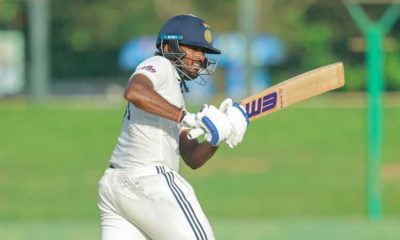





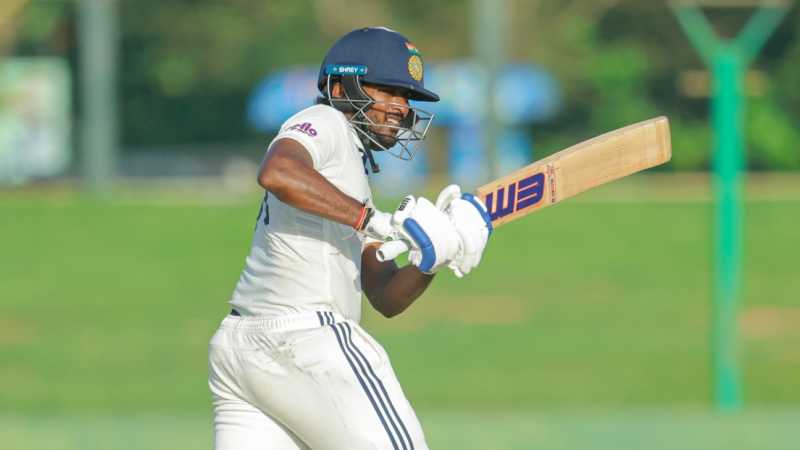
B Sai Sudarshan strengthened his case to retain the No.3 spot for the upcoming Test series in Sri Lanka, with his 168 for India A against Sri Lanka A in Galle. Sudharsan converted his overnight 104 not out into his career-best score for India A, helping his side stretch their lead to 175 by the end of the third day’s play. India A closed out the day on 541 for 8 in response to Sri Lanka A’s 366.
Devdutt Padikkal failed to add to his overnight 94 and Ruturaj Gaikwad retired hurt on 13, but India A zoomed ahead thanks to Sai Sudharsan, captain Dhruv Jurel (53), Shaik Rasheed (45) and Saransh Jain (68*).
Jurel’s innings was cut short when he was trapped lbw by left-arm spinner Dilum Sudeera, who also claimed the wicket of Sai Sudharsan. Allrounder Keshara Nuwantha, meanwhile, claimed the wickets of Padikkal and Shaik Rasheed, and Gurnoor Brar late in the day. Overall, he had figures of 4 for 158 in 50 overs.
Sri Lanka A toiled away, using as many as eight bowlers, but only Sudeera and Nuwantha were among the wickets until captain Sahan Arachchige struck late in the day.
India A’s bowling allrounders Saransh and Auqib Nabi (30) combined for an 81-run stand to take the visitors past 500.
Scores:
India A 541 for 8 in 142 overs (B Sai Sudharsan 168, Devdutt Padikkal 94, Druv Jurel 53, Saransh Jain 68*, Shaik Rasheed 45; Keshara Nuwantha 4-158, Dilum Sudeera 3-101) lead Sri Lanka A 366 in 110 overs (Sahan Arachchige 127; Gurnoor Brar 4-77, Saransh Jain 4-92) by 175 runs
(Cricinfo)
Vaobhav Sooriyavanshi at just 15 years and 99 days, has become the second youngest cricketer to play for a Full Member men’s team*, making his debut against England in Manchester. He enters a list of other precocious talents who had burst on to – and sometimes, gone away – from the international stage in their teenage years.
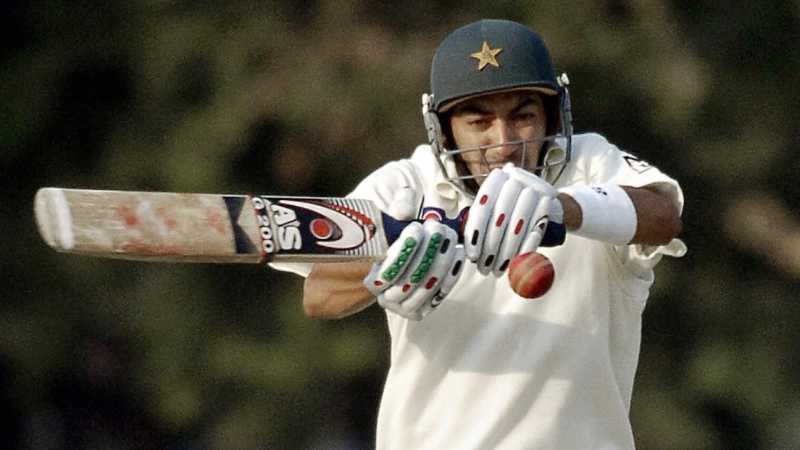
Hasan Raza (Pakistan), 14y 227d
Hasan Raza was a wonderful timer of the ball. He took the field against Zimbabwe before turning 15 in October 1996, and batted once, scoring 27 off 48 deliveries from No. 5.
Doubts, however, later emerged about his age, and the PCB withdrew the claim that Raza was the youngest men’s Test debutant in the history of the game.
Whether he was 14, or 15 as some claimed, he showed tenacity at the international stage but without the results. He played just one more Test before the turn of the century, and then was dropped from the side. A recall in 2002 resulted in his only two Test fifties, against Australia – slow knocks of 54* and 68. However, he never quite found the same success as he did in first-class cricket, where he scored 13,949 runs in a 20-year career.

Jhon Arias scored the only goal as Colombia beat Ghana 1-0 in sweltering conditions in Kansas City on Friday to reach the World Cup round of 16, continuing a quietly impressive campaign that has established them as dangerous outsiders.
Arias struck in the 14th minute, guiding home a cross from substitute Luis Suarez, and Colombia’s disciplined defence did the rest as Nestor Lorenzo’s side extended their unbeaten run and booked a meeting with Switzerland in the next round.
Colombia had largely flown under the radar at the tournament, despite going undefeated against Portugal, Uzbekistan and DR Congo to top Group K.

Their breakthrough on Friday came from two players who had not been expected to combine, as Suarez, thrust into action after Jhon Cordoba was forced off with an apparent groin injury in the eighth minute, delivered a pinpoint cross to the back post where Arias had somehow drifted unmarked.
With time and space to pick his spot, Arias calmly guided the ball into the bottom corner to hand his side a deserved lead.
The stadium felt more like Barranquilla than Kansas City as tens of thousands of Colombia supporters turned the clash with Ghana – a team ranked 60 places behind them – into a de facto home game, giving the South Americans a level of support rarely seen so far from home.

The stands were a writhing, dancing sea of yellow jerseys, twirling scarves and black-and-white sombrero vueltiao hats, that many used to fan their faces in the oppressive 30-degree Celsius (86-degree Fahrenheit) heat.
They bounced in unison, roared their team forward with every attack, and regularly broke into chants of “Vamos Colombia! Esta noche tenemos que ganar!” (Spanish for ‘Let’s go Colombia, tonight we have to win!’).
They need not have worried. Colombia were the better team by some distance.
Luis Diaz had numerous scoring chances. He fired into the side netting in the first half, then celebrated what he thought was the game’s second goal early in the second half when he slotted home Arias’s cross, but it was disallowed for offside.
Lorenzo’s men continued to push for a second goal, and Ghana goalkeeper Lawrence Ati-Zigi, who was excellent all night, made one terrific save after another in the dying minutes as Colombia’s fans cheered every one of their team’s touches of the ball.

Antoine Semenyo was Ghana’s biggest attacking threat, yet Colombia’s disciplined defence denied him a clear sight of goal.
Colombia became the fourth South American team to reach the last 16, joining surprise package Paraguay, who stunned Germany, along with Brazil and Argentina, both of whom survived scares of their own.
Colombia – whose best finish was reaching the quarterfinals in 2014 – play the Swiss on Tuesday in Vancouver.
[Aljazeera]

India A grow lead after Sai Sudharsan hits 168

Boys among men – Sooryavanshi joins Tendulkar, Aaqib and Hasan Raza

Brutal heat cancels Fourth of July events, from DC to Philadelphia

Arias sends Colombia into World Cup last-16 with 1-0 win over Ghana

Messi scores again but Argentina given World Cup upset fright by Cape Verde

Anguished families left to identify Venezuela quake victims at makeshift morgue

‘Dates have the highest sugar content to fight Coronavirus’

Sunday Island 27 December – Headlines

#SundayIsland 17th December – Headlines

Sunday Island – 28th March

Sunday Island Headlines – 21 March

Sunday Island – 21st February – Headlines
-

 News6 days ago
LAWASIA warns against ad hoc initiative to increase judges’ retirement ages
-

 Features5 days ago
Climate action to bring South Asia together
-

 News5 days ago
Chamuditha to seek removal of injunction on Youtube programme
-

 News21 hours ago
Freedom 250: US Embassy celebrates America’s 250th Independence Day through magic of American cinema
-

 Features7 days ago
People’s Bank expands digital banking network with 125th cheque deposit kiosk
-

 News2 days ago
CIABOC to question Harak Kata on Rs. 200 mn bribery allegation
-

 News2 days ago
SLAF conducts successful rescue mission under UN command in Central African Republic
-

 Midweek Review4 days ago
H’tota port’s strategic status remains focal point of geopolitical scrutiny