
Business
How Online Shoppers Navigate Labels

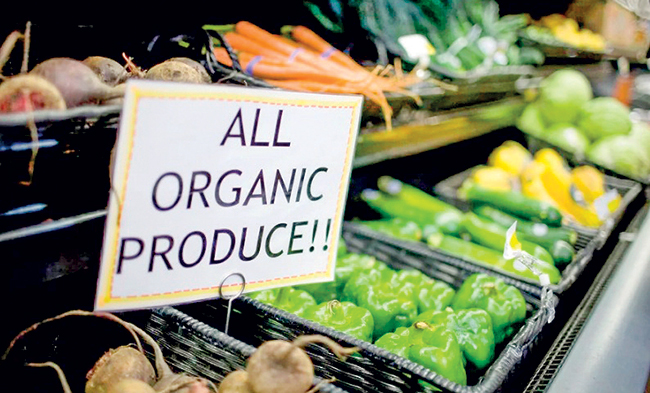
Online food retail has changed how trust is built. When customers browse your digital shelves, they are no longer holding a package, reading fine print or inspecting seals in person. Instead, their decisions hinge on small on-screen signals, badges like “Organic,” “Non-GMO,” “Fair Trade.” These labels now act as silent salespeople, influencing whether a product is added to the cart or quietly skipped.
For a growing segment of online shoppers, particularly younger, digitally fluent consumers, these badges are not decorative. They are decision shortcuts. But they are also increasingly questioned. Is the claim credible? Is it verified? Is it meaningful or simply marketing language? When shoppers cannot physically examine packaging, uncertainty creeps in and skepticism grows.
Recent findings from a comprehensive survey conducted by the TilliT team reveal a critical tension for online food retailers. TilliT is a digital platform that has been using AI and Blockchain for end-to-end tracking of global supply chains and the survey covered over 1,000 consumers representing diverse demographics and included both an online questionnaire and in-person meetings to ensure depth and representation.
The results show that while digital grocery delivers speed and convenience, it also introduces a trust gap. Today’s shoppers are informed, value-driven and actively seeking alignment with health, ethical and dietary priorities. Yet too often, the digital shelf fails to communicate credibility clearly. This is no longer just a branding challenge; it is a trust problem. And in e-commerce, trust is what turns product views into purchases.
The digital grocery cart is being pushed most frequently by younger adults. Our survey data shows a clear concentration of shoppers in the 18-34 age range, with significant activity among those aged 18-24 and 25-34.
Their shopping frequency varies, some are weekly devotees to delivery apps, while others shop online for food a few times a month or only occasionally. When it comes to their spending philosophy, the majority are pragmatic balancers, seeking a sweet spot between price and quality. However, a meaningful and growing segment, often driven by health, ethical or dietary needs, is explicitly willing to pay more for higher quality or for products bearing labels they trust. This signals a market where value is increasingly defined by transparency and credibility, not just the lowest price.
Here’s a curious finding: some online shoppers admit they usually don’t even notice certification badges while browsing. The digital interface, with its rapid scrolling and visual noise, can make these small icons easy to miss. But for those who do look, these badges become powerful signals. The most frequently noticed and sought-after labels include Organic, Sugar-free/Low sugar, Gluten-free, Vegan/Vegetarian and Non-GMO, followed by Halal and Fair Trade. Crucially, when a shopper’s eye does land on a relevant badge, its importance skyrockets.
Most rate these certifications as ‘very’ or ‘somewhat’ important in their final purchase decision. An Organic badge isn’t just decoration for a health-conscious millennial; it’s a key filter in their search for authenticity.
Don’t mistake notice for naivety. Online shoppers approach these badges with a healthy dose of caution. When asked about their level if trust, responses paint a picture of a skeptical yet hopeful audience. The most common sentiments are ‘I mostly trust it’ and the telling ‘I am not sure.’ Far fewer express full, unwavering trust. This ‘trust gap’ is the central challenge for brands and retailers. Shoppers want to believe the claims, but the digital environment, where anyone can slap a ‘natural’ icon on a product image, breeds uncertainty. This is especially true for claims related to sustainability or ethical sourcing, where verification feels more abstract than checking for gluten.
This is where the solution becomes crystal clear. Shoppers are practically begging for proof. A strong majority find a ‘Verified by an independent system’ mark, accompanied by a clickable link to view the actual certificate, to be ‘very’ or ‘extremely’ valuable. This isn’t a nice-to-have; it’s a powerful trust-builder. The data is striking: when presented with detailed certificate information (who issued it, its validity dates, what it actually means), most respondents said it would make them ‘much more likely’ to buy the product.
In a world of vague claims, verifiable, third-party validation is the antidote to doubt. It transforms a badge from a marketing symbol into a credible credential.
So, what should that click reveal? Shoppers have spoken and their priorities are pragmatic. Above all, they want a simple explanation in everyday language. Jargon and technical terms create barriers. Following that, they want to know the issuing organization’s name, is it a reputable certifier? Validity dates are critical; is this certification current? Shoppers also want clarity on scope: which specific products or ingredients does this certificate cover? Knowing the country of issuance is also a common request, adding another layer of context. This checklist is a blueprint for digital transparency: keep it simple, show the source, prove it’s current and define the scope.
Given this hunger for verification, the business implication is straightforward. When presented with a choice between two online shops selling the same product, one that clearly verifies and explains its certification badges and one that does not, respondents showed a very strong preference for the verified shop. They are ‘very likely’ or ‘somewhat likely’ to choose the platform that offers transparency. This isn’t a minor tilt in preference; it’s a significant competitive advantage. In the battle for the digital grocery basket, the retailer that invests in making labels trustworthy isn’t just building consumer confidence; it’s driving conversion and loyalty.
While the demand for verification is high, baseline understanding of common labels varies. Shoppers tend to be very familiar with terms like Organic, Vegan and Gluten-free, labels often tied to immediate personal health or dietary choices. However, familiarity drops noticeably for other important certifications like Non-GMO, Fair Trade or specific allergen-free claims. This ‘familiarity gap’ presents an opportunity. It’s not enough to just verify a Fair-Trade badge; brands and retailers can also play an educational role by explaining, in that simple language shoppers crave, what that certification means for workers and communities. Transparency paired with education is a powerful combination.
The journey from a digital storefront to a delivered grocery bag is paved with questions. The findings are a clear signal to the food and retail industry: the era of passive, decorative badges is over. Today’s online shopper, particularly the younger, value-driven consumer, is a detective. They are looking for clues, verifying sources and making informed choices aligned with complex personal values. The brands and platforms that will thrive are those that recognize this shift. They will move beyond simply displaying labels to actively validating them, explaining them in human terms and building a bridge of trust that turns cautious scrolling into confident clicking.
In the end, the most important ingredient in the future of online food shopping won’t be listed on the label, it will be the transparency that proves the label is true.
by a special correspondent



By Sanath Nanayakkare
On the surface, the 41st Board Meeting of the India-Sri Lanka Foundation (ISLF) in New Delhi on August 28, 2026, was structured as a routine diplomatic engagement. Co-chaired by Indian High Commissioner Santosh Jha and Sri Lankan High Commissioner Mahishini Colonne, the session formally approved a standard slate of cultural and educational projects.
However, looking closer at the broader macroeconomic and geopolitical landscape, the meeting underscored a much deeper structural alignment between the two nations. Against a backdrop of ongoing economic recovery, bilateral discussions increasingly touch upon critical areas of regional integration, investment, and infrastructure.
Among the key areas attracting attention are post-civil war reconciliation efforts and administrative milestones in the Northern Province.
Discussions in diplomatic circles continue to focus on the progressive release of state-held lands back to civilian inhabitants, alongside the anticipated finalization of provincial council elections to support local governance frameworks.
In the economic sphere, commercial integration remains a central theme as Sri Lanka stabilizes its foreign exchange reserves.
Recent financial dialogues in Colombo were seen exploring mechanisms such as transacting in Indian Rupees (INR), aligning with wider regional efforts to facilitate bilateral trade settlements and mitigate foreign currency pressures. Financial institutions, including the State Bank of India, continue to support these bilateral trade facilitation mechanisms.
Cooperation in the energy sector is also progressing through key joint ventures aimed at harnessing renewable resources. Proposals such as the 200MW solar power project in Sampur, developed via a partnership between NTPC and the Ceylon Electricity Board, highlight ongoing efforts to diversify national power generation. Discussions concerning cross-border grid interconnections further reflect strategies to enhance regional energy security and optimize renewable capacity.
At the same time, ongoing reviews of project tariffs – such as those involving renewable initiatives by firms like Adani Green Energy – demonstrate the government’s focus on balancing capital investments with domestic economic interests.
As the ISLF marks decades of supporting bilateral cultural exchanges through hundreds of initiatives, the overarching partnership between New Delhi and Colombo continues to evolve. Navigating these complex frameworks of trade, energy, and development remains essential as Sri Lanka charts its economic future within the South Asian region.

Sysco LABS, the Global Innovation Center of Sysco, has been named one of Sri Lanka’s Most Outstanding Women-Friendly Workplaces at the Women-Friendly Workplace Awards 2026, marking its highest recognition at the awards to date.
The recognition represents an important milestone in Sysco LABS’ ongoing journey to build a workplace where women are supported not only to enter and participate in the technology industry, but to develop, progress and build meaningful long-term careers.
Held recently, the 2026 awards organized by Satynmag continued a six-year journey of recognizing and encouraging organizations to move beyond intention towards meaningful and measurable progress for women at work. This year’s awards placed particular emphasis on a defining question for women-friendly workplaces: beyond representation, how far are women able to go?
This win also reflects a progression in the company’s recognition journey at the Women Friendly Workplaces Awards. Following an “Honorable Mention” in the 2023 edition of the ceremony while winning a special award for “Best Women in STEM Project” in 2025, 2026 marks the first time Sysco LABS has been recognized as one of Sri Lanka’s Most Outstanding Women-Friendly Workplaces.
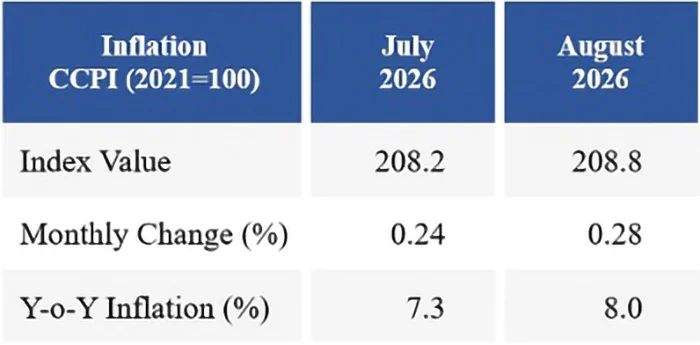
The Colombo Consumer Price Index (CCPI, 2021=100) based headline inflation (year-on-year, Y-o-Y) increased to 8.0% in August 2026 from 7.3% in July 2026, primarily due to the statistical base effect in food inflation. Meanwhile, food inflation (Y-o-Y) increased to 8.5% in August 2026 from 6.3% in July 2026, contributing mainly to the increase in headline inflation, while non-food inflation (Y-o-Y) decelerated to 7.7% in August 2026 from 7.8% in July 2026.
On a month-on-month basis, the CCPI increased by 0.28% in August 2026. This increase was mainly driven by the food category, which contributed 0.20 percentage point, largely owing to the increase in prices of Milk Powder, while the non-food category contributed a marginal 0.07 percentage point.
Meanwhile, core inflation (Y-o-Y) accelerated to 5.1% in August 2026 from 4.4% in July 2026.
According to the inflation projections made at the monetary policy round in July 2026, headline inflation is expected to remain above the target of 5% in the near term, before easing and stabilising around the target over the medium term, supported by appropriate policy measures. These projections are conditional, among other assumptions, on the expectation that the effects of the tensions in the Middle East and their spillovers will be temporary and gradually dissipate.

Showers will occur in the Western and Sabaragamuwa provinces and in Galle, Matara, Kandy and Nuwara-Eliya districts

Sun directly overhead Anamaduwa, Moragollagama, Dambulla, Manampitiya and Valaichchenai, at about 12.10 noon today (02)

SC rejects petitioners’ request for full bench

Seven years RI for former Civil Aviation Minister Piyankara Jayaratne

40 professional organisations and TU oppose proposed 22A

Ai-CHA expands Lankan footprint with new Negombo outlet

‘Dates have the highest sugar content to fight Coronavirus’

Sunday Island 27 December – Headlines

#SundayIsland 17th December – Headlines

Sunday Island – 28th March

Sunday Island Headlines – 21 March

Sunday Island – 21st February – Headlines
-

 News5 days ago
Eight politicians in drug kingpin probe
-

 Features3 days ago
“Wrap Me Up in My Blazer”— A Gentlemanly Bradby Reminiscence
-

 Business5 days ago
Sri Lanka opens up: A new season of direct connectivity
-

 Features5 days ago
Redefining ageing in Sri Lanka
-

 Latest News6 days ago
Nepal-Tibet floods: What happened, what caused them and who is missing?
-

 Editorial6 days ago
Unfolding El Niño and burning issues
-

 Foreign News7 days ago
At least eight killed, hundreds missing after Nepal flash flood
-
 Latest News7 days ago
Advisory for High Waves for the sea areas extending from Colombo to Pottuvil via Galle, Matara and Hambantota