
Opinion
Contrasting Strategy – Aggression vs support


China has invested more than USD 60 Billion in Venezuela and plans to invest further in that country. This is happening despite the abduction by the US of Venezuela’s president Maduro and his wife and US President Donald Trump’s boastful claim that he will be selling Venezuela’s oil. And what is even more surprising is that the Venezuelan Ambassador to China says nobody but Venezuela will decide the price of its oil and to whom it sells. He has assured that Chinese investments in his country will be safe and secure.
According to media reports, Venezuelan Ambassador to China, Remigio Ceballos, has stated that Venezuela will determine the price of its oil exports to China independently, asserting that prices will follow international market trends rather than dictates by the United States. Ceballos has stated that Caracas “will not heed the arrangements of the US or other countries” on oil pricing. The remarks followed reports that the U.S. is planning to exercise control over Venezuela’s state-run oil company, PDVSA, and potentially push prices down to $50 per barrel. Ceballos sought to reassure China that its investments in the South American country remained secure, emphasising that China and Venezuela are “trusted partners”. The ambassador clarified that despite geopolitical tensions, Venezuela would not follow Washington-led pricing structures, ensuring its oil remains competitive. These statements came in response to intense geopolitical maneuvering in early 2026 regarding Venezuela’s oil sector and its ongoing energy relationship with China (CNBC, 4th Feb. 2026).
Failure of agression
These developments reveal the failure of aggression in the face of support and cooperation. The US imposed crippling sanctions on Venezuela while China helped it to survive. Finally, true to form, the US did what it does best, take out the leader, like it did in Iraq, Libya and several other countries. Nowhere has this strategy succeeded, whereas the Chinese Belt and Road Initiative has been welcomed in most countries in Asia, Africa and the Middle East. China provides leadership in several key international associations and organisations designed to foster, or in some cases offer alternatives to, the existing global order. Key groupings include the Shanghai Cooperation Organization (SCO), BRICS, and the Asian Infrastructure Investment Bank (AIIB), alongside specialised UN agencies and regional forums like the Forum on China-Africa Cooperation (FOCAC). In contrast most of the US led organizations such as NATO, QUAD, AUKUS, are military alliances. Further, the US has defence agreements with several countries which are strategically vital for its interests, in the Middle East, Africa, Americas and Asia. China does not have a formal alliance requiring it to fight for another country. China adopts an anti-alliance policy and officially opposes NATO-like military alliances, arguing they create “small cliques” that cause confrontations in the region. China focuses on strategic partnerships rather than formal blocs, treating various countries as partners to avoid the confrontational nature of alliances.
With regards to aid, while the US focuses on capacity building China seems to believe that infrastructure development is more beneficial and would help the recipient country to develop its economy and be independent. Sri Lanka has experience with these US capacity building programmes and know that they are more often aimed at influencing the participants to change their political orientation and to be aligned with Western socio-political ideology. It is said that these programmes may have helped the US to bring about a regime change in the country. In Cambodia, too, the US has conducted capacity building programmes which the discerning Cambodians are suspicious of. China is the largest source of Foreign Direct Investment and top trading partner for Cambodia, with investment totaling over $23 billion by mid-2024, heavily focused on manufacturing, infrastructure, and real estate. Key projects under the Belt and Road Initiative include highways, hydroelectric dams, special economic zones, and the $1.7 billion Funan Techo Canal.
Bid to counter Chinese influence
The US attempts to counter the burgeoning advances of China by use of force. The abduction of President Maduro of Venezuela, the country with the largest oil deposits and increasingly coming under the influence of China, was its diabolical response. This criminal act shows the poverty of the US strategy. What it could do instead is develop cordial relations and respect the rights these countries must have in deciding on their socio-political structures and help them to come out of poverty without bullying and exploiting their resources. If that had been their policy no other country would have an opportunity to get a foothold in their backyard.
Iran joined the BRICS and was in the process of mending its fences with Saudi Arabia, a staunch ally of the US, with Chinese mediation. Saudi Arabia was also joining the BRICS, which is not well-disposed towards the US. China was planing to invest heavily in Iran. China and Iran signed a 25-year, $400 billion strategic cooperation agreement in 2021, aiming to boost energy and infrastructure.. The US and its ally in the Middle East, Israel, could not silently watch those developments that they saw as a threat to their hegemony and dominance in the region. The US felt the need to thwart the Chinese advance and also the growth of BRICS while Israel saw it as an opportunity to wipe out the opposition to its master plan of total genocide of Palestinians and grabbing their ancestral land in whole.
After killing Iranian supreme leader and bombarding the country into what they thought was submission, Trump said he must have a say in the appointment of the next leader and also that Ayatollah’s son was not acceptable to him. He demanded unconditional surrender of Iran and said there probably would not be anybody in Iran even to declare a surrender. Iran has not only said it will never surrender but also gone ahead and appointed the murdered supreme leader’s son as his successor. Trump said the Iranian navy was gone, its air force was gone, missile stockpiles were gone and it was already defeated. But Iran miraculously continues to fire missiles at Israel and US bases in the neighbouring countries.
Iran probably will be defeated in the war, but whether the US and Israel will achieve their goals is most unlikely. The underlying reason for this conflict is the problem of Palestine. The two-state solution adopted by the UN could be the basis for peace. The US knows this but it does not want peace in the Middle East. It can exploit the oil resources in the region by keeping it under eternal turmoil. This policy perfectly suits Israel as well and it exploits the situation to commit genocide of the Palestinians and grab their land.
In this era of multipolarity with several countries possessing long range missiles and nuclear capability and several of those countries being not in friendly terms with either US or Israel, re-arming, re-grouping and re-emerging of forces that will continue the anti-imperialist, anti-expansionist struggle cannot be prevented.
If only US, Europe emulate China
If the US and also the influential Europe could see how beneficial the policy adopted by China could be to everybody living on this planet, there would be peace in the world. This is what the Chinese have been telling the West while it engages in confrontation and aggression against those who do not fall in line and abide by their dictate. Chinese have shown their readiness to help everybody without discrimination, whether foe or friend of the US. China has significantly increased its investment in Saudi Arabia and other US allies in the Middle East, with 2024 seeing a record high in BRI (Belt and Road Initiative) engagement—reaching $39 billion in construction contracts and investments in the region. Saudi Arabia has emerged as the top recipient of Chinese investment, with over 93 projects initiated since 2021 despite it being one of the staunchest allies of the US in the Middle East with a large US military presence. The US has its largest military base in the Middle East in Qatar. Yet China has heavily invested in Qatar, primarily focusing on energy, infrastructure, and financial sectors. Major investments include Sinopec and CNPC securing stakes in Qatar’s North Field East LNG expansion projects, as well as significant participation in infrastructure projects like the Hamad Port and Lusail Stadium.
Vietnam, a victim of US aggression, has recently signed a defence cooperation agreement with it. Yet China has invested heavily in Vietnam, becoming a top source of foreign direct investment and leading in new projects as of 2025–2026. Chinese firms are investing billions in high-tech, electronics, and manufacturing in Vietnam, with over $6.7 billion pledged between January and November 2025.
Based on reports from international human rights organisations, the U.S. Department of State, and various news analyses, Saudi Arabia is widely considered a highly repressive, authoritarian country with intensified crackdown on political dissent, freedom of expression, and human rights activists. In 2016, the kingdom executed 146 people, including a mass execution of 47 men on January 2. The US says it’s attacking Iran because it is repressive, but in truth it is doing so because Iran does not toe its line, Saudi Arabia does and goes scot-free.
All in all, in this imperfect world what everybody must do is help each other disregarding their imperfections. If the US and also Europe try to emulate China, the world, in the least, would be safer.
(Some information contained in this article is from Wikipedia.)
by N. A. de S. Amaratunga



After nearly 77 years of wildlife conservation, Sri Lanka must strengthen the institutions, professional leadership and political will needed to safeguard its natural heritage for generations to come.
By Dilum Alagiyawanna
Sri Lanka has a long and proud history of protecting its natural heritage. Generations of wildlife officers, forest officers, scientists, researchers, field staff and conservationists have worked, often under difficult circumstances, to protect our forests, wildlife and ecosystems. Their contribution deserves recognition and respect.
One important milestone in this journey came in October 1949, when the Wildlife department was established as a separate institution, following the Fauna and Flora Protection Ordinance of 1937 and the expansion of the country’s wildlife reserves. The creation of a dedicated department reflected an important recognition of the time: wildlife conservation required specialised institutional attention.
Today, nearly 77 years after its establishment, Sri Lanka has an opportunity not simply to reflect on that institutional journey, but to consider what kind of institutions and leadership we need for the next 75 years.
This is not an argument about the individuals currently holding positions in our conservation institutions. Nor is it intended to question the commitment, professionalism or sacrifices of the many public servants who have served these institutions over the years.
It is a broader institutional question.
What kind of leadership does Sri Lanka need to protect its natural heritage in the 21st century?
The issue is not who occupies a particular position today. It is whether our system of identifying, developing and appointing leaders is designed to meet the conservation challenges of tomorrow
A Changing conservation landscape
When many of our major conservation institutions were established, the principal challenges were relatively straightforward: establish protected areas, prevent poaching, enforce wildlife legislation and protect forests and wildlife from direct exploitation.
Those responsibilities remain fundamental.
But conservation today is considerably more complex.
Habitat fragmentation, expanding infrastructure, human-elephant conflict, climate change, invasive species, pollution, wildlife disease, road mortality, unplanned tourism and competing demands for land and water are placing increasing pressures on ecosystems.
Conservation can no longer be treated as an isolated environmental concern.
A highway can fragment a wildlife habitat. An irrigation project can alter an ecosystem. Poorly planned tourism can degrade a protected landscape. Agricultural expansion can affect wildlife movement. Climate change can alter species distributions, water availability and ecosystem resilience.
Conservation therefore intersects with agriculture, irrigation, energy, transport, tourism, disaster management, climate policy, land-use planning and national economic development.
It has become a multidisciplinary national policy challenge.
Beyond administration: What conservation leadership requires
There is nothing inherently wrong with a career public service.
Sri Lanka needs a professional, impartial and experienced public administration. Administrative knowledge, institutional memory and an understanding of government procedures are indispensable to the functioning of the State.
The question is whether administrative experience and seniority alone should be the principal criteria for leading institutions entrusted with complex living ecosystems and irreplaceable natural capital.
I believe they should not.
Leadership of major natural-resource institutions should combine administrative competence with scientific and technical understanding, field experience, strategic thinking, integrity, sound judgement and a demonstrated commitment to conservation outcomes.
This is not an argument for automatically replacing administrators with scientists. Nor is personal passion for nature, by itself, sufficient.
What Sri Lanka needs is mission-driven professional leadership.
A person leading a conservation institution should understand not only how to administer a government department, but also why that institution exists, what ecological outcomes it is expected to achieve and what may happen if those outcomes are not achieved.
Dr P. E. P. Deraniyagala: A legacy of scientific leadership
Sri Lanka’s own history provides a remarkable example of what can happen when scientific expertise, intellectual curiosity and institutional leadership come together.
Dr P. E. P. Deraniyagala was a zoologist, palaeontologist and naturalist whose contribution to Sri Lanka’s natural heritage extended far beyond the formal responsibilities of a government position.
He was appointed Director of the Colombo Museum in 1939 and, following the reorganisation of the museums, became the first Director of the Department of National Museums, a position he held until his retirement in 1963. His scientific work ranged from Sri Lanka’s living fauna to fossil elephants and other extinct prehistoric mammals.
It lies in what he brought to that position.
He brought scientific curiosity, intellectual independence, research capability and a lifelong commitment to understanding Sri Lanka’s natural heritage.
He did not simply administer an institution concerned with heritage. He contributed to the body of knowledge upon which our understanding of that heritage depended.
That is an important lesson for today.
Our conservation institutions must not merely administer conservation programmes. They must increasingly become knowledge-driven institutions capable of generating, interpreting and applying scientific evidence to management decisions.
From institutional continuity to institutional renewal
After nearly 77 years of experience, the appropriate response is not to criticise or dismantle the institutions that have served the country.
It is to ask how we can make them stronger, more scientifically capable, technologically advanced and better equipped for the next 75 years.
The challenges of 2026 are vastly different from those of 1949.
Satellite remote sensing, GIS, GPS telemetry, camera trapping, drones, genetic analysis, artificial intelligence and ecological modelling can transform how wildlife and ecosystems are understood and managed.
But technology alone cannot transform conservation.
Institutions need the scientific capacity to interpret information, the field capacity to collect reliable data and, above all, leadership capable of turning evidence into timely decisions.
A capable leader, however, also needs an institution with adequate resources, professional autonomy, scientific capacity and the authority to act. Leadership reform therefore cannot be reduced simply to changing individuals. It must also strengthen the institutional environment in which those individuals operate.
From species management to ecosystem stewardship
Sri Lanka must also move beyond a narrow concept of wildlife management.
An elephant is not simply an animal to be managed when it enters a village.
A leopard is not simply a species to be protected when a conflict occurs.
A forest is not simply a designated area on a map.
Each exists within a larger ecological system.
Effective conservation therefore requires landscape-level thinking: protecting habitats, maintaining ecological connectivity, securing watersheds, managing human activity and ensuring that development decisions properly account for ecological consequences.
Conservation expertise must therefore be incorporated into national development planning before decisions are made, rather than being brought into the process after environmental conflicts have already emerged.
Preventing conservation conflicts before they reach the courts
There is another reality that cannot be ignored.
For decades, conservationists, environmental organisations, researchers, professionals and concerned citizens have repeatedly found themselves having to seek administrative, political and sometimes judicial intervention when environmental concerns have not been adequately resolved through normal institutional processes.
The courts have consequently become an important safeguard for environmental protection.
But this should make us ask a deeper question.
Why should citizens repeatedly have to go to court to protect a forest, wildlife habitat, wetland or other environmentally sensitive area when the State already has institutions, laws, scientists and regulatory mechanisms designed to address these matters?
Judicial intervention is an essential component of a democratic system and an important safeguard for the public interest. But courts should not have to become the primary mechanism through which conservation policy is resolved, case by case.
A judicial determination necessarily operates within the legal and evidentiary framework before the court. It cannot substitute for a scientifically informed conservation policy or a strong institutional mechanism capable of identifying and resolving environmental risks at an early stage.
The objective should therefore be to build institutions strong enough to prevent many of these disputes from reaching the courtroom in the first place.
Conservationists and environmental organisations should ideally be able to engage with government institutions early in the decision-making process, supported by credible scientific evidence and transparent procedures, rather than being forced into the role of permanent opponents of the State.
Leadership that gets decisions right
This is precisely why Sri Lanka needs conservation leadership with the knowledge, independence, judgement and courage to make the right decisions at the right time.
Good conservation leadership is not simply about enforcing the law after a conflict has emerged.
It is about anticipating problems, understanding ecological consequences, identifying risks early and taking scientifically sound decisions before an issue becomes a political, social or legal dispute.
Sometimes the right decision may require saying no.
Sometimes it may require proposing a better alternative.
And sometimes it may require bringing scientists, communities, development agencies and political decision-makers together early enough to find a solution that protects both the public interest and the environment.
This is not about confrontation with governments or development.
It is about preventing unnecessary confrontation by getting the decision right in the first place.
The right leader can prevent a conservation problem from becoming an administrative problem, an administrative problem from becoming a political problem, and a political problem from ultimately becoming a legal dispute.
The best conservation decision is often the one that prevents the conflict from arising in the first place.
Conservation requires political will
Strong professional leadership, however, is not enough.
Conservation also requires political leadership with the vision, commitment and political will to support the right decisions, particularly when they may be difficult or politically inconvenient.
India’s Project Tiger, launched in 1973, provides a compelling example. The Government of India established the programme in response to the serious decline of tiger populations, creating a national conservation initiative that combined scientific management, protected areas and strong political commitment.
Indira Gandhi’s interest in environmental protection and her government’s support helped create the political conditions for major conservation initiatives during that period.
The lesson is not that political leaders should run conservation institutions.
It is the opposite.
Political leadership must create the space, authority and support for professional conservation institutions to do their job properly.
A scientifically sound decision made by a conservation institution can achieve little if political leadership is unwilling to stand behind it. Conversely, political will, working together with scientific and professional leadership, can turn a good conservation idea into a transformative national programme.
Sri Lanka needs both sides of this equation:
professional conservation leadership capable of making the right decisions, and political leadership with the will to support those decisions in the national interest.
The ideal relationship is not political interference in conservation.
It is political commitment to evidence-based conservation.
Natural Heritage Is National Capital
Sri Lanka’s natural resources should also be recognised as national capital.
Forests support water security.
Wetlands provide natural flood protection.
Healthy watersheds support agriculture and hydropower.
Biodiversity supports tourism.
Marine ecosystems support fisheries.
Intact landscapes provide resilience against climate-related disasters.
When these systems are degraded, the country incurs an economic cost.
The question should therefore not simply be:
How much will conservation cost?
It should also be:
How much will it cost Sri Lanka if we fail to conserve its natural capital?
This is why conservation expertise must be integrated into national development decision-making from the beginning.
Choosing the leaders for tomorrow
Sri Lanka does not lack people with knowledge, experience and commitment.
Our universities, research institutions, wildlife and forest services, professional organisations and civil society contain scientists, researchers, field practitioners and conservationists with considerable expertise.
What is needed is a system that allows this expertise to contribute more effectively to institutional leadership.
Future appointments to senior positions in natural-resource institutions should therefore consider more than administrative seniority.
They should consider:
Scientific and technical competence
Conservation and field experience
Strategic leadership
Institutional management capability
Integrity and independence
Understanding of communities and stakeholders
A demonstrated record of achieving meaningful outcomes
Such a system would not weaken the public service.
It would strengthen it by bringing administrative excellence and conservation excellence together.
The Wildlife Department is a useful lens through which to examine this broader question, but the issue extends far beyond wildlife. It concerns every institution entrusted with Sri Lanka’s forests, biodiversity, wetlands, coastal ecosystems, marine resources and other forms of natural capital.
What should Sri Lanka’s conservation institutions look like for the next 75 years?
Sri Lanka should be proud of the conservation institutions it has built since the middle of the last century.
But institutional pride should never become institutional complacency.
The establishment of the Wildlife Department in 1949 was itself an example of institutional adaptation. The country recognised that wildlife conservation had become sufficiently important and specialised to require a dedicated institution.
The same principle applies today.
The conservation challenges of 2026 are vastly different from those of 1949.
The answer is not to abandon what was built.
It is to evolve it.
We need conservation institutions that are stronger, more scientific, more innovative and better equipped to influence national development decisions.
We need leadership selection systems that recognise conservation as a specialised professional responsibility.
We need a public service in which administrative excellence is complemented by scientific expertise, field experience and a genuine commitment to conservation outcomes.
And we need political leadership with the vision and will to recognise that protecting natural capital is not an obstacle to national development, but an essential condition for sustainable national prosperity.
This is not about replacing individuals.
It is about building a better system for the future.
It is not about weakening existing institutions.
It is about strengthening them for the challenges ahead.
And it is not about choosing between development and conservation.
It is about ensuring that development does not destroy the natural capital upon which Sri Lanka’s long-term prosperity depends.
After nearly 77 years of dedicated wildlife conservation, perhaps this is the right moment to ask a fundamental question:
What should Sri Lanka’s conservation institutions look like for the next 75 years?
The answer should not reject the past.
It should be an ambitious evolution of it.
Because when the next generation looks back at our time, they will not judge us simply by how well we administered the institutions we inherited.
They will judge us by what forests remained standing, what species survived, what ecosystems remained intact, and whether we had the wisdom and courage to pass on Sri Lanka’s extraordinary natural heritage in better condition than we received it.
Author: Dilum Alagiyawanna is a telecommunications engineer turned environmental and wildlife conservationist, citizen scientist and wildlife documentary filmmaker. His work bridges science, public policy and sustainable development, with particular emphasis on the long-term conservation of Sri Lanka’s elephants and other threatened species.
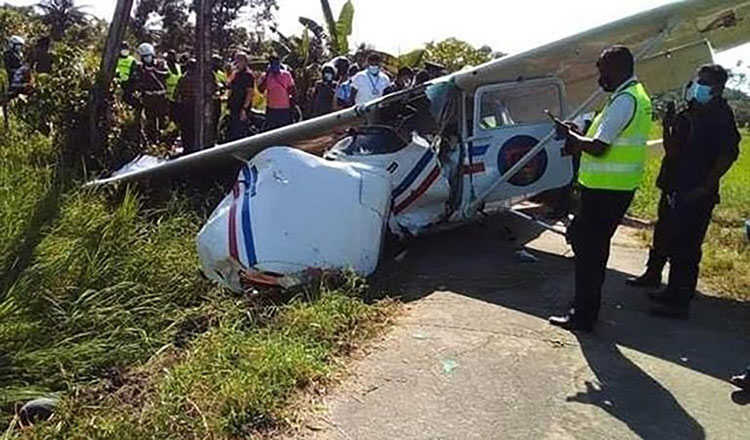
On Monday 27 December 2021, according to a Flight Safety Foundation narrative, “Cessna 172L 4R-GAF (ex 4R-HDC) of Sakurai Aviation crash landed in a paddy field in Paththayam Watta, Kimbulapitiya, Negombo in the Gampaha district close to Bandaranaike International Airport (VCBI) after the aircraft suffered an engine RPM fluctuation and subsequent engine failure. Three of the four occupants were injured. The charter flight was on its way to Koggala Airport (VCCK) from Sigiriya Airport (VCCS) when the problems started to occur. It had initially taken off from Ratmalana Airport (VCCC) and was supposed to land there after departing Koggala Airport (VCCK). The flight was going to make an emergency landing at Bandaranaike International Airport (VCBI) but while the aircraft was descending the pilot in command informed the controller that he had no control over the engine power. During the final approach to runway 22 the pilot in command then declared a “MAYDAY” call and the aircraft crash landed soon after.”
The touchdown itself at the paddy field was safe but due to a concrete road, which was not visible from to air at low level and running across the field, the nose wheel hit it and broke off creating the destruction and injury.
With the economic recovery, the present government has started reconstructing the highways and expressways that were suspended in the recent past. In countries like the United States of America (USA) there are straight stretches of expressways and highways, at regular intervals, where light to medium size aircraft could safely land in an emergency unlike the accident described above. Not only that, that particular stretch of road is maintained by the local Regulating Authority like the Federal Aviation Administration (FAA) in the case of the USA.
A Safe Landing on an Expressway in India.
The Sri Lanka National Aviation Policy of 2017 also recommends that there should be helipads at regular intervals along the expressways/ highways to facilitate medical evacuation in case of motor accidents. It should be noted that the Minister in Charge of Aviation and Highways is one and the same
Will the Government spare a thought for safer multimodal transport especially when there is a push to make Domestic Aviation available for tourism? Or will it be just another pipe dream?
Capt. G A Fernando
Former member of the Accident Investigation Team, Civil Aviation Authority, Sri Lanka.(CAASL)
Immediate past President of Aircraft Owners and Operators Association, Sri Lanka. (AOAOA)

by Geedreck Uswatte-aratchi,
B.A.(Cey.), Ph.D. (Cantab.)
In my first year at Peradeniya, I lived in Room 54 on the ground floor of the first quadrangle of Ramanathan Hall. In room 55 lived the prize-winning short story writer Somapala Wijesinghe, in his second year. On the first night, I walked a bit late to dinner to avoid the fierce raggers. As my luck would have it, there was a short man who barked out, ‘You fresher, what school do you come from?’ ‘From Kuliyapitiya Central School’, said I, meekly. The short man laughed loud derisively, ‘Where the hell is that? You have no business to come to this hallowed place. You look starved. Go and eat, I will deal with you in time.’ I was scared and hungry. So did I meet my first and long-lasting friend in Peradeniya. Haris read history under Ray Chaudhry, Sinha, G. C. Mendis and Lakshman Perera. The brilliant historians of Peradeniya were yet to come. I read Economics in the Takaran Shed School on the embankment across the road from the Arts Building.
Haris had an irresistible impish sense of humour. It did not spare friend or foe. When he came to Peradeniya, he brought his decrepit bicycle by rail. It had no bell, no lights, front or tail and no breaks but he never hurt himself or another except once and that grievously when he was very young in Panadura; he lost one eye in a road accident. The offending party was not Haris. That in no way spoiled the fun he had on his bicycle in Peradeniya or later. He was wildly popular and much admired. There was hardly any student in Peradeniya who did not know Haris. Among other things, I learnt from him to wear my shoe, making a slipper of it by beating down the heel.
There were several student’s societies in Peradeniya. It was usual for some of these societies to organise a bus tour to some place of interest. Usually, they came back late at night having shouted themselves hoarse and dead tired. One of our mutual friends joined a trip that year. In the evening, after dinner, Haris came to my room glistening with mischief. We both went in to our friend’s room and systematically dismantled his bed, put the mattress atop the closet, undid the springs and left them all over the floor. Our friend came back eager to hit the pillow but there was no bed. We came solicitously to help him re-assemble his bed and dismount the mattress. Our friend was furious with us till next morning. He bided his time. I joined a trip to Mahiyangana, mainly to go down the 18 bends. I came back dog tired fearing the worst. There might be a bucket of water ready to drench me as I opened my door. There wasn’t but my mattress was atop the closest. Never mind, mi pan rai, as I learnt to say in Bangkok, much later.
Vernugopal, who played hockey and later was a Certified Public Accountant in New Jersey, Haris and I nearly fell into serious trouble in our second year. Norman, son of Weerasuriya, QC, came to see Peradeniya, where he was scheduled to come into residence next year. I did not see him but he had come in a Mercedes Benz and had worn an expensive warm jacket that he had bought in London, earlier in the year. Vernu, for one reason or another, had lifted it and given it to Haris for safe keeping. Ever out for mischief, Haris rushed it to my room and asked me to keep it with me and, the next morning, move it out of the Campus, unobserved. He pressed me the next morning and I complied and forgot about it all. Not for long. One day the Warden knocked on my door; very unusual, I thought. ‘Do you have in your possession an expensive jacket belonging to a visitor to our Hall?’, he asked. ‘I have a jacket but I don’t know whom it belongs to. I will have to consult Haris who gave it to me a few days ago.’ ‘No matter all that. I want the jacket in my quarters before 6, this evening.’. I learnt about the episode later. Nicholas Attygalle had succeeded Ivor Jennings as Vice Chancellor. Attygalle and Weerasurya (Snr.) were pals. We all would have been in trouble if the jacket went missing. I was mighty relieved when all was settled.
Harris had a long string of cousins who lived mostly along Galle Road. They were his mother’s siblings’ children. I lived in a boarding house in Bambalpitiya to go to work. One Saturday morning Haris and I set out in his car to go to Hikkaduva (not the Hikkaduva of today) for the weekend. We visited one cousin in Moratuva, several in Panadura, another in Kalutara and so on and reached Ambalangoda about four in the afternoon. I declined the offer to ride back with him and took the 3.15 next day afternoon train to the Fort.
Haris’ hobby was carpentry. He parked his car on the lawn and the garage turned into a workshop. He had a good collection of tools. Some of the furniture in his house was made by him. He insisted on repairing his roof. One morning someone called from his home that Haris had fallen from the roof and we rushed much concerned. The turf had received him gently and he was none the worse for the accident. He kept on mending his roof.
Hema was a fitting companion to Haris: joyful and a perfect host. Mali and I spent many happy days with them, especially after the two children were born. Haris did a tremendous job bringing up the two of them by himself to be distinguished and highly productive citizens of this country. One of them lived with her family in the father’s house and Haris took great pleasure as the grandchildren went to good universities and eventually took up interesting work.
A hallmark of Haris’ life was the simplicity in which he lived it. The lives of Haris and family were almost stoic. Their home, the furniture in it, the clothes they wore and the occasions in life that they celebrated were all lessons in simplicity. One of the children, who was in a learned profession, once worked in Polonnaruva. She came to her home in Colombo, when she could, by bus. She later worked in Panadura and similarly often came back to Colombo by bus. Among a people who notoriously exhibit wealth they do not fully possess (read the ratio of household debt to household income), here was an oasis of serenity and simplicity. I respected him and his family very much.
Haris came to Peradeniya with some familiarity with research work. At Ananada Sastralaya, Kotte where Haris studied to enter university, young Amaradasa Virasinghe was a teacher. Virasinhge had been much inspired by Professor M.D.Ratnasuriya, who came from London University. The world of English literature was rocked by F.R.Leavis’ journal Scrutiny. Gananath Obeysekere had graduated from the English Department which was headed by E.F.C. Ludowyk who had graduated from Cambridge and was familiar with that work. The two young graduates decided to publish a quarterly Sinhala literary review and the first issue of Samskrti appeared in 1953. Haris had a hand in putting the first issue together in Obeysekere’s home in Lauries Road in Bambalapitiya. Virasinghe and his colleagues published Samskrti for about 20 years when Virasinghe decided to go to Pennsylvania. Amaradasa Gunewardena (Sinhala, Ramanathan, 1954) heroically carried on the journal for several years irregularly, until when it ceased publication. Virasinghe came back in 2000 or so and wanted to revive samskrti. With time, much had changed. The original enthusiasts all had moved, except two: Susil Siriwardena from Oxford and Usvatte-aratchi, who had come back after 25 years overseas.. They revived the journal to survive till 2015. Although the university population had multiplied several-fold and the Sinhala readding public even more, publishable material was scarce. And the journal spurted on for a year or two and died.
When Haris joined the Department of Government Archives under Amaravamsa Devaraja, the Department was in Nuvara Eliya. It had been moved from Colombo when there was a risk that Japanese might bomb the capital and the archives might be lost. Further, the cooler and slightly drier climate in Nuvara Eliya was likely to preserve the documents at lower cost. Peradeniya which turned out to be a major user of Archives was in the neighbourhood. However, Colombo had many users who could not afford the delays and the cost of driving to Nuvara Eliya. As time went on three universities had sprung up in and near Colombo and there emerged many users. President Jayewardene himself was a keen reader of Sri Lanka’s history. And there was an excellent site in Independence Square. It fell to Haris who was Deputy Director then to take care of the project to put up the new building and equip it. They could not have found a better person, had they searched the world for years. His integrity in the management of funds was rock solid. He had the cheque ready the day before payment was due and the builder had his first day of surprise when he was so informed. With many young students of history, law, economics and anthropology, there was a heightened interest in Archives and they found an excellent archivist in Haris.
Haris himself enjoyed the work immensely. As time permitted, he wrote two well-researched and data rich valuable works, as I recollect. He never lost interest in history and archives and we regularly chatted about what we were reading, thinking or writing. I dared not make a mistake in history. Haris’ red pen would find employment.
Haris was the first friend I made in Peradeniya and he is the last to whom I bid adieu. You made history and history will treat you splendidly.

Iran attacks US bases in Jordan after US strikes Larak Island

Showers will occur in the Western, North-western and Sabaragamuwa provinces and in Galle, Matara, Kandy and Nuwara-Eliya districts.

Sun directly overhead Neriyakulam, Punewa, Kebithigollewa, Pankulam and Sinhapura at about 12.10 noon today (31)

BASL takes exception to Justice Ganepola being denied a place in SC

Sajith challenges govt. to hold PC polls

Mahendran denies name change allegation

‘Dates have the highest sugar content to fight Coronavirus’

Sunday Island 27 December – Headlines

#SundayIsland 17th December – Headlines

Sunday Island – 28th March

Sunday Island Headlines – 21 March

Sunday Island – 21st February – Headlines
-

 News6 days ago
Missing doctor’s body found in Mahiyanganaya
-
 News6 days ago
Australia declines to release Finance Secy Suriyapperuma’s citizenship details
-

 News6 days ago
22A: BASL suggests CJ recuse himself from hearing petitions
-

 News3 days ago
Eight politicians in drug kingpin probe
-

 Features1 day ago
“Wrap Me Up in My Blazer”— A Gentlemanly Bradby Reminiscence
-

 Business3 days ago
Sri Lanka opens up: A new season of direct connectivity
-

 Features3 days ago
Redefining ageing in Sri Lanka
-
 Features5 days ago
Insights from Chieftains of Uva: Genealogy of two Kandyan Families – Part II