
Business
Sri Lanka’s recovery reveals a ‘numerical puzzle’ in employment stats


Factory output rises, but many remain outside the labour market
Sri Lanka’s latest economic indicators point to a curious numerical puzzle as industrial production is rising while labour force participation has not moved in tandem.Data for January 2026 show that the Index of Industrial Production (IIP) rose 4.4% year-on-year to 99.3, signalling a modest improvement in manufacturing activity compared with January 2025. The expansion was led mainly by food products, which grew 10.6%, wearing apparel which increased 12.5%, and other non-metallic mineral products, which recorded 3.6% growth.
Ordinarily, such growth in factory output would be expected to draw more people into the workforce. Yet Sri Lanka’s labour market statistics tell a slightly different story.
The labour force participation rate has been in the high 40% range in recent years. Latest estimates show it at around 46.9%, compared with about 49.9% in an earlier period, suggesting that a noticeable segment of the working-age population has remained outside the labour market even as production has begun to pick up.
In other words, factories appear to be producing more, but the pool of workers actively participating in the labour market has not expanded at the same pace.
Meanwhile, the unemployment rate has remained relatively low, just above 4%, indicating that those who are actively seeking employment are generally able to find work.
Business sentiment indicators also point to continued momentum in the real economy. The Purchasing Managers’ Index (PMI) for manufacturing has remained above the 50 point threshold, signalling expansion in factory activity, though slightly less than the stronger readings recorded toward the end of last year. The services sector PMI, meanwhile, continues to reflect steady business activity.
An economic analyst told The Island that taken together, the numbers suggest that Sri Lanka’s productive sectors are slowly regaining their footing after the severe economic stresses of recent years, but the gap between rising industrial output and subdued labour force participation would raise a question for economists and policymakers if they put their mind to the matter,
“If factories are producing more, where are the workers? Where is more hiring?”, he asked.
“One could argue that workers who exited the labour market during the economic crisis through migration or shifts to informal activity may not yet have fully returned. And the gap is unlikely to be explained by automation in factories. If that is the case, a sustained revival in export-oriented industries such as apparel and food processing should gradually draw more people back into the workforce,” he explained.
“So, the numbers underline a simple but important challenge for policymakers to ensure that improvements in industrial production are matched by broader participation in the labour market. Until more people return to the workforce, Sri Lanka’s recovery may continue to show this curious numerical puzzle of factories producing more, but fewer people showing up in the labour statistics,” he argued.
By Sanath Nanayakkare

by SK Samaranayake
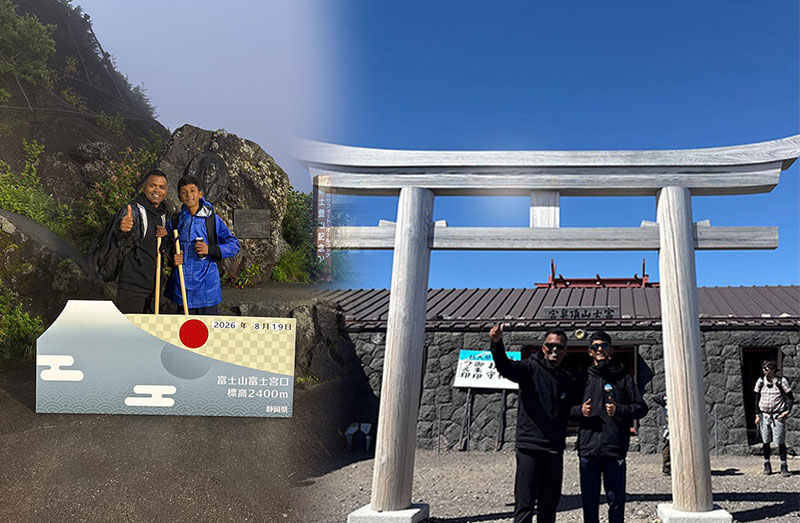
For Daham Gunasena, reaching the summit of Mt. Fuji with his 12-year-old son was not the end of the journey but the beginning of a different kind of lesson.
Gunasena, Director – Commercial at SPAR Sri Lanka and a senior business leader, academic and Chartered Accountant, spent nearly 12 hours on August 19 climbing Japan’s highest mountain with his son, Methum. After eight hours of climbing, the pair reached the 3,776-metre summit before beginning a demanding four-hour descent to Fujinomiya 5th Station.
“The summit was only halfway,” Gunasena reflected, describing the experience as a lesson in preparation, perseverance and responsibility.
Their journey began two days earlier with a trial excursion to the 6th Station and the volcanic landscape around Mt. Hoei. The experience allowed Gunasena to assess the altitude, terrain, weather and equipment before deciding whether his son was ready for the summit attempt.
The climb itself reinforced the value of taking one step at a time. Rather than focusing on the distant summit, father and son concentrated on the next marker, the next few steps and short periods of rest.
Reaching the summit brought another lesson. After taking photographs and celebrating, they still had four hours of descent ahead of them over loose volcanic terrain.
“Reaching the top was an achievement. Returning safely was success,” Gunasena said.
The experience also prompted him to reflect on how Japan manages Mt. Fuji, including visitor education, digital information, sanitation, transport, safety and environmental protection.
Having climbed Sri Pada 12 times last year and five times so far this year, Gunasena sees opportunities to apply some of these principles in Sri Lanka without compromising the mountain’s unique pilgrimage traditions.
He suggested a comprehensive digital platform for Sri Pada providing information on weather, congestion, transport, sanitation, first aid and emergencies, while educating foreign visitors about its religious significance.
For Gunasena, however, the most enduring lesson was personal: a mountain can teach what lectures cannot—through preparation, perseverance, respect for nature and the shared experience of taking each step together.

Sri Lankan industries are being encouraged to adopt advanced condition monitoring technologies to detect equipment problems before they develop into costly failures, as global technology company FLIR and its local partner Marlbo Trading Company strengthen their collaboration.
The companies brought together industry professionals at a technical seminar held on August 20 at Taj Samudra, Colombo, focusing on the use of thermography and acoustic imaging to reduce unplanned downtime, improve energy efficiency and lower maintenance costs.
Organised by Marlbo under the theme “Condition Monitoring Using Thermography and Acoustic Imaging for Measurable ROI,” the seminar highlighted the growing importance of proactive and predictive maintenance in improving equipment reliability and operational efficiency.
FLIR Sales Director – Instrumentation, India, Bhaskar Lala, and APAC Condition Monitoring Specialist David Gambarte shared their expertise on the latest diagnostic technologies and their practical industrial applications.
Thermal imaging can identify abnormal heat patterns linked to electrical and mechanical faults, while acoustic imaging can detect problems that may go unnoticed during routine inspections.
The technology is particularly useful in identifying compressed-air leaks, which can cause significant energy losses and increase operating costs.
Shevon Liyanage, Engineer – Measuring Instruments at Marlbo, also shared insights into applying condition monitoring technologies in the Sri Lankan industrial environment.

Lumbini Tea Valley Ceylon won an award for its Singharaja Wirytips at The Leafies: International Tea Awards held in London in 2024, marking another international recognition for the Sri Lankan tea producer.
The award comes as the company marks two decades of direct exports, with its premium and organic Ceylon teas now reaching 35 countries across six continents.
Established in 1984, Lumbini Tea Valley began its direct export drive after Chaminda Jayawardana joined the family business in 2000 alongside his father, Dayapala Jayawardana. The initiative materialised in 2006 with the company’s first direct shipment—a 15-kilogram consignment of Flowery Broken Orange Pekoe (FBOP) tea to the United States.
Since then, the company has expanded its direct-export operations, which now account for around 20% of its total manufacturing output. Following its transition to organic production, approximately half of its organic tea output is exported directly by the company.
Its key export markets include Japan, the United States, France, the Netherlands, Switzerland and Australia, with direct shipments now reaching 35 countries.
The company said its direct-export model would continue to expand amid growing international demand for traceable, single-origin Ceylon tea, with premium and organic grades at the centre of its export strategy.

Petrol to cost less from midnight today (30)

Head teacher evacuated 900 children minutes before school washed away by Nepal floods

UPDATE: Seven killed and 23 missing after boat capsizes off northern Cyprus, says Turkish Cypriot PM

Iceland votes against restarting talks on joining EU

“Rathuwewi Mihimadala” Book Launched with the Participation of the Prime Minister

Turkiye, Somalia forces free cargo vessel hijacked by pirates

‘Dates have the highest sugar content to fight Coronavirus’

Sunday Island 27 December – Headlines

#SundayIsland 17th December – Headlines

Sunday Island – 28th March

Sunday Island Headlines – 21 March

Sunday Island – 21st February – Headlines
-

 News6 days ago
Missing doctor’s body found in Mahiyanganaya
-

 News6 days ago
Australia declines to release Finance Secy Suriyapperuma’s citizenship details
-

 News6 days ago
22A: BASL suggests CJ recuse himself from hearing petitions
-

 News3 days ago
Eight politicians in drug kingpin probe
-

 Editorial7 days ago
Govts. drag feet as undergrads age
-

 Business3 days ago
Sri Lanka opens up: A new season of direct connectivity
-
 Features5 days ago
Insights from Chieftains of Uva: Genealogy of two Kandyan Families – Part II
-

 Features3 days ago
Redefining ageing in Sri Lanka