
News
Owners of small cars driven round the bend due to non-availability of tyres

by Suresh Perera
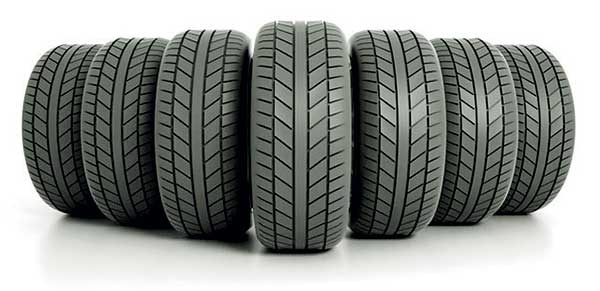
A shortage of automobile tyres in the market is driving motorists round the bend amidst complaints that dealers still holding stocks have inflated prices in the backdrop of existing import restrictions.
The worst affected are owners of small cars, many of whom derive an income by operating passenger taxi and affiliated services.
“We have no option but to ground our vehicles and be deprived of earnings to care for our families”, some passenger taxi services operators complained.
There is also the risk of facing legal action as the traffic police are now examining tyres of passenger vehicles on the roads following the bus accident at Passara, they noted.
Moreover, in the case of an accident, there is every possibility that insurance claims will be dishonored in case the tyres are found worn out, they further said.
The market is not wholly dependent on locally manufactured products, as the import restrictions apply only to radial tyres for rim sizes 12 and 13, and for motorcycle and three-wheeler tyres, says Ravi Dadlani, Managing Director, CEAT Kelani Holdings, a key player in the local tyre industry.
“That’s the crux of the matter. Tyres for rim sizes 12 and 13 are used in small cars, which are aplenty in the country not only for private use but also in the taxi services business, the operators pointed out.
“How can we run hires with worn out tyres and endanger the lives of passengers especially on wet days?”, they asked.
There is no restriction on the import of all other tyre types and sizes, including those for trucks and buses, Dadlani said.
With regard to ‘import restricted sizes’ – cars rim sizes 12 and 13, motorcycles and three-wheelers, CEAT produces 31,800 car Radial tyres in 12 & 13 sizes per month (whereas the market demand for these sizes is 32,000) meeting 100% of the market requirement, he explained.
If that was so, where have all the tyres pumped into the market gone?, the operators queried. “With dealers claiming they have not received fresh stocks, we have been going around in circles to find the right (tyre) sizes”.
Even refurbished tyres are being now being sold for fancy prices due to the shortage. Unlike earlier, there are no small tyres dumped on roadsides now because everything is being refurbished as prices are good due to the demand, they asserted.
“They wanted Rs. 5,000 for a size 13 refurbished tyre with no guarantee on performance. Perhaps, road accidents have shot up because some motorists use them as there’s no option”, a taxi service driver remarked.
It’s a risk no doubt, but some people prefer to take the challenge rather than keep their vehicles grounded and go hungry, he said.
CEAT also produces 100% of the requirement for three-wheeler tyres and 50% of the requirement for motorcycle tyres, the Managing Director said.
“Together with other local manufacturers of three-wheeler and motorcycle tyres, we can meet 150% of Sri Lanka’s demand in these categories”, he assured.
“People who talk of statistics should go around and see for themselves the reality of the situation on the ground”, the operators suggested.
Those who are holding stocks are selling them at exorbitant prices, they claimed.
The dealers are provided a price list covering all sizes and types of tyres by each manufacturer and are entitled to discounts of up to, or more than 30%. They are expected to pass on a substantial discount to the end customer based on the purchase terms, and to our knowledge the majority of genuine establishments still do so, Dadlani said.
There may be a price list, but that does not necessarily mean it happens that way. The shortage in the market has seen the emergence of brokers and middlemen who can procure tyres for customers at fancy prices, the operators further asserted.
Those who sit in comfort and dish out figures should do a round and find out what’s happening in the marketplace. They will then be able to come to terms with reality, they said.
Dealers say that when they order 100 tyres, for example, they receive only 25 and these are sold in double quick time due to the demand, they added.
“Our supplies to each dealer are on the basis of an established demand pattern based on the size of the market served by each outlet. This has worked well over many years. However, some dealers are now arbitrarily demanding more tyres to build up a larger inventory and may complain if they do not receive the increased volumes they are ordering”, Dadlani pointed out.
“It is also possible that a particular tyre size may not be available on the day it is ordered, but given the production cycles we operate, that size will become available within that month. We are in touch with cab companies and have not received complaints of vehicle fleets being grounded due to lack of tyres”, he continued.
A tyre dealer in Colombo The Sunday Island spoke to said local brands were not available, but offered a size 14 Chinese product for Rs. 9,900 each. Another dealer said he has only Dunlop to fit rim sizes 13 and 14 and quoted Rs. 11,750 for each.
The Managing Director said that CEAT has the capacity to produce 100% of the car and van radial tyre requirements for rim sizes 12 and 13, and together with other local manufacturers, 150% of the requirement of motorcycle tyres and 150% of the requirement for three-wheeler tyres.
Asked whether CEAT increased prices after the import restrictions were enforced, he said the company reduced prices in December 2019 and kept them unchanged in 2020 and until January 2021. During this period, natural rubber prices in the world market increased by over 50%. As a result, CEAT revised prices by 11.8% in January 2021 purely to absorb the raw material cost/other costs increases.
Asked whether the temporary closure of the CEAT manufacturing plant due to some employees testing Covid-19 positive lead to a disruption in the supply chain and reflect on market availability of its products, Dadlani replied, “In line with the government mandated health and safety protocols and in the interest of employee safety, we suspended manufacturing for seven days in February this year. This did result in an unavoidable disruption of supplies, considering that we manufacture about 3,200 radial and motorcycle tyres per day. We however made up for the production loss through additional production on Sundays”.





Latest News
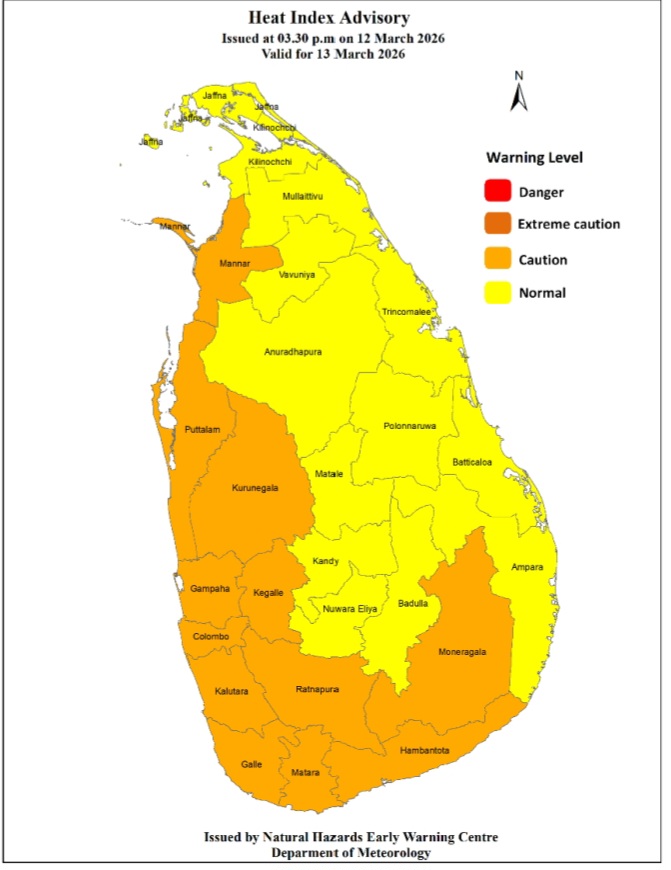
Heat Index likely to increase up to ‘Caution level’ at some places in the Western, Sabaragamuwa, Southern and North-western provinces and in Monaragala and Mannar districts

Warm Weather Advisory
Issued by the Natural Hazards Early Warning Centre of the Department of Meteorology at 3.30 p.m. on 12 March 2026, valid for 13 March 2026.
Heat index, the temperature felt on human body is likely to increase up to ‘Caution level’ at some places in Western, Sabaragamuwa, Southern and North-western provinces and in
Monaragala and Mannar districts.
The Heat Index Forecast is calculated by using relative humidity and maximum temperature and this is the condition that is felt on your body. This is not the forecast of maximum temperature. It is generated by the Department of Meteorology for the next day period and prepared by using global numerical weather prediction model data.

Effect of the heat index on human body is mentioned in the above table and it is prepared on
the advice of the Ministry of Health and Indigenous Medical Services.
ACTION REQUIRED
Job sites: Stay hydrated and takes breaks in the shade as often as possible.
Indoors: Check up on the elderly and the sick.
Vehicles: Never leave children unattended.
Outdoors: Limit strenuous outdoor activities, find shade and stay hydrated.
Dress: Wear lightweight and white or light-colored clothing.
Note:
In addition, please refer to advisories issued by the Disaster Preparedness & Response Division, Ministry of Health in this regard as well. For further clarifications please contact 011-7446491.


The Frontline Socialist Party (FSP) yesterday accused the government of trying to award another tender to the Indian company that supplied low-grade coal to the Norochcholai Power Plant and failed to deliver the stipulated amount of coal according to schedule.
The allegation was made by the Education Secretary of the Progressive Socialist Party, Pubudu Jayagoda, during media briefing at the party office in Nugegoda last afternoon.
Jayagoda said that in September 2025, the government had awarded a tender to the Indian company Trident Chemphar to supply 25 coal shipments for electricity generation in 2026.
In August 2025, it was confirmed that the coal delivered by the company was substandard. The company also failed to supply coal on schedule. Although the first shipment was expected in the second week of December 2025, it arrived at the end of the month. By mid-March, only 12 ships had arrived, and biweekly deliveries have been disrupted, putting Sri Lanka at risk of a severe energy shortage.
On 11 March, the government called a sudden spot tender for five coal shipments. Four companies submitted bids, and they include Trident Chemphar. FSP criticiced awarding the tender to the same discredited company, saying it was unethical and could trigger a major national crisis, as the company had failed to supply quality coal reliably in the past.
Previously, coal quality was strictly measured, with a “Reject Value”. But now to help the errant supplier the term of Reject Value has now been omitted altogether and replaced with a new term ‘Minimum Value’ setting it as the minimum calorific threshold—coal producing less than 5,900 kilocalories per kilogram was rejected, and coal with ash content above 16% was also discarded.
However, the government is now reportedly lowering these standards, accepting substandard coal, and changing tender specifications to accommodate the company.
Jayagoda castigated the latest stunt coming especially at a time when the world faces war and oil shortages. Diesel meant for electricity generation is being diverted to school buses, public transport, and emergency vehicles, leaving households at risk of prolonged blackouts. Even if diesel is imported, electricity tariffs could skyrocket.

The Indian Ministry of External Affairs has said it is considering requests for diesel supplies from neighbouring countries, including Sri Lanka, Bangladesh and the Maldives.
Speaking to the Press Trust of India, Ministry Spokesperson Randhir Jaiswal noted that India was a major exporter of refined petroleum products in the region. He confirmed that Bangladesh had formally requested a diesel supply, which is currently under review.
He said that diesel exports to Bangladesh had largely continued since 2017, but any new allocations would take into account India’s refining capacity, domestic demand, and overall fuel availability.
Jaiswal added that similar requests from Sri Lanka and the Maldives were also being considered, with India’s own energy requirements forming a key part of the decision-making process.

Heat Index likely to increase up to ‘Caution level’ at some places in the Western, Sabaragamuwa, Southern and North-western provinces and in Monaragala and Mannar districts

showers above 50 mm can be expected at some places in the Western and Sabaragamuwa provinces and in the Galle and Matara districts

Govt. bends rules, lowers coal standards in favour of errant company: FSP

Lanka requests diesel from India

Gas shortage pushes up electricity demand, night peak rises: CEB

Navy seizes narcotics haul, lethal weapons in two vessels, arrests 10 suspects

‘Dates have the highest sugar content to fight Coronavirus’

Sunday Island 27 December – Headlines

#SundayIsland 17th December – Headlines

Sunday Island – 28th March

Sunday Island Headlines – 21 March

Sunday Island – 21st February – Headlines
-

 News6 days ago
Peradeniya Uni issues alert over leopards in its premises
-

 News4 days ago
Repatriation of Iranian naval personnel Sri Lanka’s call: Washington
-

 News6 days ago
Wife raises alarm over Sallay’s detention under PTA
-

 News3 days ago
Prof. Dunusinghe warns Lanka at serious risk due to ME war
-

 Features4 days ago
Winds of Change:Geopolitics at the crossroads of South and Southeast Asia
-

 Latest News6 days ago
Heat Index at ‘Caution Level’ in the Sabaragamuwa province and, Colombo, Gampaha, Kurunegala, Anuradhapura, Vavuniya, Hambanthota and Monaragala districts
-

 Features6 days ago
The final voyage of the Iranian warship sunk by the US
-

 Sports2 days ago
Royal start favourites in historic Battle of the Blues