
Latest News
Pakistan into Super Eight after Farhan ton sinks Namibia

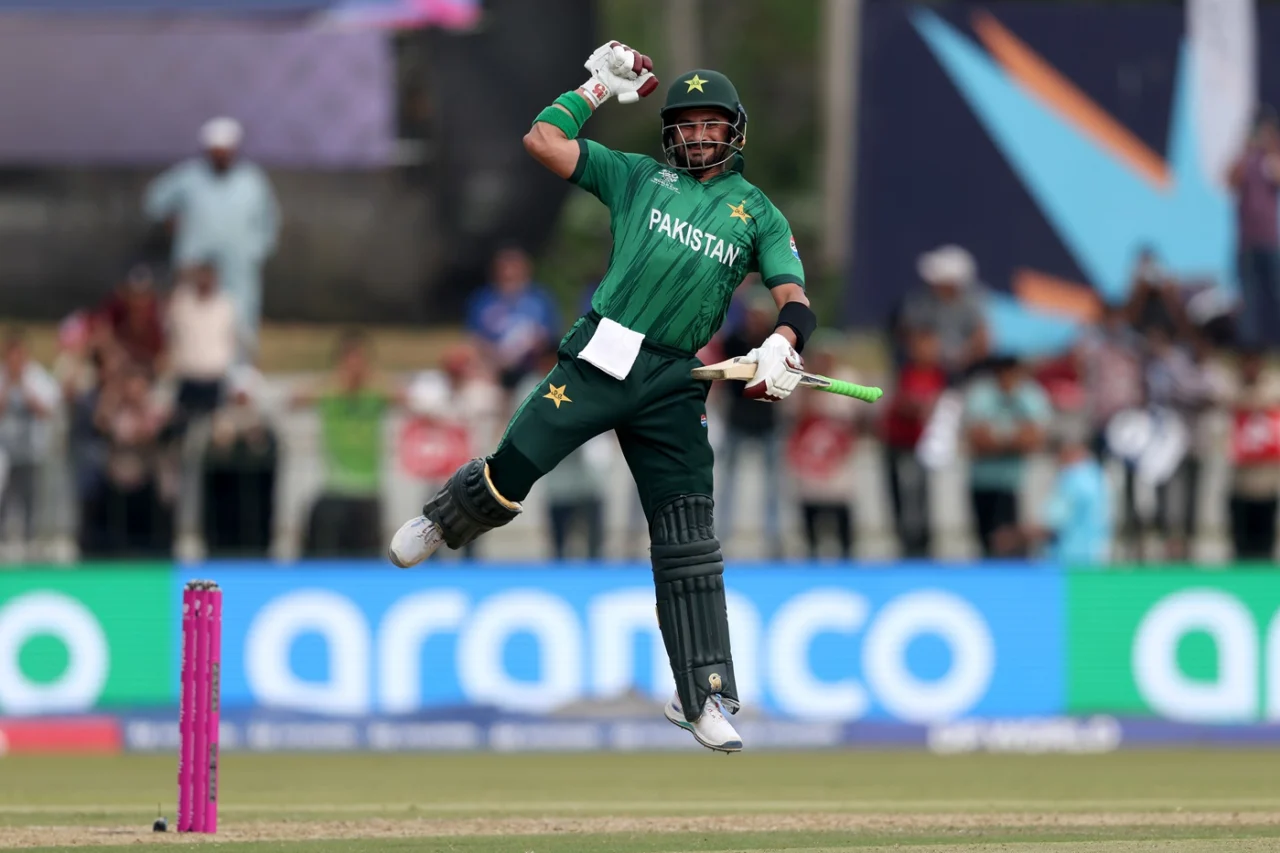
Sahibzada Farhan settled his side’s nerves with a blazing unbeaten hundred, as Namibia were outgunned by 102 runs in Colombo to end any doubts about Pakistan’s progression to the T20 World Cup Super Eight. With 11 fours and four sixes, Farhan produced a perfect burst of acceleration against a toiling attack. His second fifty of his 57-ball century came from just 20 balls. And his eventual 100 not out from 58 balls would be more runs than Namibia managed (97) before being bowled out.
Needing a victory (or, at the very least, a washout) to keep the hopefuls of USA at bay, Pakistan produced the most comprehensive win of their campaign. It was sealed by their four-man spin cohort. Mohammad Nawaz led a mid-innings squeeze with 1 for 22 in his four overs, before Shadab Khan and Usman Tariq dovetailed for each of Namibia’s last seven wickets.
Shadab was the main character of their victory surge. He had earlier been pushed up to No. 5, ahead of Babar Azam, to help Farhan thrash 78 runs from the final six overs of their innings. He then followed up with 3 for 19, the last of them coming via a superb diving catch at square leg from Saim Ayub, off Zane Green, which spoke of Pakistan’s mounting confidence.
Shadab himself was also in the act with a smart catch at midwicket, to claim the first breakthrough of Tariq’s late entrance. Though he didn’t bowl until the 12th over, Tariq’s extraordinary repertoire of carrom balls and delayed-release leggies proved unfathomable to Namibia’s lower-order. Ruben Trumpelmann and Bernard Scholtz were both bowled through the gate by perfect googlies, before Willem Myburgh snicked off to a legbreak, to cap Tariq’s career-best figures of 4 for 16.
It wasn’t the perfect performance from Pakistan. In particular, their batting powerplay was a microcosm of their campaign: rarely convincing, yet still doing the needful in spite of some ugly moments. Ayub’s 14 from 12 balls comprised two leading edges and a flying nick for four past the keeper; Farhan’s first boundary came via a misfield in the covers, and his second to a similarly wild hack through deep third off Jack Brassell, moments after he had flung his bat through square leg while mistiming a cut through point.
But, by degrees, Pakistan settled into their work, emboldened by every over in which their under-performing middle-order was spared early exposure. Namibia rang in the changes, rotating through six options in their first eight overs. But it was their two bowlers serving up back-to-back overs who inadvertently released the mounting pressure.
Farhan found his range with back-to-back fours off Ruben Trumpelmann, including an unrepentant slog through midwicket, then took his new-found poise out on Willem Myburgh. The legspinner’s first over had gone for just five; his second realized three vast sixes, with Farhan contributing back-to-back slog-sweeps. Though he ended the same over in a heap, after jarring his knee during a drive, the shackles were officially off.
Farhan nudged the first ball of the 12th over through midwicket to bring up a 37-ball half-century. Twenty balls later, he did likewise to Gerhard Erasmus, to cavort through to his maiden T20I hundred. His was also the third of this year’s tournament, a new record.
In between whiles, his acceleration was violent and unrelenting, though it did not begin in earnest until the 15th over, when Trumpelmann’s slower balls were collared for back-to-back fours down the ground. That sounded the bugle charge. JJ Smit’s left-arm spin was then smoked for 17 runs, including two more fours and a baseball slug for six; and Brassell’s last was sent for 20, with Farhan marching into the 90s as he hoisted a slower ball over fine leg for his fourth six.
Salman Agha played a vital part in Pakistan’s uptick. His 38 from 23 balls included three fours and two sixes, as he helped propel his team to 107 for 1 after 12. He was livid with himself when he holed out to mid-off with his job far from done, and Khawaja Nafay’s five-ball stay meant Pakistan were soon in familiar danger at 118 for 3 in the 14th. But in came Shadab, with licence to swing his bat. He was only too eager to deliver.
Namibia needed ten an over from the outset, and they did give it a go in the powerplay. Faheem Ashraf was an unlikely candidate bowling the first over, with Shaheen Afridi paying the price for some leaky displays so far in the tournament – and consequently dropped. Ashraf’s introduction looked doubly sketchy when Louren Steenkamp picked his third-ball slower ball to pump him over the sightscreen.
Pakistan’s frailties were all too apparent in the same over. Nawaz dropped a sitter at deep midwicket off Jan Frylinck. Soon, at 32 for 0 after four, Namibia were putting up a decent challenge.Salman Mirza, however, switched ends to bowl Frylinck through the gate for 9, and when Jan Loftie-Eaton ruined his strong start by attempting a non-existent run to Agha at mid-off, the downturn was swift and decisive. Nawaz made amends for his catching by luring Steenkamp into a top-edged swipe for 23, and four balls later, Shadab snicked off the captain, Erasmus, with a big legbreak in his first over. The end would follow swiftly.
Brief scores:
Pakistan 199 for 3 in 20 overs (Sahibzadz Farhan 100*, Saim Ayub 14, Salman Agha 38, Shadab Khan 36*; Gerhard Erasmus 1-25, Jack Brassell 2-38) beat Namibia 97 in 17.3 overs (Louren Steenkamp 23, Alexander Busing Volschenk 20; Salman Mirza 1-11,Mohammad Nawaz 1-22, Usman Tariq 4-16, Shadab Khan 3-19) by 102 runs
[Cricinfo]

Pakistan’s Foreign Ministry on Thursday confirmed that the United States and Iran were in discussions – through Islamabad – to hold a second meeting between their negotiators to end their now nearly seven-week war, with a fragile ceasefire announced on April 8 days away from expiring.
But it added that no date had been set for that next round of negotiations, even as Islamabad stepped up a parallel diplomatic push to keep the process alive.
“Who will come, how big the delegation will be, who will stay, and who will go is for the parties to decide,” Foreign Ministry spokesperson Tahir Andrabi told reporters in Islamabad, referring to what upcoming talks might look like. “As a mediator, it’s important for us to keep the talks confidential. We had the details and information of the talks entrusted to us by the negotiating parties.”
Speaking of the first round of talks on April 12 in Islamabad, which concluded without a deal, Andrabi said: “There was neither a breakthrough nor a breakdown.”
The spokesperson confirmed that nuclear issues remained among the key subjects under discussion, but declined to elaborate.
His comments came as Pakistan’s civil and military leadership is travelling across the region in what some observers have begun calling the “Islamabad Process”, reflecting the government’s attempt to frame negotiations as an ongoing diplomatic effort rather than a one-off engagement.
Pakistan’s Prime Minister Shehbaz Sharif arrived in Doha on Thursday, the second stop of a four-day regional tour that began with Jeddah on Wednesday, and will see him visiting Antalya next.
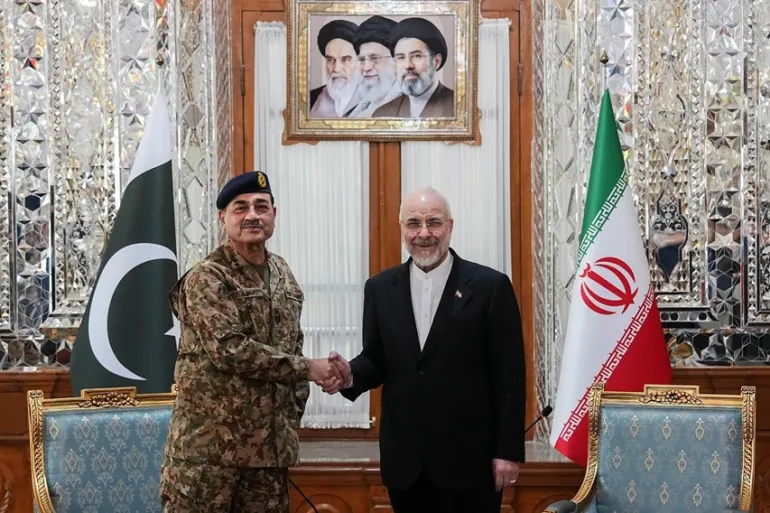
Meanwhile, Pakistan’s Chief of Defence Forces (CDF) Asim Munir arrrived in Teheran on Wednesday with a delegation that included Interior Minister Mohsin Naqvi.
Munir was received at the airport with a warm hug from Iranian Foreign Minister Abbas Araghchi, who said he was “delighted” to welcome the field marshal and expressed gratitude for Pakistan’s “gracious hosting of dialogue”.
On Thursday, Iranian Parliamentary Speaker Mohammad Bagher Ghalibaf, who led Tehran’s delegation at the Islamabad talks, also met Munir.
Reza Amiri Moghadam, Iran’s ambassador to Pakistan, said at an event in Islamabad that Tehran would not consider any venue other than Pakistan for talks with Washington.
“We will do talks in Pakistan and nowhere else, because we trust Pakistan,” he said.
Muhammad Faisal, a Pakistani security analyst and scholar at the University of Technology Sydney, said the parallel outreach reflected a deliberate division of labour.
“Pakistan’s strategy appears to be dual-tracked: PM Sharif is reassuring Gulf allies and attempting to build a broader support coalition, while CDF Munir is engaged in hard negotiations between the two sides to narrow gaps between Iran and the US, with an eye on extending the ceasefire and reaching a broader understanding,” he told Al Jazeera.
Reports that Munir might travel to Washington, DC after Tehran were denied by security officials, who called them “speculative”. Andrabi said he was not aware of any such development.

In Jeddah on Wednesday, Sharif met Saudi Crown Prince Mohammed bin Salman and expressed “full solidarity and support” for the kingdom following regional escalation, according to Pakistan’s Foreign Ministry. The crown prince praised what Riyadh described as the “constructive role” played by both Sharif and Munir.
In Doha, Sharif met Qatar’s Emir Sheikh Tamim bin Hamad Al Thani and discussed “the regional situation, particularly in the Gulf region”, underscoring “the importance of de-escalation, dialogue and close international coordination to ensure peace and stability”, the prime minister’s office said.
From Doha, Sharif heads to Antalya with Deputy Prime Minister and Foreign Minister Ishaq Dar. They are expected to meet counterparts from Saudi Arabia, Turkiye and potentially Egypt on the sidelines of the Antalya Diplomacy Forum on April 17.
The Antalya meeting is part of a broader diplomatic effort. Turkiye is preparing to host talks on a regional security platform involving Pakistan, Saudi Arabia and possibly Egypt, according to officials familiar with the discussions.
It would be the third such meeting in a month, following earlier rounds of talks in Riyadh and Islamabad.
The goal is to establish a platform for regular, structured cooperation on regional security issues, the officials said, stressing the discussions are distinct from current efforts to end the Iran war.
Turkish Foreign Minister Hakan Fidan confirmed that discussions were under way, but said no agreement had been finalised.
“This pact is necessary so that countries can be assured of one another,” he told the state-run Anadolu Agency on Monday.
Turkiye also reaffirmed support for the US-Iran peace process on Thursday.
“We will continue to provide the necessary support for the ongoing ceasefire to turn into a permanent truce and eventually lasting peace, without becoming more complex and difficult to manage,” the Defence Ministry said, adding that it expected “the parties will be constructive in the ongoing negotiation process”.
Pakistan’s Foreign Ministry said senior officials from the four countries had also met in Islamabad earlier this week to prepare recommendations for Antalya.
The two-week ceasefire brokered by Pakistan on April 8, which halted attacks in Iran and the Gulf, is due to expire on April 22. While still holding, it is under increasing strain.
A US naval blockade on Iranian ports remains in place, with the US Central Command saying its forces had turned away nine ships as of Wednesday.
Kamran Yousuf, an Islamabad-based journalist and expert on diplomatic affairs, said he expected the ceasefire to be extended.
“I would be really surprised if the current ceasefire is not extended. There is little appetite on both sides to go back to war. There are enough signs on the ground that if there is no deal before the truce expires, the ceasefire will be extended,” he told Al Jazeera.
Faisal offered a more cautious assessment, warning that failure to secure a second round would shift Pakistan’s role.
“Pakistan’s mediation will not collapse immediately, but Islamabad’s role will change from mediator to crisis manager. If hostilities resume, Pakistan will focus again on brokering a ceasefire,” he said.
Despite uncertainty, signals from both Washington and Tehran have remained cautiously optimistic.
White House press secretary Karoline Leavitt said further talks would “very likely” take place in Islamabad, adding, “We feel good about the prospects of a deal.”
Iran’s Foreign Ministry spokesperson Esmaeil Baghaei said multiple messages had been exchanged with Washington through Pakistan since April 12.
US President Donald Trump said on Tuesday that talks could resume within two days and that Washington was “more inclined to go” to Pakistan.

The path to a second round remains complicated by unresolved disputes.
Iran has insisted that Lebanon be included in any agreement, arguing that ongoing Israeli strikes there, which have killed more than 2,000 people and displaced 1.2 million, cannot be separated from the wider conflict.
On April 14, the United States convened a trilateral meeting in Washington with the ambassadors of Israel and Lebanon, the first direct engagement between the two sides since 1993.
US Secretary of State Marco Rubio mediated the talks, which both sides described as “productive”, but no ceasefire or follow-up meeting was agreed.
Washington has maintained that any Lebanon deal must remain separate from US-Iran negotiations, rejecting Tehran’s position. On Thursday, Israel said its Prime Minister Benjamin Netanyahu would speak on the phone with Lebanese President Joseph Aoun — but Beirut had not confirmed any plans for a telephone conversation. The two countries do not have formal diplomatic relations.
At Thursday’s briefing, Andrabi aligned Pakistan with Iran on this issue.
“Peace in Lebanon is essential for US-Iran peace talks,” he said, adding that “signs of improvement on the Israel-Lebanon front over the past two days are encouraging.”
Yousuf said a Lebanon ceasefire would send an important signal to Iran.
“Extending the ceasefire to Lebanon will be an important confidence-building measure, a signal from the US that it is serious about a second round. It will also give Tehran good reason to return to the table,” he said.
But he added that the deeper challenge remained Iran’s nuclear programme.
“The nuclear issue is at the heart of the real problem. The flurry of shuttle diplomacy initiated by Pakistan is aimed at bridging the gap between the two sides,” he said.
Grace Wermenbol, a former US national security official and senior visiting fellow at the German Marshall Fund, said Washington’s approach to Lebanon would hinge on Trump’s willingness to pressure Israel.
“A clear pathway to a cessation of hostilities in Lebanon exists,” she told Al Jazeera. “The question is whether Trump will be willing to apply the pressure necessary on Israel to halt its military offensive and allow the Lebanese government to continue its military disarmament efforts. So far, and this is also true for the months preceding the latest escalation between Israel and Hezbollah, we have not seen this pressure materialise.”
The Strait of Hormuz remains another major obstacle.
The waterway, through which roughly a fifth of the world’s oil passes during peacetime, has effectively been blocked by Iran since early in the war, except for ships belonging to countries that have struck individual deals with Tehran.
Starting Monday, the US imposed its own naval blockade on the strait, to prevent any Iran-linked vessel from passing through.
“Iran’s effective closure of the Strait of Hormuz has emerged as the primary issue in US-Iranian negotiations. Opening it is crucial to easing upward pressure on oil prices and instilling confidence in global markets,” Wermenbol said.
She added that Tehran appeared to be betting Washington would eventually back down.
“There is no easy military option here,” she said. “The only way to resolve this issue and remove the threat to maritime traffic will need to involve a diplomatic deal.”
[Aljazeera]

The leaders of Israel and Lebanon have agreed a 10-day ceasefire, US President Donald Trump has said, starting from 17:00 EST (21:00 GMT; midnight local time) on Thursday.
For the past six weeks, Israel and Hezbollah – an Iran-backed armed group – have been fighting in southern Lebanon.
Israeli Prime Minister Benjamin Netanyahu confirmed Israel’s participation in the truce, but said troops would maintain a 10km-deep (6.2 mile) “security zone” in the country’s south, adding: “We are there, and we are not leaving.”
Hezbollah appeared willing to participate in the ceasefire, but said it must include “a comprehensive halt to attacks” across Lebanon and “no freedom of movement for Israeli forces”.
Iran’s foreign ministry also welcomed the ceasefire. Tehran had insisted that its own two-week ceasefire with the US should include Lebanon while the US and Israel said it did not.
The US and Iran have been discussing a second round of peace talks in Pakistan and, speaking to reporters in Washington, Trump said the US and Iran had already agreed on a lot, including that Tehran would not have nuclear weapons “beyond 20 years” – but warned that “if there is no deal, fighting resumes”.
The latest war between Israel and Hezbollah began on 2 March, two days after the US and Israel launched a joint attack on Iran, with Hezbollah firing rockets into northern Israel.
The armed group – which is also a political movement in Lebanon – said it was retaliating for the assassination of Iran’s Supreme Leader Ayatollah Ali Khamenei.
More than 2,000 people in Lebanon have since been killed, with more than a million – or roughly a fifth of the population – displaced. An estimated 37,000 homes have been destroyed or damaged. Israel says Hezbollah attacks have killed two civilians in Israel, and that 13 Israeli soldiers have been killed in combat in Lebanon.
Israel and Lebanon held rare direct talks in Washington this week aimed at easing the war, which has seen deadly air strikes on parts of the Lebanese capital, Beirut. Israel is not in conflict with Lebanon’s armed forces.
 Trump told reporters on Thursday that he thought Lebanon would “take care” of Hezbollah (BBC)
Latest News
Heat Index at Caution Level in the Northern, North-central, North-western, Western, Sabaragamuwa, Eastern and Southern provinces and in Monaragala district
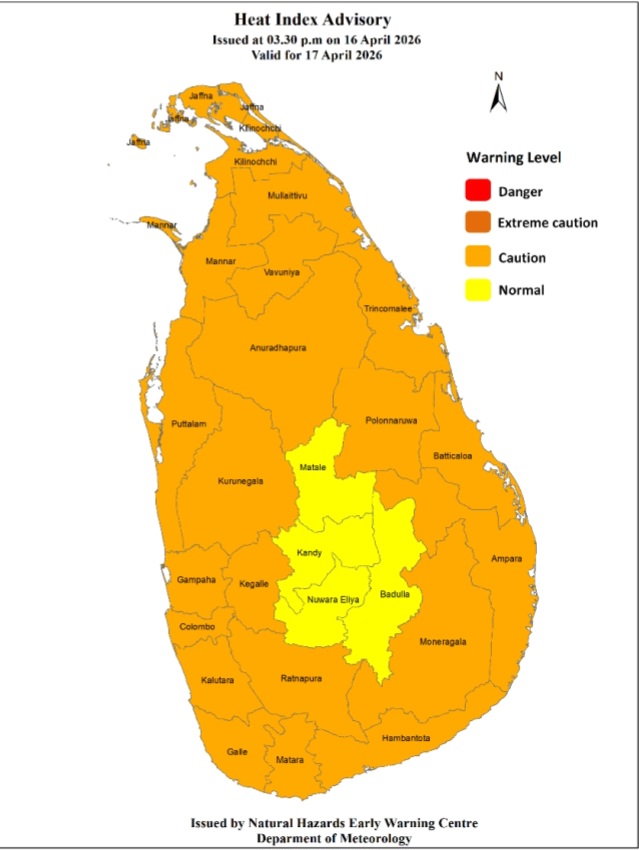
Warm Weather Advisory
Issued by the Natural Hazards Early Warning Centre
Issued at 3.30 p.m. on 16 April 2026, valid for 17 April 2026.
The Heat index, the temperature felt on human body is likely to increase up to ‘Caution level’ at some places in the Northern, North-central, North-western, Western, Sabaragamuwa, Eastern
and Southern provinces and in Monaragala district.
The Heat Index Forecast is calculated by using relative humidity and maximum temperature and this is the condition that is felt on your body. This is not the forecast of maximum temperature. It is generated by the Department of Meteorology for the next day period and prepared by using global numerical weather prediction model data.

Effect of the heat index on human body is mentioned in the above table and it is prepared on the advice of the Ministry of Health and Indigenous Medical Services.
ACTION REQUIRED
Job sites: Stay hydrated and takes breaks in the shade as often as possible.
Indoors: Check up on the elderly and the sick.
Vehicles: Never leave children unattended.
Outdoors: Limit strenuous outdoor activities, find shade and stay hydrated.
Dress: Wear lightweight and white or light-colored clothing.
Note:
In addition, please refer to advisories issued by the Disaster Preparedness & Response Division, Ministry of Health in this regard as well. For further clarifications please contact 011-7446491.

No date set for US-Iran talks, as Pakistan pushes to keep diplomacy alive

Arshdeep and Prabhsimran star as Punjab Kings hammer Mumbai Indians

Showers expected in the Western, Sabaragamuwa, Southern and Uva provinces and in Kandy and Nuwara-Eliya districts after 1.00 pm

Israel and Lebanon agree 10-day ceasefire, Trump says

Heat Index at Caution Level in the Northern, North-central, North-western, Western, Sabaragamuwa, Eastern and Southern provinces and in Monaragala district

Ex-COPE head questions Prez Secy’s intervention in coal scam probe

‘Dates have the highest sugar content to fight Coronavirus’

Sunday Island 27 December – Headlines

#SundayIsland 17th December – Headlines

Sunday Island – 28th March

Sunday Island Headlines – 21 March

Sunday Island – 21st February – Headlines
-

 News5 days ago
CEB orders temporary shutdown of large rooftop solar systems
-
 Features5 days ago
From Royal College Platoon to National Cadet Corps: 145 years of discipline, leadership, and modern challenges
-

 Latest News4 days ago
PNS TAIMUR & ASLAT arrive in Colombo
-

 News6 days ago
Anura Solomons passes away
-

 Features5 days ago
CIA’s hidden weapon in Iran
-
 Latest News4 days ago
Prasidh, Buttler set up comfortable win for Gujarat Titans
-

 Business6 days ago
SL’s economic outlook for 2026 being shaped by M-E conflict
-

 Latest News5 days ago
Heat index likely to increase up to ‘Caution level’ at some places in the Northern, North-central, North-western, Western, Sabaragamuwa, Southern and Eastern provinces and Monaragala district