
News
Jha outlines post-Ditwah India projects, security and defence cooperation

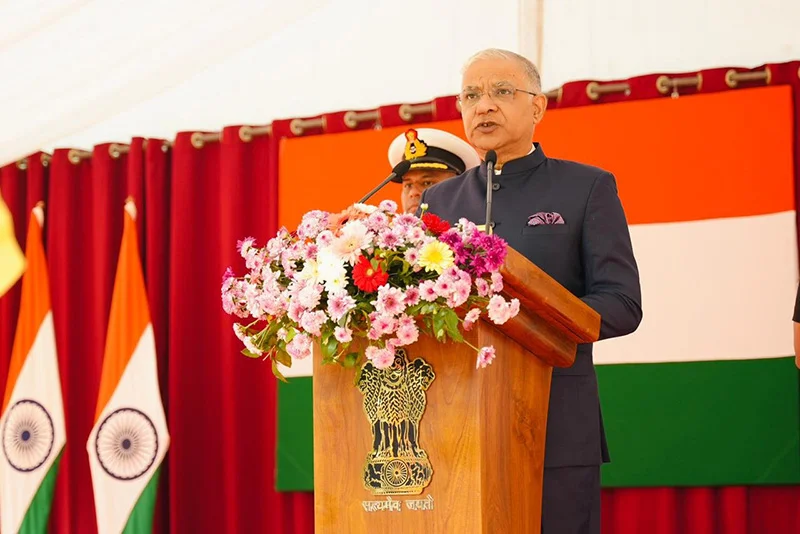
Indian High Commissioner Santosh Jha outlined major post-Ditwah work undertaken by the Modi administration in Sri Lanka. Addressing the evening reception at India House on the occasion of the 77th Republic Day of India, Jha said: “Immediately after Ditwah, External Affairs Minister of India, Dr. S. Jaishankar visited Sri Lanka, as Prime Minister’s Special Envoy, to express our solidarity and to announce an assistance package of over 450 million USD. The package is meant to support Sri Lanka’s Rebuilding Sri Lanka Initiative post-Ditwah. It covers five broad sectors:
i. rehabilitation and restoration of road, railway and bridge connectivity;
ii. rebuilding housing and water supply;
iii. support for health and education;
iv. support for agriculture and livestock; and
v. working towards better disaster response and preparedness.
We are aware that the utility of this package lies in its execution and impact. We are working closely with the government of Sri Lanka to ensure timely implementation. I am happy to report that delivery on the ground has already begun. In particular the more urgent tasks of restoring bridges and railway lines; and relocating houses and hospitals have already begun. Discussions have also been held to enhance Sri Lanka’s preparedness to deal with future natural disasters.”
Commenting on other developments, Jha said: “The importance of our security and defence cooperation cannot be overstated, especially as we are located in such proximate geography. This manifests when we collaborate to crack-down on transnational criminal networks and illegal activities in our neighbourhood. It also manifests in our joint endeavours to ensure maritime security. It is increasingly felt when we have to address man-made or natural disasters, as was evident, most recently, during Cyclone Ditwah. It has also been useful in augmenting Sri Lanka’s defence capabilities through supply of platforms, training programmes and joint exercises, including those aimed at building Sri Lanka’s capabilities on disaster mitigation and relief and rehabilitation.”
“Sri Lanka has a special place in this foreign policy vision. Our unbreakable bond is underpinned by our civilisational linkages and geographical proximity. Today, we enjoy exceptional levels of trust, goodwill and friendship – not just between our leaders but also between our peoples. India-Sri Lanka relations have emerged as a global model for cooperative partnership between neighbours.
The visit of Prime Minister Shri Narendra Modi to Sri Lanka in April 2025 and earlier by President Anura Kumara Dissanayaka to India in December 2024 has charted an ambitious roadmap for this partnership. Physical, Digital and Energy connectivity are agreed as key pillars of our partnership. Shared aspirations for development and shared commitment to security have emerged as key goals.
Over the last year, we have worked strenuously to realise these shared objectives. Construction of the Sampur Solar Power project has already been launched. We have made significant progress on grid interconnection. Talks are ongoing on the development of Trincomalee as an energy hub between India, Sri Lanka and the UAE.
India is also supporting modernisation of physical infrastructure. The upgraded railway track, with modern signalling system the on Maho-Omanthai railway line, is under implementation. In the past decade or so, India has helped rebuild or restore about 500 KMs of railway line; and installed about 400 KMs of signalling systems. The project for modernisation of the Kankesanthurai Port is expected to be launched soon. The passenger ferry service between Nagapattinam and Kankesanthurai is now a regular feature. We are now working to restore ferry links between Rameswaram and Talaimannar. In the aviation sector, there are around 180 weekly flights between India and Sri Lanka. Last year, Trichy was added as the second destination after Chennai, with flight connectivity to Jaffna.
Digitization is a key focus area of our partnership. Sri Lanka’s digitization journey is poised for a take-off with progress in implementation of Sri Lanka Unique Digital Identity (SLUDI) project. This will enable unfolding the entire stack of Digital Public Infrastructure (DPI) in Sri Lanka. Sri Lanka’s aspiration to build a cashless system is supported by the introduction of UPI payment system in Sri Lanka.

News
Showers will occur in the Western, Sabaragamuwa and North-western provinces and in Galle, Matara, Kandy and Nuwara-Eliya districts


WEATHER FORECAST FOR 24 JUNE 2026
Issued at 05.30 a.m. on 24 June 2026 by the Department of Meteorology
Several spells of showers will occur in the Western, Sabaragamuwa and North-western provinces and in Galle, Matara, Kandy and Nuwara-Eliya districts. Showers or thundershowers may occur at a few places in the Uva province and in Ampara and Batticaloa districts after 2.00 p.m.
Fairly strong winds about (30-40) kmph can be expectedat times over the Western slopes of the central hills, the Northern, North-central, North-western and Southern provinces and in Trincomalee district.
The general public is kindly requested to take adequate precautions to minimize damage caused by temporary localized strong winds and lightning during thundershowers.

Parliament proceedings were disrupted yesterday when Opposition MPs staged a protest demanding an immediate debate on the delay in filling vacancies in the Supreme Court and the Court of Appeal, prompting Speaker Dr. Jagath Wickramaratne to suspend sittings.
The tense situation arose when around 20 Opposition MPs sought an emergency debate, under Standing Order 19 (1), citing concerns over judicial vacancies and proposals to increase the retirement age of judges. Kalutara District SJB MP Ajith P. Perera informed the House that a written request, signed by 20 Opposition members, had been submitted to the Speaker earlier in the day.
Responding to the request, Leader of the House and Minister Bimal Rathnayake said the government was unable to accommodate the debate as the day’s agenda included the second reading of the Value Added Tax (Amendment) Bill, two Orders under the Special Commodity Levy Act and regulations under the Imports and Exports (Control) Act, all scheduled for a vote before adjournment.
Kurunegala District SJB MP Dayasiri Jayasekera argued that the Speaker had the authority to grant the request without seeking the concurrence of the government. He maintained that the matter was of urgent public importance and should take precedence over other matters.
As exchanges between government and Opposition members intensified, several MPs, including Opposition and SJB Leader Sajith Premadasa, Harsha de Silva and Dayasiri Jayasekera, voiced strong objections. A number of Opposition MPs moved towards the Well of the House, while some attempted to approach the Mace. Parliamentary security personnel, led by Sergeant-at-Arms Kushan Jayaratne, intervened and prevented any breach of security.
Amid the escalating commotion, Speaker Wickramaratne announced a 10-minute suspension of sittings.
When the House resumed, the Speaker ruled that proceedings would continue in accordance with Standing Orders and called on the government to proceed with the business listed on the Order Paper. Despite continued protests from the Opposition benches, Deputy Minister of Finance and Planning Dr. Anil Jayantha moved the scheduled motions, and the debate on the VAT (Amendment) Bill and related measures resumed.
By Saman Indrajith

Climate change, pollution, deforestation and water degradation are no longer abstract environmental concerns but mounting economic threats already affecting Sri Lanka’s power generation, food security, trade, fisheries and tourism, Bar Association of Sri Lanka (BASL) President Rajeev Amarasuriya warned on Saturday.
Addressing the Sri Lanka Public Interest Environmental Law Conference 2026 at Grand Monarch, Thalawathugoda, Amarasuriya said Sri Lanka could no longer afford to treat environmental protection as a secondary policy concern when droughts, shrinking forest cover, polluted water and marine degradation were beginning to carry a direct economic cost.
The conference, organised by the BASL together with the Centre for Environmental Justice (CEJ), brought together judges, lawyers, academics and environmental activists to examine the role of public interest litigation in resolving environment-related disputes and strengthening environmental governance.
In one of the strongest business-focused interventions at the event, Amarasuriya argued that environmental law must now be viewed as an essential part of economic policy, particularly in a country where electricity generation, agriculture, fisheries, tourism and maritime trade are heavily dependent on natural systems.
He said Sri Lanka’s environmental vulnerabilities were now closely intertwined with the performance of key sectors of the economy. Water use in agriculture, for instance, has a direct impact on hydropower generation, while drought conditions can simultaneously hit crop production and reduce electricity output.
Amarasuriya noted that in favourable years, more than 40% of Sri Lanka’s electricity can come from hydropower. Prolonged droughts, therefore, do not merely create ecological stress; they also threaten the energy mix, increase generation costs and deepen wider economic pressures.
Agriculture, he said, remains one of the biggest users of freshwater in Sri Lanka, and pressure on water resources can directly reduce water availability for hydropower generation. The result is a double blow to the economy — stress on food production and added pressure on electricity supply.
He also highlighted the long-term economic implications of forest loss, noting that Sri Lanka has lost more than half of its natural forest cover over the last century. That decline, he warned, is not simply a biodiversity issue. It weakens watersheds, undermines climate resilience, affects water security and damages sectors such as tourism and agriculture that rely heavily on healthy ecosystems.
Amarasuriya said the Sustainable Development Goals should be seen not as separate environmental targets but as part of an integrated development strategy. SDG 13 on climate action, SDG 7 on affordable and clean energy, SDG 2 on climate-smart agriculture and food security, and SDG 15 on forests, biodiversity and mangroves all point to the same reality — that environmental stability is inseparable from economic resilience.
He stressed that forests, wetlands and mangroves are not peripheral ecological assets but productive national resources that strengthen biodiversity, protect coastlines, sustain fisheries and shield communities from climate shocks.
The BASL President also sounded a warning over cross-border pollution, saying Sri Lanka had experienced pollution washing up on its northern shores from beyond its borders, particularly through sea currents from South India. Such incidents, he said, illustrated a basic truth of environmental law: pollution does not stop at political boundaries.
Ocean currents and atmospheric movements allow waste, oil spills and other pollutants generated in one jurisdiction to affect another, he said, adding that Sri Lanka’s strategic position in the Indian Ocean increases its exposure to such risks.
That exposure is heightened by the island’s location on one of the world’s busiest East-West shipping routes. While that gives Sri Lanka major commercial advantages, it also raises the risk of marine pollution incidents and shipping-related environmental damage.
At the same time, he noted that more than 80% of marine pollution originates from land-based activities before entering the sea, showing how failures in waste management and environmental regulation on land can quickly become marine and economic crises.
Amarasuriya said the marine environment should be viewed not only as a natural asset but as a key pillar of trade and national income. Around 90% of Sri Lanka’s international trade is carried by sea, making clean oceans, healthy coastal waters and safe shipping routes essential to the economy.
“Protecting our marine environment is therefore not only an environmental responsibility, but an absolute economic necessity,” he said.
He devoted a significant part of his address to the blue economy, describing it as one of Sri Lanka’s most valuable but under-utilised strategic assets. As an island nation, Sri Lanka’s exclusive economic zone is nearly eight times larger than its land area, creating major opportunities in fisheries, shipping, tourism and other ocean-based industries.
Sri Lanka’s coastline stretches about 3,620 kilometres, while the fisheries sector directly supports the livelihoods of more than 600,000 people. Yet marine pollution, overfishing, habitat destruction and climate change are steadily eroding that economic potential, he warned.
Sustainable fisheries, marine conservation and responsible maritime governance are therefore essential not only for environmental reasons but also to protect jobs, export earnings, food supplies and long-term ocean-based growth.
Amarasuriya also identified water pollution as one of the most serious and persistent threats to the country’s economy and public health. Rivers, reservoirs, groundwater and coastal waters are under pressure from industrial waste, untreated sewage, agricultural runoff and plastic pollution, he said.
The damage is not confined to ecosystems. Polluted water raises health risks, affects productivity, undermines local economies and threatens agriculture, which accounts for a major share of freshwater use in Sri Lanka. With a large proportion of Sri Lankans depending on groundwater and freshwater sources for daily use, contamination of those resources has direct implications for food security, health and livelihoods.
He said stronger regulation, better waste management, improved infrastructure and more effective public participation were urgently needed to prevent further deterioration.
Rejecting the argument that environmental protection is an obstacle to development, Amarasuriya said the opposite was true. Healthy forests, wetlands, fisheries, biodiversity-rich agriculture and clean coastal ecosystems are central to long-term economic growth and stability.
For a country like Sri Lanka — small in size, rich in natural assets and heavily dependent on tourism, agriculture, fisheries and maritime trade — environmental decline translates directly into economic vulnerability, he said.
He noted that more than half of global GDP depends directly or indirectly on nature and ecosystem services, and said Sri Lanka was a clear example of that relationship. The country’s tourism industry, in particular, has long depended on beaches, wildlife, wetlands, forests and biodiversity, while agriculture and fisheries are equally tied to the health of land and water resources.
Environmental protection should therefore be treated as an investment in economic resilience rather than a burden on development, he said.
The conference opened with a welcome address by CEJ Chairman Hemantha Withanage, while Supreme Court Justice Yasantha Kodagoda, PC, delivered the keynote address on public interest litigation in environment-related disputes.
Justice Kodagoda stressed that environmental disputes should not be approached mechanically through litigation alone. Lawyers, he said, must first identify whether a genuine dispute exists, who the disputing parties are, what outcome is sought and whether judicial adjudication is in fact the most suitable mechanism. Environmental disputes may involve the State, private polluters or both, he observed, and in some instances the State itself may be the polluter.
He urged lawyers to think beyond reflexive court action and to consider negotiation, mediation, conciliation and other forms of dispute resolution where appropriate, noting that litigation can be costly, unpredictable and not always the best route to environmental justice.
The first panel discussion, moderated by Attorney-at-Law Vishwa De Livera Tennakoon, examined advancing environmental rights through human rights frameworks and writ jurisdiction, with contributions from Dr. Lalanaath de Silva, President’s Counsel M.A. Sumanthiran, Deputy Solicitor General Dr. Avanti Perera and Prof. Kokila Konasinghe of the Faculty of Law, University of Colombo, who joined virtually.
The second panel, moderated by Dr. Asanka Edirisinghe, Senior Lecturer at the Faculty of Law of General Sir John Kotelawala Defence University, explored how judicial interventions have widened the scope of environmental law. Panellists included Ritwick Dutta, Executive Director and Managing Trustee of the Legal Initiative for Forest and Environment (LIFE), India, who joined online, Dr. Ravindranath Dabare, Attorney-at-Law and Co-Founder of CEJ, and Attorney-at-Law Nuwan Bopage.
The afternoon session also featured a guest speech by Supreme Court Justice Janak de Silva, while the vote of thanks was delivered by CEJ Executive Director Dilena Pathragoda.
Amarasuriya, in his concluding remarks, called for a stronger role for the legal profession, the judiciary, civil society and the media in protecting natural resources, saying environmental protection could not be left solely to governments or international organisations.
Climate change, cross-border pollution, the blue economy, food security and water pollution, he said, were not isolated concerns but interconnected national challenges requiring integrated legal, policy and institutional responses.
Sri Lanka still possessed extraordinary natural assets — forests, mangroves, biodiversity, reservoirs and renewable energy potential — but unless they were managed wisely, the country would pay a rising economic price for environmental neglect, he warned.
By Ifham Nizam

Showers will occur in the Western, Sabaragamuwa and North-western provinces and in Galle, Matara, Kandy and Nuwara-Eliya districts

Court vacancy row throws Parliament into turmoil; sittings disrupted

Climate, pollution, forest loss now hitting economy: BASL chief

GSP+ in jeopardy: GL

CPC vehicle auction not concluded nearly three months after bids were called

Ven. Gnanasara’s sentence upheld by Colombo HC

‘Dates have the highest sugar content to fight Coronavirus’

Sunday Island 27 December – Headlines

#SundayIsland 17th December – Headlines

Sunday Island – 28th March

Sunday Island Headlines – 21 March

Sunday Island – 21st February – Headlines
-

 News5 days ago
Creditor receives USD 2.5 mn as Lankan public bears loss from theft of Treasury funds
-

 News4 days ago
Creditor not yet paid
-
 News4 days ago
Consumers bearing 22% tax burden despite 18% VAT claim: Dr. Harsha de Silva
-

 Opinion6 days ago
Beyond diagnosis: A strategic design for 7% growth by 2029 (Part I)
-

 Opinion5 days ago
SriLankan Airbus struck by lightning
-

 Latest News2 days ago
Sooryavanshi thumps fastest List A fifty as India A win tri-series
-

 Features3 days ago
Nanda Pethiyagoda Wanasundara as three generations of family saw her
-

 Editorial3 days ago
Fuel crisis: Beyond price debate