
Business
Climate risks, poverty, and recovery financing in focus at CEPA policy panel

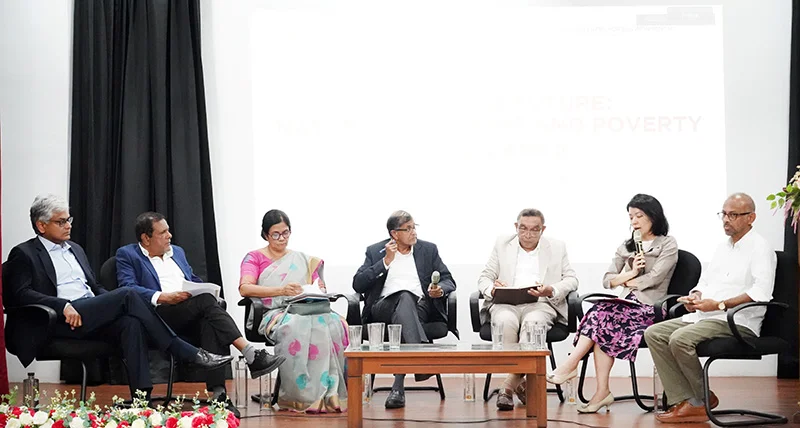
Sri Lanka’s rising exposure to climate-related disasters and their growing implications for poverty, development planning, and fiscal sustainability were examined at a high-level policy panel organised by the Centre for Poverty Analysis (CEPA), in collaboration with the Centre for Environmental Studies and Sustainable Development of the Open University of Sri Lanka.
The discussion, titled “Facing the Future: Environmental Disasters and Poverty in Sri Lanka,” was held on 26 January at the Open University of Sri Lanka, Nawala, against the backdrop of Cyclone Ditwah and a series of climate shocks that have intensified vulnerabilities as the country recovers from the 2022 economic crisis.
Addressing post-disaster recovery financing, John Keells Holdings Chairperson and CEO Krishan Balendra said the private sector’s role has been focused on mobilising funds rather than determining reconstruction priorities. He noted that fiscal discipline maintained since the economic crisis allowed the Government to finance immediate relief without emergency market borrowing. The Rebuilding Sri Lanka Fund, he said, has so far mobilised over Rs. 8.4 billion from private sector sources, with additional commitments expected as overseas partners complete approval processes.
Several panellists highlighted that Sri Lanka’s disaster risks are being amplified by weaknesses in development planning and institutional coordination. Prof. Jagath Munasinghe of the University of Moratuwa observed that while Sri Lanka has numerous institutions and plans, the core challenge lies in poor coordination and weak implementation frameworks. He stressed that the country has repeatedly failed to undertake advance risk and damage assessments despite decades of exposure to floods, landslides, and other disasters, limiting opportunities to genuinely “build back better.”
From an environmental economics perspective, Dr. Herath Gunathilake emphasised that climate-related disasters are scientifically linked to global climate change, even as global governance systems for climate action weaken. Given Sri Lanka’s limited capacity to influence global emissions outcomes, he argued that national policy must place greater emphasis on adaptation, resilience, and disaster preparedness, while continuing to meet international climate responsibilities.
Concerns were also raised regarding environmental regulation and enforcement. Kusala Mahalekama, Director, Strategic Environmental Assessment at the Central Environmental Authority, pointed to capacity constraints in monitoring compliance with Environmental Impact Assessment (EIA) conditions, particularly in infrastructure, irrigation, and energy projects. She underscored the importance of expanding Strategic Environmental Assessments (SEA) at national and regional levels to integrate disaster risk reduction into policies, plans, and programmes, allowing for better mapping of vulnerable ecosystems and communities.
Linking environmental vulnerability with long-standing development challenges, CEPA Executive Director Prof. Sirimal Abeyratne noted that Sri Lanka’s limited urbanisation and industrialisation have resulted in nearly 78.5% of the population living in rural areas, often in environmentally fragile locations such as riverbanks, coastal belts, and landslide-prone zones. He stressed that disaster mitigation should focus on reducing people’s exposure to risk through better spatial planning, urban development, and livelihood diversification, rather than attempting to prevent natural events themselves.
-

- Dr. Indika Bulankulame, Senior Research Member and Head of Communications at CEPA, delivering the welcome address at the event.
-
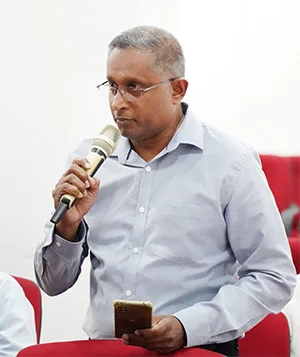
- Participants engage with the panelists during the Q&A session of the discussion.
Delivering opening remarks, UNDP Resident Representative Azusa Kubota highlighted the importance of nationally led assessment and recovery frameworks. She explained that different post-disaster assessment tools serve distinct purposes and should not be directly compared. Sri Lanka’s Post-Disaster Needs Assessment (PDNA) led by the Disaster Management Centre and Ministry of Finance, she said, represents the most comprehensive national instrument to guide emergency financing, recovery planning, and a coordinated “Building Back Better” approach based on hazard-informed planning and stronger institutional collaboration.
The discussion was moderated by Dr. Ganeshan Wignaraja, Senior Advisor at CEPA and Visiting Fellow at ODI, UK. Participants agreed that without deeper integration of disaster risk reduction into development planning, climate shocks could undermine recovery gains and place renewed pressure on public finances and livelihoods.


Private taxi operators at Bandaranaike International Airport are calling for urgent rental relief, stating that they are struggling to sustain operations after paying nearly Rs. 19 million in monthly rental fees amid a sharp decline in tourist arrivals during the off-season.
The operators said tourist arrivals have dropped by nearly 80%, severely affecting their income and making it difficult to continue meeting high operational costs.
“Only a small number of tourists are now arriving at the airport, and a majority of them are being taken by metered taxi operators, who pay only around Rs. 700 per ride as fees to Airport and Aviation Services, an operator said.
According to the operators, the six long-standing private taxi service providers at the airport each pay monthly rentals ranging from approximately Rs. 2.9 million to Rs. 4 million. In addition, they are required to maintain a minimum a fleet of six vehicles along with dedicated airport staff.
“What we are requesting is a temporary reduction in monthly rental payments for around three to four months until tourist arrivals improve and the industry returns to normal, they said.
The operators noted that they have been operating at the airport for more than two decades, providing transport services to both local and international travelers, while metered taxi services entered the airport transport sector only about two years ago.
They also alleged that metered taxi operators have been granted more favourable operating conditions and questioned the process through which those operators were allowed to operate at the airport.
Operators argue that the present financial burden has become unsustainable, given the sharp drop in business volumes and what they describe as an uneven competitive environment within the airport transport system.
“What we are requesting is a 50% reduction in monthly rental fees for a period of at least three months, they said.
They also raised concerns about the quality and condition of some vehicles operated by metered taxi providers.
“Passengers are often unaware of the condition of some of these vehicles until they enter them, which can compromise safety standards, one operator claimed.
In contrast, the private airport taxi operators say they maintain newer vehicles and employ experienced, professionally trained drivers to ensure higher standards of passenger safety and service quality.
The operators warned that failure to address the issue could have wider economic and social consequences. The six service providers collectively employ around 250 staff, and continued financial pressure may lead to job losses and a reduction in organised airport transport services.
By Hiran H Senewiratne

The operation of Automobile Association of Ceylon(AAC) Call Boxes, in the past had provided yeoman service to many motorists including during the era of British planters. AAC services for members are a motoring security when they travel.
The Call Box in Nuwara Eliya was recently refurbished to provide a better and improved service to the Members in the area and the touring public. Now from this Call Box the motorists could get Road Side Assistance, Valuation Reports, Technical Advice and also issuance of International Driving Permits.
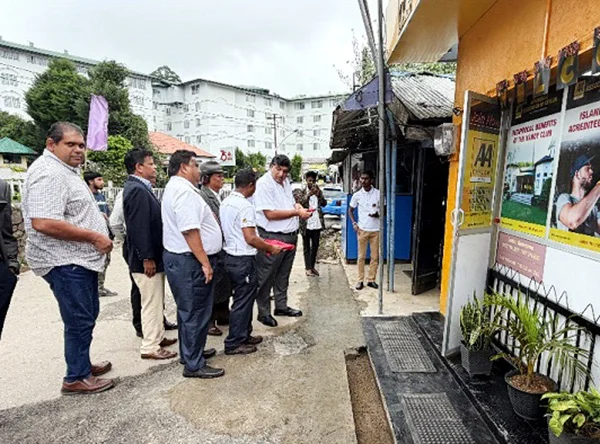
The refurbished Call Box at Nuwara Eliya was declared open by Dhammika Attygalle, President of the Association in the presence of S V Ganesh – Vice President, several Executive Committee members, Puthrasigamani, Life Member of the Association, Eng. C S Samarasekera of RDA- Nuwara Eliya, Devapriya Hettiarachchi, Secretary (AAC) and Eng. C L Liyanasuriya – Chief Engineer(AAC).
The services from the Nuwara Eliya Call Box are available from 8.00am to 5.00pm.
Call Technical Officer Sampath Madagama on 0767315696.

From Risk to Opportunity: Mainstreaming Climate Action into Sri Lanka’s Growth Story
As climate rules tighten globally and investor expectations shift from commitment to compliance, climate action is now directly tied to trade, competitiveness, and access to finance. Against this backdrop, The Ceylon Chamber of Commerce will host the second edition of the Sri Lanka Climate Summit on 9 June 2026 at the Taj Samudra Hotel, convening policymakers, industry leaders, financiers, and technical experts to focus on pathways for integrating climate action into Sri Lanka’s growth story.
Held as a biennial platform, the Summit returns this year under the theme “From Risk to Opportunity: Mainstreaming Climate Action into Sri Lanka’s Growth Story.” While the inaugural edition in 2024 focused on building awareness and advocacy, the 2026 Summit shifts the conversation toward implementation, technical readiness, and compliance as climate-related obligations begin to directly influence access to markets, finance, and investment.
Rather than treating sustainability as a standalone agenda, this year’s discussions will explore how climate considerations are becoming embedded across core areas of business and economic decision-making, from infrastructure and trade to finance, governance, digitalisation, agriculture, and supply chains.

China’s Xi Jinping, Russian President Vladimir Putin hold talks in Beijing

Politics is not something separate from development. It shapes every choice we make in governance – PM

Taijul takes six as Bangladesh complete 2-0 sweep

At least 10 dead as huge floods sweep southern and central China

Ebola outbreak may be spreading faster than first thought, WHO doctor warns

Sooryavanshi’s stunning 93 takes Rajasthan Royals closer to IPL playoffs

‘Dates have the highest sugar content to fight Coronavirus’

Sunday Island 27 December – Headlines

#SundayIsland 17th December – Headlines

Sunday Island – 28th March

Sunday Island Headlines – 21 March

Sunday Island – 21st February – Headlines
-

 Features4 days ago
Sri Lankan Airlines Airbus Scandal and the Death of Kapila Chandrasena and my Brother Rajeewa
-

 News5 days ago
Lanka’s eligibility to draw next IMF tranche of USD 700 mn hinges on ‘restoration of cost-recovery pricing for electricity and fuel’
-

 News4 days ago
Kapila Chandrasena case: GN phone records under court scrutiny
-

 News4 days ago
Rupee slide rekindles 2022 crisis fears as inflation risks mount
-

 Opinion7 days ago
Electricity tariffs have skyrocketed: Can further increases be prevented?
-

 Business4 days ago
Expansion of PayPal services in Sri Lanka officially announced
-

 Features6 days ago
Mysterious Death of United Nations Secretary General Hammarskjöld
-

 News4 days ago
Court orders further arrests in alleged USD 42 Mn NDB fraud case