
Sports
Remembering one of cricket’s finest leaders

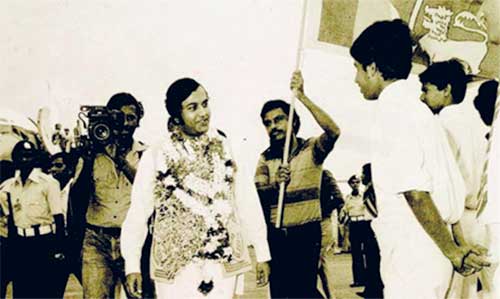
Gamini Dissanayakae returns home having attended the ICC meeting that granted Sri Lanka Test status.
by Rex Clementine
The 79th birth anniversary of former Minister Gamini Dissanayake falls today. Dissanayake was one of the longest serving Presidents of Sri Lanka Cricket and was instrumental in winning the nation Test status in 1981, something that he achieved at the age of 39. Dissanayake had become a Minister at the age of 35 and had many feathers in his cap from 1978 to 1989.
World Cup winning captain Arjuna Ranatunga who delivered the keynote address at an event held yesterday at the Sports Ministry to mark his 79th birth anniversary elaborated on the immense contributions he made in developing the sport and building up leaders like him.
Having achieved the nation’s dream of Test status in 1981 after many failed attempts, it was a massive blow when several leading players defected to South Africa on a rebel tour. Gamini came down hard on the players handing all participants 25 year bans.
This was a bitter blow for players as they were banned from coaching and other cricket activities but none of them hold a grudge against Gamini. First Test captain Bandula Warnapura recently revealed that he did not have an axe to grind with the former Board President.
Business tycoon Abdul Rahman Bukathir, who conducted cricket tournaments in Sharjah, told this paper in 2011 how meticulous Dissanayake was in getting the best comforts for his players while they were in UAE.
The first instance where the players were paid per diem in USD was in Sharjah and this was negotiated by Dissanayake.
Ranatunga recalled how he visited Dissanayakae just before he went on a tour to Zimbabwe in 1994 and it was while in Harare that he learned the killing of his mentor while canvassing ahead of the Presidential election. The charismatic and caring leader was only 52. Dissanayake had wanted Ranatunga to get the right combination for the World Cup that was fast approaching.
Soon after landing at Katunayake having won the World Cup in 1996, one of the first things that Arjuna did was to visit Dissanayake family with the World Cup trophy.
Gamini’s elder son Naveen was the first Sports Minister of the Yahapalana government. Following negotiations with the International Cricket Council, Naveen had got the blessings of the global governing body to appoint an Interim Committee and change the constitution of SLC. Former Supreme Court Judge Prasanna Jayawardene had done a case study along the constitutions of South Africa Cricket and Irish Cricket boards. But before changes could take place, during a cabinet reshuffle then Prime Minister Ranil Wickremesinghe agreed to give away the Sports Ministry to the SLFP. Under new Sports Minister Dayasiri Jayasekara cricket elections were called and all familiar faces returned to govern cricket. The rest as they say is history.


by Rex Clementine
In the history of Test cricket, we have witnessed some epic rearguard actions that have saved the day.
Our coach Gary Kirsten himself once batted for 14 and half hours after England enforced the follow on in Durban. Sir Garfield Sobers did something similar when he occupied the crease for many hours to save the Lord’s Test of 1963.
Then, again at Lord’s, Mahela Jayawardene led from the front in 2006. Sri Lanka were forced to follow on after conceding a first innings deficit of 359 runs, but MJ produced a masterclass. With six other Sri Lankans posting half centuries, the tourists pulled off one of their greatest escapes.
And then, this week, came Sonal Dinusha.
What truly remarkable batting that was.
There is, however, one significant difference between Dinusha and those other greats. Kirsten, MJ and Sir Garry were all seasoned campaigners. Dinusha is a rookie playing just his fifth Test.
What was so impressive about the 25-year-old was how organised he was. He didn’t lose patience. He didn’t get carried away. There was no rush of blood.
These are hardly traits we associate with young players in modern cricket. We see them flashing outside off stump. We see them charging down the track wanting to take the spinners to the cleaners. We see them engaging opponents and getting sucked into needless scraps.
Dinusha, though, is different.
But how come? In this day and age of the IPL and instant gratification, how have we unearthed a cricketer with such temperament?
There is little doubt that this is a special kid and a special talent. Hopefully, Sri Lanka can dream big. Head Coach Gary Kirsten called it one of Sri Lanka’s finest match saving knocks.
“I love the way he plays Test cricket. He understands what the bowlers are trying to do to him. This innings today will go down in history as one of the best match-saving knocks for Sri Lanka.”
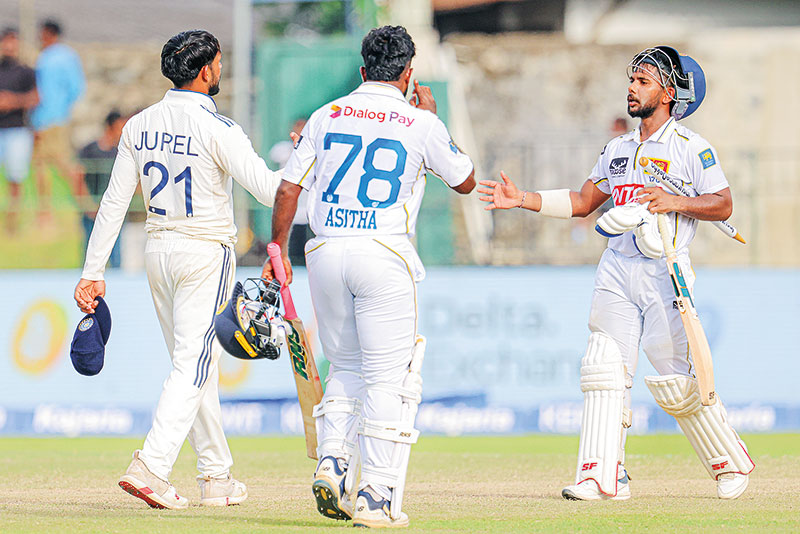
Dinusha batted for seven hours in the second innings. The fact that he had also scored a hundred in the first innings, having already made another century in Galle, makes his achievement even more extraordinary. He finished the series with 420 runs in four innings.
That was some insane batting. Let’s hope the kid keeps going.
Despite the series defeat, there were other positives for Sri Lanka. The manner in which Pasindu Sooriyabandara batted and the composure young spinner Keshara Nuwantha showcased when the team was under the cosh after yet another collapse were encouraging signs.
The lower order played impressive roles too. Lahiru Kumara batted like a champion and frankly, put some of the opening batters and the captain to shame.
Several Indian players turned up at the SSC on the final morning probably thinking this would be a quick finish and they would soon be heading home. Some might even have fancied squeezing in a bit of last minute shopping.
Dinusha and Sri Lanka’s tail had other ideas.
Those plans went out of the window as the lower order showed remarkable resolve, eating up overs and frustrating an Indian attack that had arrived expecting to administer the last rites.
“Really impressed with some of the young batters who have shown their mettle in Test match cricket. Apart from Sonal Dinusha and Pasindu Sooriyabandara, everyone put their hearts together, fighting as hard as we could to save the Test match. The character shown by everyone pleased me,” Kirsten said.
The fast bowling was top notch too. Both Lahiru Kumara and Asitha Fernando had their moments and provided another useful reminder that Sri Lanka do not always have to turn to raging turners to win Test matches. Quicks can win you games too.
By Anura Tennekoon
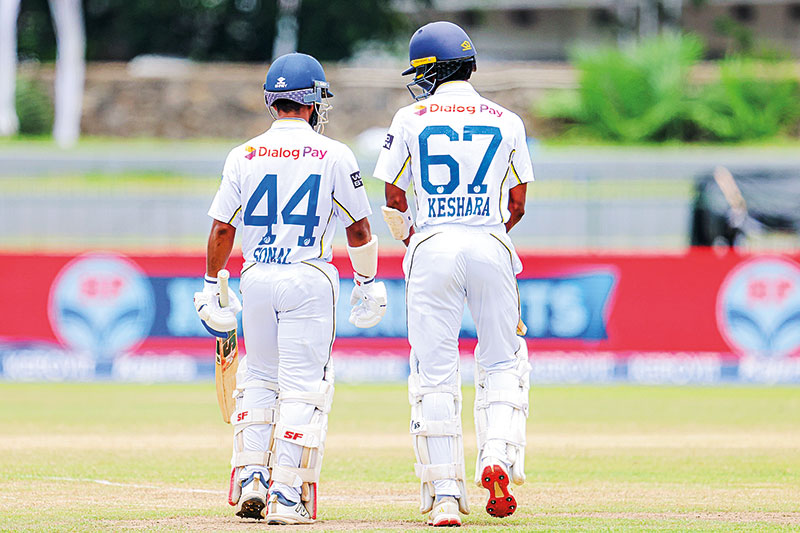
Sonal Dinusha, Sri Lanka’s number six batter, played the innings of a lifetime when he batted throughout the fifth day of the second Test against India to earn his side a hard-fought draw.
At the start of the final day, Sri Lanka were six wickets down and held a lead of just 16 runs. It was not a pretty picture. Few in their right mind would have given Sri Lanka much chance of surviving even until the lunch break, with India seemingly poised to complete a comprehensive victory.
Sonal, however, had other ideas. He resolved to bat as deep into the day as possible, finding willing allies among the lower order. They combined determination and patience with controlled aggression and sound defence. It caught the Indian bowlers by surprise. An attack that had looked lethal earlier in the game gradually began to lose its sting and direction.
The two overnight batters survived the entire morning session, adding 113 runs from 265 deliveries. After lunch, Nuwantha was eventually dismissed for a well-compiled 46, but by then Sri Lanka had begun to believe.
Lahiru Kumara, the burly fast bowler, joined Sonal in the middle and ensured India would have no easy route back into the contest. He did exactly what was required of him, dropping anchor and occupying the crease for 90 deliveries while scoring just 12 runs. Runs were almost irrelevant by then; survival was everything.
The pair batted through the tea break and beyond, taking Sri Lanka towards safety. It was a supreme batting effort, led magnificently by Sonal and aided and abetted by the bowlers at the other end.
I have hardly touched upon Sonal’s own contribution with the bat to this remarkable rescue mission. He employed the sweep, both orthodox and unorthodox, to excellent effect and scored most of his runs by placing the ball judiciously into the gaps and accumulating steadily. It was an innings of the highest order.
If I may point out one flaw, it was his reluctance to play the cover drive and off-drive, thereby depriving himself of some valuable scoring opportunities. But that is a minor observation in what was otherwise a stupendous batting effort for which no amount of praise can be too much.
A thing of beauty is indeed a joy forever, and this was an innings to remember.
Now that you have got off to such a flying start in your Test career, lad, keep improving and keep reaching for the skies.
My very best wishes to you in all your cricketing endeavours.
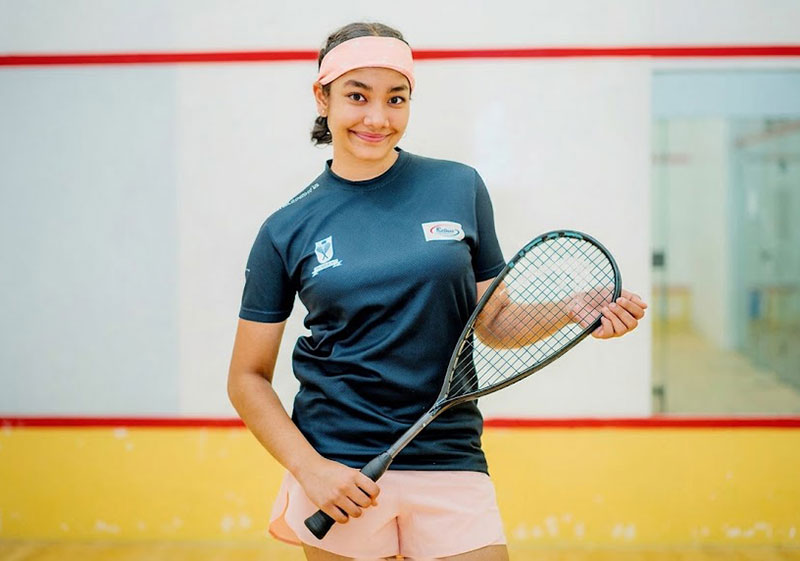
Gateway College’s Sithumli Mendis continued to make her mark on the international squash circuit, claiming her third overseas accolade after finishing runner-up in the Classic Plate at the 19th Korea Open Junior Squash Championships 2026 in Incheon, South Korea.
The promising youngster produced a string of impressive performances during the tournament, held from August 12 to 15 and featuring players from 18 countries and regions.
Sithumli began her campaign in commanding fashion, sweeping aside South Korea’s Ji Won Won in straight games, 11-5, 11-3, 11-4.
She faced a sterner examination in her second match against Malaysia’s J. M. Balasingam. Despite putting up a spirited fight, Sithumli went down 9-11, 7-11, 6-11, 8-11.
The setback, however, did little to dampen her resolve.
Dropping into the Classic Plate competition, Sithumli regrouped in style. She overcame South Korea’s Mun Ha-ram 11-8, 12-10 before accounting for another home favourite, Doeun Kim, 11-7, 11-6 in the semi-final to secure her place in the title clash.
In the final, Sithumli came up against South Korea’s Jane Lee and once again refused to go quietly. After conceding the opening game 7-11, she hit back strongly to take the second 11-4. Lee, however, held her nerve in the decider, winning 11-8 and leaving the Sri Lankan youngster with a well-earned runner-up finish.
The achievement represents another significant step in Sithumli’s blossoming career and marks her third international award.
Her success in Korea follows an impressive showing at the 37th Junior National Squash Championships in Sri Lanka last month. She finished runner-up in the Girls’ Under-17 event and claimed third place in the Girls’ Under-19 category.
Those performances also earned Sithumli the Most Promising Junior Girl Player of the Year 2026 award, underlining her status as one of Sri Lanka’s brightest young squash prospects.
The Korea Open brought together talented juniors from the United States, South Korea, Canada, Malaysia, India, Pakistan, Sri Lanka, Mongolia, China, Hong Kong China, Japan, Saudi Arabia, Chinese Taipei, Singapore, Macao China, Australia, Qatar and the United Kingdom.
Against such a strong international field, Sithumli’s podium finish was another encouraging indication that the young Sri Lankan is beginning to make her presence felt beyond home shores.

Voting closes in Iceland’s knife-edge EU referendum

Showers in the Sabaragamuwa, Western and North-western provinces and in Galle, Matara, Kandy and Nuwara-Eliya districts

Sun directly overhead Mannar, Periyamadu, Puliyankulam, Welioya and Pulmoddai about 12.11 noon today (30)

Lanka tracks 11 US-sanctioned Iranian tankers off coast

House to debate abolition of Chief of Defence Staff post

Mass graves tragic evidence of failed states – Rathnayake

‘Dates have the highest sugar content to fight Coronavirus’

Sunday Island 27 December – Headlines

#SundayIsland 17th December – Headlines

Sunday Island – 28th March

Sunday Island Headlines – 21 March

Sunday Island – 21st February – Headlines
-

 News5 days ago
Missing doctor’s body found in Mahiyanganaya
-
 News5 days ago
Australia declines to release Finance Secy Suriyapperuma’s citizenship details
-

 News5 days ago
22A: BASL suggests CJ recuse himself from hearing petitions
-

 News2 days ago
Eight politicians in drug kingpin probe
-

 Editorial6 days ago
Govts. drag feet as undergrads age
-
 Features4 days ago
Insights from Chieftains of Uva: Genealogy of two Kandyan Families – Part II
-

 Features4 days ago
Export diversification: Missing the wood for the trees – Part I
-

 Business2 days ago
Sri Lanka opens up: A new season of direct connectivity