
Opinion
Ditwah wake-up call demands a national volunteer community service for rebuilding Sri Lanka

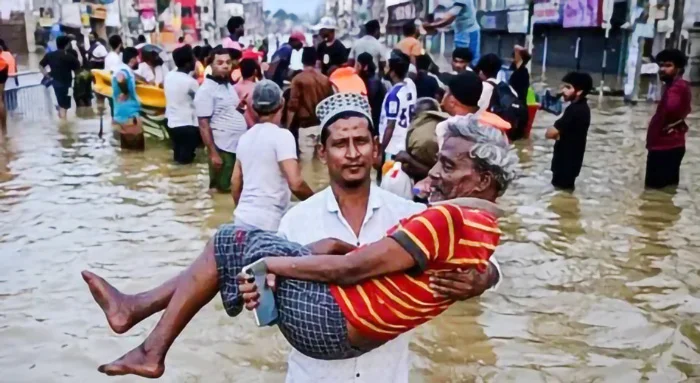
The Tsunami of 2004 struck our coasts, but the recent Cyclone Ditwah has delivered an unprecedented blow, devastating and traumatising the entire country. President Anura Kumara Dissanayake rightly called it the “largest and most challenging natural disaster” in Sri Lanka’s history.
The toll is staggering: Over 600 people were confirmed dead, with hundreds still missing. More than 2 million citizens – nearly one in ten people—have been affected. 41,000 to 86,000 houses are damaged or completely destroyed. The damage is widespread, with 22 of the island’s 25 districts declared disaster-affected areas. A provisional economic damage estimate reaching up to USD 7 billion—a figure that instantly consumes about 7% of our national GDP. This was not merely a natural disaster; it was a crisis amplified by systemic failure, culminating in a catastrophe that now demands a radical, long-term policy response.
Unlike the Tsunami, the destruction to our vital inland infrastructure—roads, bridges, railway lines, and power networks—has been colossal, crippling the nation’s ability to recover. Over 25,000 members of the tri-forces have been mobilised, and the nation rightly hails their courageous and relentless efforts in rescue and relief. They should now be graduated from ‘Rana Viruvo’ to RUN VIRUVO considering the efforts they are still putting into the relief operations in this unprecedented calamity. But the scale of the rebuilding effort requires a permanently sustained unified national mechanism, perhaps learning from their rich experiences.
Why did devastation reach this cataclysmic level?
Unlike a sudden earthquake/Tsunami, a cyclone’s path is largely traceable. Yet, the “post-mortem” on Ditwah reveals a horrifying truth: the storm’s devastation was amplified by our own institutional failures.
The India Meteorological Department (IMD) which runs the Regional Specialised Meteorological Centre (RMSC) monitors the oceans in this region and issues alerts for cyclones. It serves all the regional countries — Bangladesh, Maldives, Myanmar, Oman, Pakistan, Sri Lanka and Thailand. The RMSC first predicted the formation of a depression as early as November 13 and issued an alert over the possibility of a cyclone forming on November 20. From November 23 onwards, IMD/RMSC had been routinely sharing frequent weather updates with Sri Lanka.
Robust models from the India Meteorological Department and the RMSC provided ample warnings of the depression and subsequent cyclonic intensification. Some of these predictions by the RMC and even the BBC forecasted rainfall over 300- 400 mm which could go up to even half a meter per day. True to their forecasts, Matale tragically received unprecedented rainfall of around 520 mm, triggering fatal landslides. Ditwah’s impact was worsened by its unusually slow movement over the island which sustained heavy rainfall over several days.
The Governance Gap
The critical breakdown occurred between the scientific prediction and the state’s executive arm. Warnings, if not taken seriously or acted upon, become meaningless data points. The core issue is a fragmented disaster management system that lacks the “unified command structure” required for real-time data sharing and rapid deployment. As one analyst noted, the disaster delivered a hard lesson: we entered one of our worst natural disasters in decades without a functioning national strategy and with a severe deficit in “adaptive capacity.
Scientific forecasts were not translated into an appropriate, urgent disaster preparedness program by the Sri Lankan state apparatus. Public reports indicate that national preparedness was woefully short of what was needed. The warnings failed to translate into a coherent, proactive response into an appropriate disaster preparedness action program on the island. This failure points directly to long-standing institutional deficits.
The Strategic Imperative: Dedicated Workforce for a $7B Recovery
President Anura Kumara Dissanayake rightly emphasised that restoring public life requires a unified operational mechanism that goes beyond normal state administration. To tackle this immense task, the Government has established a ‘Rebuilding Sri Lanka Fund’ to finance the medium- and long-term recovery, including essential infrastructure and public health issues.
This newly established ‘Rebuilding Sri Lanka Fund’ addresses the financial cost, but it does not solve the fundamental manpower crisis which is a key bottleneck in retarding the progress of this formidable undertaking. Rebuilding 247 kilometers of impacted roads, restoring two-thirds of unusable railway lines, clearing hundreds of landslides, and repairing crucial irrigation systems demands a sustained, disciplined, and massive workforce that normal state administration simply cannot provide. Furthermore, with the changing climate, events of this nature and magnitude may be more frequent in the future.
As such, there is a moral call to a strategic imperative. The immediate, ad-hoc spontaneous public volunteerism is commendable, but the scale of the task ahead requires a permanent, non-partisan national investment in human resources. The time for piecemeal recovery programs is over. Ditwah has forced the issue of structural accountability and national capacity onto the policy agenda.
A Call for Mandatory National Service
One of the most responsible paths forward is to utilise this crisis to institutionalise a robust National Service System, transforming a generation of youth into a standing army for climate resilience and nation-building. To fail to do so would be to guarantee that the next storm will bring an even higher price.
Sri Lanka cannot afford to be unprepared again. The solution is to immediately mobilise and, for the long term, institutionalise the patriotic energy of our youth into a robust, structured National Service System. This service should be more than just disaster relief; it is a long-term investment that will:
i) Build the Nation: Provide a rapid-response labour force for future disasters, infrastructure projects, and conservation efforts.
ii) Forge Character: Instill essential skills like discipline, leadership, accountability, and responsibility in our youth, thereby contributing to lower rates of substance abuse and crime.
iii) Strengthen Unity: Promote social cohesion and reinforce national identity by having youth from all backgrounds work together for a common cause.
The legal framework for such a move already exists. The Mobilisation and Supplementary Forces Act, No. 40 of 1985, already gives the government the powers to issue a National Service Order to enlist people in a National Armed Reserve. This mechanism can be adapted to establish a non-military, civilian-focused service.
Sri Lanka already has a government supported National Volunteer Service affiliated to her Social Services Department. It coordinates volunteers, develops management systems, and works with partners like the UN volunteers. This service can be improved and upgraded to tackle challenges in natural and/or human induced disasters which are going to be more frequent with greater intensity, at times.
In the immediate term, the large number of existing volunteers dispersed all over the island need to be engaged as understudy groups, working directly alongside the armed forces and government departments in the recovery process which is already happening in a number of instances.
Ditwah is our wake-up call for longer-term strategic planning and policy reforms. Alongside reacting to catastrophes in a piecemeal manner in the short-term, we must systematically start building a resilient nation with a vision for the future. Investing in a structured, mandatory Civilian National Service is the only way to safeguard our future against the inevitable challenges of climate change and to truly rebuild Sri Lanka.
Globally over 60 countries have national service portfolios mostly of military nature. Both Germany and France have recently reintroduced their national services to meet their own specific needs. In the US, the National Community Service centers around the Corporation for National and Community Service (CNCS), a federal agency that runs programs like AmeriCorps and Senior Corps, mobilising millions of Americans in service to address needs in education, disaster relief, environment, and more, fostering civic duty and offering educational awards for service.
Incorporate National Service into Educational Reforms
We must mobilize our youthful energy into a national service portfolio unique to our own needs giving due recognition to our history, geography and culture. As a long-term investment, this should be initiated while children are still in school, preparing them mentally and physically to contribute to nation-building.
A well-designed National Volunteer Community Service would instill discipline and foster essential skills like leadership, responsibility, and mutual respect, while contributing at the same time to national development. We can tailor this service to tackle our unique challenges in public safety, disaster relief, and environment conservation.
Existing school programmes like scouting and cadeting can be innovatively transformed to lay a sound foundation for this life-changing National Service for all schoolchildren. According to the initial estimates of UNICEF, over 275,000 children are among the 1.4 million people affected both physically and mentally who need careful rehabilitation.
The current educational reforms are an ideal platform to impart crucial values in patriotism and introduce essential skills like time management, discipline, and accountability. This system could not only build successful individuals but also help decrease social issues like substance abuse and crime among youth.
In the immediate future, to meet the demands of the recovery effort now, currently available volunteers should be engaged as understudy groups, working alongside the armed forces and government departments involved in the rebuilding process. The long-term investment in a Mandatory National Service, on the other hand, will strengthen our national identity and contribute to the “unified operational mechanism” the President has called for.
The author can be contacted at nimsavg@gmail.com
by Emeritus Professor
Nimal Gunatilleke

Aragalaya betrayed? ‘The treason of the intellectuals’ in the age of populism – Part II
The JVP/NPP conceptualisation of the ‘Jathika punarudaya’ (national renaissance) interpreted the Sri Lankan Renaissance as the aspiration to regain the moment we lost in the global modernisation project, which is believed to have emerged in the twentieth century as a result of the Western European Renaissance and Enlightenment imagination. Jathika punarudaya values modernity as the era of citizens based on a representative democratic model founded on a common social contract. It values human rights, civil rights, and political rights as the core of modernity. It values social interventions based on the values of social justice and collectivism. But is the current government acting on the basis of those renaissance beliefs that they claim to believe in?
This government came to power within the framework of bourgeois parliamentary democracy. However, the opposition alleges that the government is working to limit the right of the opposition to question the government’s actions within that framework, and within Parliament itself. The continued postponement of provincial council elections by the government has been criticized as a delay in the implementation of decentralised political power, especially in provinces inhabited by Tamils and Muslims.
The promise to abolish the executive presidency and restore a parliamentary-based political power structure continues to be postponed. This has drawn attention as a possible way to suppress trade union activities and intimidate political activists through repressive laws such as the Public Security Act and the Emergency Law, which are continuously implemented through the authoritarian use of the power of the executive presidency.
‘Honest party leadership,’ not the institutional system
The JVP, the core political party of the current government, which insists that its members are honest, claims that even if they violate certain rules and regulations in the course of governing, there is nothing wrong with it because it is not done for personal interest but for the common good. This implies that this government does not rely on rules, regulations, and a system of institutions built to last, but rather on the leaders of its own party, the JVP, whose leaders believe themselves to be honest. The system of institutions established on rules and regulations is for the rest of the people.
Attempts to subjugate institutions and public opinion to the government’s opinion
It is apparent that the government wants to implement its pre-designed agenda without any hindrance. To that end, the government is trying to subjugate all institutions and public opinion to its sole opinion. The most striking example of this approach is the government’s attempt to implement, without any genuine public discussion, neoliberal reforms formulated by previous governments regarding national education, which will have a decisive impact on the future of the country. The leadership brags that the proposed education reforms will be implemented as originally designed, regardless of any criticism or objections.
The government sets up committees at the local level claiming to represent the public, but people complain that they exclude anyone who does not conform to their way of thinking.
Freedom of expression
Civil rights activists say the current government’s continued use of the Online Safety Act, which was passed by the previous government despite public opposition, poses a serious threat to freedom of expression. Freedom of expression has been suppressed under the guise of legality. The government has made it a policy to summon and question individuals who criticise the government—even national-level politicians—at the CID. This amounts to intimidating its critics.
The government has not only broken its promises by failing to repeal the existing PTA but is also attempting to pass a new anti-terrorism law that local and international civil rights organizations have unanimously condemned as even more repressive. It has been stated that there is scope for the proposed new law to intensify the current use of anti-terrorism law as a weapon to suppress freedom of expression.
“The Arts Council has become an arts police!”
The latest instance of the government’s attempt to curb freedom of expression that has come under serious public criticism is the detention of four books by a Sri Lankan writer, Theebachelvan, who writes in Tamil, by Sri Lankan Customs when they were brought into the country from India. Later, a statement issued by the Director of Customs said that two of the novels would be released based on recommendations issued by the National Arts Council and the Literary Council, while the other two would not be released based on the recommendations of those boards and the Ministry of Defense.
The statement that “The Arts Council has become an arts police!” sums up the public protest that arose questioning the “legal and moral rights of the members of the Arts Council and the Literary Council who have received political appointments” to “measure and mark the boundaries of freedom of speech and expression at their own discretion” by giving such recommendations and assuming a power that they do not have.
Going beyond this general situation, the serious question that has been raised is: on what basis did Customs consider the views expressed in the two books by Theebachelvan that have been censored to be equivalent to the crime of ‘sedition’ under Section 120 of the Penal Code, which was cited as the reason for the detention? A related question is whether there is a connection between the allegation of sedition and the fact that the writer is a Tamil from Kilinochchi.
The irony here is the intervention of the current government’s Minister of Culture, the heads of the Arts Council under the Ministry of Culture, and its own literary sub-council in deciding this matter, along with the follow-up statements defending the government’s decision made by the same authorities, as well as by writers, artists, intellectuals, and academics who have been holding positions under the current government and those who have not.
There was strong public criticism that these individuals—who were believed to have held radical, liberal views on freedom of expression and ethnic rights before the current government came to power—have been appointed to various positions under the current government and now approve its repressive decisions in the name of ethnic reconciliation.
The following sentiments extracted from the comments made by Sumathy Sivamohan on her FB page, expressing her shock at a statement made by one of the leading Sinhala writers involved in making such statements, encapsulate the essence of the public criticism of the issue:
” I am shocked at [name of the person]’s words on the detainment of Theebachelvan’s works by Customs. … The radicalness, the liberalness, are just thin veneers of their Sinhala-only stances. …. Now, they talk of Reconciliation. Reconciliation via Repression. …. Reconciliation, my foot! …. reconciliation is in your head, I think …. [I am] outraged. But now, [I] am certain of one thing. This is the bluff and bluster of liberals. …. That [name of the person] and others think, when Sinhala people think there’s reconciliation, there’s reconciliation, smacks of very deep-rooted racism
I don’t understand the argument, ‘we have to protect this government’ sentiment, touted by many liberals, who in intimate circles voice criticism. And these are the same people who supported the LTTE too, when it suited them—their liberal Sinhala agendas. … Now, they are blubbering …. it is shocking, for it whisks the mask off the faces of these liberal faces. There is a side of Sinhala liberalism that slavishly supports sentiments pertaining to the LTTE. They are the same, they are all the same. Those radicals, those liberals, those everybody, who think because they are Sinhala they have superior knowledge of matters. Sickening.” (reproduced with permission). (To be continued)
by Kumudu Kusum Kumara


 (The author is on X as @sasmester)
On 6 May 2026, I wrote an essay in this column titled, ‘Monks, the Law and the Future of the Buddhist Monastic Order.’ While my point of departure was the arrest of 22 Buddhist monks on narcotics charges, my focus was the need to treat everyone in this country equally before the law – including Buddhist monks. The fact that the Mahanayaka Theros had requested in a statement that the errant monks be thoroughly investigated and legally dealt with was encouraging given their usual silence in such cases. Now, another – and an even more visible case – has come to the fore. This time, the Chief Prelate of the Atamasthana, Venerable Pallegama Hemarathana Thero, has been accused of sexually abusing an underage girl from Anuradhapura. The National Child Protection Authority reported the facts of the incident that had been discovered to the Anuradhapura Magistrate’s Court on 8 May 2026, and the court subsequently ordered the arrest of the suspect monk and the girl’s mother. Anuradhapura Chief Magistrate has also imposed a foreign travel ban on the suspect monk.
But unlike with the 22 monks in the earlier case, the usual silence on the part of the Reverend Mahanayakas and other senior monks have descended upon Venerable Hemarathana’s case and the seeming non-equality before the law seems to prevail again – at least to some extent. This time, there are no public statements or meetings with the President to urge action to the ‘fullest extent of the law’ as was the case earlier. One must assume this is because the accused this time is a senior and influential prelate as opposed to a group of unknown young monks in the earlier case.
While his case was gathering momentum both in the courts and in public discourse, Ven Hemaratana promptly admitted himself to a comfortable private hospital in Colombo following the established path already followed by many affluent suspects. However, he was officially arrested on 8 May 2026. It is unfortunate that he resorted to this course of action rather than presenting himself to the prison authorities through the courts. This is because this action of anticipated privilege places him on par with all the powerful suspects in this country in recent times who have taken the same path. This is a matter of his own choice. My understanding is Venerable Hemarathana, after being arrested at the private hospital has been officially placed under remand and held in a government hospital under prison custody. While the law has worked here in terms of the arrest and the preceding action unlike numerous other occasions in recent decades when it comes to powerful individuals, many commentators claim it has still been somewhat slow. This perception also comes from the long history of negative experiences society has witnessed and the expectation of better delivery of justice under the watch of the present government. Overall, however, I think the procedure so far indicates a somewhat positive development given the unenviable history involving such high-profile cases in the past. But the public vigilance over the case should not diminish.
However, despite the typical silence within the formal Buddhist ecclesiastical establishment, there is considerable debate and often unmitigated noise mostly emanating from social media clamouring for the need for justice for the allegedly abused girl. If not for this noise, my sense is, the present case too might have been swept under the carpet as has been done many times before in similar circumstances.
But the social media clamour, despite its positive impact on pressuring government agencies towards action, has its own major failings. Many of these articulations have already decided upon Venerable Hemarathana’s guilt as if they had access to all the evidence in the case and have unparalleled legal expertise that would allow them to act as judge, jury and executioner in a court of public popularity. This approach itself is very dangerous. Irrespective of how we may feel about the case and the plight of the young girl who has been victimised in more ways than one, Venerable Hemarathana is still merely an accused or suspect. Nothing has been proven beyond any doubt in a court of law. Social media acting as an all-inclusive judicial mechanism is simply dangerous and unintelligent. The next victim can easily be any one of us for no good reason and the present social media trend-setters have already set the precedent.
The only sensible thing the social media and intelligent citizens, particularly Buddhists can do is not to make judgements in a situation where they simply cannot, but contribute to sensible and thoughtful debate and pressure the Buddhist establishment as well as the government to initiate urgent ecclesiastical reforms and ensure monks are treated exactly the same as all other citizens when they violate the law of the land. Hiding or protecting wrongdoers is not the solution as it will only make matters worse in the long run.
A somewhat comparative but limited global example is the Catholic Church which has faced extensive and recurring controversies regarding child sexual abuse across almost all continents, mostly as a vocal public discourse from the 1980s onward. It would be good to see how these controversies emerged and what happened.
The controversies in the United States emerged in 1985, 2002, 2018 even though it is the 2002 Boston Globe exposé that is considered the most damaging and became a global turning point indicating systemic institutional silence within the church. The controversies in Ireland emerged between the 1990s and 2009 mostly emanating from several government-commissioned reports that include the Ryan Report (2009) and Murphy Report (2009), which documented widespread physical and sexual abuse in Church-controlled institutions from 1936 to 1999, which concluded both the Church and state failed to protect children. Similar conservatories concerning the Catholic Church have emerged in Canada between the 1990s and 2015; in Australia between 2012 and 2018 as well as in other countries like Germany, Belgium, the Netherlands, France, Spain, Mexico and Chile.
What is important is these controversies created considerable public concern, characterised by a profound loss of institutional trust and demands for transparency. Crucially, these scandals fundamentally transformed the public perception of the Church and prompted significant legal and institutional reforms globally. This sense of public outrage, concern, demand for institutional reform and follow-up action is what is woefully lacking in Sri Lanka when it comes to the Buddhist monastic order.
But the Buddhist order certainly needs reform. And it needs such reform urgently and we must see these reforms in action without delay. Monastic orders should not be allowed to deal with or protect wrongdoers when they violate the law. Dealing with such situations should only be up to the legal and judicial system of the country.
Venerable Galkande Dammananda, in a YouTube interview with Saroj Pathirana on 18 May 2026 clearly noted that any member of the clergy who has violated the law should be dealt with by the law and it would simply be wrong not to do so. He was very clear in his explanation that no exemptions should be provided to monks. This basic legal and commonsense position which we seem to have forgotten in this country when it comes to powerful people in general and Buddhist monks in particular, should be the point of departure for reforming the Buddhist monastic order.
It would be instructive to understand the dilemmas faced by the Catholic Church globally if we are serious about getting Buddhist institutional network reformed. The crisis in the Catholic Church and its long-term neglect of justice and silence over wrongdoing ensured many people, particularly in countries like the United States distanced themselves from the church. Any inaction on the part of the Buddhist order and the government might lead the future of the Buddhist establishment in this direction too. One should not disregard the present unhappiness that is clearly visible and felt in society, mostly articulated in social media. These are mostly Buddhist voices.
We need to decide whether we want to reform our institutions and go forward or allow them to collapse and descend into chaos. The people should not forget that like any elected government, the Buddhist as well as other religious establishments survive on our collective kindness. And that kindness should not be based on blind and unintelligent faith. If they do not reform themselves and reinvent themselves, they certainly do not deserve our support.
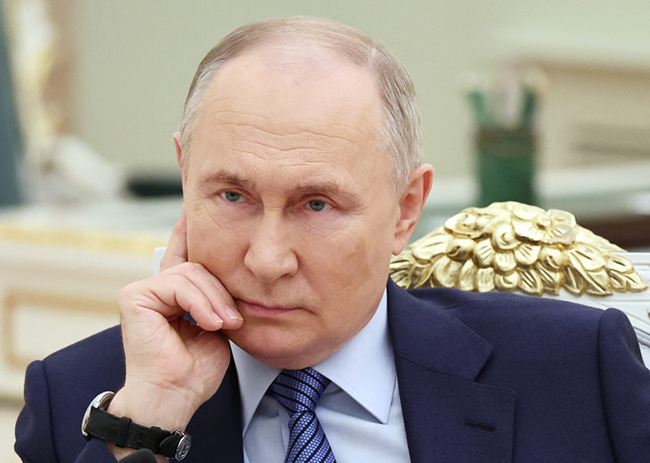
On 6 May, the British establishment organ, The Economist published an essay, “Vladimir Putin is losing his grip on Russia” by “a former senior official in the Russian government.” The anonymous author stated that Vladimir Putin has driven Russia into a dead-end and that a structural shift has occurred, whereby “senior officials, regional governors and businessmen” have mentally detached themselves from the state’s actions, viewing the current trajectory as “his” war rather than “ours”.
According to this narrative, Vladimir Putin’s grip on power is weakening due to the collapse of a social contract based on economic stability, replaced by purposeless and heavy-handed repression as the war backfires, with the regime’s efforts to maintain control only accelerating its internal decay.
Nine days later, on 15 May, The Guardian published a similar article by Rajan Menon, professor emeritus of international relations at Powell School, City University of New York. Sri Lankan cognoscenti might know him as a Western establishment intellectual, repeating Eelamist claims about civilian casualties at Mullivaikkal.
Menon argues that Russia’s war in Ukraine has become a grinding, attritional conflict that Vladimir Putin cannot end easily, even though the costs to Russia are enormous (the author quotes a figure of an estimated 1.3 million Russian troops dead or wounded). He says Russia’s GDP numbers look superficially strong, but this is misleading as there is no real prosperity: growth is driven by weapons production, with longterm development sacrificed for shortterm war needs, resulting in worsening labour shortages and rising inflation and budget deficits.
Putin cannot admit failure or seek compromise, Menon posits, because he has framed the war as existential, any retreat undermining his authority and the system he built. The author portrays a Russia of crushed dissent, pervasive propaganda, and general resignation to the war continuing indefinitely. He concludes that the Kremlin, locked into a costly, prolonged conflict, prefers escalation and endurance over negotiation, even if the war is unsustainable in the long run.
Both stories received wide coverage in the media, from Fortune to the right-wing Irish Times. Meanwhile, several other British media outlets ran similar stories. On 9 May, the BBC’s “From our own correspondent” reported that Putin faced rising unpopularity. “Putin faces Hitler-style downfall & could wind up dead in a bunker…” screamed the headline in the down-market Murdoch mouthpiece, The Sun the next day. The only slightly more respectable Daily Telegraph ran with “Paranoid Putin’s war is unravelling” on 13 May. Throughout this period the unhinged Daily Mail ran regular rant-pieces against Putin.
On 17 May, The Economist followed up with an article headlined, “Russia is starting to lose ground in Ukraine,” which claimed “… the tide of the conflict looks to be turning. Russia’s death toll remains extraordinarily high, and its spring offensive has stalled.”
Critical examination of the content of these articles can be quite revealing. For example, those “extraordinarily high” Russian casualty figures – supposedly ten times higher than Ukraine’s. Canadian analyst Alexandre Robert revealed the only comprehensive (name-by-name) tabulation of the relative casualties in the conflict on his History Legends YouTube channel. He calculated that by the end of February 2026, 170,537 Ukrainian military personnel had been killed, compared to 155,725 Russians. While these totals are high (the Ukrainian figures are considerably higher than Western estimates), the Russian casualties are much lower than estimated by Western or Ukrainian sources.
The result has been a manpower shortage on both sides. Russia mobilises men aged 18-30, targeting 261,000 annually, but only achieving about half this. For Ukraine, draft evasion in huge numbers, and nearly 300,000 soldiers deserting or going AWOL intensifies the problem, driven by exhausted frontline units, reduced voluntary enlistment, overstretched training pipelines, and public unease with mobilisation. The Ukrainian authorities have resorted to coercive, heavy-handed mobilisation practices, often seizing civilians on the street. The drafting age is 25-60, but Ukrainian men between 18-60 may not leave the country. Men aged 18-24 may be drafted if they have received training.
While Western analysts argue that Ukraine faces an acute shortage of trained, deployable infantry, they think that Russia maintains numerical mass but at sharply lower quality, relying on poorly trained mobilised reservists, prison recruits, and highattrition assault tactics. In this framing, Ukraine’s problem is a structural deficit of ready soldiers, whereas Russia’s is a quality and cohesion deficit, producing a “mass versus skill” dynamic that shapes the war’s tempo and casualty patterns.
Of course, they base this on a presumption of enormous Russian casualties due to “massed assaults.” In fact, in the face of massive enemy drone presence, the Russians developed tactics of infiltration by small teams of up to eight men, who go deep into enemy-held territory, from which they direct artillery fire and drone attacks on enemy positions. Using these tactics, they began capturing more territory, and an element of movement was added. This meant greater exposure to drones, raising casualty rates.
The Russian advances tend to be in short bursts, to minimise casualties. In contrast, the Ukrainians tend to make long rushes forward, taking more losses. Recently, they have adopted Russian infiltration tactics, making considerable progress in counterattacks. However, the Russians’ superiority in weapons and equipment means they recapture the territory lost fairly quickly.
The Russians fire about 10,000-20,000 artillery shells per day, compared to just 2,000 for the Ukrainians (spiking at 5,000 during offensives). Most of the Russian shells are manufactured domestically, the rest coming from North Korea and Iran. Ukraine is dependent upon its NATO allies, whose production is boosted by purchases from South Korea, South Africa, Turkey, and possibly indirectly from Pakistan and India.
Even more importantly, Russia uses 3,000-5,000 drones per day, while Ukraine launches 2,000-3,000 (spiking at 5,000 during offensives). Drones now cause an estimated 70% of battlefield losses, and the conflict has moved from “artillery-centric” to “drone-centric.” Both Ukraine and Russia build their own drones. But Russia is winning the war of attrition.
While The Economist has suggested otherwise, Russia’s spring offensive has not “stalled” amid “extraordinarily high” losses. The Russians paused operations waiting for the end of Easter and Victory Day ceasefires. Their spring offensive started getting into gear after Victory Day.
Economically, the war has been biting into Russian GDP growth, which declined from about 3.6% in 2023 to about 1.4% in 2025. However, manufacturing, driven by war production, has been growing at about 4% annually – although non-war-related production remains flat. Exports grew to US$ 30 billion in February and may be far higher due to the price escalation of petroleum following Trump’s war on Iran. Unemployment is at a historic low of 2%. Russia is tackling the resultant labour shortage through immigration of skilled workers from India, Bangladesh and China, with Sri Lanka also mentioned in the mix. Inflation is down to 5% from over 8% in 2023. So, economic stagnation is not a concern.
What about the issue of Putin’s popularity? The opinion polls have been consistent, with Putin having an approval rating of 65-85%. While most people expect the war to end in 2026, they favour escalation in the event of it extending. So, whence arises the Western perception of Putin’s fragility? A 23 February article by Peter Rutland and Elizaveta Gaufman in The Conversation says that signs of erosion and underlying fragility are increasingly visible beneath the surface. Of course, both of these academics – like Rajan Menon – have Cold War biases.
Why this sudden outburst of anti-Putin negativity? One much-commented-on aspect of the mainstream media of the West is the extent to which it sticks uniformly to the same narrative. For example, the media campaign which accused the then Labour Party leader, Jeremy Corbyn falsely of anti-Semitism included almost the entire mainstream media, including The Economist and The Guardian. So, this seems to be the beginning of a new propaganda campaign against Putin.
Of course, “Putin is losing his grip” nor “Putin’s undoing” are not rare phrases in the Western media. For example, “A war in Ukraine … could even prove Vladimir Putin’s undoing,” read a Facebook post by The Economist on 30 January 2022. Now, it says, “Putin is Hitler.” None other than former US Secretary of State Hillary Clinton equated Putin to Hitler in 2014.
The Western media may have launched this propaganda offensive because of the globally popular perception that Putin emerged a victor in the US-Israeli war on Iran. The West as a whole, its alliances fractured by popular opinion, faces humiliation. Revealing the truth about the Ukraine War – that Russia has captured nearly the entire Donbass region, its main strategic aim – might cause people to question the entire modus operandi of the Western powers.
While the political space exists in NATO countries to continue backing Ukraine, Ukrainian expectations are higher than what the publics of these countries would support. Deepening involvement (which Ukraine requires to stave off defeat) would likely face more resistance. The old consensus is breaking down.
By Vinod Moonesinghe

Cabinet approves sale of Paddy stocks held by the Paddy Marketing Board
Amendment to the Promotion of Export Agriculture Act, No. 46 of 1992 to be gazatted
Ms. M.K.D.N. Madampe, appointed as Director General of the Department of Management Services

Cabinet approves collaboration agreement between Sri Lanka and Brazil for the implementation of the “Sugarcane Project in Sri Lanka”
Cabinet approval for Implementation of a Project for the Joint Exchange of Genetic Resources between Sri Lanka and Vietnam and the Development of High-Yielding and Salinity-resilient Rice Varieties.

Landslide Early Warnings issued to the Districts of Kalutara, Kegalle, Nuwara Eliya and Ratnapura extended till1600 hrs on Wednesday [27]

‘Dates have the highest sugar content to fight Coronavirus’

Sunday Island 27 December – Headlines

#SundayIsland 17th December – Headlines

Sunday Island – 28th March

Sunday Island Headlines – 21 March

Sunday Island – 21st February – Headlines
-
 Features7 days ago
Octopus, Leech, and Snake: How Sri Lanka’s banks feast while the nation starves
-
 Sports7 days ago
Sri Lanka women’s volleyball team ready for Central Asian challenge
-
 Opinion6 days ago
Murder of Ehelepola family, Bogambara Wewa and Sightings of Wangediya
-

 Business5 days ago
Historic launch of CCWE Fashion Week & International Summit 2026
-
 News6 days ago
Steps underway to safeguard Sri Lanka’s maritime heritage
-
 News2 days ago
Police probe underway to ascertain links between criminals deported from UAE and local politicians
-
 Features3 days ago
The NPP’s pivot to the past
-

 Editorial6 days ago
A play without its protagonist