Connect with us

Latest News

Northern Japan hit by M7.5 earthquake, tsunami advisories lifted

Published

on

A magnitude 7.5 earthquake struck northern Japan on Monday. Tsunami advisories have been lifted for the Pacific coastline in northern Japan. But officials have issued an alert for a potential megaquake in northern Japan.

Strong tremors felt across the region

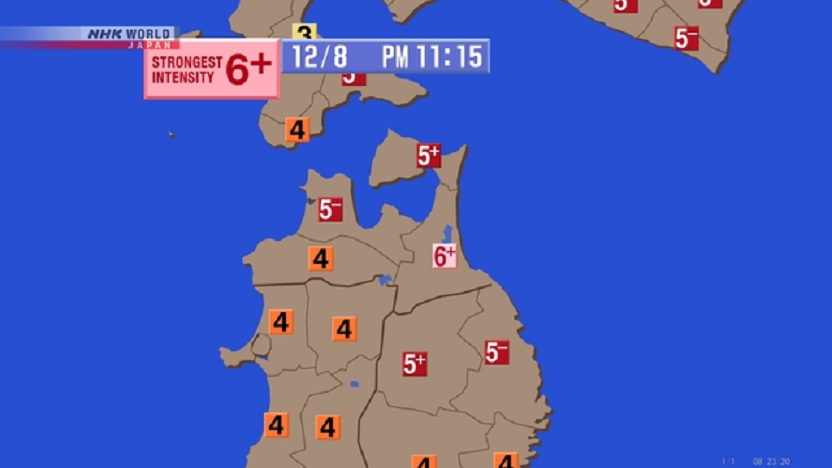
The earthquake struck off the eastern coast of Aomori Prefecture at 11:15 p.m. on Monday.

The Japan Meteorological Agency has downgraded the magnitude of the quake centered off the Pacific coast in Aomori Prefecture to 7.5 from 7.6.

The depth has also been adjusted to 54 kilometers, from an initial estimate of 50 kilometers.

Tremors with an intensity of upper 6 on the Japanese intensity scale of 0 to 7 were observed in the city of Hachinohe in Aomori Prefecture.

As of 1:00 a.m., six people in Aomori have been injured by either falling down or getting hit by falling objects at their homes.

Tsunami advisories lifted

Authorities had issued a tsunami warning for Iwate Prefecture and parts of Hokkaido and Aomori.

At Kuji Port in Iwate, a tsunami measuring 70 centimeters was observed. In Hokkaido, a 50-centimeter tsunami was seen in Urakawa Town and a 40-centimeter tsunami was observed at Mutsuogawara Port.

The Japan Meteorological Agency says: it is the first time the agency has issued a tsunami warning since July, when a powerful quake off Kamchatka, Russia, prompted it to issue one for Japan’s Pacific coastal areas.

Over 3 hours later, authorities downgraded the tsunami warning to advisories. And they lifted all tsunami advisories for the Pacific coastline of northern Japan at 6:20 a.m. on Tuesday.

‘Long-period ground motions’ recorded

According to authorities, long-period ground motions were recorded during the Monday earthquake.

The motions are slow, large-amplitude seismic waves with frequencies of 2 seconds or longer that occur during a large earthquake. Such motions are known to have a significant impact on high-rise buildings.

Strong long-period motions, classified class-3, the second highest in the 4-level scale were observed in the village of Rokkasho in Aomori Prefecture. Such class-3 waves are strong enough to make it difficult for people in a high-rise building to stand up.

‘An alert for a potential mega quake’ issued

Officials at Japan’s Meteorological Agency have issued an alert for a potential mega quake following Monday’s quake.

A mega quake could trigger tsunami along Japan’s Pacific coast from Hokkaido to Chiba Prefecture.

Officials are urging people to check evacuation routes, prepare emergency kits, secure home furniture and confirm backup food, water and portable toilets.

People along the Pacific coast in those areas should remain on the alert during the next week, even though an evacuation recommendation will not be issued.

The alert is the first since this category of warning was started in 2022.

Morikubo Tsukasa, Cabinet Office official for disaster preparedness, has held a news conference over a potential mega quake.

Morikubo: Based on the statistics of earthquakes that have occurred around the world so far, there is a possibility that a large-scale earthquake with a magnitude of 8 or higher could occur as a follow-up earthquake along the Japan Trench and the Chishima Trench off Hokkaido. It is unclear whether a large-scale earthquake will occur. But everyone should heed the call to take precaution to protect their own lives.

Residents ordered to evacuate

After tsunami warnings were issued, some municipalities in Hokkaido, and the Tohoku region issued evacuation orders to residents.

Traffic disrupted on Monday

East Japan Railway Company says that as of Tuesday, outbound trains on the Tohoku Shinkansen have been suspended between Fukushima and Shin-Aomori stations due to the earthquake. The company says three trains stopped in this section.

The company says that it is checking for any damage to railway tracks and that it remains unclear when services will resume.

The Morioka branch of East Japan Railway says that as of midnight on Tuesday, services on the Tohoku Main Line were suspended in Iwate Prefecture.

It says two trains made emergency stops. It remains unclear when services will resume. There are no reports of injuries.

As for Hokkaido, the operator of its busiest airport, New Chitose Airport near Sapporo, says that as of 11:40 p.m. on Monday, it was checking whether there are any abnormalities on two runways.

Highways have been affected. East Nippon Expressway Company says that as of 11:45 p.m. on Monday, traffic was completely stopped between the Shiraoi and Shinchitose Airport Interchanges and between the Tomakomai Higashi and Numanohata Nishi Interchanges.

Major traffic disorder unlikely on Tuesday

East Japan Railway Company says there has been no impact on its bullet train and regular train services after authorities issued the alert for potential megaquake following magnitude-7 or over quakes related to Monday’s quake. The operator, however, warns that delays or cancellations are still possible if damage to infrastructure is confirmed.

All Nippon Airways and Japan Airlines say they plan to operate as usual starting Tuesday.

According to Cabinet Office guidelines, no restrictions will be placed on railways, airports and roads, even after such an alert is issued. The authorities are supposed to provide the public with information about locations they consider being vulnerable to a possible major quake, as well as evacuation sites.

In August 2024, authorities issued a Nankai Trough megaquake advisory after a powerful earthquake struck in southern Japan. The operator of the Tokaido Shinkansen was forced to slow down its bullet trains in some sections over the ensuing one-week period.

Power Companies: No abnormalities at nuclear plants

Tokyo Electric Power Company says it has confirmed that there are no abnormalities at the Fukushima Daiichi and Daini nuclear plants.

The company says it halted the release of treated and diluted water from the Fukushima Daiichi nuclear power plant at 11:42 pm on Monday, as per predetermined procedures.

The facility suffered a triple meltdown during the March 2011 earthquake and tsunami. The water used to cool molten fuel has been mixing with rain and groundwater.

That has been treated to remove most radioactive substances, except tritium. It’s then diluted, reducing levels of tritium to well below the World Health Organization’s guidance for drinking water, before it is released into the ocean.

TEPCO also ordered some employees at the facility to evacuate. There have been no reports so far of injuries at the nuclear power plant.

Tohoku Electric Power Company says no abnormalities have been detected at the Higashidori nuclear power plant in Aomori Prefecture and the Onagawa plant in Miyagi Prefecture.

Hokkaido Electric Power Company says no problems have been found at the Tomari nuclear power plant in the prefecture.

Government bracing for damages

The Japanese government set up a task force at the crisis management center in the prime minister’s office at 11:16 p.m. on Monday in response to the earthquake.

Prime Minister Takaichi Sanae entered the prime minister’s office shortly after 11:50 p.m.

She instructed the government to immediately provide information on any tsunami and evacuation orders to the people in an appropriate manner, take thorough measures to prevent harm, such as evacuating residents, and get a grasp of the extent of damage as soon as possible.

Takaichi: The central government will work closely with local governments and make the utmost effort to carry out measures, such as emergency response, including rescue for the affected people.

Chief Cabinet Secretary Kihara Minoru held a news conference on Tuesday. Kihara said the government continues to assess the extent of the damage.

He added that the government is devoting all its efforts to disaster prevention measures, with rescue and relief efforts as its top priority, led by the police, fire departments, Self-Defense Forces, and Japan Coast Guard.

Expert view on the quake

Sakai Shinichi, professor at the Earthquake Research Institute of the University of Tokyo, says: If this was a shallow earthquake centered in the sea, there is a high possibility that a tsunami has already occurred. People should stay away from the coast. It is important to evacuate and to take measures to stay warm.

Sakai says: The epicenter may be north of the epicenter area of the 2011 Great East Japan Earthquake. This time, the earthquake is believed to have occurred at the plate boundary, so I think it was a slightly larger earthquake. The magnitude could be revised in the future.

[NHK]



Continue Reading
Advertisement
Click to comment

Leave a Reply

Your email address will not be published. Required fields are marked *

Latest News

Ben Stokes four-for, Ben Duckett hundred as England roar back

Published

on

By

Ben Duckett raced through to an 88-ball hundred [Cricinfo]

As well as things had gone for New Zealand on day one at Trent Bridge, they went badly on day two. England,  led by a four-wicket haul from Ben Stokes, completed their turnaround with the ball to cap the visitors at 438 – having been 317 for 0 – and Ben Duckett then rattled off his first international hundred in more than a year to launch the reply.

Duckett was given a life on 8, dropped in the slips by Henry Nicholls, but went on to form a second-wicket partnership worth 179 at exactly a run a ball with Jacob Bethell,  who was eyeing a hundred of his own by the close of another scorching day in Nottingham.

New Zealand’s problems were compounded by a concussion suffered by Blair Tickner, who was struck on the side of the helmet by Jofra Archer while batting and, despite initially being cleared to continue and delivering a three-over spell before tea, did not emerge for the evening session. He was eventually replaced by Zak Foulkes.

With Tickner, Mitchell Santner and Ben Sears – the three changes from New Zealand’s victorious XI at The Oval – all leaking runs at upwards of five an over, things began to unravel for the tourists. When Duckett brought up an 88-ball hundred midway through the evening session, the game had almost completely flipped in trajectory from 24 hours earlier, when Tom Latham and Devon Conway were amassing 150s during their triple-century opening stand.

Having taken two wickets with the last two balls on day one, England continued their fightback on the second morning. Stokes claimed three in the session during an eight-over spell, as New Zealand’s middle order struggled to build on the foundation laid for them, before two in an over from Shoaib Bashir helped wrap the innings up.

It meant New Zealand had suffered a collapse of 10 for 121 and their total of 438, while respectable, was nevertheless the third-lowest in Test history for any innings featuring a 300-run partnership – behind England’s 407 against India at Edgbaston last summer, and the 431 made by West Indies at Sabina Park in 1999 – and the lowest when those runs had been scored by the openers.

England’s momentum was briefly checked when Will O’Rourke had Emilio Gay caught down the leg side for a five-ball duck in the second over. They should have been 8 for 2 when Nathan Smith found Duckett’s outside edge, only for Nicholls to make a hash of the catch at third slip.

Duckett, who had twice drilled Smith for fours in his opening over, was in the mood to make New Zealand pay for such generosity. His next ball also disappeared through the covers, and he used the knowledge of his home ground to good effect, cutting, pulling and clipping his way to ten boundaries in a 40-ball fifty.

With Bethell recovering from a scratchy start against O’Rourke and the probing Smith, England went on to make New Zealand sweat in the field in much the same way they had through two-and-a-half sessions on day one.

Runs flowed in the passage after tea. Santner wasn’t allowed to settle, picked off for five boundaries in his first four overs by Duckett – although one of those, a thick outside edge, might have been held by Daryl Mitchell at slip had he not been stood so wide. From the other end, Sears was pulled and driven by Bethell, leaking 23 runs from three overs as England raced into three figures.

Latham was forced to go back to O’Rourke and, while Santner began to find some rhythm in his first Test appearance in ten months, Bethell worked him leg side for a single to bring up his first half-century in a home Test – and first such score in the first innings, having made all of his previous four in the second dig.

Duckett was by now in the 90s and quickly homed in on the milestone, his seventh hundred in Tests and first since the India series last year – ending a barren run of 22 innings in which he had only passed 50 three times. It was also his fourth 50-plus score in four innings at his home ground and although he was bowled shortly after, dragging on against Smith, Joe Root joined Bethell to steer England to the close two down.

New Zealand had added 77 to their overnight 361 for 4, Blundell’s 30 the only score of note as they fell well short of 500 – a total that looked all but inevitable when Latham and Conway were cashing in after opting to bat in baking conditions. Their frustration at being pegged back perhaps added to a sense of grievance around the dismissals of Mitchell and Santner, with both given out by the third umpire, Adrian Holdstock, after reviews.

The mercury was still rising on the second morning, with temperatures in the mid-30s C again forecast. New Zealand made a largely circumspect start in the knowledge that another long day in the field for England would only strengthen their hand in this deciding Test – only for Stokes to once again wrest the game his way during a tenacious spell with the ball.

O’Rourke, the nightwatcher, provided the main impetus for New Zealand inside the first hour as he advanced to his highest score in first-class cricket – beating the 17 not out he had made for Canterbury against Otago in March 2023. He managed boundaries off Archer, Josh Tongue and Stokes, comfortably eclipsing his previous Test best of 5 not out – and England then fluffed their first chance of a breakthrough as Jamie Smith dived across first slip in pursuit of a thick outside edge, but only managed to fingertip the ball out of Root’s grasp.

Stokes, already a shade of beetroot, threw his arms up in anger but bent himself to the task and extracted Mitchell an over later. Umpire Nitin Menon did not initially grant the appeal as Stokes nipped one past the bat, but UltraEdge detected a feather of an outside edge; Mitchell, however, seemed to think the sound was his bat hitting his front pad as he pushed forward.

O’Rourke was dismissed after the drinks break without having added to his score, and Stokes then chipped out his third of the session, and 250th in Tests, when Santner ducked into a bouncer and ballooned a catch to Bethell in the gully. Santner reviewed, gesturing that the ball had struck him on the arm guard. But Holdstock, in the TV umpire seat, took barely 30 seconds to examine one front-on replay before concluding that there was also contact with the strap of his glove, and upholding the on-field call.

After lunch, Bashir bounced back from dropping Blundell at deep backward square leg – a tough chance off Archer, but one he should have held having made up the ground. Archer’s chagrin appeared to extend to not joining the huddle to celebrate Bashir’s breakthrough a few balls later, when Smith drilled a return catch back – at least until Stokes made a point of calling the fast bowler up from fine leg.

Bashir made it two in four balls when Blundell missed a reverse-hoick at a delivery from round the wicket, which ball-tracking showed had pitched in line on review. With Nos. 10 and 11 at the crease, Archer had Tickner ducking and diving before delivering a full, straight one to pin Sears in front of leg stump first ball.

Scores:
England 223 for 2 in 45 overs (Ben Duckett 113, Jacob Bethell 74*) trail New Zealand 438 in 114.5 overs (Tom Latham 151, Devon Conway 157; Ben  Stokes 4-70) by 215 runs

[Cricinfo]

Continue Reading

Latest News

Venezuela shaken by magnitude 4.9 tremor days after major earthquakes

Published

on

By

A new earthquake has been detected off the northern coast of Venezuela, registering as magnitude 4.9 on the Richter scale.

The tremor on Friday comes days after a pair of powerful earthquakes struck the country on Wednesday evening, killing at least 920 people and leaving parts of the capital of Caracas devastated.

The earthquake tracker organisation EMSC said in a social media post that the latest earthquake took place 61 kilometres (36 miles) northwest of Maracay in northern Venezuela.

Additional details are not yet known, but the news service Reuters reported that tremors from Friday’s earthquake were felt in Maracay and Caracas, citing local witnesses.

The South American nation is still reeling from the two earthquakes on Wednesday, one which registered 7.2 and the other 7.5 on the nine-point Richter scale.

The death toll is expected to climb, with the US Geological Survey estimating that the number of casualties could exceed 10,000.

At least 3,360 people have been reported injured, and more than 172 people remain trapped beneath the rubble. The number of missing has surpassed 50,000, according to the Venezuelan government.

On Friday, Interior Minister Diosdado Cabello announced that there would be restricted access to some of the areas hardest hit by the earthquake in the state of La Guaira.

Residents have been organising to collect supplies and search for survivors. Some have even used their vehicles as improvised ambulances.

The Venezuelan government, meanwhile, has loosened restrictions on social media platforms like X, which were blocked in the wake of the disputed 2024 presidential election.

That, in turn, has allowed community members to share information about missing loved ones.

“It’s the community that has managed to get people out alive,” said 25-year-old Jennifer Palacios, whose six-year-old son is buried beneath the rubble along with five relatives. “We need them to bring cranes to move the slabs. There are still people trapped.”

[Aljazeera]

Continue Reading

Latest News

US strikes Iran in response to drone strike on commercial ship

Published

on

By

US President Donald Trump, pictured in the Oval Office on June 26, has called the attack on the Ever Lovely a violation of the June memorandum of understanding [Aljazeera]

The United States has renewed its attacks against Iran in response to an incident a day earlier when a cargo vessel was struck by an Iranian drone.

On Friday, the US Central Command, which oversees military operations in the Middle East, said it had issued a “powerful response to yesterday’s attack”.

“US aircraft struck Iranian missile and drone storage locations and coastal radar sites,” CENTCOM said in a statement.

“Iran’s dangerous behavior undermined freedom of navigation as commerce increasingly flows through the vital international trade corridor.”

US strikes were reported near the southern Iranian port of Sirik after the announcement.

Afterwards, Iran’s Islamic Revolutionary Guard Corps (IRGC) said it responded with attacks against US military installations in the region.

In a statement to the government news service IRNA, the IRGC warned, “In the event of repeated aggression, our response will be more extensive than this.”

The exchange of fire has left questions swirling over whether a June 17 memorandum of understanding (MoU) signed between the US and Iran will hold.

Each side has accused the other of violating the deal, which included a ceasefire.

The document called for a “permanent” end to “military operations on all fronts, including in Lebanon”, effectively pausing the war the US and Israel had launched against Iran on February 28.

The memorandum was not final but was rather framed as a precursor to further negotiations, including over traffic through the Strait of Hormuz, a vital waterway for global trade.

[Aljazeera]

Continue Reading

Trending