
Sports
Salt, Brook fireworks set up crushing England win

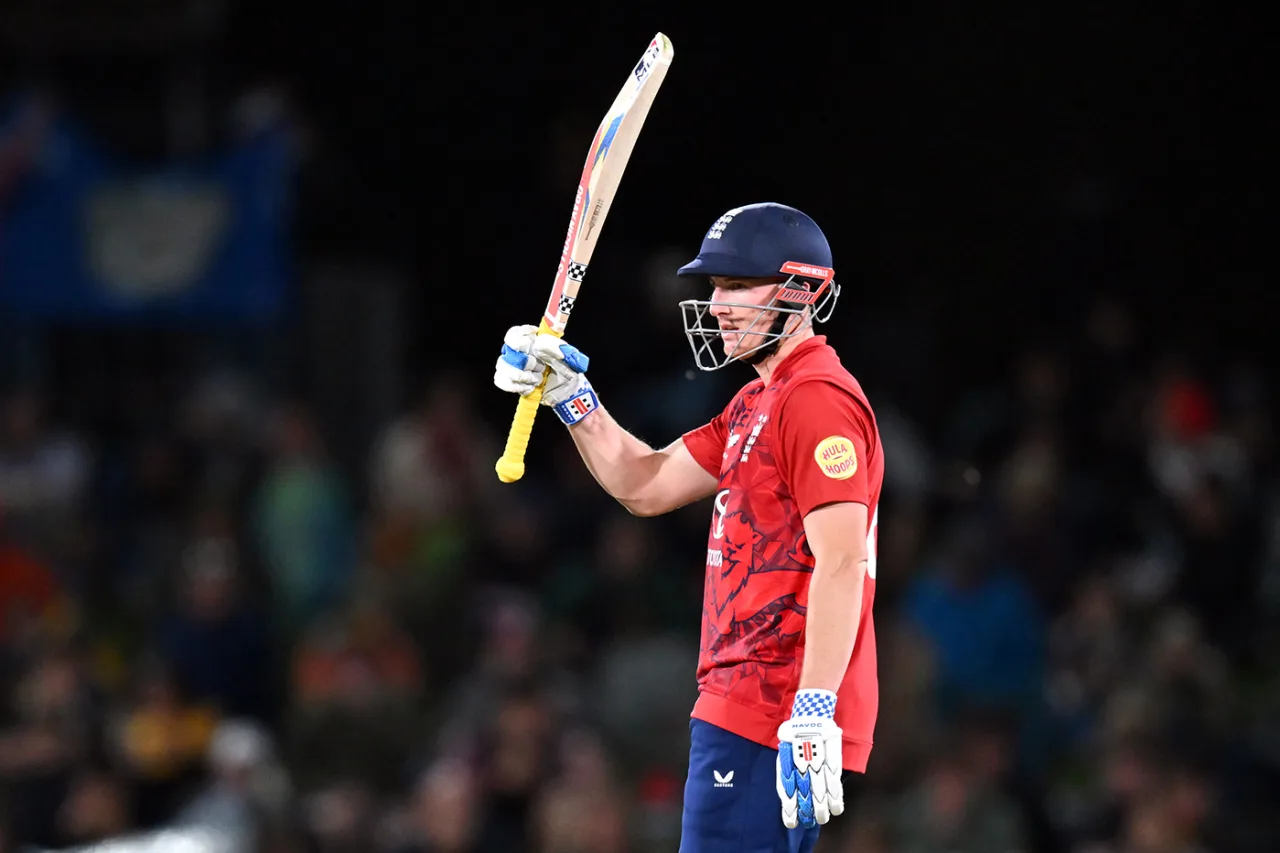
Phil Salt and Harry Brook combined to blow New Zealand out of the water in the second T20I, as England sealed a dominant 65-run win in Christchurch to take an insurmountable 1-0 lead in this three-match series.
Both Salt (85 off 56 balls) and Brook (78 off 35) were independently brutal but came together in devastating fashion with a partnership of 129 from just 69 deliveries. England’s 236 for 4 was a new record T20I score at Hagley Oval, comfortably bumping off the previous best of 208 with 10 balls still to go in their innings. New Zealand were eventually dismissed for 171 with two overs to spare.
Mitchell Santner’s decision to bowl first upon winning the toss was a case of rinse-and-repeat; both teams opting for the same XIs after Saturday’s washout in the first T20I. Unfortunately for the Black Caps skipper, this was a truer surface than the one which saw England scrape to 153 for 6.
Drier with more pace, Santner’s bowlers were up against it from the off, with all six used posting double-figure economy rates. They were not helped by two dropped catches that would have given them a more realistic target.
The one that mattered more gave Brook a life on 40, after he had successfully overturned a caught behind decision on 22. The visiting captain was at his destructive best, with 54 runs through boundaries, including five sixes, two of which were carted out of the ground. Despite Kyle Jamieson accounting for both Brook and then Salt in the space of three deliveries, Tom Banton’s unbeaten 29 from 12 added the record-busting cherry on top.
Brydon Carse’s twin strikes in the second over clipped the Kiwis’ wings in pursuit of 237. And though Tim Seiffert and Mark Chapman restarted the chase with an engaging stand of 69, their respective demises to the spin duo of Adil Rashid and Liam Dawson all but confirmed the result.
Santner did his utmost to inject some late jeopardy with a breezy 36 off 15, before falling to Rashid’s final delivery, the legspinner finishing a solid evening’s work with 4 for 32. Luke Wood then had the honour of capping off victory in the 18th over with two dismissals in four deliveries, with New Zealand losing all 10 wickets to catches.
This new iteration of Salt is developing a knack of cashing in after missing out. His career-best 141 not out against South Africa in September came two days after a first-ball duck. And with as many days since 3 off 4 in the first T20I at Hagley Oval, he looked on course for a fifth century in the format.
No doubt Salt will feel he missed out in a different way, falling for 85 when he was caught on the long-off sponge, 15 short of three figures with as many balls of the innings remaining. Once again he spearheaded a record total a month after leading the breaching of 300.
He upheld his first-over responsibility by putting Matt Henry’s second ball on to the grass bank at midwicket, then whipping behind square leg along the floor once Henry had corrected. By the time Jos Buttler faced his second ball, Salt had already struck 20 from nine.
That was as dominant as Salt was in his stands. Once Buttler was dismissed for 4, he adopted a secondary role during his work with Bethell (scoring 19 of their 44 together) and Brook (46 of their 129). Hardly a passenger but more than happy to cede the driving.
Perhaps the best example of his continued intent was his dismissal, attempting a second six (and 13th boundary) two balls after Brook had holed out at deep midwicket. He now has more T20I runs than Jason Roy, despite 22 fewer innings, moving up to sixth for England run-scorers in the format, with a strike rate of 168.12 that is at least 16 ahead of any of those in the top 10.
“We’ve got such a strong batting line-up, we can keep going,” Brook said after a second coin toss of the series had gone against him on this tour. The response came after the England captain seemed nonplussed with being asked to set a total.
And how. Arriving in the eighth over, Brook, a straight-talker, got straight down to business. He raced to 19 off six, courtesy of three successive boundaries off Santner, with two sixes – the first into the crowd, the second over the roof at midwicket – sandwiching a craftily ramped four.
A second six beyond the confines of this boutique ground allowed him to knock two singles for a 22-ball half-century – his fifth overall in T20Is and first as captain.
He celebrated with 21 off the returning Kyle Jamieson in the following over. Earlier, he had provided 14 of the 20 picked off from Jimmy Neesham’s one-and-only over.
Both were examples of constantly putting bowlers under pressure, already a well-worn mantra in his six months at the helm. That knack of leading by example is not only why he was handed the keys to the white-ball job but instilled as Test vice-captain ahead of this winter’s Ashes.
That both teams opted for two spinners owed more to trending towards 2026’s T20 World Cup in India and Sri Lanka. While New Zealand’s returned 1 for 77 from seven overs, England’s bagged 6 for 70 in eight.
The fact both wanted to bowl first showed there was a collective misreading of conditions. And as the lights took over for the second half, the pitch did begin to grip. It was, in more ways than one, a great toss to lose.
There is not much more to be said of Rashid, his status as one of England’s most-valuable white-ball cricketers set in stone long before becoming the first visiting bowler to take four or more in a T20I at this venue. But it was Dawson who laid down his credentials to partner the leggie for next year’s global tournament.
The left-arm spinner’s wiliness was on show in his first three overs, manipulating his angles to remove Mark Chapman and then the dangerous Michael Bracewell. It took until Dawson’s 16th delivery for New Zealand to find a boundary off him – Jimmy Neesham smearing a four to midwicket – and even then, heading into his final over, the Hampshire allrounder had an impressive 2 for 15 by his name.
Twenty-three conceded off a scatty fourth messed up those figures. Two sixes from Santner were responsible the untidy finish, triggering five wides as Dawson bunged a full toss down the leg side in an attempt to hide the ball from the home skipper’s arc. Nevertheless, Santner’s 0 for 41 earlier in the piece highlighted just how impressive England’s own southpaw twirler had been.
For all England’s enterprise with the bat, there was unnecessary generosity from their hosts. You do not usually associate slack fielding with New Zealand, but two drops tilted this match against them significantly in Christchurch.
Tim Seifert was responsible for missing the first and tougher chance. Jacob Duffy, having pulled out of the previous delivery as Jacob Bethell gave himself room to the leg side, dug one in short with a bit of cut. Bethell, on 7, went for his pull shot, only to top-edge high towards short third.
Seifert had tracked it well, but was done by the stiff north-west breeze, ending up on his back, palming the ball just before he hit the deck. Though Bethell “only” managed 17 more before being dismissed with the last ball of the sixth over, his back-to-back sixes off Bracewell lifted England’s powerplay score to 68 for 2.
That it was the highest at this ground was a sign of things to come, but that, too, could have been avoided. At the start of the 13th over, Matt Henry returned and was greeted with a lofted straight heave from Brook. Somehow, Neesham, having just bowled an over that cost 20, botched a straightforward catch at long-on allowing Brook a life.
They did not have to count the cost of dropping Sam Curran twice on Saturday, the allrounder’s 49 not out hustling England to a respectable total of 153 before the rain intervened. Here, the price of the combined errors was 55 – a figure New Zealand only made up for in their innings with the final ball of the powerplay.
Brief scores:
England 236 for 4 in 20 overs (Phil Salt 85, Jacob Bethell 24, Harry Brook 78, tom Banton 29*; Jacob Duffy 1-44, Kyle Jamieson 2-47, Michael Bracewell 1-36) beat New Zealand 171 in 18 overs (Tim Seifert 39, Mark Chapman 28, James Neesham 17, Mitchell Santner 36; Luke Wood 2-36, Brydon Carse 2-27, Adil Rashid 4-32, Liam Dawson 2-38) by 65 runs
[Cricinfo]

Latest News
Breakdown of the teams and groups of the FIFA World Cup in Canada, Mexico and the US after the final playoffs

Iraq’s qualification for the FIFA World Cup 2026 has completed the lineup of 48 nations for the tournament hosted by Canada, Mexico and the United States.
The Lions of Mesopotamia edged Bolivia 2-1 on Tuesday to win the second final of the FIFA Playoff tournament in Mexico. In the first final earlier, Democratic Republic of the Congo beat Jamaica 1-0.
In the other games, Turkiye, Bosnia and Herzegovina, Sweden and Czechia were the final four teams to complete the European quota of World Cup qualification.
Widely considered the most famous sporting event in the world, the 2026 FIFA World Cup will be its biggest ever. Forty-eight nations will play instead of the usual 32, with 104 matches in 16 venues across the three host nations.
Argentina will look to defend the trophy lifted by iconic captain, Lionel Messi at Qatar 2022. Cape Verde, Curacao, Jordan and Uzbekistan will make their debut.
The World Cup’s first game will be a throwback to 2010 when Mexico take on South Africa on June 11 in Mexico City in a replay of the tournament opener then. Football fans will hope the opening goal this year matches the screamer scored by Lawrence Tshabalala from the South African hosts then.
Mexico in group A – which includes South Korea and Czechia – will be one of the toughest of the 12 groups.
Team USA are alongside Australia, Paraguay and Turkiye.
Canada, too, face the challenging task of making it out of a group comprising Switzerland, Qatar and Bosnia.
Here’s a breakdown of the 48 teams in the 12 groups:
Group A:
- Mexico
- South Korea
- South Africa
- Czechia
Group B:
- Canada
- Switzerland
- Qatar
- Bosnia and Herzegovina
Group C:
- Brazil
- Morocco
- Scotland
- Haiti
Group D:
- USA
- Australia
- Paraguay
- Turkiye
Group E:
- Germany
- Ecuador
- Ivory Coast
- Curacao
Group F:
- Netherlands
- Japan
- Tunisia
- Sweden
Group G:
- Belgium
- Iran
- Egypt
- New Zealand
Group H:
- Spain
- Uruguay
- Saudi Arabia
- Cape Verde
Group I:
- France
- Senegal
- Norway
- Iraq
Group J:
- Argentina
- Austria
- Algeria
- Jordan
Group K:
- Portugal
- Colombia
- Uzbekistan
- DRC
Group L:
- England
- Croatia
- Panama
- Ghana
[Aljazeera]

The head of Italy’s football federation (FIGC) has resigned, falling on his sword after the men’s national team failed to qualify for a World Cup for a third consecutive time.
Gabriele Gravina revealed he would step down as the country’s top football official following a meeting held at the FIGC’s headquarters in Rome on Thursday.
His announcement came a day after Sport Minister Andrea Abodi called on him to resign.
Four-time World Cup winners Italy fell at the playoffs again on Tuesday, this time after a penalty shootout against Bosnia and Herzegovina, and will miss this year’s finals in the United States, Canada and Mexico.
The shock waves of the latest humiliation for one of the world’s most successful football nations forced Gravina, 72, to go back on his initial plans to wait until a FIGC board meeting next week to announce a decision on his future.
The FIGC said in a statement that a vote for a new president would be held on June 22.
Giovanni Malago, the former longtime head of the Italian National Olympic Committee who was president of the Milano Cortina Winter Olympics organisation committee, is reportedly one of the names in the hat.
Before then, head coach Gennaro Gattuso is expected to also step down, while general manager Gianluigi Buffon, the former Italy goalkeeper, announced his resignation on Thursday.
Italy’s failure to reach the first-ever 48-team World Cup – which will feature the likes of Cape Verde and Curacao – led Abodi to release a statement saying: “It’s clear that Italian football needs to be rebuilt from the ground up and that starts with changes at the top of the FIGC.”
[Aljazeera]
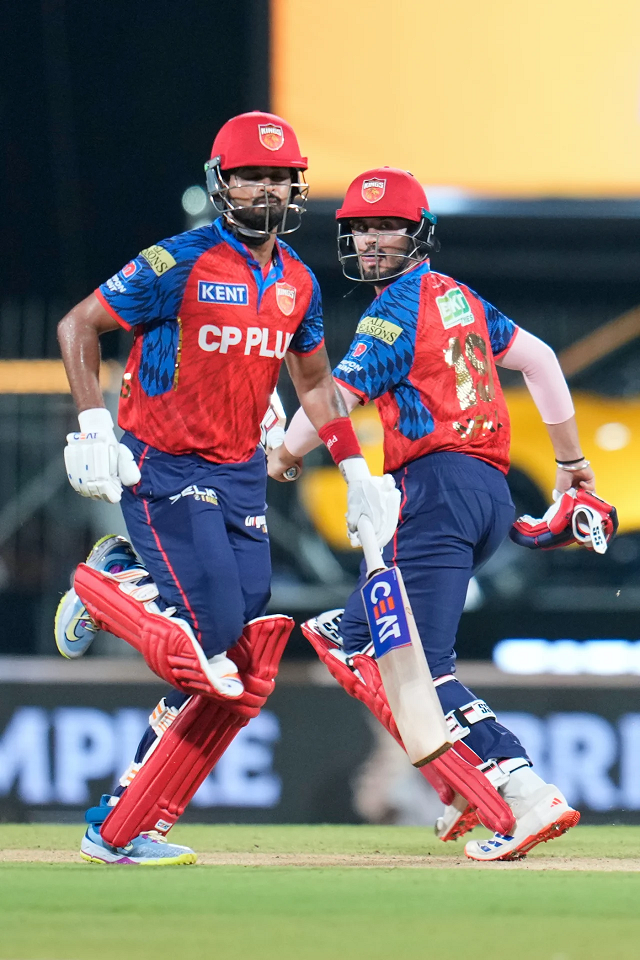
Punjab are the Kings of 200 plus chases in the IPL. They’d done it eight times before Friday night, and they did it again as Priyansh Arya and Shreyas Iyer laid waste to the Chennai Super Kings bowling attack. Arya had 33 off 9 when the PBKS fifty came up in the fourth over of their innings. Shreyas was 4 off 5 before accelerating to a 26-ball fifty.
CSK are now winless after two games and what will worry them is that they were outplayed in conditions that enhance their strength. They have a strong top five. Pitches like this one, which allow them to hit through the line, makes them stronger. But the 209 for 5 they put up didn’t cover for the weakness in their bowling.
PBKS’ win was their fourth in a row against CSK at the MA Chidambaram Stadium.
An 18-year-old who came into a struggling team mid-season last year and emerged as one of their best players might have had reason to believe he had established himself. But with the arrival of Sanju Samson, Ayush Mhatre was bumped down from opener to No. 3. Samson hasn’t been able to get going, falling for two single-digit scores, but the knock-on effect that had on Friday was that Mhatre was out there in the powerplay. And with the field up, he had the liberty to play his shots, and some of them were just so good, including a forehand smash across the line against Vyshak Vijaykumar.
Mhatre was dismissed on the pull shot in the first game of CSK’s season. In the lead-up to this one, Mike Hussey with the whanger kept feeding him short balls and he kept working on the swivel-pull. That work paid off. The third boundary he hit – of three back-to-back – was a confident swivel-pull – and Mhatre deserves more credit for it because the first two were full balls that he had put away over mid-on to engineer that change in length from Xavier Bartlett.
Later, when the field spread and the PBKS bowlers were having success keeping others quiet with wide yorkers – Shivam Dube was 14 off 14 at one point – Mhatre dug one out for a single. That was 10.2. By 10.5, he’d found a solution for a ball the bowler thought was a banker – bringing the bat down as he had done before but this time opening the face to beat short third and backward point to their right and deep point to the left. It was a shot that combined quick thinking with perfect timing.
Mhatre was dropped on 59 and 67 and eventually fell for 73 off 43. At the time, the other end had contributed 38 off 32. The extras chipped in with 12.
Mhatre fell during a period where PBKS picked up three wickets for 20 runs in three overs. In that time, CSK’s projected score slipped from 200 to 185.
CSK’s middle order is a problem with Dewald Brevis recovering from a side injury. But it didn’t feel like a problem while Sarfaraz Khan was at the crease. As a domestic stalwart, he has seen it all and done it all. As one of the IPL’s first teenage stars, when he was sharing a dressing room with Virat Kohli and Chris Gayle, he has always got T20 cricket. Some of his shots were so cool. There was one where it seemed like he’d left a bouncer, the ball going past him before he pushed his bat up at it and sent it for six over the keeper. There were several that he nonchalantly deflected to the deep third boundary and these were off deliveries that the bowler thought he had done well, either going yorker or going into the wicket without giving any room. Sarfaraz’s 32 off 12 balls carried CSK to 209 for 5. It was the first 200-plus score at Chepauk in the IPL since April 2024.
This was a day for breathtaking cameos. Arya topped Sarfaraz’s efforts with 39 off 11 balls. PBKS assistant coach Brad Haddin recalled how Arya had wowed the whole coaching staff when he started batting in the camp ahead of IPL 2025. The bat speed in particular was unbelievable. But what really impressed Haddin was that when Arya joined the team ahead of this season, he had improved on his strengths. He had downed CSK with a century last year. He needed just 11 balls to down them this year. The shots were pure too. There was an on-the-up cover drive for four with zero follow-through that told CSK what they were giving him just wasn’t good enough. PBKS brought up their fifty in the fourth over. They downed more than 30% of the target inside the powerplay.
CSK’s bowlers created a little bit of pressure between the ninth and 12th overs when they were gifted Prabhsimran Singh’s wicket through a run-out and Cooper Connolly’s off a full-toss. At the start of the 13th over, PBKS’ chances of victory, according to the ESPNcricinfo forecaster, was 45%. CSK brought on Rahul Chahar to see if they could push their advantage. Shreyas whacked him for two sixes, moved from 4 off 5 to 19 off 10. PBKS’ chances of winning after those six balls was up at 65%. It didn’t take long for that figure to hit 100. Shreyas helped himself to a 26-ball fifty.
Brief scores:
Punjab Kings 210 for 5 in 18.4 overs (Priyansh Arya 39, Prabhsimran Singh 43, Cooper Connolly 36, Shreyas Iyer 50, Nehal Wadhera 10, Shashnak Singh 14*; Anshul Kamboj 2-43, Matt Henry 2-54) beat Chennai Super Kings 209 for 5 in 20 overs (Rutraj Gaikwad 28, Ayush Mhatre 73, Shivam Dube 45, Sarfaraz Khan 32; Xavier Bartlett 1-48, Marco Jansen 1-43, Vijayakumar Vyshak 2-38, Yuzvendfa Chahal 1-21) by five wickets
[Cricinfo]

Iran executes two convicted members of banned opposition group

Afghanistan earthquake kills eight members of same family

Breakdown of the teams and groups of the FIFA World Cup in Canada, Mexico and the US after the final playoffs

365 US service members injured since start of Iran war – Pentagon

World Cup 2026: Italy’s football chief resigns after qualifying failure

Iran says it downed two US jets as search for one pilot continues

‘Dates have the highest sugar content to fight Coronavirus’

Sunday Island 27 December – Headlines

#SundayIsland 17th December – Headlines

Sunday Island – 28th March

Sunday Island Headlines – 21 March

Sunday Island – 21st February – Headlines
-

 News3 days ago
2025 GCE AL: 62% qualify for Uni entrance; results of 111 suspended
-

 News5 days ago
Tariff shock from 01 April as power costs climb across the board
-

 News6 days ago
Inquiry into female employee’s complaint: Retired HC Judge’s recommendations ignored
-

 Features7 days ago
When seabed goes dark: The Persian Gulf, cable sabotage, and race for space-based monopoly
-

 Features6 days ago
New arithmetic of conflict: How the drone revolution is inverting economics of war
-

 Business4 days ago
Hour of reckoning comes for SL’s power sector
-

 Editorial3 days ago
Search for Easter Sunday terror mastermind
-

 Sports6 days ago
Sri Lanka’s 1996 World Cup heroes to play exhibition match in Kuala Lumpur