
Opinion
Make presidential mission for low-cost renewable energy a reality


On behalf of the LEADS Forum (admin@srilankaleads.com)
We commend the vision of Sri Lanka’s current government to reduce national electricity costs by at least 30% and position the country as having the lowest electricity tariffs in the region. This goal is both ambitious and achievable, provided, as the President has rightly emphasised, that we reduce dependence on costly fossil fuels and accelerate the deployment of renewable energy, particularly rooftop solar with storage.
Rooftop solar remains one of the most practical and cost-effective solutions, offering households not just energy savings but a valuable investment opportunity.
The Case for Rooftop Solar
Sri Lanka currently depends heavily on fossil fuel–based electricity generation. Thermal and diesel plants produce power at costs ranging from LKR 30–60 per kWh, while many Independent Power Producer (IPP) contracts impose high capacity charges—sometimes reaching LKR 60–90 per kWh. These expenses weigh heavily on both the Ceylon Electricity Board (CEB) and the broader economy.
By contrast, rooftop solar systems, even when combined with battery storage, are estimated to generate power for less than LKR 45.80 per kWh, according to publicly available data. Redirecting policy support toward solar plus storage would significantly reduce system costs, conserve foreign exchange, and shield the economy from global fuel price volatility.
Learning from Global Leaders
Countries such as Germany, Spain, and Australia—leaders in renewable energy—have demonstrated the value of integrating rooftop solar into their energy mix.
In Sri Lanka, large-scale land-mounted or floating solar projects often face environmental and social challenges. Rooftop solar, however, avoids these issues and delivers distinctive advantages:
* No land acquisition or resettlement challenges.
* Rapid deployment (weeks for households; 12–24 months for larger projects).
* Reduced household electricity bills and potential income from selling surplus power.
* Job creation in installation, maintenance, and local battery assembly.
According to the Sustainable Energy Authority (SEA), Sri Lanka already hosts over 100,000 rooftop solar installations, totalling around 1,000 MW of capacity. With the right policies, this success can be scaled up rapidly.
The Role of Energy Storage
To truly replace fossil fuels, solar generation must be paired with reliable storage. Battery systems—whether at the household, community, or grid scale—can store daytime solar power for use during peak evening hours.
Industrial-scale solar projects with integrated storage, such as Battery Energy Storage Systems (BESS) or pumped hydro, can also deliver firm energy, reducing dependence on high-cost IPPs and improving grid stability.
Policy Recommendations
To accelerate this transition and achieve 70% renewable energy by 2030, we recommend:
* Introducing an evening peak tariff and enabling households to sell stored energy back to the grid.
* Offering duty concessions on solar panels, inverters, and batteries to lower upfront costs and enhance investor confidence.
* Promoting community energy cooperatives, consistent with the NPP manifesto, to democratise energy access.
These measures will stimulate private investment, ease the government’s fiscal burden, and fast-track renewable energy adoption.
Economic and Social Benefits
Deploying 1,000 MW of rooftop solar with storage could deliver:
* LKR 16–17 billion in annual savings by displacing fossil fuel generation.
* Additional household income through energy exports.
* Substantial job creation in green industries.
* Nearly 1 million tons of CO₂ reduction each year.
* Reduced dependence on IPPs, ensuring affordable and predictable tariffs.
Conclusion
Rooftop solar with distributed storage represents Sri Lanka’s most viable pathway to achieving lower electricity tariffs, meeting renewable energy targets, reducing fossil fuel imports, and enhancing national energy security.
This is not just an energy policy—it is a vision for Sri Lanka’s future. With decisive leadership and the right policies, we can deliver lower costs, new employment opportunities, and a cleaner environment, positioning our nation as a regional and global leader in renewable energy.

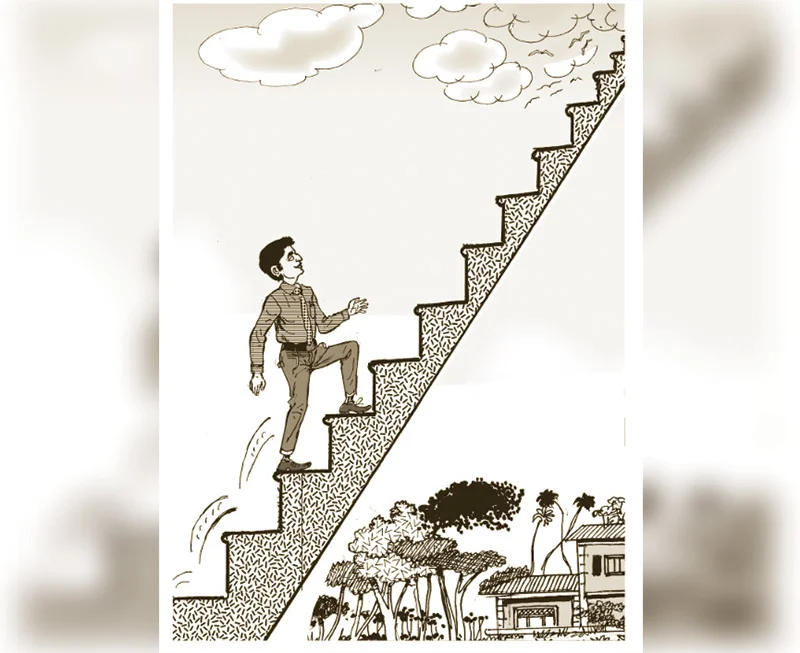
Some people seem to have been born lucky. Whatever they lay their hands on ends in success. They pass competitive examinations, find jobs and marry ideal partners. There are others who seem to be unlucky all the time. They fail examinations and remain unemployed. They also find it difficult to find their life partners. Nobody knows how this happens. However, serendipity is not a game of chance. Experts have identified certain habits that can set you all up for good fortune.
Jane (not her real name) after getting through her G.C.E. (Advanced Level) examination tried to find a job for several years. All her attempts ended in vain. Then she tried various other avenues to find her niche in life. One day she happened to attend a friend’s wedding at a five-star hotel. She observed how food had been laid out in a professional manner. Something clicked in her mind. “Can’t I become a chef?”
Thereafter she desperately tried to find a place to follow a course in culinary art. The course fees were very high and her parents could not afford them. One day, quite by chance, she met a chef working in a big hotel. She became friendly with him and expressed her desire to become a chef. The chef listened to her attentively and asked her to join his hotel as a kitchen helper. She accepted the offer and worked as a kitchen helper for a few years. Her enthusiasm and dedication to her duties impressed the management. She was appointed as a Commis Chef.
Kitchen brigade
She was happy to work as a junior, entry-level cook in a professional kitchen. She had to support senior chefs by performing basic food preparations, maintaining station cleanliness, organising stock and learning core culinary techniques. Although she had not followed any professional courses, Jane found herself on her way up the kitchen brigade often rotating through different sections to gain broad experience. After working there for a few years, she managed to join a leading tourist hotel in the Maldives. Her quest for excellence is not yet over. Jane is now planning to join a leading tourist hotel in Australia.
Some people say that kismet led Jane in her quest for becoming a chef. However, her openness to life’s quirky possibilities put her in the right place at the right time. Her success shows that luck is not something mysterious. To a very large extent, you are responsible for much of the good fortune that you encounter. This view has been confirmed by Richard Wiseman, a professor of psychology and the author of ‘The luck Factor.’
It is a fascinating exercise to delve into traits that separate fortunate people from the self-proclaimed unlucky souls. If you wish to succeed in life, always expect good things to happen. When you do so, the scales of serendipity tilt in your favour. In Wiseman’s words, “Their expectations become self-fulfilling prophecies.” In a study at New York University it was found that students who firmly believed that they would pass the final examination with flying colours significantly had excellent results.
Try your luck
The fact of self-assurance will motivate you to work hard. Never feel that you are unlucky. Some people complain that they never win lottery prizes and stop buying raffle tickets. Winning a prize from a raffle ticket happens by chance. If you do not buy them, you will never win a prize. Therefore, always try your luck with positive feelings.
If you look around, you will see that lucky people are surrounded by a lot of friends and acquaintances. Lucky people talk to lots of people and attract their attention and goodwill. This will create a network of like-minded people. Colleen Seifert, a cognitive scientist at the University of Michigan, advises people to get out of the everyday rut. Most people who do routine work find themselves in a rut. They should try to get out of it and do something different and profitable. One way is to follow a course of studies to hone your skills. Another method is to join an English-speaking club or Toastmasters Club. You can also join a library and start reading books on various subjects. When you do so, you will have a chance to encounter influential people. Such a meeting will be a turning point in your life.
Always think that there is a light at the end of the tunnel. In many bad situations there will be at least one good event. Learn how to embrace the unpredictable and engineer the unexpected. If you think you are a lucky person, you will transform a stumbling block into a positive event. Nobody can win any battle without making mistakes. Depend on your sixth sense or instinct before doing something important. Leaving a permanent and pensionable job may pose a big risk. However, if you do not take such a risk, you will not succeed in life. Many ordinary government employees have quit their jobs to become accountants, lawyers, judges and architects.
Sense of responsibility
Most successful people have a deep sense of responsibility for their thoughts and actions. It means you have to keep your word and be faithful to your family and self. Believe in what you do and work hard to achieve your goal. Such an attitude will set your own standards. In the meantime, stop comparing yourself with others who have succeeded in their chosen fields of activity. The wartime British Prime Minister Winston Churchill exemplified integrity and respect in the face of opposition. During his final years as the prime minister he attended an official function. Some people started whispering that he should step down as he was getting senile. When the ceremony was over, Churchill turned to the men who were whispering and said, “Gentlemen, they also say he is deaf!”
If you wish to win, take time to nurture others’ dreams. A wise man said, “If you want one year’s prosperity, grow grain. But if you want ten years’ prosperity, grow men and women.” On your way to success you cannot simply ignore others. Provide others with nutrients of gratitude and encouragement. When people around you succeed, you should feel happy.
Human life is full of ups and downs, disappointments and missed opportunities. The pages of history are full of heroic stories of undaunted men and women who had triumphed over disabilities and adversities. Draw inspiration from their victorious spirit. We live in a highly competitive and goal-oriented world. Everybody is seeking instant success. Get involved in something bigger than yourself. Work towards your goal in a spirit of excellence.
The Chinese call luck an opportunity and they say it knocks every day at your door. Some people hear it, but others do not. It is not enough to hear the opportunity to knock at your door. You must let it in, greet it and make friends with it to work together. All the fruits of success will be yours then.
karunaratners@gmail.com
By R. S. Karunaratne

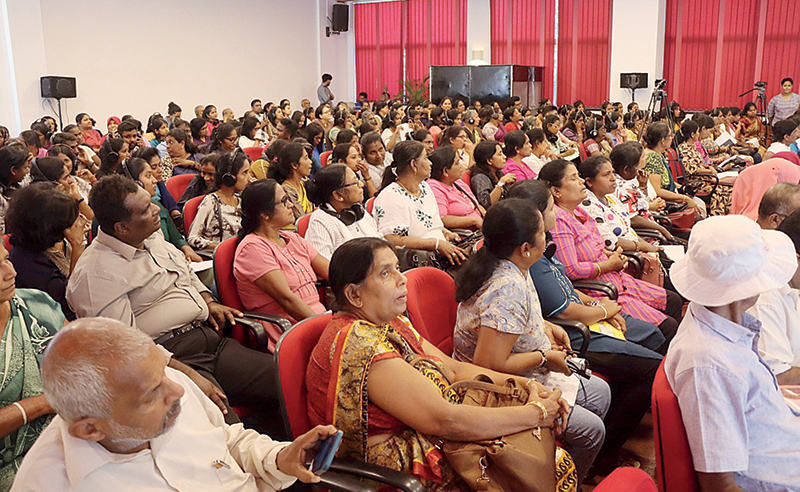
January 21 | Olympus Auditorium, Bandaranaike Centre for International Studies (BCIS)
The National Collective of Community Savings and Credit Services Providers organised the conference “Microfinance and Credit Regulatory Authority Bill: Neither Here, Nor There” on January 21 at the Olympus Auditorium, Bandaranaike Centre for International Studies (BCIS), BMICH, to foreground the community savings and credit services as an alternative credit practice to moneylending and microfinance. While underscoring the uniqueness of community credit practices, grounded in collective rights, solidarity, mutual aid, the non-hierarchical nature of organising and long years of practice, community credit providers opposed the Asian Development Bank (ADB)-Treasury-CBSL attempt to subsume the community credit model under moneylending and microfinance in the proposed Microfinance and Credit Regulatory Authority Bill. Over 200 community credit practitioners from more than 50 community organisations from Mannar, Kilinochchi, Jaffna, Mullaitivu, Batticaloa, Anuradhapura, Polonnaruwa, Badulla, Rathnapura, and Hambanthota had gathered at the conference.
M. K. Jayathissa, a farmer leader from Hingurakgoda, Polonnaruwa, explained the microfinance crisis as resulting from the microfinancialisation of rural credit and the targeting of low-income women. He recalled his role in the farmers’ struggle against debt during the 1990s. Jayathissa linked the microfinance crisis among women and the farmers’ debt crisis to a wider crisis in food production.
Renuka Bhadrakanthi, chairperson of the Ekabaddha Praja Sanwardhana Kantha Maha Sangamaya, Weligepola, shared her three decades of experience as a community practitioner. She showed how the community credit framework helped women build assets and wealth through small savings. Unlike market-based initiatives such as microfinance and moneylending, community-controlled credit systems empowered women both with agency and material capabilities. Renuka also noted the regional diversity in organisational frameworks and credit purposes. She stressed the need for vigilance and action now, as globalisation and neoliberalism drive economic reforms aimed at capturing community wealth and making people dependent on the market.
Rajeswary Sritharan from Yuhashakthi, Mullaitivu, brought in experiences from war-torn societies. Yuhashakthi and Mahashakthi networks, operating in the Northern and Eastern provinces and comprising more than 10,000 women members, were created during the civil war to support women’s ability to control the household economy. These two networks have proven resilience against war-related dispossession and loss while also strengthening women. Rajeswary contended that self-help community credit groups are informal and unregulated, revealing that societies are governed by a collective ethos, community audits, and democratic decision-making, ensuring transparency and accountability. She pointed out that community groups do not have a history of bringing their members before the police or courts when they fail to service their debts, unlike microfinance companies. She also raised the significance of community groups such as Yuhashakthi and Mahashakthi as first responders in times of crisis, even as recently as with Ditwah, intervening and assisting affected communities much before the government could.
-
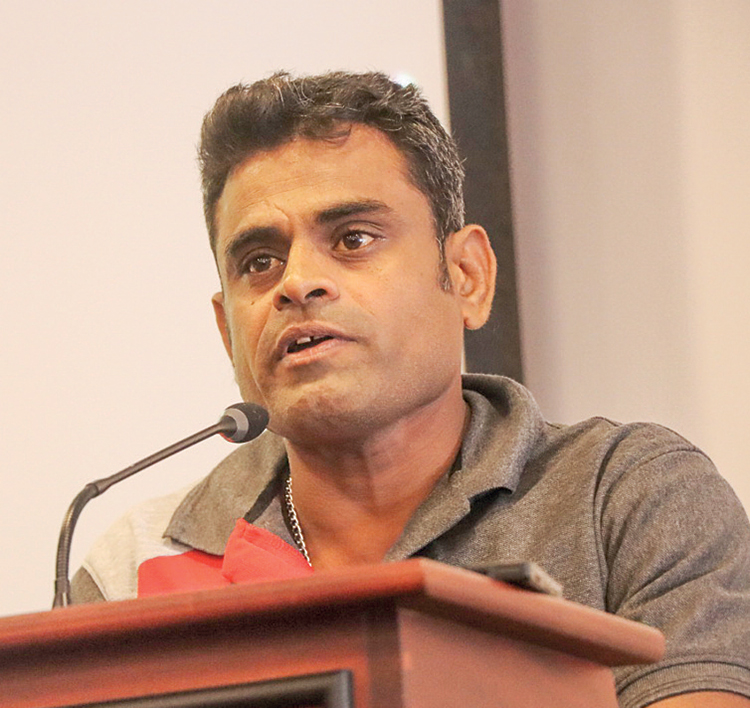
- Suneth Aruna Kumara
-
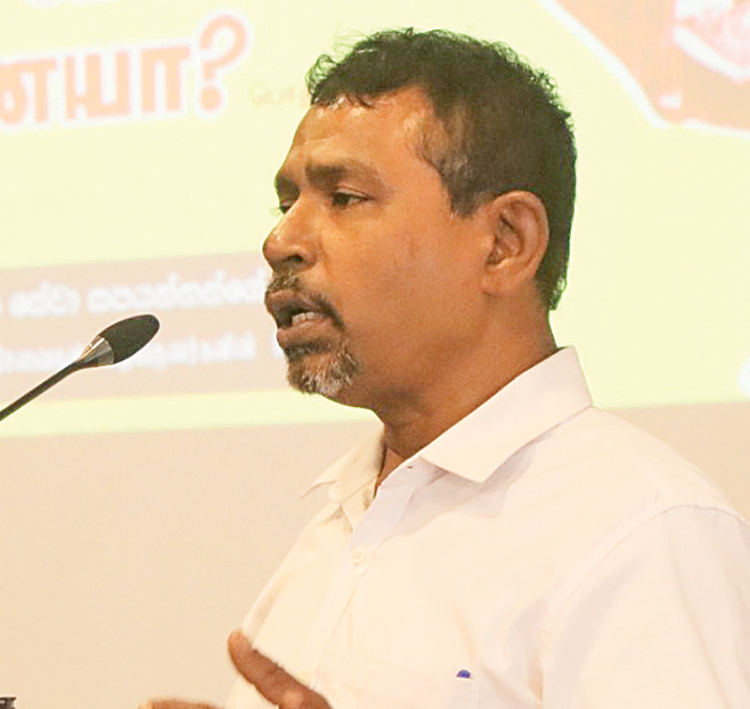
- Pubudu Manohara
-
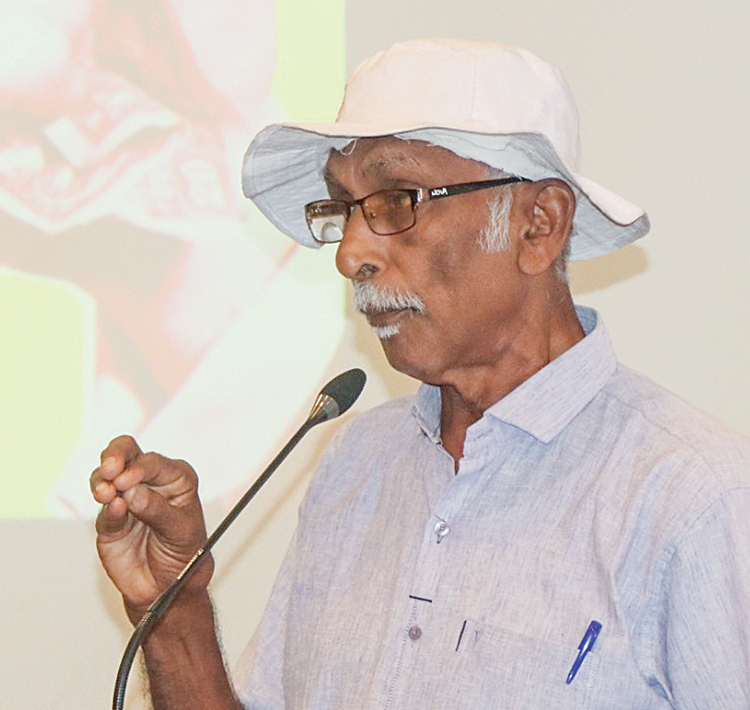
- M K Jayathissa
Suneth Aruna Kumara, representing Vimukthi Gami Gowi Kantha Samithiya, Hingurakgoda, Polonnaruwa and also speaking on behalf of the microfinance-affected women, highlighted the creative space that collective forms of association have opened up for microfinance victims. “People who were hiding, afraid of debt collectors, are trying to rebuild their lives autonomously,” he said. In this journey, women are rethinking the meaning of credit, whether it is possible to create credit mechanisms that do not rely on interest income, and imaginative ways of decommodifying community relations. Suneth emphasised that women’s initiatives are emerging from their lived experiences as debtors, exploited by predatory interest rates and violent recovery practices. As a victim himself, Suneth criticised the proposed regulatory Bill for failing to adequately safeguard microfinance and credit consumers by providing legally binding safeguards. According to Suneth, the proposed Bill does not guarantee that the microfinance crisis will not recur.
Another highlight of the conference was the sharing of experiences by Malaihaya women, presented by Letchumanan Kamaleswary from the Centre for Equality and Justice. Kamaleswary described debt as ever-present in the Malaiyaha community. It forced migration from South India and kept people captive as plantation labour for over 200 years. Although the plantation management restricts all community associations within the plantations, microfinance companies can enter and operate freely. Debt is so severe that most Malaiyaha women work past their retirement age.
-
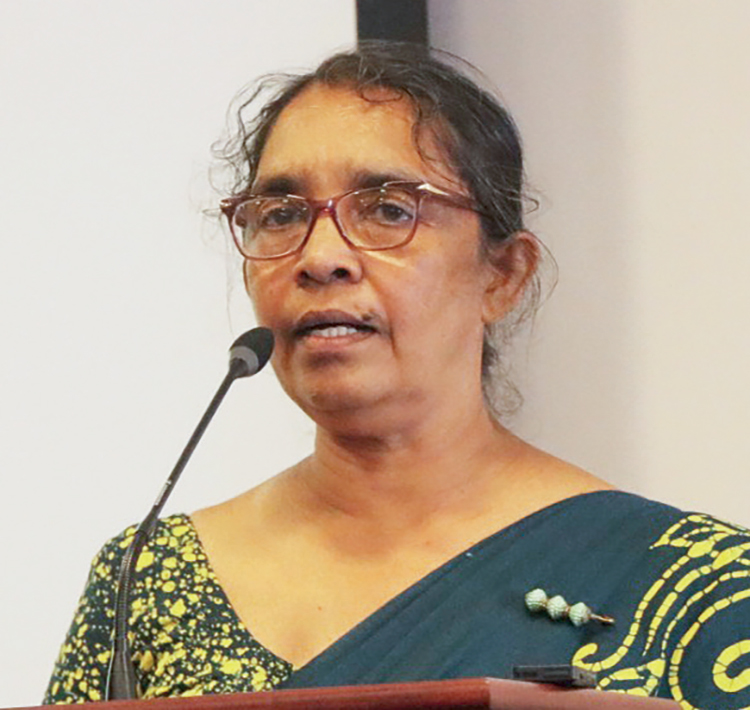
- Renuka Bhadrakanthi
-
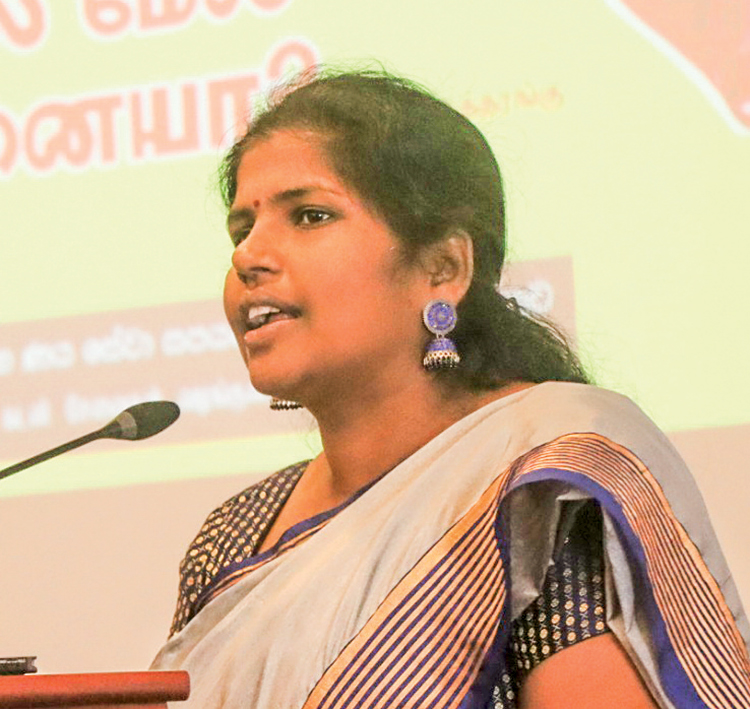
- Rajeswary Sritharan
Pubudu Manohara, from the Rural Development Foundation in Hambanthota, traced the history of community credit projects to various state poverty alleviation programmes since 1977. These projects, affiliated with governments and supported by international groups such as the World Bank and UNDP, have survived many national and local crises. Over time, however, both the government and international organisations like the ADB have become wary of people’s ability to save. “They are afraid of our ability to create community funds,” he said.
The discussion emphasised that mobilising community groups and local political leaders is essential to oppose the Bill in its current form. Concerns arose about the negative impact of heavy regulations on community organisations and women’s resilience. “Domestic violence is rooted in economic violence. The destruction of community organisations will have a direct effect on local development and local economic activities. That will also burden the government,” said a Yuhashakthi representative from Mullathivu.
Community organisers urged the government to consult directly with them when developing regulations, emphasising that new rules should protect and strengthen community-based initiatives rather than respond to external pressures. They argued that the ADB, having promoted commercialisation of microfinance and contributed to the resulting crisis, lacks the legal and ethical standing to advocate for regulatory frameworks. Instead of receiving directives from the International Financial Institutions (IFIs), the government should converse with the grassroots communities, devising homegrown developmental solutions to regenerate local economies, empower the most vulnerable and build community wealth, the community organisers stressed.

After jog for the camera, wearing shorts in Jaffna, thanks to the freedom gained by the country being liberated from the clutches of the Tigers by the valiant efforts led by Mahinda Rajapaksa, President Anura Kumara Dissanayaka, said: “Some come past Sri Maha Bodhi and other Buddhist temples all the way to Jaffna to observe Sil, not to spread compassion but hatred.” When the need of the hour is reconciliation what an outrageous statement that was, to be made by the head of state! Will he say that the people of the North and the East bypass many Kovils straddling the area and come to Kataragama to spread hate? Probably not! His claim has become a hot topic of conversation.
Having lost a majority of the votes garnered from the North at the presidential and parliamentary elections, to the Tamil nationalist parties at the local government elections, President Dissanayake’s claim may well have been a pitiful attempt to recover lost ground in the North. But at what cost?
It all started with AKD’s refusal to refer to those brave service personnel who saved the unity and the integrity of the country as Rana Viruwo. Interestingly, the most devastating rebuke for this came from a Tamil MP, who is an avowed admirer of Prabhakaran, stating in Parliament that a Sinhala Rana Viruwa saved his life when he was about to be washed off in the flood waters resulting from Cyclone Ditwah. He teased the government by asking in ‘raw’ Sinhala Ei umbalata lejjada unta Rana Viruwo kiyanna? (Are you shy to call them war heroes?)
In addition to slinging mud at MR and harassing service personnel, there is no doubt whatsoever that AKD’s government is trying to harass any Tamil politicians who helped eradicate the Tigers. This fact is borne out by the treatment meted out to Douglas Devananda. Shamindra Ferdinando has explained this in his article, “EPDP’s Devananda and missing weapons supplied by Army” (The Island, 7 January).
NPP ministers publicly insult Buddhist monks, but whenever they are in trouble, they rush to Kandy to meet the Maha Nayakas, the latest being Harini’s visit. Instead of admitting the mistake and trying to make amends, the government went on, until it realised the futility in trying to justify the ‘Buddy’ episode. Excuses given by Harini to the Maha Nayakas, to say the least, were laughable. She had the audacity to say that though the questionable web link was printed in the textbook there were no instructions to click on it! She may continue as Prime Minister but can anyone who does not know what to do with a link or who is trying to encourage ten-year-olds to have e-buddies when the rest of the world is heading towards banning 16-year-olds from social media, continue to be the Minister of Education?
Number of MOUs/pacts signed with India, including defence, have not yet been disclosed even to Parliament. The Cabinet Spokesman once stated that the contents of those MOUs/pacts could not be divulged without the consent of India. Interestingly, we have had very frequent visits from VVIP politicians and top government officials from India, some at very short notice. One of them referred to these as ‘usual’ ones! However, what is unusual is that a party that shed a lot of blood of Sri Lankans for even selling ‘Bombay’ onions, is now in government and seems under Indian command. Perhaps, its transformation occurred when India sponsored a visit by AKD in early 2024, which helped him secure the presidency. Among the NPP’s election pledges, the most touted one was to reveal the mastermind behind the Easter Sunday attacks. It has been alleged in some quarters that India was behind the attacks. The NPP government’s silence about this speaks volumes!
It has transpired recently that it was Indian High Commissioner Gopal Baglay who pressured Speaker Mahinda Yapa Abeywardena in July 2022 to take over the presidency after the elected President was toppled by protesters, but many believe that it was a joint effort by the Indian HC and the ‘Viceroy’ who just left, after an overstay! It is an illegal act as pointed out in the editorial “Conspiracy to subvert constitutional order” (The Island, 22 January) and may be investigated by a future government, if elections are not postponed forever!
We seem to be watching a puppet show where many puppeteers outside are pulling the strings! Are we paying the price for electing a bunch of inexperienced politicians?
By Dr Upul Wijayawardhana ✍️

Royal Navy of Oman Ship ‘AL SEEB’ leaves island

Gold tops $5,000 for first time ever, adding to historic rally

Showers will occur in the Northern, North-central, Eastern, North-western, Western, Sabaragamuwa and Uva provinces and in Matale, Matara, Galle and Nuwara-Eliya districts

U – 19 World Cup: Andrew, McKenzie deliver West Indies comfortable win

U – 19 World Cup: Bowlers, Hogan help Australia breeze past South Africa

Abhishek blasts 14-ball fifty to hand India unassailable 3-0 lead against New Zealand

‘Dates have the highest sugar content to fight Coronavirus’

Sunday Island 27 December – Headlines

#SundayIsland 17th December – Headlines

Sunday Island – 28th March

Sunday Island Headlines – 21 March

Sunday Island – 21st February – Headlines
-
 Business23 hours ago
ComBank, UnionPay launch SplendorPlus Card for travelers to China
-
 Business2 days ago
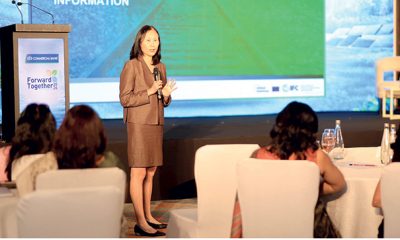
ComBank advances ForwardTogether agenda with event on sustainable business transformation
-

 Opinion7 days ago
American rulers’ hatred for Venezuela and its leaders
-
 Opinion5 days ago
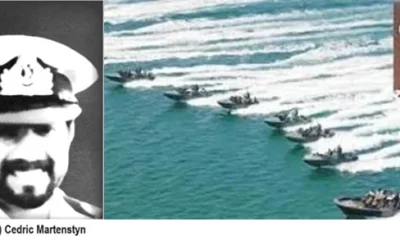
Remembering Cedric, who helped neutralise LTTE terrorism
-
 Business5 days ago
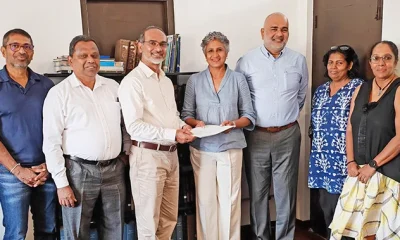
CORALL Conservation Trust Fund – a historic first for SL
-

 Opinion4 days ago
A puppet show?
-
 Opinion2 days ago
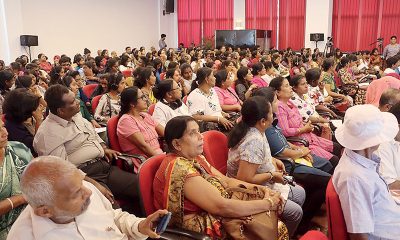
Conference “Microfinance and Credit Regulatory Authority Bill: Neither Here, Nor There”
-

 Opinion7 days ago
History of St. Sebastian’s National Shrine Kandana