
Business
Biodiversity Sri Lanka: A Decade of Business-Led Conservation


Celebrating 10 years of business-driven biodiversity action, with Dilmah among its founding partners
Biodiversity Sri Lanka (BSL) marked its 10th anniversary this year, celebrating a decade of uniting businesses, scientists, and policymakers to safeguard the island’s natural heritage. From its inception, Dilmah Tea played a pivotal role alongside IUCN and the Ceylon Chamber of Commerce in co-initiating BSL, funding its first staff member and helping shape the platform that would connect companies eager to act on biodiversity with the expertise and frameworks needed for measurable impact.
What began in 2012 as the Business and Biodiversity Platform, driven by this founding partnership, evolved into BSL in 2015 – making Sri Lanka the first country after Japan to establish a corporate-led biodiversity initiative. This milestone anniversary was commemorated with Annual Technical Sessions on 24th September and the BSL Annual General Meeting on 26th September, both celebrating BSL’s pioneering role and looking ahead to an even stronger decade of action.
“I look back with a sense of pride and also great appreciation because we trod untrodden ground,” said Shiranee Yasaratne, Senior Technical Advisor to BSL. “At that point I need to recollect the initiation carried out by the likes of Mr. Prema Cooray, the Secretary Generals of the Ceylon Chamber of Commerce, IUCN, and Dilmah Conservation, which funded the first staff member for the platform.”
What started as a lonely journey with five members has today grown into a network of over 100 member organisations spanning the sectors of manufacturing, tourism, IT, finance, and more. Its flagship LIFE Series has built a portfolio of multi-stakeholder projects to restore threatened ecosystems. The first initiative restored 12 hectares in Kanneliya Conservation Forest and has since expanded to 10 hectares of mangrove restoration in Anawilundawa Sanctuary, management of 130 kilometres of coastline to reduce plastic pollution, coral reef rehabilitation, and restoration of Lunugamwehera National Park areas degraded by invasive species.
At this year’s Annual Technical Sessions, keynote addresses highlighted the urgency of business engagement. Renowned biodiversity scientist Rohan Pethiyagoda underlined the importance of corporate action for nature, while Prof. Madhu Verma, Senior Economic Advisor at IORA Ecological Solutions in India, stressed the need to value nature in economic decision-making.
A high-level panel moderated by Malik Fernando, Chairman / CEO of Resplendent Ceylon, explored how businesses are embedding biodiversity into strategy. Panelists included Prof. Sirimal Abeyratne, Emeritus Professor of Economics at the University of Colombo, Architect Murad Ismail, Dr Shamen Vidanage, Country Representative IUCN and Rohitha Bandara, Executive Director – Finance and ESG at Hayleys Fabric PLC, with expert reflections from Aban Marker Kabraji, Senior Regional Advisor on Climate and Environment, UNEP ROAP.
Recognising Dilmah’s commitment to biodiversity Kabraji said, “I was there at the creation of Biodiversity Sri Lanka, I know how much the Dilmah Family led it. All I can say is you showed us the way, and I thank you for it.” It is commendable how Dilmah has taken a corporate leadership role towards a national sustainability objective.
The afternoon shifted to focused breakout sessions where economists, scientists, researchers, and corporate leaders exchanged ideas across six themes: Financing the Plastic Revolution; Science, Policy and Partnerships; Harnessing Nature to Transform Business Strategy; AI & Nature for Enriched Experiences; Cultivating Biodiversity in Agriculture and Plantations; and Aligning Business and Nature. Member-led examples showcased on-the-ground projects, challenges, and lessons.
At the Annual General Meeting, BSL Chairperson and Chairman / CEO of Dilmah Dilhan C. Fernando presided, sharing updates from the past year after which a new Board of Directors was appointed.
“Through our LIFE Series and science-led restoration programs, BSL is pioneering private-public-people collaborations that go beyond tree planting to deliver resilient landscapes, thriving wildlife, and shared prosperity,” said Fernando.
A highlight of the AGM was the unveiling of BSL’s new logo and strategy, structured around five pillars under the acronym L.I.F.E. These focus on restoring landscapes, supporting local communities, promoting responsible resource use, and forging partnerships between business, science, and policy to drive lasting impact.
In today’s global context, sustainability is no longer optional. For Sri Lankan companies, particularly those linked to European and American markets, compliance with environmental standards is becoming mandatory. BSL’s mission goes further – nurturing businesses that embed sustainability into core strategy, while addressing climate change, pollution, and resource depletion.
With a decade of impact behind it, BSL now looks ahead to a future where business takes a leading role in building a nature-positive Sri Lanka.

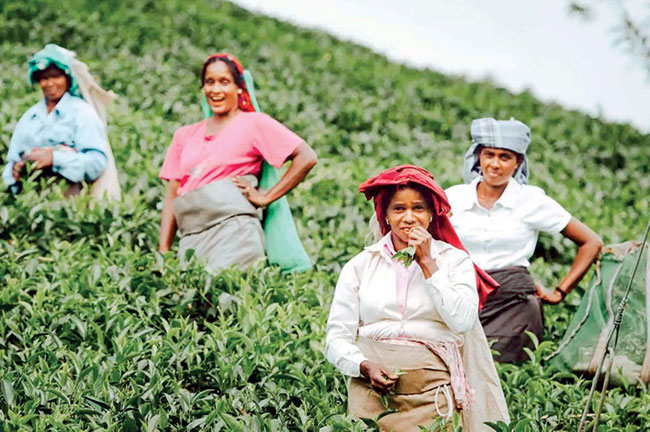
The weekly Colombo Tea Auction concluded with offerings increasing to 6.5 million kilogrammes, a marginal rise from the previous week’s 6.4 million kilogrammes. However, the market witnessed a significant pullback from key international buyers, leading to a subdued trading atmosphere and declining prices across several categories.
Industry sources reported a noticeable lack of interest from shippers to the traditional markets of the United Kingdom and the European continent. While shippers to the Commonwealth of Independent States (CIS) and the Middle East maintained a presence, their participation was described as selective and at lower price levels. Buyers from Japan and China also operated at reduced levels, with South African shippers showing minimal engagement.
This cautious stance from the shipping community cast a shadow over the Ex-Estate sector, which offered 1.0 million kilogrammes. The overall quality of teas in this category was described as relatively uninteresting, leading to a weakening of prices. In the Western High Grown category, prices for the best available BOP/BOPF grades declined by Rs. 20 to 40 per kilogramme, while the plainer varieties saw a drop of about Rs. 20 per kilogramme. A fair quantity of these teas remained unsold due to a lack of suitable bids.
Nuwara Eliya teas attracted little to no interest, with the majority of offerings remaining unsold. Uda Pussellawa BOPs weakened further by up to Rs. 50 per kilogramme, while the corresponding BOPFs struggled to maintain their previous price levels. In the Uva region, BOPs saw prices fall by Rs. 50 per kilogramme, though the BOPF varieties were relatively more stable. The High and Medium Grown CTC teas continued to be a weak feature, with many lots unsold and those that were sold recording a price drop of Rs. 20 to 40 per kilogramme. Off-grades and dust grades also experienced a sluggish market, with fair volumes remaining unsold.
In contrast to the gloom in the High Growns, the Low Grown sector, which totalled approximately 2.7 million kilogrammes, met with more encouraging demand. The Leafy and Semi-Leafy categories saw fair demand, while the Tippy and Premium categories were met with good interest. While some well-made varieties in the Leafy catalogues remained firm, many other grades experienced easier prices. However, the Tippy catalogue saw high-priced FBOPs holding firm and the FF1s generally becoming dearer. The Premium catalogue, featuring tippy teas, also met with good demand and saw prices appreciate overall.
Based on Forbes & Walker Tea Brokers comments
By Sanath Nanayakkare

The Asian Development Bank (ADB) has formally entered into its first partnership with the International Committee of the Red Cross (ICRC), marking a significant step towards integrating humanitarian action with long-term development efforts in fragile and conflict-affected regions across Asia and the Pacific.
A Letter of Intent establishing the collaboration was signed on June 10 by ADB Vice-President for Sectors and Themes Fatima Yasmin and ICRC Director-General Pierre Krähenbühl. The agreement provides a framework for coordinating programmes, exchanging knowledge on emerging humanitarian challenges, promoting innovation and sharing best practices through joint events and publications.
The partnership brings together ADB’s development expertise and financing capabilities with the ICRC’s operational experience and access to communities affected by conflict and violence.
Highlighting the significance of the initiative, ADB President Masato Kanda wrote on X on June 17 that the partnership would help strengthen resilience in fragile and conflict-affected areas.
“By bringing together ADB’s longer-term development perspective with ICRC’s humanitarian field presence and operational experience, we can better support people affected by conflict and violence,” Kanda said.
Speaking at the signing ceremony, Yasmin said today’s interconnected challenges require development institutions to move beyond traditional approaches.
“The ICRC brings trusted access to affected communities and credibility in environments that ADB alone cannot easily reach,” she said.
Krähenbühl described the agreement as an important step towards bridging humanitarian assistance and long-term development, adding that it could create opportunities for joint responses in fragile settings across the region.
A Sri Lankan socio-economist told The Island Financial Review that the partnership reflects a growing recognition among development institutions that conflict, fragility and climate-related shocks are becoming major constraints on economic progress.
“Traditionally, development banks focused on long-term infrastructure and economic projects while humanitarian agencies addressed immediate crises. This partnership seeks to connect those two worlds by reducing vulnerability before crises deepen,” he said.

Prime Residencies, the real leader in the modern real estate, and a subsidiary of Prime Group, officially marked the commencement of construction on its latest ultra-luxury residential development, THE GOLF, with its groundbreaking ceremony held at the project site on Lake Drive, Colombo 8. The event brought together key stakeholders and project partners to mark the ceremonial breaking of the ground, signalling that a vision long in the making is currently under construction.

Cricket journalist and broadcast legend Qamar Ahmed dies aged 88

Stafanie Taylor, spinners help West Indies overcome Scotland threat

Showers will occur at times in the Western, Sabaragamuwa and North-western provinces and in Galle, Matara, Kandy and Nuwara-Eliya districts

Thirty-five killed as gunmen attack Niger’s biggest airport

Creditor receives USD 2.5 mn as Lankan public bears loss from theft of Treasury funds

Former Minister Nalin raises defence of double jeopardy

‘Dates have the highest sugar content to fight Coronavirus’

Sunday Island 27 December – Headlines

#SundayIsland 17th December – Headlines

Sunday Island – 28th March

Sunday Island Headlines – 21 March

Sunday Island – 21st February – Headlines
-

 News4 days ago
Release of 2025 O/L results likely to be delayed
-

 Sports4 days ago
Tharanga set for high-profile javelin clash in Ostrava
-

 Features5 days ago
Politics of protected species
-

 News3 days ago
Beijing Capital Airlines to resume flights to Colombo signalling boost to tourism
-

 News4 days ago
Theft of USD 2.5 mn from Treasury: CoPF accused of complicity in NPP cover-up
-

 News6 days ago
Commonwealth lawyers urge Lanka to uphold rule of law
-

 Opinion4 days ago
Decoding Trump’s 12.5% “Forced Labor Tariff” on Sri Lanka
-

 Opinion4 days ago
Palm leaf manuscripts of Sri Lanka – Part V