
Latest News
WWC 2025: Bowlers, Haider propel Bangladesh to second win at World Cup

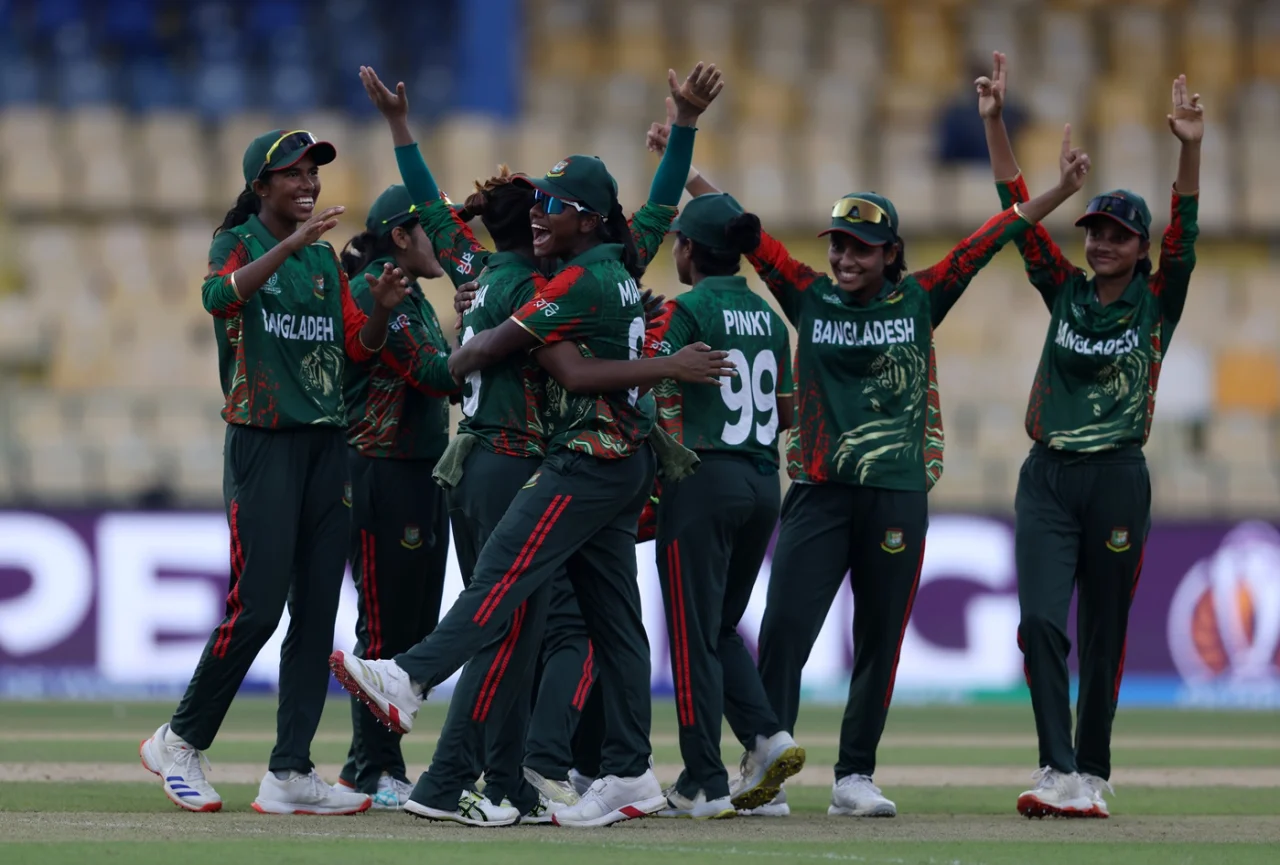
Bangladesh recorded their second ever win at a Women’s World Cup against the same opposition as their first – Pakistan.
In the first of 11 group games in Colombo, the two teams that came through the qualifiers fought a low-scoring battle, despite good batting conditions, as the attacks took centre stage.
The headlines belonged to Bangladesh’s bowlers. Sole seamer Marufa Akter set the tone with two wickets in the first over, before their five-pronged spin attack caused all sorts of problems for Pakistan. Bangladesh’s three leg spinners, Fahima Khatun, Rabeya Khan and Shorna Akter claimed six wickets between them with Shorna finishing with career-best figures of 3 for 5.
The result means Pakistan have only won one of their last 22 World Cup matches and three out of their 31 overall, and will be disappointed with the way they started this competition. After opting to bat first, only two Pakistan batters – Rameen Shamim and Fatima Sana – got past 20 and they had a highest partnership of 42. In contrast, Bangladesh’s debutant opener Rubya Haider batted through the innings and scored a half-century to back up their strong performance in the field.
A visibly more conditioned Marufa found swing immediately and success soon after. The penultimate ball of her first over pitched outside off and shaped back into Omaima Sohail, who stayed on the back foot, left a gap between bat and pad and was bowled. The final ball was even better, hooped in and took Sidra Amin’s inside-edge on its way to leg stump. That was Amin’s first golden duck in ODIs, and first since 2019. Left-handed Muneeba Ali faced Marufa’s hat-trick ball at the start of the next over, and it angled in and straightened on her but she was able to keep it out, only to be beaten next ball.
At the other end, the tournament’s youngest player, offspinner Nishita Akter took the other new ball. The first boundary came off her, when Muneeba clipped Nishita fine and then swept her away to deep backward-square. The sweep quickly became Pakistan’s go-to shot as they scored 20 of their first 45 runs with it.
Left-arm spinner Nahida Akter was introduced in the eighth over, with Muneeba and Shamim, batting at No.4 for the first time, starting to settle. Nahida removed both. Muneeba chased a wide Nahida delivery and cut it to Nishita at point, ending the third-wicket partnership at 42. In Nahida’s next over, she tossed it up to Shamim, who chipped it straight back for the simplest of return catches. Pakistan were 47 for 4 in the 14th over.
Aliya Riaz and Sidra Nawaz launched a mini counterattack when Aliya brought up the team’s fifty with a slash through backward point and Nawaz hit back-to-back boundaries off Fahima. But Nawaz’s stay at the crease was troubled. She was given out lbw to Fahima on 0 and reviewed. UltraEdge showed she had hit the ball. Three overs later, Nawaz was given not out off Rabeya Khan and Bangladesh reviewed a close call. Replays showed the ball close to both the bat and the pad as it spun back in and third umpire N Janani ruled it had hit the pad first. Nawaz was out for 15.
Sana came in at No.7 and hit the sixth ball she faced for four. She was the only batter to get Marufa to the boundary, when she creamed her through point. But Bangladesh soon applied the squeeze again. Pakistan scored six runs off the next 24 balls and pressure told: Aliya tried to hit Nishita over long-off but didn’t get enough on it and Marufa ran in from the rope to take a good catch. Sana didn’t last much longer. Two overs later, she played down the wrong line against Fahima, was hit on the front pad and given out. Sana reviewed immediately, thinking both bat and pad were close to the ball, but umpire Janani upheld the on-field decision.
Legspinner Shorna found bounce and turn and had Natalia Pervaiz caught behind in her first over. Pakistan were in danger of being bowled out inside 35 overs. They avoided that, but only just and still lost their ninth wicket in bizarre fashion. Nashra Sandhu left a full ball from Shorna and as her bat came down, she struck her own stumps to become only the second batter to be dismissed hit wicket in Women’s World Cups.
No runs were scored off Shorna’s first three overs before Diana Baig swept her for four but the fun was short lived. Sadia Iqbal holed out to mid-on halfway through the 39th over to end the innings with 69 balls remaining.
With a modest score to defend, Pakistan had to strike a balance between taking wickets and keeping Bangladesh quiet – Sana and Baig got it right early on. They found movement and teased the edge and Bangladesh had only scored seven runs off the first 22 balls of their reply. And then Baig struck. She beat Fargana Hoque with a ball that seamed in and hit her on the knee roll. Pakistan reviewed and Ultra Edge confirmed there was no bat and the ball would have hit legstump. Baig delivered a five-over spell upfront, through the powerplay, with an analysis of 5-3-2-1.
Pakistan went for double spin after the fielding restrictions were lifted and offspinner Shamim got the next wicket. She had Sharmin Akter out lbw as she was hit on the back pad.
Bangladesh captain Nigar Sultana took ten balls to get off the mark but when she did, it was in some style. She advanced down the pitch to turn a Sadia Iqbal delivery into a half-volley and hit it down the ground for four. The tension was broken in the next over when Shamim’s first ball beat everyone for four byes and then Sultana swept and reverse swept her way to two more fours.
Haider then got in on the action. She cleared the front leg to hit Shamim wide of mid-on for four, and then took on Sandhu, in an over that cost 14 runs. Haider swung Sandhu over mid-on, carved her through backward point and then charged down the pitch to hit her over mid-off. Sana brought Baig back on and Haider sent her over mid-on too as Bangladesh took control.
Pakistan kept fighting as Baig and Sana tried their best to remove Haider and Sultana. Sana thought she had found Haider’s outside edge and had her caught behind and sent it upstairs but the ball hit her thigh pad on the way through. Soon Baig thought she had Sultana lbw and called for a review but ball tracking showed it was sliding down leg. Eventually, the Pakistan pair combined when Sultana tried to short-arm jab Sana through short mid-wicket but bottom-ended to Baig.
Haider reached fifty off her 64th ball when she sent Ramim between point and cover for four. Bangladesh needed 29 runs from the last 24 overs and got there with 113 balls to spare.
Brief scores:
Bangladesh Women130 for 3 in 31.1 overs (Rubya Haider 54*, Nigar Sultana 23, Sobhana Mostray 24*; Fatima Sana 1-30, Diana Baig 1-14, Rameen Shamim 1-23) beat Pakistan Women 129 in 38.3 overs (Rameen Shamim 23, Fatima Sana 22; Shorna Akter 3-05, Nahida Akter 2-19, Marufa Akter 2-31) by six wickets
[Cricinfo]




President Anura Kumara Dissanayake today (20) paid his last respects to the remains of Most Venerable Kappetiyagoda Siri Wimala Thera, Anunayake of the Sri Lanka Ramanna Maha Nikaya and Chief Incumbent of the Rajopawanaramaya Temple in Gatambe, Kandy, who passed away.
The President visited the Rajopawanaramaya Temple in Gatambe, Kandy, where the remains of the Thera are lying, and paid his last respects. He subsequently expressed his deepest condolences to the Maha Sangha and the temple’s Dayaka Sabha, who are mourning the passing of the Thera.
Central Province Governor and Consultant Physician Dr Harsha Suranga Fernando, Kandy District Secretary Indika Udawatta and several others were present.
President’s Media Division (PMD)

India opener Shafali Verma has received an official reprimand and a demerit point for breaching Level 1 of the ICC Code of Conduct during the second T20I against Zimbabwe on Sunday.
Shafali, an ICC release said, breached Article 2.2 of the ICC Code of Conduct for Players and Player Support Personnel, which relates to “abuse of cricket equipment or clothing, ground equipment or fixtures and fittings during an International Match.”
It was Shafali’s first offence in a 24-month period.
The incident occurred in the 12th over of Zimbabwe’s innings when Shafali threw the ball into the ground in frustration after dropping a chance at mid-off offered by Chipo Mugeri-Tiripano off Sree Charani.
Shafali admitted the offence and accepted the sanction proposed by match referee GS Lakshmi, which meant there was no need for a formal hearing.
Level 1 breaches carry a minimum penalty of an official reprimand, a maximum penalty of 50% of a player’s match fee, and one or two demerit points.
India currently lead the three-match series 2-0 with the third game to be played on Tuesday evening. The T20Is will be followed by three ODIs in Vadodara from October 23.
(Cricinfo)

A total of 146 players will be competing for 27 available slots in the WPL 2027 mini auction on October 28 in Kochi. Of these, England batter Sophia Dunkley and Australia captain Sophie Molineux are the only two players who have listed themselves at the maximum base price of INR 50 lakh.
The auction pool has 119 Indian players, including 22 capped and 97 uncapped players, with 20 slots available for Indian players. The overseas pool has 27 players – 14 capped and 13 uncapped – including six from Associate teams, with seven slots available.
G Kamalini (released by Mumbai Indians), Kiran Navigre (released by U P Warriorz), Heather Graham and Jess Jonassen have registered at the second-highest base price of INR 40 lakh, while a total of 30 players have registered at INR 30 lakh.
Among the notable absentees are West Indies allrounder Deandra Dottin, who was released by UPW, and Australia legspinner Alana King, who was released by Delhi Capitals. Lizelle Lee, who was DC’s highest run-scorer last season, has also not listed herself after being released by the franchise.
What the teams look like going into the auction
Only two English players – Dunkley and Kira Chathli (INR 10 lakh) – have registered for the auction, with several others, including Danni Wyatt-Hodge, Alice Capsey, Dani Gibson, Lauren Filer and Linsey Smith opting to skip the WPL next year.
Cricinfo has learned that England are likely to play three T20Is in Sri Lanka in early February, which will clash with the final week of the WPL. While the ECB is likely to allow players to stay in India to complete the tournament, most players have instead chosen to prioritise their international commitments ahead of the Champions Trophy later that month.
The relatively low salaries on offer at the WPL are also understood to be a factor in many English players deciding not to register, with most internationals earning significantly more to play in the Hundred (up to £190,000 last year) than the highest permitted base price in the WPL of INR 50 lakh (£40,000 approx).
Molineux was part of the Royal Challengers Bengaluru [RCB] title-winning squad in 2024, and had bagged 12 wickets in ten games at an economy rate of 7.31. She was retained by RCB for the 2025 season but a knee injury ruled her out of the season. Dunkley, meanwhile, played for Gujarat Giants [GT] in 2023 before opting not to register for the 2024 season. She went unsold in the 2025 auction.
Among the premier internationals who have listed themselves for INR 30 lakh are Australia allrounder Grace Harris (released by RCB), Sri Lanka captain Chamari Athapaththu, South Africa left-arm spinner Nonkululeko Mlaba and South Africa allrounder Chloe Tryon.
UPW, who released nine players, will go into the auction with the biggest purse of INR 3.75 crore.
[Cricinfo]

Import and Export (Control) Regulations No. 08 of 2026
Draft Bill of the Public Private Partnership Enterprises Act to be gazzetted
Amendment of the Ayurvedha Act No. 31 of 1961

Cabinet nod to amend the Sri Lanka Development Administration Institute Act No. 9 of 1982
Establishment of the National Higher Performance Centre
State patronage for the cremation ceremony of the late deputy prelate (Anu Nayaka Thero) of the Sri Laka Ramangya Maha Nikaya, Gatambe Rajopawanramadhipatha, Siri Chandawimala Wanshalankara, Chandrakeerthi Sri Amarawansha, Sadhdharmawageeshwara, Shasanashobhanna Most Venerable Keppetiyagoda Siriwimalabhidhana Thero

‘Dates have the highest sugar content to fight Coronavirus’

Sunday Island 27 December – Headlines

#SundayIsland 17th December – Headlines

Sunday Island – 28th March

Sunday Island Headlines – 21 March

Sunday Island – 21st February – Headlines
-

 Features3 days ago
Kotahena:A Small Enclave, An Extraordinary Legacy
-

 News7 days ago
Sri Lanka, India caught in US-Iran ship crisis
-

 News4 days ago
Asgiri Mahanayake calls for immediate release of Gnanasara Thera
-

 Latest News7 days ago
Missiles intercepted near Riyadh after Saudi coalition hits Yemen fuel depot
-

 Latest News7 days ago
Kusal Mendis’ unbeaten 87 hands Sri Lanka consolation win
-

 News2 days ago
Record 1,600 students take Russian Classical Ballet examination in Sri Lanka
-
 News6 days ago
AC President recuses himself from hearing prison attire case pertaining to Gnanasara Thera
-

 News5 days ago
Naval officer testifies Yoshitha received Rs. 5.15 mn in salaries during SLN service