
News
SL plans to use nuclear energy for power generation


Sri Lanka informed the 69th General Conference of the IAEA held from 15-19 September in Vienna that it was exploring nuclear power as a reliable, low-carbon energy source to diversify its energy mix and address the dual challenges of climate change and energy security, and that the country had included nuclear power as an energy source within the base case of CEB Least Cost Long-Term Generation and Expansion Plan 2025-2044.
The Foreign Ministry statement in this regard: “Delivering the national statement of Sri Lanka at this key event of the IAEA calendar, Permanent Representative of Sri Lanka to the IAEA Ambassador M R K Lenagala underscored the country’s close engagement with the IAEA since joining the Agency in 1957, and reaffirmed Sri Lanka’s unwavering support for the IAEA’s mission to accelerate and enlarge the contribution of atomic energy to peace, health and prosperity across the globe. A briefing on the progress Sri Lanka has made in the use of nuclear applications for peaceful uses was provided, including the establishment of a Cyclotron based radio pharmaceutical proton facility to support PET scanning for cancer diagnosis on an initiative by the Sri Lanka Atomic Energy Board with the regulatory approvals from the Sri Lanka Atomic Energy Regulatory Board, National Medicines Regulatory Authority and Central Environmental Authority.
While appreciating the IAEA’s continued support and technical guidance towards the progress of Sri Lanka’s peaceful applications of nuclear science and technology including through the Technical Collaboration Projects, the Ambassador outlined several key initiatives that Sri Lanka has undertaken to strengthen the country’s nuclear infrastructure. Reference was made to the participation of a high delegation led by the Speaker of the Sri Lanka Parliament earlier this year, in a consultative meeting with the IAEA on adherence to global nuclear security framework focused on the Physical Protection of Nuclear Material and its Amendment (CPPNM), as well as to the SLAEB’s hosting of four IAEA follow-up review missions to Sri Lanka, reflecting the country’s continuous engagement with the IAEA.”


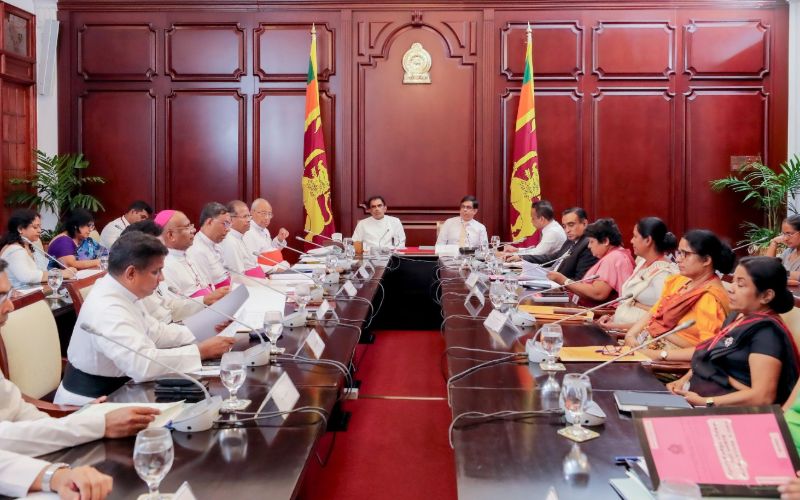
A discussion with the Catholic Council was held on Thursday (21) afternoon at the Presidential Secretariat under the co-chairmanship of Minister of Science and Technology, Chrishantha Abeysena and Secretary to the President Dr. Nandika Sanath Kumanayake.
Discussions focused on administrative issues relating to Catholic schools taken over by the Government, the formulation of a structured teacher cadre system for Catholic religious education, the need to recruit Catholic nuns and priests into the teaching profession and the establishment of a mechanism to obtain the support of the Ministry of Education for the administration of Government-acquired Catholic schools.
It was also decided that discussions with the Catholic Council would be held three times annually, while Senior Additional Secretary to the President Roshan Gamage would serve as Secretary to the forum.
Expressing appreciation on behalf of the Catholic Council, His Eminence Malcolm Cardinal Ranjith thanked President Anura Kumara Dissanayake and the Government for facilitating the discussion.
His Eminence further stated that the expectation was to ensure every student, without discrimination, is given the opportunity to learn his or her own religion and stressed the importance of resolving the prevailing issues within the education sector.
Also present at the occasion were Most Rev. Bishop Harold Anthony Perera, Most Rev. Bishop Christy Noel Emmanuel, Most Rev. Bishop Anton Ranjith, Most Rev. Bishop Wimal Siri Jayasuriya, other clergy representing the Catholic Council, Secretary to the Ministry of Education, Nalaka Kaluwewa and senior officials of the Ministry of Education.
(PMD)

The International Cricket Council (ICC) has decided to broaden the Women’s Emerging Nations Trophy, which was launched last year. Unlike the inaugural edition held in November 2025 that featured eight Associate teams, the second edition will comprise 10 teams, including five Test-playing nations. The tournament is scheduled to be held in November this year.

Italian Navy’s ITS GIOVANNI DELLE BANDE NERE, which arrived in Colombo (21 May 2026) on a replenishment visit, departed the island today (22 May).
The Sri Lanka Navy bade a customary farewell to the departing ship in compliance with naval traditions at the port of Colombo.
During her brief stay in Colombo, the Commanding Officer of the ship, Commander Antonio BUFIS called on the Commander Western Naval Area at the Western Naval Command Headquarters.

Catholic Council reconvenes after nine years

ICC to widen Women’s Emerging Nations Trophy

Italian Navy’s ITS GIOVANNI DELLE BANDE NERE departs following replenishment visit

PM meets Secretary-General of the Commonwealth of Nations

Tennessee execution called off after failed lethal injection

Landslide early warnings issued to the Districts of Colombo, Gampaha, Kalutara, Kegalle, Nuwara Eliya and Ratnapura

‘Dates have the highest sugar content to fight Coronavirus’

Sunday Island 27 December – Headlines

#SundayIsland 17th December – Headlines

Sunday Island – 28th March

Sunday Island Headlines – 21 March

Sunday Island – 21st February – Headlines
-

 Features6 days ago
Sri Lankan Airlines Airbus Scandal and the Death of Kapila Chandrasena and my Brother Rajeewa
-
 News7 days ago
Lanka’s eligibility to draw next IMF tranche of USD 700 mn hinges on ‘restoration of cost-recovery pricing for electricity and fuel’
-

 News6 days ago
Kapila Chandrasena case: GN phone records under court scrutiny
-

 News6 days ago
Rupee slide rekindles 2022 crisis fears as inflation risks mount
-

 Features3 days ago
Octopus, Leech, and Snake: How Sri Lanka’s banks feast while the nation starves
-
 Business6 days ago
Expansion of PayPal services in Sri Lanka officially announced
-
 News2 days ago
Steps underway to safeguard Sri Lanka’s maritime heritage
-

 News6 days ago
Court orders further arrests in alleged USD 42 Mn NDB fraud case