
Latest News
Cyber-attack causes delays at Heathrow and other European airports

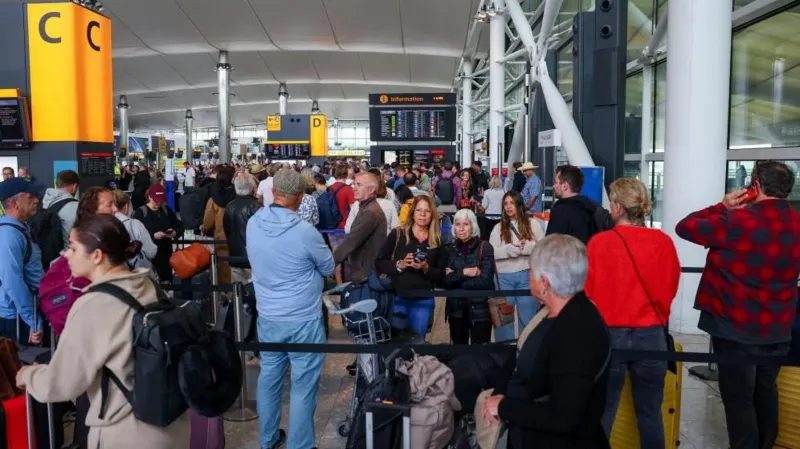
Heathrow is among several European airports hit by a cyber-attack affecting an electronic check-in and baggage system.
A number of flights were delayed at the airport on Saturday as a “technical issue” impacted software provided to several airlines.
Brussels Airport said a cyber-attack on Friday night meant passengers were being checked in and boarded manually, while Berlin’s Brandenburg Airport also reported longer waiting times due to the problem.
RTX, which owns software provider Collins Aerospace, said it was “aware of a cyber-related disruption” to its system in “select airports” and that it was working to resolve the issue as quickly as possible.
The company added: “The impact is limited to electronic customer check-in and baggage drop and can be mitigated with manual check-in operations.”
It said its Muse software – which allows different airlines to use the same check-in desks and boarding gates at an airport, rather than requiring their own – had been affected.
The BBC understands that British Airways is operating as normal using a back-up system, but that most other airlines operating from Heathrow have been affected.
Hundreds of flights have been delayed at the airports throughout Saturday, according to flight tracker FlightAware.
Dublin Airport said it and Cork Airport had experienced a “minor impact” from the cyber-attack, with some airlines implementing manual check-in processes.
Lucy Spencer said she had been queuing to check in for a Malaysia Airlines flight for more than two hours, and that staff were manually tagging luggage and checking passengers in over the phone.
“They told us to use the boarding passes on our phone, but when we got to the gates they weren’t working – they’ve now sent us back to the check-in gate,” she told the BBC from Heathrow’s Terminal 4, adding that she could see hundreds of people queuing up.
Another passenger, Monazza Aslam, said she had been sitting on the tarmac for over an hour “with no idea when we will fly”, and had already missed her onward connection at Doha.
“I’ve been at Heathrow with my elderly parents since 05:00,” she said, adding: “We are hungry and tired.”
Johnny Lal, who was due to fly to Bombay for his mother-in-law’s funeral on Saturday, said he and his mother will now miss their flight.
He told the BBC his mother “can’t walk one step without her [mobility] scooter” but that Heathrow staff had been unable to provide her with one. “They keep just telling us the systems are down.”
Luke Agger-Joynes said that, while queues in Terminal 3 were “much larger than normal”, the airline for his US flight and the airport “seem to be prepared and the queues are moving much faster than I feared”.
He added: “They are also calling out specific flights and picking people out of the queue to ensure they don’t miss their flights.”
Heathrow said additional staff were at hand in check-in areas to help minimise disruption.
“We advise passengers to check their flight status with their airline before travelling to the airport and arrive no earlier than three hours before a long haul flight or two hours for a domestic flight.”
A National Cyber Security Centre spokesperson said: “We are working with Collins Aerospace and affected UK airports, alongside Department for Transport and law enforcement colleagues, to fully understand the impact of an incident.”
Transport Secretary Heidi Alexander said she was aware of the incident and was “getting regular updates and monitoring the situation”.
EasyJet and Ryanair, which do not operate out of Heathrow but are among Europe’s biggest airlines, said they were operating as normal.
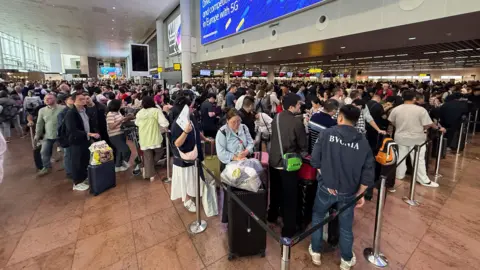
Brussels Airport said there would be a “large impact on the flight schedule”, including cancellations and delays. Long queues and large crowds could be seen at the airport on Saturday morning.
Europe’s combined aviation safety organisation, Eurocontrol, said airline operators had been asked to cancel half their flight schedules to and from the airport between 04:00 GMT on Saturday and 02:00 on Monday due to the disruption.
Travel journalist Simon Calder said that “any disruption is potentially serious” at Heathrow, given it is Europe’s busiest airport, and that “departure control is a really complex business”.
He told the BBC: “These things are all interconnected, so a little bit of a problem in Brussels, in Berlin… people start missing connections, planes and passengers and pilots are not where they are meant to be, and things can get quite a lot worse before they get better.”
It was only last July that a global IT crash due to a faulty software update from cybersecurity firm Crowdstrike caused disruption to aviation, grounding flights across the US.
Analysts said at the time that the incident highlighted how the industry could be vulnerable to issues with digital systems.
While there are unfounded accusations circulating that this cyber-attack was carried out by Kremlin-sponsored hackers, all major hacks in the past few years have been carried out by criminal gangs more interested in extracting money from their victims.
Extortion gangs have made hundreds of millions of dollars a year by stealing data or using ransomware to cause chaos and extract ransoms in bitcoin from their victims.
It is far too early to know who is behind this attack. Some cyber-security experts suggested this could be a ransomware attack, but note that these can be perpetrated by state-sponsored actors as well.
Collins Aerospace has yet to comment publicly about the nature or origin of the hack.
Many hacking gangs are headquartered in Russia or other former Soviet countries, some of which are thought to have ties to the Russian state.
But there have been plenty of arrests elsewhere, while British and American teenagers are accused of carrying out some recent large cyber-attacks against Las Vegas casinos, M&S, Co-op and Transport for London.
[BBC]

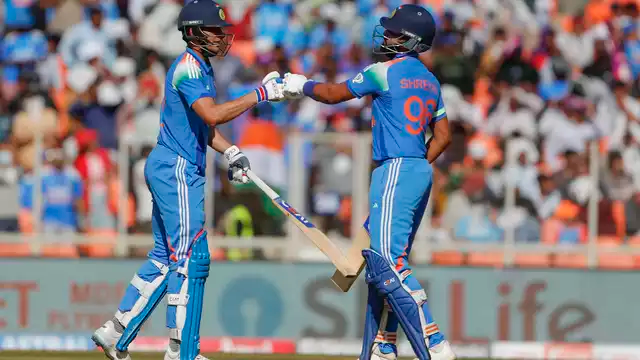
Squad for the first three ODIs: Shubman Gill [C], Rohit Sharma, Virat Kohli, Shreyas Iyer [VC], KL Rahul [WK], Nitish Kumar Reddy, Axar Patel, Naman Dhir, Anshul Kamboj, Gurnoor Brar, Ruturaj Gaikwad, Arshdeep Singh, Ishan Kishan [WK], Mohammed Siraj, Prasidh Krishna*, Kuldeep Yadav
Squad for fourth and fifth ODIs: Shreyas Iyer [C], Rohit Sharma, Virat Kohli, Tilak Varma, Ishan Kishan [WK, VC], Nitish Kumar Reddy, Axar Patel, Naman Dhir, Auqib Nabi, Gurnoor Brar, Ruturaj Gaikwad, Arshdeep Singh, Kumar Kushagra [WK], Mohammed Siraj, Yash Thakur, Kuldeep Yadav
[Cricbuzz]
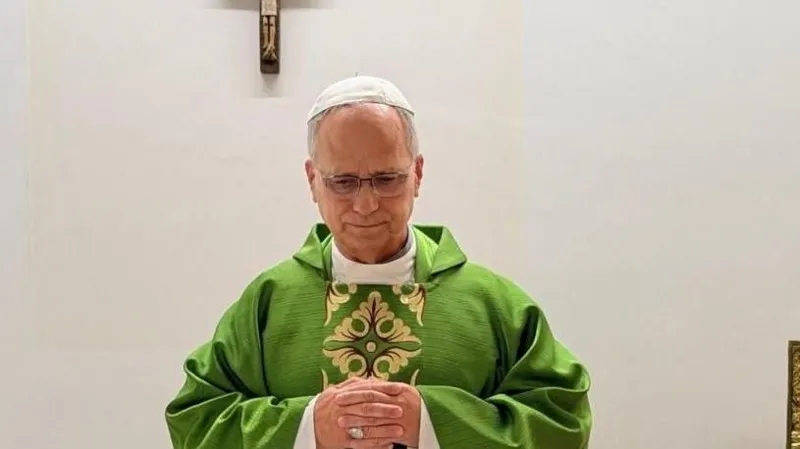
Pope Leo XIV has been pictured celebrating Mass from hospital, in the first images of him released by the Vatican since he underwent lung surgery.
The 71-year-old pontiff was diagnosed with lung cancer after the surgery at Rome’s Gemelli Hospital on Tuesday afternoon, which the Vatican said had been “successful” and proceeded without complications.
The images shared on Friday showed the Chicago-born Pope wearing a green robe while standing behind a makeshift altar on the tenth floor of the hospital.
Pope Leo “celebrated with the medical and nursing staff” and thanked workers for their service, the Vatican press office said.
On Friday, the Pope’s doctors said tests had shown “a steady improvement in his general condition” since his procedure.
His doctors said that a chest X-ray indicated “good recovery of the operated lung”.
The whole lower lobe of the Pope’s right lung was removed “to ensure the procedure was radical”, the Vatican said following the surgery.
“After the operation, the Pope awoke normally and returned after a brief period of observation to his room,” it said earlier, before he spent a “peaceful night” at the hospital.

Pope Leo first announced that he would be having the operation during his weekly Sunday prayers, telling the crowd in St Peter’s Square that doctors had found a “well-contained” nodule on his lung “at an early stage” and advised him to have it removed.
Nodules are quite common and not necessarily cancerous, but after it was examined the medical team confirmed it was, “as suspected by pre-operative tests”, the Vatican said. He was diagnosed with lung adenocarcinoma.
The Vatican has stressed that the Pope had shown no symptoms of infection or illness prior to the procedure.
[BBC]
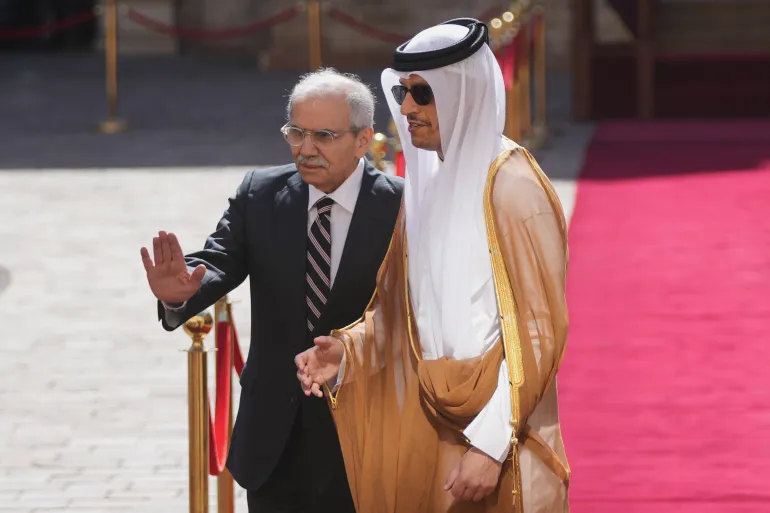
Qatar’s prime minister has announced plans to set up what he described as a “massive” solar plant in Lebanon to help ease its energy crisis.
Sheikh Mohammed bin Abdulrahman bin Jassim Al Thani made the announcement during his visit to Beirut on Friday, after meeting his Lebanese counterpart, Nawaf Salam.
“We have agreed to establish a comprehensive framework for cooperation in the energy sector and to present viable solutions,” Sheikh Mohammed said.
QatarEnergy has reached an agreement with French company TotalEnergies to jointly develop a solar power plant in Lebanon as an initial project.
The aim is to develop a major investment project “that would benefit the Lebanese economy, as well as the Qatari companies and entities participating in it”, he added.
Prime Minister Salam said he would put the plans for Lebanon’s electricity sector to the Lebanese Cabinet soon.
“The Qatari side will fund, implement and activate the project without any cost on the Lebanese state,” Lebanon’s leader said, adding that such a move is important because of the country’s financial crisis.
Lebanon’s state electricity company is one of the biggest sources of debt, haemorrhaging about $40bn over past decades with a bloated workforce and outdated infrastructure. The company provides only a few hours of electricity a day and the state, until a year ago, took advances from the Central Bank when diesel fuel ran out.
Sheikh Mohammed said Doha stands in “solidarity with the Lebanese people” and the entire region “in this dire hour”. Lebanon has been struggling with multiple energy crises in recent years and the situation has been compounded by the country’s financial collapse and Israel’s ongoing assault.
Earlier in the day, the Qatari PM also met Lebanon’s president and parliament speaker.
Among the topics discussed was the situation in southern Lebanon, where Israel continues its assault, capturing dozens of towns and villages.
Sheikh Mohammed said “Israeli violations within the Lebanese territories” were a large part of his talks.
He said that Israel should withdraw from Lebanon and cease its attacks, adding that Qatar is working in coordination with the United States to help lay the groundwork for future reconstruction in southern Lebanon to allow displaced people to return to their homes.
Israeli attacks on southern Lebanon have continued despite a ceasefire agreed in June. Under the agreement brokered by the US, the Lebanese government is to disarm Iran-backed Hezbollah. In return, Israeli forces will gradually withdraw from southern areas that they occupy. However, Hezbollah is not part of the agreement and has refused to disarm until Israel withdraws from the country.
Lebanese authorities say Israeli attacks have killed more than 4,300 people in the country since March. About 1.2 million people were also displaced in Lebanon at the height of the war.
Although most have returned home since the June ceasefire, more than 300,000 people remain displaced, according to the International Organization for Migration.
Lebanon’s PM Salam thanked Qatar for its “continuous” support during some of Lebanon’s “darkest hours”.
[A;jazeera]

Showers above 75 mm are likely at some places in the Western, Sabaragamuwa, Central and North-central provinces and in Trincomalee and Mullaitivu districts

Cut power bills by 3-5%, don’t hike them, consumers demand

Asgiri Mahanayake calls for immediate release of Gnanasara Thera

Lanka Air Force joins multinational exercise in India

Shiranthi granted bail in ‘Siriliya Saviya’ fund probe

Three Thai nationals arrested with hashish at BIA

‘Dates have the highest sugar content to fight Coronavirus’

Sunday Island 27 December – Headlines

#SundayIsland 17th December – Headlines

Sunday Island – 28th March

Sunday Island Headlines – 21 March

Sunday Island – 21st February – Headlines
-

 News6 days ago
Sri Lanka escalates anti-graft drive with Shiranthi’s jailing
-

 Latest News5 days ago
Farhan and Sadaqat help Pakistan seal series in style
-

 News6 days ago
Iranian ships stranded, Lanka fears US sanctions
-

 Latest News4 days ago
Nissanka’s return headlines Sri Lanka’s Test squad against Pakistan
-

 Features5 days ago
Intake 16: 45 years of duty and honour
-
 News5 days ago
Malwathu Chapter issues statement on talks with President over Gnanasara Thera’s robes
-
 News5 days ago
CP alleges NPP has taken the blame for illegal US sanctions on Iranian vessels
-
 News6 days ago
Navi Pillay’s Lankan affairs in focus as she wins 2026 Nobel Peace Prize