
Features
The Biden Presidency is a Point of Inflection

“This country belongs to the people who inhabit it. Whenever they grow weary of the existing government they can exercise their constitutional right of amending it, or their revolutionary right to dismember or overthrow it.”
Abraham Lincoln, First Inaugural Address, 1861.
by Kumar David
The term ‘economy’ is constrained and narrow, the phrase ‘material and social conditions of life and the interface between State and citizen’ is clumsy but better conveys my import. I have no choice but to keep switching terminology as this column progresses. True, America is still the “greatest power on earth” (said with rasping tongue on dry palate) but it is also a very troubled nation in a turbulent world. I have a gut sense that the Biden Presidency signals a transition between what is and what may be. Let my mind roam through this maze; without imagination we are dullards.
It’s not that Old Joe is great or god’s gift to America, it is that matters have come to such a pass that it is not possible to run away any longer. America lives on borrowed time and fake money thanks to the world’s greed for the almighty dollar. The US runs up ever more debt and prints ever more dollars and the world chases them in perpetual defiance of financial gravity. This has to give! It will in three ways – (a) domestic instability – drawn out or sudden, (ii) wakeup and change, (iii) withdrawal from global dollar veneration. Or more likely an interweaving of all three in now indeterminate proportions.
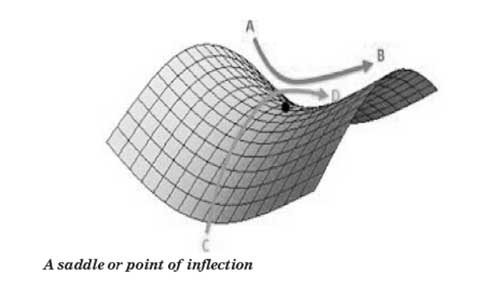
My conjecture, for the purposes of today’s essay is that Old Joe, perhaps kicking and screaming, will be a step in the direction of option (ii). Commentators these days are stodgy and dull; instead, let us be bold. In these strange times imagination is more real than prosaic reason. I begin with the proposition that the Biden Administration intends to and will 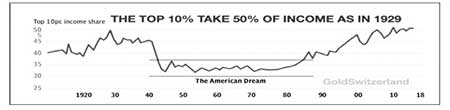 be the antithesis of Trump since its domestic and global credibility are predicated thereon. Next it will have to address social problems that were the grounds for the rise of the Trump Base. It will have to address them from premises where it can, in the end, say: “Trump was an aberration, his methods were wrong. We overcame crises from diametrically opposed premises on race, economy, climate, global engagement and moral values at large”. Third, not only this presidency but what becomes of future presidencies will depend on whether the Biden experience stands or falls. In other words I am making the case that we are at an inflexion point in American history. At an inflexion or a saddle point a momentous transition can materialise but it is an uncertain switch which may flip in unexpected directions.
Luck has been on Biden’s side so far and he is cashing in. There has been a 70% reduction in the rate of spread of covid since mid-January. Ninety million vaccine doses have been distributed and three-quarters have found their way into people’s arms. Biden is backed by a scientific team headed by Anthony Fuchi, America’s and perhaps the world’s leading expert on infectious diseases and the team includes Professor (Ms) Rochelle Walenky of Harvard Medical School and current head of the Centre for Disease Control, and health-care businessman Andy Slavitt who signed on as Presidential Covid Advisor. US scientists in tears say “Oh my god what a change”. On other matters too the US has given notice: Return to the Paris Accord, WHO and Iran Nuclear deal. US allies are ecstatic and ungrudgingly make room for the big guy calling it a reassertion of American leadership or a return of the prodigal, depending on whether the speaker is of Anglo-Saxon/Germanic or a Latin-derived tongue. The switch from a Neanderthal to a Homo-sapiens variant of genus Americanus is widely welcome. The icing on the cake was Percy’s arrival on Mars.
Yet things are bad for America though Biden glows in redeemers luck. Some scientists on US TV say the country will lick the pandemic by Christmas even if the fast spreading British and South African mutants prove stubborn, but others reckon that unless tough measures as in S Korea, China, Taiwan and New Zealand are adopted this will not be possible. Americans, unlike people elsewhere, are uncooperative though science has got the virus by the vitals, and if it sets its sights it can subdue it. However, more critically, this is not the case with socio-economic ‘epidemics’ which span all dimensions – class, state, poverty, wealth & income, race and politicos hungering for eternal power. In respect of the last cancer, be it America or Lanka, vermin behaviour is similar.
While Biden has scored some successes his greatest challenge, the one that will decide his fate, is how his Administration addresses the economic conundrum that underlies partisanship, sparks social instability and nurtured the extremism which burst out in terrorist proportions on Capitol Hill on January 6. So much has been written about inequality in the world’s richest country that I can get by with one graph. The top 10% in the US take 50% of national income as in 1929 in the period leading up to the Great Depression. The forty years from the end of WW2 to the mid-1980s spans the four decade dream of American exceptionalism; the shinning city on the hill, the immigrants’ beacon, the apogee of welfare capitalism when income distribution was fairer. But that was then. Wealth inequality now is even worse than income inequality. The top 5% owns nearly 70% of all wealth and the median wealth of the poorest 20% is either zero or negative (indebted). The median wealth of White families exceeds $150,000, Latinos $6500 and Blacks $3500 – 2016 statistics. Wealth-Income inequality is but a single indicator; I do not have the space to enumerate other inequities such as healthcare, education and housing. Inequality and inequity almost completely explain why so many are angry and why nearly 75 million Americans voted for an insolent, uneducated scoundrel.
What can a new administration, even if well-intentioned and willing to go the extra mile do? Inflection is not revolution, nor are Americans ready to countenance structural overturn of property relations. Capitalism has accomplished “wonders surpassing Egyptian pyramids, Roman aqueducts and Gothic cathedrals”; it has conducted expeditions that have reached the planets of the sun. Still it carries within it the seeds of its own decay. That came to pass in the Great Depression and again in the Great Recession of 2009. The point is how governments and the entrenched global economic order dealt with the downfall this time. No, not by classic cleansing of the Augean Stables as Adam Smith anticipated nor by Schumpeter’s creative destruction. Finance capital was too entrenched to be thus overthrown. This time the tools were different; creation of gigantic debt.
Not only Sri Lanka, though we are among the most foolish at the game, in America, Europe, Japan and everywhere, central banks are issuing electronic paper-money like spillage gushing from a ruptured sewer.
I cannot inundate you in a statistical flood; one bar chart must suffice. The chart makes a point needed for this essay, Bidden’s impasse. The rupture spurted out stimulus packages (grants to bankrupt businesses and to banks deemed “too big to fail” that their bankruptcy would entail a threat to the system itself). Quantitative Easing (QE) poured astronomical quantities of central bank (CB) money into financial houses, banks and insurance companies. CB funds purchased their bonds at low or negative real interest rates and thus found its way into stock-markets and prime property creating an asset boom and the largest flare-up of income and wealth inequality in capitalism’s history. In America alone this injection reached nearly three trillion dollars in 2020 before the December $960 billion ‘Covid Package’. The Fed’s net balance-sheet 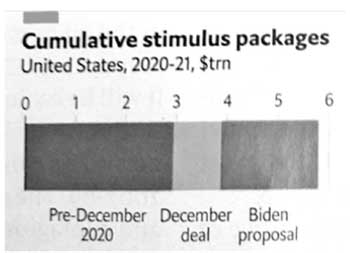 (net because short-term support is recovered at intervals) swelled to $5.3 trillion in March 2020. At one point Bank of America’s Mark Cabana feared that “Unlimited QE and emergency liquidity programs will see the Fed balance sheet double in size (to $10 trillion) over 2020” (CNBC, 27 March, 2020). Biden is now comitted to another $1.9 trilllion to fight the pandemic, provide essential public assistance and rebuild infrastructure. This is unavoidable and has my support. (Wipe that smirk off your face; no I don’t have a vote in the US Senate!)
Forget the plethora of hard to remember stats; the simple point is this, I cannot see how the US, whoever the president can escape from a stranglehold that has become perpetual indebtedness. US National Debt (debt owed by the Federal Government will reach $27 trillion as you read this, and that does not include unfunded future Medicare and Social Security commitments; add such omissions and the US is looking at future Federal indebtedness of about $125 trillion (see ). This leaves out State Governments, Commercial and household debts, which technically are not Biden’s nightmare. With a massive commitment to infrastructure and a targeted push to renew of capitalist entrepreneurship, can the Biden Presidency pull America out of the hole? Not unless it is accompanied by economic restructuring which is doubtful.
Before closing I need to comment on the Bidden Inflection Point from the perspective of human rights, relations with China and Russia and Israel-Palestine conflicts. In my view there will be no big change except the nuclear arms agreement with Russia. The rhetoric all round will be more decent than Trump’s. It is on Palestine that we will see the worst. There are too many pro-Israeli incumbents at the heart of the Presidency and Biden will do no more, and maybe less, than his predecessor to ease the misery of the Palestinians. On human rights, Gota will be disappointed to learn that despite the Core Group watering down the Geneva Resolution, Biden Administration is likely to be more forceful than Putin and Kim embracing Donald Trump.



It has been some time since I read an Agatha Christie, the plot of which I cannot remember. So, I was delighted to find on the shelves of a friend Lord Edgware Dies, which I had a vague memory of, but no certainty about who had done it.
When I read it, I found that my memory of who was probably the killer was correct, but I could not be certain and the red herrings Christie threw in were so diverting that until almost the very end I wondered if I had been wrong.
The plot is very simple. Jane Wilkinson, who is married to Lord Edgware, tells him that she is desperate for a divorce since she is in love with a very proper Anglo-Catholic peer, Lord Melton, but Edgware refuses to divorce her. She asks Poirot to talk to him, which he does, and is surprised to find that Edgware has told Jane he is prepared to give her a divorce. This was, after he had categorically refused, through a letter, which Jane said she had not received.
That night Edgware is murdered, after Jane had been to see him, or so the butler said, and also Edgware’s secretary. But Jane had been that evening at a grand dinner many miles away, where a dozen fellow guests could swear to her presence.
There was a solution however to the mystery of two Jane Wilkinsons, namely a skilful impersonator called Carlotta Adams who, in the opening chapter had impersonated Jane Wilkinson, who had also been at the performance. But when Poirot goes to see her, he finds that she had been found dead on the morning after Edgware had been killed, of an overdose. And in her bag was a gold case, with a strange inscription, that contained the drug, along with a pair of pince-nez.
Her maid said she had written a letter to her sister in America and posted it the previous night. Poirot asks Inspector Japp to get the letter, and a transcript is received from America, and in it the name of Edgware’s nephew Ronald Marsh is mentioned; he had taken Carlotta to dinner after her performance, with which the book opens, and had then set her a challenge. Japp arrests Marsh, but Poirot is not happy and asks for the original of the letter, which the sister sends him. That shows that a page is missing, and the tear is obvious, though that raises the question as to why it had not simply been cut.
Matters are further complicated by the fact that Marsh had gone in a taxi to the Edgware house, along with Edgware’s daughter Geraldine, in the interval of an opera which had previously seemed to provide them with cast iron alibis. Geraldine had gone in to fetch her pearls so that Marsh could raise money he needed, and thus had an opportunity to kill Edgware, as did Marsh, for the driver said he had got out of the taxi while waiting and gone into the house.

Agatha Christie
Marsh explained why he had gone to the house on the night of the murder as having followed Bryan Martin, an American actor, who had been in love with Jane, whom he saw go into the house with a key. But there was no one visible when he entered, and Geraldine almost immediately came down and they left together. And Martin too has become an object of suspicion to Poirot, for he had been to see him before the murders were discovered with a story of being followed by a man with a gold tooth – a story Poirot immediately realized was false when he was asked how old the man was, and was told he was young, for young people did not have gold teeth.
A heap of French money Edgware had got for a trip to Paris was missing, but since Marsh had no need for it after his cousin’s offer of help, Poirot deduces that it must have been taken by the butler, who has disappeared. Christie has stressed that he is astonishingly handsome, unusual in a butler, and Poirot notes a resemblance to Martin, so he thinks the mysterious man going into the house must have been him.
Incidentally, later Poirot assumes that Edgware’s change of mind was because he was involved in some scandal, and I believe Christie intends us to see the cause of this in his handsome butler, though this is not specified.
Meanwhile, Poirot has asked Japp to find out the provenance of the case found in Carlotta’s handbag, and it turns out to have been made in Paris, specially commissioned, and collected by a woman with pince-nez.
But then another murder occurs—that of another guest at the grand dinner, which provided Jane with her alibi. The victim is an actor who had been bemused when Jane, at a lunch, thought the Judgment of Paris referred to the city. He told Hastings he wanted to see Poirot, but was killed before he could get to the appointment. Poirot had rushed there when told about his request, but it was too late.
Meanwhile, Poirot has tried out the pince-nez on Edgware’s secretary, but she could not see through these. It was only a chance remark heard outside the theatre that led him to try them out on Wilkinson’s maid Ellis, a spare pair that had been appropriated for the night of the murders.
Poirot then lays things out, having summoned Martin and told him that he probably suppressed Edgware’s letter, as he had been dropped by then and he did not want Jane to marry another. But after teasing Martin, Poirot says that Jane was in fact the murderer, and she got Carlotta to impersonate her at the dinner while she went to the house and killed her husband. After meeting Carlotta later and checking with her through a call that she had not been rumbled, Jane had gone ahead with the murder – she put veronal into her drink and the case with veronal into the handbag. She forgot to take out the pince-nez she had used earlier to imitate an American. Carlotta had registered as the American in a hotel and Jane had gone to see her, and there they exchanged identities. After seen the letter, she made use of it by tearing off the page that referred to her, and the S of She, so that the person who had challenged Carlotta to impersonate her seemed to be a man.
There is a coda in which Jane, condemned to death, writes to Hastings, still full of pride at her ingenuity hoping she will be remembered.
by Prof. O. A. Ileperuma
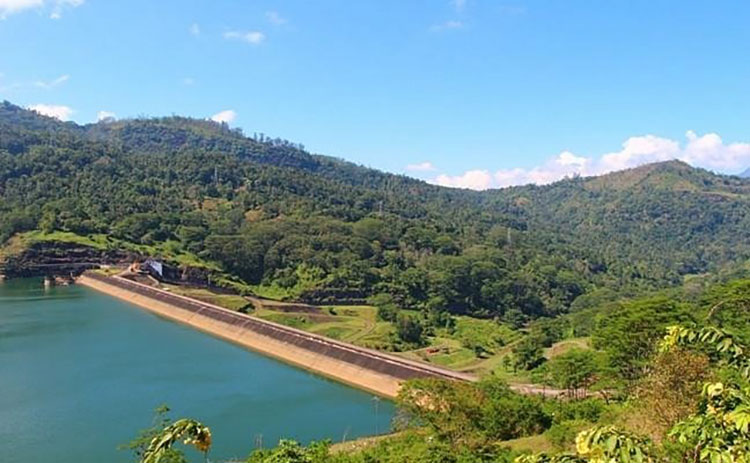
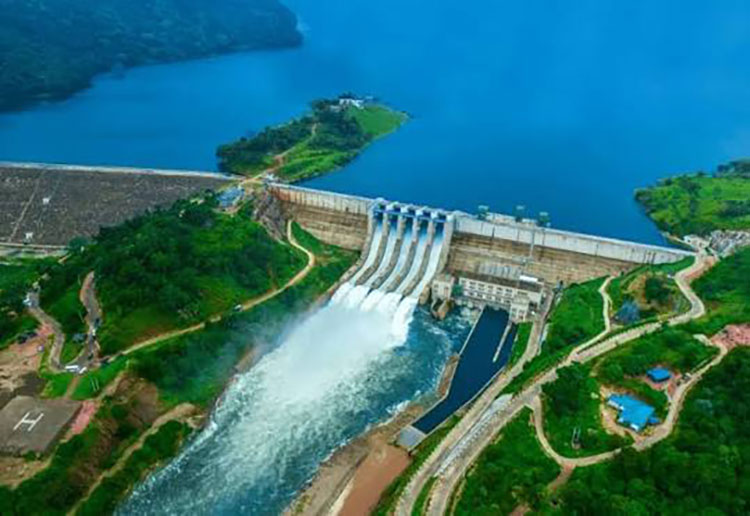
Silting of reservoirs is a major problem today affecting our hydropower production and irrigation systems. The main Mahaweli reservoirs are silted to a considerable extent reducing the water holding capacity of them. Due to poor soil management practices, floodwaters deposit large amounts of silt in these reservoirs. When the Polgolla reservoir was fully drained about two years back, one could see mountains of silt in the lower reaches of the reservoir. A rough estimate is that 50% of the total capacity of these reservoirs has been lost to siltation. This is a serious issue which affects not only power and agriculture but also flood control.
Our ancient irrigation systems ensured that desilting of reservoirs took place under royal decree where all users of the reservoirs were ordered to carry out desilting of reservoirs during the dry season. The clay thus collected was used in making bricks for the construction of great stupas which dot the landscape of our ancient kingdoms. This ensured that the reservoirs had their full capacity filled with water for the next cultivating season. Our ancient kings were clever enough not to construct reservoirs by blocking main rivers such as the Mahaweli. A classic example is the Minipe left canal where they tapped only the surface water of Mahaweli. Even the bigger tanks such as Nuwara Wewa and Parakrama Samudraya were fed with minor rivulets. There were also other ingenious features in the cascade irrigation systems built by the ancient kings, such as mud sluice canals and forest reservations between the reservoirs in the cascade system. These reservations helped trap silt and remove excess nutrients, which could otherwise contribute to increasing salinity as water flowed from one reservoir to another.
-

- Parakrama Samudraya
-

- Kalawewa
-
- Kotmale

Victoria
Moragahakanda
A classic engineering marvel is the former Yoda Ela, which carries water from Kalawewa to Nuwara Wewa and Tissa Wewa. It is 87 km long although the straight distance between these points is only about 40 km. The gradient of this canal is about 10 cm per km or 6 inches per mile. Yodha Ela functions as a moving reservoir and feeds about 4,600 hectares of paddy lands. It is a winding canal with about 120 smaller reservoirs on its way. It was constructed during the reign of King Dhatusena around 459 AD and later expanded by King Parakramabahu by connecting more reservoirs to the network. Unfortunately, during the Mahaweli project our modern-day engineers constructed a concrete canal replacing the winding path of this Yoda Ela also called Jaya Ganga. This effectively removed the ability of the old Yoda Ela to remove silt and nutrients. The bank of this Ela has wet zone trees such as jak and areca nut growing well. They take up the nutrients from the flowing stream making the water suitable for irrigation later.
Ancient Mesopotamian civilisations depended on dams constructed along the two main rivers, Euphrates and Tigris. After continuous irrigation of their fields over several thousand years, salinity of the irrigated lands increased making them unsuitable for agriculture. People died due to famine and this clearly illustrates the danger of blocking main rivers for agriculture. There is scientific evidence that the salinity of paddy soils in the Mahaweli C area is increasing.
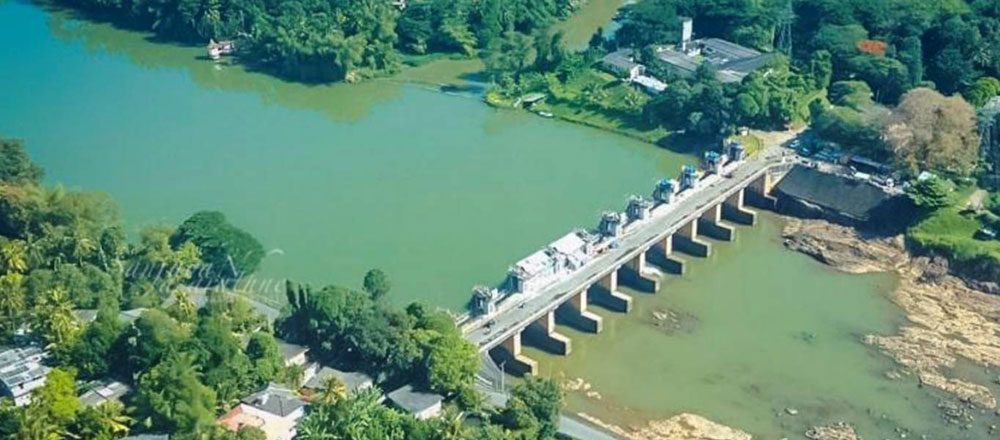
We saw the devastation caused by Cyclone Ditwah. The sluice gates of the Kotmale Reservoir were opened, and Kandy and Peradeniya were flooded. If the reservoir had had greater storage capacity, couldn’t the opening of the gates have been delayed? This may not be an argument that modern-day engineers would readily accept, and I am not an irrigation expert. These ideas may well be naïve. But most of us tend to think of reservoirs mainly in terms of hydropower generation and irrigation, while their role in flood control receives much less attention. The question therefore deserves serious consideration. Could restoring lost reservoir capacity through desilting help improve our ability to manage extreme rainfall and reduce flood risks?
Desilting our reservoirs should be considered a national priority.
Export diversification – Missing the wood for the trees – Part III
by Gomi Senadhira
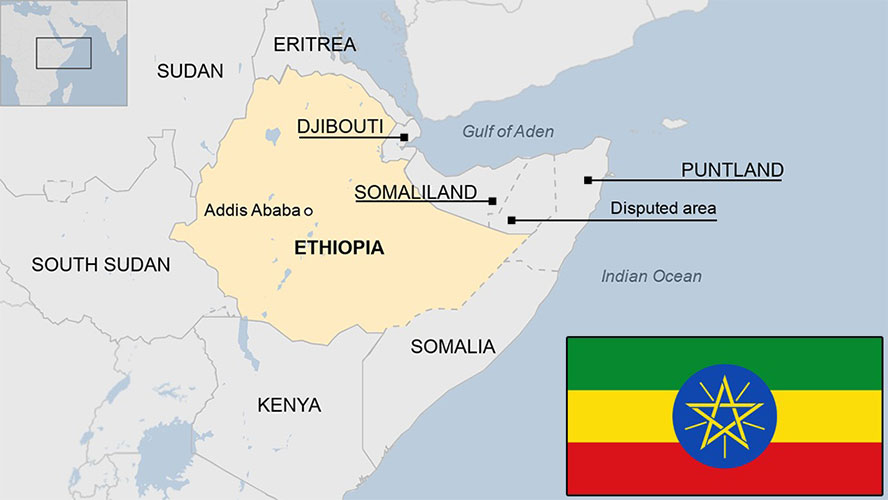
In Sri Lanka, the word “Ethiopia” is often used as disparaging slang to describe individuals or areas experiencing extreme poverty, starvation, or severe economic hardship. This linguistic habit originated in the 1980s with the Western media coverage of the devastating Ethiopian famine of 1983-85. That media coverage shocked the world but also left an outdated and offensive global stereotype that the country is permanently starving. Much has changed since then. By now, with an annual growth rate of around 9%, it is the fastest-growing economy in sub-Saharan Africa. Ethiopia has also emerged as a highly competitive exporter and is challenging not only its competitors in the region but also countries like Sri Lanka. This article is on how Sri Lanka has lost ground to Ethiopia (and a few other countries) in the GCC markets for agricultural and floricultural products.
Sri Lanka – A Pioneer in the Agriculture and Floricultural Market in the GCC
As discussed in Part II of this article, by the mid-1980s Sri Lanka had established a strong foothold in the GCC’s fruit, vegetable, and floricultural market. Geographical proximity and well-established shipping and air links gave Sri Lanka a strong comparative advantage over Southeast Asian and African nations. Thailand, Vietnam, and Kenya were not even in the market. At that time, Ethiopia was experiencing (as BBC news reports described) “a biblical famine”.
The market was not very large, but it was lucrative and growing. Trade Minister Lalith Athulathmudali as well as the Chairman of the Export Development Board, Victor Santiapillai, who visited Kuwait (and the GCC countries), recognised the market potential for these products and encouraged us to continue with our work. The minister was particularly keen to further develop links between the market for these products, exporters, and his Export Production Villages (EPVs). So, it was becoming a successful case not only for export diversification but also for transferring gains from exports directly to rural households.
From Trailblazer to Tailender
As a result, even by the beginning of this century Sri Lanka had a larger market share than most of its competitors from Asia or Africa. But since then, our competitiveness has weakened significantly. The tables below provide a comparative snapshot of Sri Lanka’s performance vis-à-vis Thailand, Vietnam, Kenya and Ethiopia in the GCC market for vegetables, fruits and floricultural products. As illustrated therein, in 2001 Sri Lanka was ahead of Thailand, Kenya and Ethiopia in this small but rapidly growing market. Since then, we have fallen behind Thailand, Kenya and many other countries in that lucrative market. If this trend continues, Sri Lanka will fall behind Ethiopia within the next few years. (See Table 1)
In the GCC market for vegetables (covered in HS chapter 07), Sri Lanka was ahead of most other competitors in 2001. As illustrated in Table 1 , Sri Lanka had failed to develop this market, while Thailand, Kenya, and even Ethiopia had very efficiently increased their market shares. The GCC is a market to which Sri Lanka can supply some vegetables, like cabbages, by sea. It appears Sri Lanka had also failed to exploit this mode of supply.
We can see a similar trend in the market for fruits. Vietnam, Kenya, and Thailand have emerged as major players, while exports from Sri Lanka have staggered on slowly. In this segment, Vietnam has emerged as a leading player during the last twenty years and the GCC imports from Viet Nam have shot up from US$44 thousand in 2001 to US$346 million by 2024. In part one of these articles, I discussed the remarkable increase of jackfruit exports from Vietnam “…just $3 million in 2015 to an impressive $236.8 million in 2023” while most of our jackfruit production rots under the trees. This explains how countries develop their markets, geographically and product-wise. (See Table 2)
Sri Lanka’s performance has been weakest in the market for floricultural products (HS Chapter 06), which groups live trees, cut flowers, and ornamental foliage. When we first entered the market in the 1980s, the market was dominated by the Netherlands, and Kenya and Ethiopia were not even in the market. At that time, we identified the Gulf states as a market where Sri Lanka could have a dominant presence due to geographical proximity. Even in 2001, Sri Lanka was ahead of Kenya, Ethiopia, and Thailand. But by now, Kenya has emerged as the dominant supplier. Ethiopia is also expanding its market share and is the third-largest exporter. (See Table 3)
Missing the Wood for the Trees
In the mid-1980s, Sri Lanka first established its foothold in the GCC market. Since then, Thailand, Vietnam, Kenya, and even Ethiopia have moved well ahead of us and have become leading players. Why did we lag behind in our export diversification efforts in general and, more particularly, in the GCC market?
The reasons are very clear. After the initial attempts in the 1980s and early 1990s, Sri Lanka has not been proactively involved in identifying, developing, and promoting new products and markets, or protecting and further developing new markets already established. The focus has simply been on traditional exports: tea, coconut, cinnamon, and garments, while other products were almost ignored. In essence, we have been and continue to focus intensely on a narrow group of products and markets, and we have lost sight of the bigger picture.
(The writer can be reached at senadhiragomi@gmail.com)

ITS Giuseppe Garibaldi’ departs Colombo

Green Climate Fund (GCF) Regional Dialogue for East and South Asia will be held from 14 to 17 September 2026 at Cinnamon Life at City of Dreams Hotel, Colombo

Showers will occur in the Western, North-western and Sabaragamuwa provinces and in Kandy, Nuwara-Eliya, Galle and Matara districts

Prof. Pieris says Buddha Dhamma recognised as source of law under Constitution

GR leaves FCID after making statement over MiG deal

Dengue cases top 97,000 in 2026

‘Dates have the highest sugar content to fight Coronavirus’

Sunday Island 27 December – Headlines

#SundayIsland 17th December – Headlines

Sunday Island – 28th March

Sunday Island Headlines – 21 March

Sunday Island – 21st February – Headlines
-

 Sports2 days ago
DDS set to lose Test captaincy
-

 Latest News7 days ago
Tharanga creates history with Diamond League crown in Brussels
-

 Features6 days ago
After the parade: What a traffic OIC’s walk-out tells us
-

 News7 days ago
Dispute which triggered listed company director being detained at BIA resolved
-

 Editorial6 days ago
Arrests as theatre
-

 News5 days ago
Thailand shuts door on undesirables from Sri Lanka
-

 Latest News6 days ago
Harshitha’s composed knock seals Sri Lanka’s semi-final berth
-

 News6 days ago
‘Choka Malli’ slips out of country before travel ban