
Life style
Rediscovering Eden: How One Man’s Journey Breathed New Life into Sri Lanka’s Botanical Legacy


At Genesis by Dilmah in Colombo, where the walls are lined with reminders of Sri Lanka’s natural wealth and the scent of Ceylon tea lingers in the air, an extraordinary gathering took place. But this was no typical book launch. It was a celebration of rediscovery, a call to conscience, and perhaps most importantly, a testament to the enduring richness of Sri Lanka’s forests.
The event marked the unveiling of “Discovering Additions to the Flora of Sri Lanka”, a 700-page botanical volume that documents more than 200 new or newly recorded flowering plant species in Sri Lanka. At its heart is a man whose name many in the scientific establishment had not heard a decade ago: Dr. Himesh Jayasinghe, a civil servant turned full-time field botanist, whose journey has become a modern-day parable of purpose and persistence.
Roots of a forgotten legacy
Taking the stage with characteristic modesty and erudition, Dr. Rohan Pethiyagoda, globally recognised biodiversity scientist and the 2022 Blue Planet Laureate, offered a sweeping historical account of Sri Lanka’s place in the global story of botany. He began with Paul Hermann, the Dutch physician who arrived in 1672, and who not only translated Sinhala plant names into Latin but also laid the groundwork for one of the earliest books on tropical botany, Musaeum Zeylanicum.
Hermann’s work was revolutionary. He collected over a thousand plant specimens, many of which remain preserved in Dutch herbaria today. His legacy inspired botanical luminaries like Carl Linnaeus, the father of modern taxonomy, who named numerous species based on Hermann’s collections.
“The historical richness of Sri Lanka’s flora,” Pethiyagoda said, “has long fascinated the world. But that legacy gave us what I call the anaesthetic of familiarity. We assumed we knew it all. And so, we stopped looking.”
But as this book shows, there’s plenty we still don’t know.
-
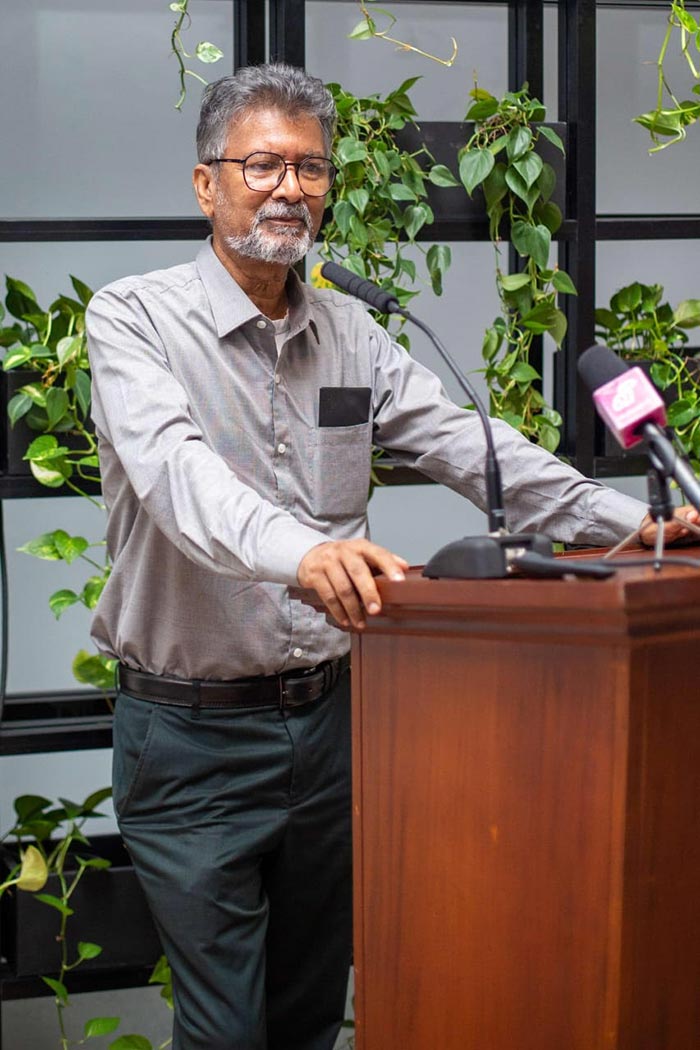
- Professor Wijesundara
-

- Dr. Pethiyagoda
Life rewritten in green
One of the most compelling threads in this story is the transformation of Himesh Jayasinghe, the book’s lead author. Trained as an engineer and employed in the Department of Immigration and Emigration, Himesh’s life took a radical turn when he found himself increasingly drawn to the mysteries of the wild.
In 2019, Pethiyagoda first heard of Himesh through Dr. Surya Yudhistira and Professor Nimal Gunatilleke, the latter calling him “a once-in-a-century phenomenon.” At that point, Himesh had already left his job, devoting himself full-time to botany with neither institutional affiliation nor funding.
The statement stunned many in the room. Coming from Gunatilleke, Sri Lanka’s foremost tropical forest ecologist, the phrase was not used lightly.
“Himesh was essentially operating in a vacuum,” Pethiyagoda recalled. “He had no grant, no university post, no scientific training. What he had was a camera, a field notebook, and relentless determination.”
Moved by his commitment and potential, Pethiyagoda helped secure a research fellowship for Himesh at the National Institute of Fundamental Studies (NIFS) in Kandy. Fieldwork support came from Dilmah Conservation, which recognised the unique value of his work early on.
-

- Dr. Gunawardana with the author Dr. Gunawardana with the author
-

- Distinguished gathering
Seeing with New Eyes
As the audience listened, it became clear that Himesh’s story is not just one of discovery, but of rediscovery. He had revisited historical herbarium records, trekking to the exact GPS coordinates of where certain species were last collected, sometimes more than a century ago. In one case, he relocated a species not seen since 1872.
Professor Siril Wijesundara, former Director-General of the Department of Botanical Gardens, gave a heartfelt tribute. “He didn’t study botany in the conventional sense,” he said. “But he sees what others don’t. And that’s a rare gift.”
Wijesundara compared Himesh to a monk who enters the order later in life, not for tradition, but for truth. “There’s a clarity, a humility, and a quiet persistence in his work,” he said. “It’s not glamorous, but it’s transformational.”
Himesh has now photographed and documented nearly 80% of Sri Lanka’s flowering plant species, many in multiple growth stages. His detailed field notes, illustrations, and observations offer an unprecedented look at phenology, morphology, and microhabitat.
A Book of Beginnings, Not Conclusions
While “Discovering Additions to the Flora of Sri Lanka” may sound like a capstone, those who know Himesh’s work understand it is just the beginning. It is envisioned as the first in a potential eight-volume fully illustrated flora of Sri Lanka, a national treasure in the making, if funding and public interest hold strong.
The volume includes 212 plant taxa, including 26 species new to science and 35 rediscoveries. More than 40% of the flora described in this book is endemic to Sri Lanka, reinforcing the island’s status as one of the world’s biodiversity hotspots.
Clearing the Path for Science
Also in attendance was Ranjan Marasinghe, the newly appointed Director-General of the Department of Wildlife Conservation. He acknowledged the critical role his department had played in facilitating field access and research permits.
But more importantly, he made a promise. “Let this be my legacy,” Marasinghe said. “To simplify, streamline, and support the process of biodiversity research in Sri Lanka. People like Himesh should not be hindered by bureaucracy. They should be empowered.”
He also highlighted Himesh’s broader engagement, noting that he had supported the Department in designing the Kesbewa Wetland Park, and had worked with indigenous communities to record medicinal plants, some of which are described in the book.
Nature is Not a Luxury
Dilhan C. Fernando, CEO of Dilmah Tea and head of Dilmah Conservation, reminded the audience that biodiversity is not just a “green issue.” It is an economic one.
“Over 50% of global GDP depends on nature,” he said. “Yet we treat biodiversity as though it’s optional. It is not.”
He described the book launch as a moment of moral clarity. “This is not about flowers. This is about food, medicine, water, soil, and identity.”
Dilhan spoke emotionally about his late father Merrill J. Fernando, who instilled in the company the twin values of quality and kindness—to people and to nature. “We’ve supported this work not just because it’s important to tea, but because it’s important to Sri Lanka,” he said.
Future already here
At a time when climate change, habitat loss, and ecological amnesia threaten to engulf the planet, this publication is a reminder that resistance can take many forms. Sometimes, it is a scientist kneeling in the mud, waiting for a flower to bloom.
And that resistance, in this case, has yielded results. Several species documented by Himesh are already under threat. One plant he rediscovered in a single wet zone patch had been presumed extinct for over 100 years.
This kind of data, now preserved in print, has direct implications for land use, reforestation, agroforestry, and protected area expansion.
A national moment
In closing, Dr. Pethiyagoda issued a challenge: “Let us not allow this to be a one-off. Let us build on this, volume after volume, until Sri Lanka finally has the flora it deserves.”
He compared Himesh’s contribution to that of a national athlete or artist. “Why do we celebrate cricketers and ignore scientists? What Himesh has done is no less significant. He has redefined what is possible.”
What This Book Really Represents
Beyond the taxonomy and photography, beyond the rediscoveries and accolades, this book is a philosophical act. It insists that in an age of despair, it is still possible to be curious. To look closely. To believe that not everything has already been seen.
It reminds us that knowledge is not fixed. That the forests still hold secrets. And that the future of conservation may rest not in grand declarations, but in humble, persistent observation.
As Himesh himself said during his brief, heartfelt remarks:
“I only wanted to understand the forest. The more I saw, the more I realised how little we know. I just kept walking.”
Final thoughts
In a country often mired in political turbulence and economic uncertainty, it is easy to overlook the quiet revolutions. But every now and then, someone like Himesh Jayasinghe emerges, not to disrupt, but to illuminate.
And in that light, we begin to see ourselves more clearly.
By Ifham Nizam ✍️

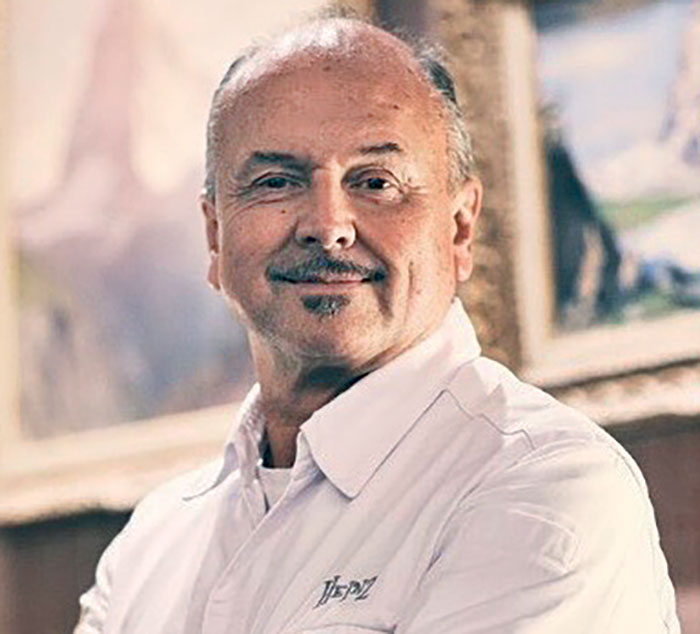
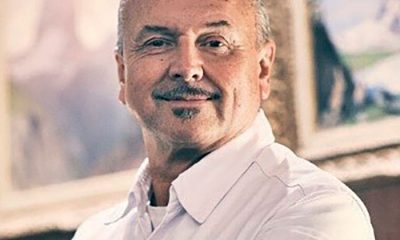
High in the Swiss Alps, where mountain landscapes shape both life and cuisine, Chef Heinz Rufibach spent more than four decades mastering the art of Alpine cooking. From the grand hotels of St. Moritz and Gstaad to the peaks of Zermatt, his career has been defined by a deep respect for tradition, local flavours and the quiet precision of Swiss craftsmanship.
Now, the chef. affectionately known as Le Cuisinier de Zermatt. brings that remarkable culinary heritage to Colombo for an exclusive Swiss dining experience at Bistro des Marées, Cinnamon Life at City of Dreams Sri Lanka.
From 23 to 26 July, guests will have the opportunity to experience a specially curated menu by Chef Rufibach, celebrating the authentic flavours of Switzerland’s Alpine regions and the dishes that have shaped his lifelong connection with the mountains.
A former Executive Chef of the Grand Hotel Zermatterhof, Chef Rufibach has built a reputation as one of Switzerland’s celebrated culinary figures. Named Swiss Chef of the Year and a holder of a Michelin star for six consecutive years, his cooking reflects the balance between fine dining precision and the warmth of the traditional Alpine table.
For Chef Rufibach, Swiss cuisine is more than a collection of recipes. It is a reflection of place, people and generations of culinary heritage.
“Swiss cuisine is built on tradition, seasonality and a deep connection to the land. Through this menu, I hope to share the flavours and stories of the Alps with guests in Colombo and offer them a true taste of Switzerland,” he said.
The menu at Bistro des Marées takes guests on a journey through Switzerland’s diverse culinary regions, beginning with elegant starters, such as dried meat tartare with green asparagus and Parmesan, marinated salmon with mustard sauce and herbs, and the traditional Gommer Cholera, a Valais speciality of apple, leek and cheese baked in puff pastry.
The experience continues with comforting Swiss classics, including Valais white wine soup with dried apricots and Bündner barley soup, before moving into signature dishes, such as Swiss cheese fondue with bread cubes and potatoes, raclette with traditional accompaniments, and Zürcher Geschnetzeltes with rösti. Other highlights include Basel-style salmon with papet vaudois and fried onions, saffron-infused lamb ragout with mashed potato, and Ghackets mit Hörnli, a beloved Swiss comfort dish of braised beef mince, pasta and apple sauce.
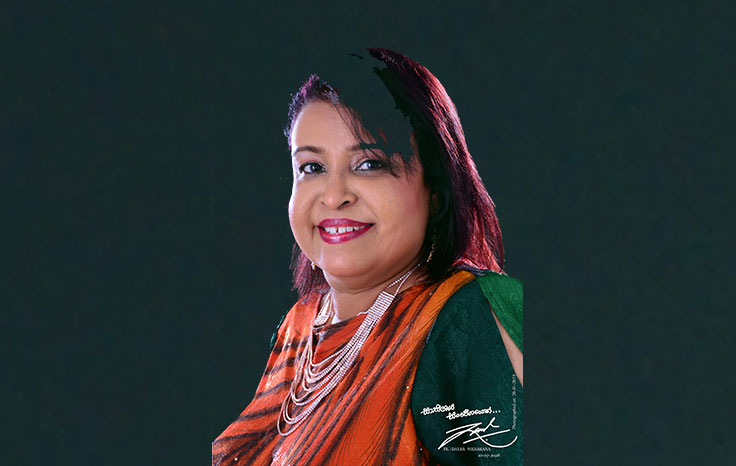
My dearest Maria. I never thought I would have to write this, this soon but then I realised, I owe it to you.
Remember the very first day I met you ? It was way back in 1981. I was 19, working at Lake House and writing to the Sunday Observer’s “Sat Mag” magazine. You were 23.
I made a prior appointment with you on the old rotary dial phone and arrived at Ekanayake Mawatha, Nugegoda, sharp on time. I waited and waited. There were (either) dogs or cats playing around me, with their fur flying all around me. That irritated me. I waited and waited. I wanted to, but could not walk out because the Editor was waiting for the article.
You sailed in one wretched hour late. I was furious. You never apologised either. That’s how we began our friendship. Rather a rocky start wasn’t it ?
What struck me most was NOT the fact that you were the highly celebrated Kandy Lamissi at that time, but rather the sparkle in your eyes and the warmth of your smile. It came from the depths of your heart and radiated outwards to everyone you came into contact with – both those who liked you and those who did not like you.
You radiated that sparkle and smile during the best of times and even the most difficult of times. You had your fair share of both in your 68 years. That smile was your trademark. It stayed on until the end.
We were neighbours, too, in Nugegoda. You were on that side of the junction and I was on this side of the junction. Remember in the mid-1990s when fitness fever hit us and we ambitiously started those 6.00 am early morning walks. They were alas short lived when children in passing school vans began shouting “Aunty Aunty” or “Kandy Lamissiiiiii”. That put an end to our walks and we reverted back to being unfit.
You also had a very, very wicked sense of humour which I loved to bits. Remember that evening when, with dead pan faces, you and I walked into the Metro Cinema Nugegoda and bought two balcony tickets for the 6.30 pm show. The man at the ticket counter couldn’t not believe his eyes. And how we, again with dead pan faces, slowly crept upstairs and sat in the (last row) middle seats much to the shock of all those lovers around us.
You were the Star. I was much lesser known to them than you. They were shocked and looked at you in great disbelief. I remember at one intense moment of the film, we asked the couple next to us, “Meh, excuse me. Aney welaawa keeyada?”. They only didn’t slap us.
And then, during the movie we crunched on and made a helluva din with the prawn crackers, much to the irritation of those around us.
We hadn’t come to watch the film. We just wanted to shock and annoy those lovers. Mission accomplished, we sailed out in the Interval, our sides splitting with laughter. We could not remember the movie either.
Remember those incessantly chats we used to have on a variety of topics? You could hold forth on practically any topic. Those chats sometimes went on till well past midnight and we hadn’t finished talking either.
Teshan your son was the apple of your eye, to use a cliché. How proud you were of him and how very much you used to talk about him. You took pride in his academic success and the fine young man he has turned out to be.
In our 46-year friendship, you and I have had our misgivings, too. Remember Mariazelle how we didn’t speak to each other for about three years?
And then in December 2015 you were a guest artiste and I the emcee at the Break-Away New Year’s Eve Ball organised by (your cousin) Sohan Weerasinghe and Corrine Almeida. We were still not talking to each other, but then, just after the countdown to midnight, you came up to me, hugged me and wished me with tears in your eyes. My respect for you hit the ceiling that night. Our friendship became rock solid from that day onwards.
We last met over dinner at Harpos Commons in Kotte, just before illness dragged you down. You had medical problems but you never complained. Remember the stories we traded and how much we laughed and laughed, at times much to the displeasure of the other diners. Harpo might have got the complaints but he never told me either.
And now you’re gone. Gone just like that. Before I close, I’d like to quote a few lines from your dear friend Aruna Siriwardhana’s tribute :
“I take a moment to mention two special beings in Mariazelle’s life. One is surgeon Prof. Srinath Chandrasekera (a musician himself) who for the past six months or so, together with his team at the Kalubowila Hospital, took indescribably attentive care of her. The other is singer Dinu, who virtually placed her life and work on hold, to care for Mariazelle”.
It was heart-breaking to see you lie in that coffin at Barney Raymonds last Monday (13 July). You were dressed in ivory and gold. You looked peaceful. You were free from suffering and free from pain.
“Kandy Lamissi” will ALWAYS be sung at parties and weddings and home comings and dinner dances and batch get-togethers. “Kandy Lamissi” and You have an unlimited life span. You will both go on forever!
And I will always remember that sparkle in your eyes and the warmth of your smile. That to me was You.
Goodbye my dearest Maria. May your journey in Samsara be speedy.
by Kumar de Silva ✍️
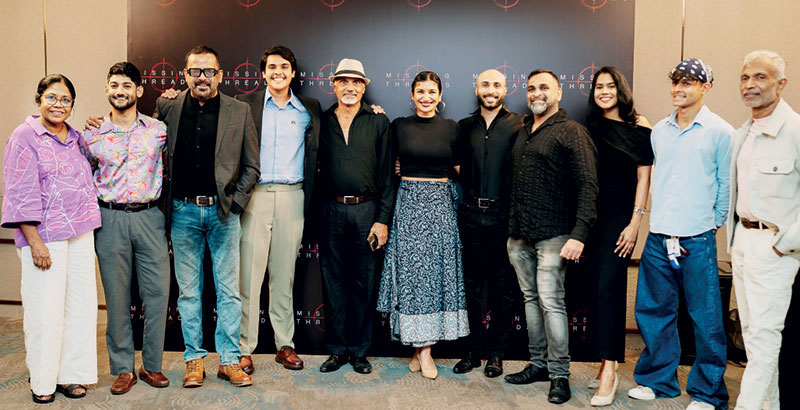
Production has officially begun on Missing Threads, marking it the first time a Sri Lankan production has been aimed first and foremost at an American audience. On Tuesday the 7th of July, a dinner was held bringing together the cast, crew, funders, and friends and family to mark the occasion.
The evening opened with guests arriving to chatter and press photography. Talavou Alailima opened proceedings, and a selection of Director Joshua Alailima’s previous films were screened, between speeches from key figures behind the production. The night closed with a large buffet and the signing of contracts.
Missing Threads
is an investigative crime thriller compared to films such as Zodiac and Se7en. The film follows journalist Maya Perera as she unravels a string of lies, all tying back to the mega corporation Verdeon, leading to a far more sinister truth about the internal affairs of the country at large.
This marks a significant milestone for Sri Lanka. It is the first time a Sri Lankan film has targeted primarily the USA Hollywood audience. This will further foreign relations, opening the door to industry expansion and significant economic potential.
Missing Threads
brings together a standout cast of actors, including Kaushalya Fernando (The Forsaken Land), Buddika Jayaratne (Sunny’s Mansion), Dharmapriya Dias (Machan), and Shyam Fernando (Paradise). It is led by international Sri Lankan actress Rebecca Munasinghe and leading social media influencer “Neesh.” Missing Threads is produced by Talavou Alailima, founder of Power World Gyms and Edge Nutrition.
Director Joshua Alailima is currently studying at one of the top film universities in America, Biola University, whose alumni network includes Doctor Strange director Scott Derrickson and world famous influencer Zach King.
Joshua has been directing since he was a young teenager. He is now 20 and directing his feature debut, a rare feat by Hollywood industry standards.
Missing Threads
brings in an international crew, with people from the USA, Sri Lanka, and Australia flying in to work on the project. Post production will take place in Sri Lanka, India, and the USA. The film is shot on the Arri Alexa LF, the same camera used for the movie Dune. It is the only one currently in Sri Lanka.

A few showers will occur in the Western, Sabaragamuwa and North-western provinces and in Kandy, Nuwara-Eliya, Galle and Matara districts

Customs asked to resume probe or face legal action

Outgoing Chinese Ambassador Qi Zhenhong bids farewell to Mahanayake Theras

Move to extend retirement age of top judges: BASL asks govt. to stop process pending meaningful consultations

Govt. mum on identities of JVP founder’s wife and children

Three high-profile alleged suicides shaping key investigations

‘Dates have the highest sugar content to fight Coronavirus’

Sunday Island 27 December – Headlines

#SundayIsland 17th December – Headlines

Sunday Island – 28th March

Sunday Island Headlines – 21 March

Sunday Island – 21st February – Headlines
-
 Features3 days ago
Two memorable excerpts from a former SLAF commander’s memoir
-

 Business3 days ago
‘Giving up was never an option’: The fisherman who fought back after losing millions in SL
-
 Latest News4 days ago
Davis cup Asia/Oceania Group IV 2026 to be held in Colombo from 20th to 25th July
-

 Features3 days ago
Erdoğan’s New Republic
-
 Life style3 days ago
Taste of the Swiss Alps comes to Colombo
-
 News4 days ago
Dengue outbreak gallops ahead: Infections surpasses 73,455, leaving 50 dead
-
 News4 days ago
Evidence recorded in money laundering case against Yoshitha Rajapaksa
-

 News5 days ago
Money laundering case against Yoshitha, fixed for pre-trial conference