
Business
Breaking free from conventional investment paths; How to make your money work harder

Understanding Where Your Money Goes and How Businesses Grow
Picture this: You have some extra money sitting in your drawer, while across town, an established manufacturing company with a solid track record desperately needs funds to expand their operations and hire more workers. How do these two needs meet? Welcome to the fascinating world of capital markets – Sri Lanka’s financial matchmaking service.
What Exactly Are Capital Markets?
Think of capital markets as giant marketplaces where money changes hands. Just like in an ordinary marketplace, companies come to capital markets to “buy” money (through borrowing or selling shares), while people with extra cash come to “sell” their money (by investing) in exchange for returns.
In simple terms, capital markets help channel money from people who have it (savers and investors) to people who need it (businesses and governments) to grow and create jobs.
Breaking Free from the Middleman: Why Direct Investment Matters
It is the general consensus that the depositing your hard-earned money in a bank is the safest option, what’s with the collective financial trauma Sri Lankans have gone through via experiences like the Golden Key Scandal and the Sakvithi Debacle.
For years, the journey of your money looked like this: You earn money → deposit it in a bank → bank lends it to businesses → bank keeps most of the profit. In fact, according to the Economic Financial Review 2024, published by The Central Bank of Sri Lanka, showed that deposits, collectively racked up to an amount of Rupees 17,969.4 billion which accounted for 81% of the banking industry’s total liabilities and equity at the end of 2024. This reveals how there is a massive deposit concentration in the economy created by the overwhelming confidence in the banking sector. It is obvious that Sri Lankans understand the vitality of the banks and that they provide essential services, keep our money safe, and fund countless businesses. Essentially, they have become the backbone of Sri Lanka’s financial system.
However, this system has natural limitations. Banks must be careful with depositors’ money, so they’re selective about who gets loans. Interest rates stay high because banks need to cover their costs and risks. Many promising small businesses get turned away simply because they don’t fit standard lending criteria.
The Bottom Line is that Banks have served Sri Lanka well and continue to play a crucial role. But very little of your bank savings are used for the overall development of the country. So where do we go from here?
The Game Changer: Direct Connection to Funds via The Capital Market
Enter capital markets with a revolutionary idea: “Why not let savers and borrowers deal directly with each other?” Essentially cutting out of the middleman which simply means “removing the go-between.”
Moving away from the role of banks, capital markets offer something additional: the power for ordinary people to directly participate in building the economy while growing their own wealth. It’s not about choosing sides – it’s about having more financial freedom and opportunities.
Instead of your money sitting in a bank that decides who gets it, you can now directly choose to invest in companies you believe in. It’s like buying directly from the farmer instead of going through multiple middlemen.
Two Roads to Raising Money: Equity vs Debt
When companies need money, they have two main paths in capital markets:
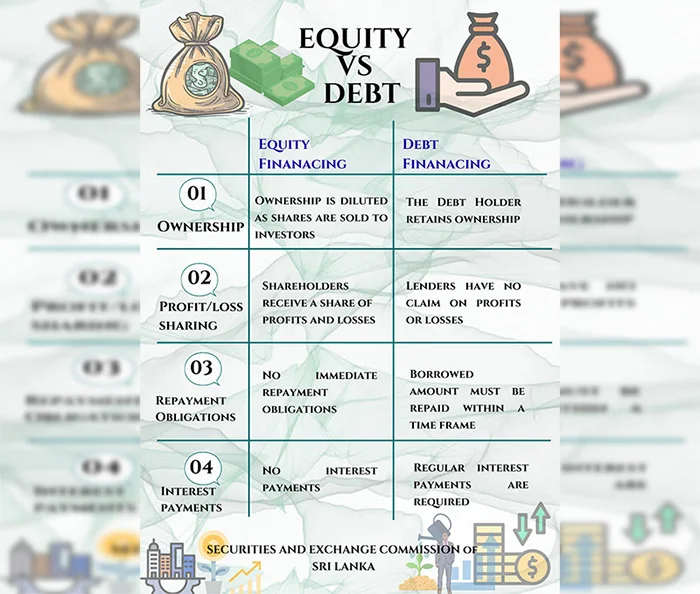
When it comes to the ownership in terms of Equity, the ownership dilutes with each share issue but in terms of debt . the holder retains the ownership. In equity shareholders receive a share of their profits and losses but in debt, the holder has no claim on profit and losses
The Ownership Route: Equity Markets
Imagine you and your friends want to start a restaurant. Instead of borrowing money, you decide to sell small pieces of ownership to raise funds. This is exactly what happens in equity markets. Companies sell shares, which represent small pieces of ownership, to the public to raise capital. When you buy shares, you become a part-owner of the company, and if the company performs well, your shares become more valuable. Additionally, you might receive dividends, which are your share of the company’s profits distributed to shareholders.
The Lending Route: Debt Markets
Sometimes companies prefer to borrow money rather than give away ownership, which is where debt markets come in. In this scenario, companies issue IOUs called bonds or debentures to raise funds. When you buy these securities, you’re essentially lending money to the company, and they promise to pay you back with interest over a specified period. You receive regular interest payments throughout the loan term until they repay the full principal amount. Think of it like this: if equity is like having a business partner, debt is like being a money lender with a written promise of repayment.
Things That Set Apart; Equity Vs Debt
Ownership – When it comes to equity financing, ownership is diluted as shares are sold to investors. However, in debt financing, the debt holder retains ownership.
Profit/Loss Sharing – In equity financing, shareholders receive a share of profits and losses, as opposed to debt financing in which lenders have no claim on profits or losses
To be Continued
by Securities and Exchange Commission of
Sri Lanka



As Sri Lanka confronts mounting environmental and economic pressures, a timely national conversation on resilience has underscored the urgent need to rethink how societies respond to change—by balancing resistance with alignment to nature.
The inaugural Nature Talks Webinar Series, titled “Nature’s Secrets for Building Resilience in a Changing World,” took place on Wednesday night, bringing together leading environmental thinkers who argued that resilience is no longer optional, but essential in navigating climate and ecological uncertainty.
Organised collaboratively by the International Centre for Biological Studies (ICBS), GAP HQ, and the Biomimicry Research Centre, the session aimed to bridge science, policy, and innovation, while drawing practical lessons from nature.
Leading the discussion, Professor Sarath Kotagama of the University of Colombo emphasised that resilience must be understood as a combination of resistance and alignment.
“Resilience is about resisting where necessary, but also forming alliances with change,” he said. “We are not saying we can stop everything. The real question is—can we adjust to live with it?”
He urged societies to reflect on their ability not only to prevent or resist environmental change, but also to adapt intelligently to it. Referring to global developments such as Artemis II, Kotagama noted that humanity is increasingly being reminded of how rapidly conditions are shifting on Earth.
Drawing lessons from the COVID-19 pandemic, Professor Kotagama outlined several insights that have reshaped thinking on resilience.
“One of the most important lessons was the role of microbes,” he said. “We always focused on large animals in biodiversity, but COVID showed us that invisible organisms can have a massive impact on the planet.”
He explained that while conservation has traditionally prioritised charismatic species such as elephants and birds, microorganisms—often overlooked—are equally critical to ecological balance.
Professor Kotagama also challenged assumptions about nature. “Nature is not always kind or caring. Under certain conditions, it can be harsh, and humans don’t necessarily feel affection for all forms of life—especially microbes,” he said.
At the same time, he stressed the decisive role of science. “If not for science, we would not have survived as we did,” he noted, pointing to the rapid development of vaccines despite global norms that typically require years of testing.
He further highlighted the importance of governance. “We may not always like governments, but during COVID, governments mattered. Without coordinated action, the outcome would have been far worse,” he said.
Professor Kotagama added that the pandemic exposed vulnerabilities in the global economic system, with industries such as tourism collapsing almost overnight due to what he described as “an invisible microbe.”
“It showed clearly that systems we thought were stable can be disrupted instantly,” he said, warning that unsustainable development models—particularly in tourism—must be reconsidered.
Meanwhile, Professor Sevandi Jayakody of Wayamba University of Sri Lanka highlighted biomimicry as a key pathway to resilience.
“The biggest answer to resilience is biomimicry,” Professor Jayakody said. “Nature already holds solutions—we just need to understand and apply them.”
She explained that biomimicry can operate at the level of form, process, or systems, and cited mangrove restoration as a practical example. Attempts to artificially recreate ecosystems often fall short unless they follow natural patterns such as tidal flows and species interactions.
“In restoring degraded mangroves, we learned that forcing systems does not work. When we followed natural contours and introduced resilient ‘nurse’ species, the ecosystem began to recover on its own,” she said.
Professor Jayakody emphasised that resilience must be embedded within environmental systems rather than imposed externally. “Resilience is a function of the environment we live in. If we ignore that, our interventions will fail,” she said.
She also cautioned against expecting rapid results. “Nature is slow. Humans are in a hurry,” Professor Jayakody noted, pointing to long-term data showing that even measurable ecological changes—such as seasonal shifts—can occur gradually over decades.
“Change is inevitable, but it is not always sudden. We need long-term data, patience, and the wisdom to interpret it correctly,” she added.
Moderating the session, Imaduwa Priyadarshana brought a practical perspective on sustainable design and adaptation, highlighting how nature-based thinking can inform urban planning and infrastructure.
With Sri Lanka grappling with climate variability, coastal degradation, and energy challenges, the experts stressed that such knowledge-sharing platforms are increasingly vital. The discussion aligned with a growing global shift towards nature-based solutions—learning from ecosystems that have evolved resilience over millennia.
By Ifham Nizam

Uber Eats is now live in Nuwara Eliya, making it easier for locals and tourists to enjoy their favourite meals – from a hot plate of kottu on a chilly evening to a comforting rice and curry spread or crispy egg hoppers – delivered right to their doorstep.
Known for its cool climate, old-world charm, and rolling tea estates, Nuwara Eliya sees a surge of Sri Lankan and international visitors during the April holiday season. But as temperatures drop in the evenings, food options have traditionally been limited, with many outlets closing early.
With Uber Eats now available, consumers can discover and order from a growing range of local restaurants and neighbourhood favourites – without stepping out. The platform also extends access to meals into the late evening, making it easier to find food even after most outlets have closed. In Nuwara Eliya, specially designed temperature-controlled insulated bags will help ensure meals are delivered hot. Consumers can choose from a wide variety of cuisines including Sri Lankan, Indian, Chinese, Thai, and Arabic or order from global brands such as KFC, Pizza Hut, and Domino’s.
The launch supports the local community by enabling restaurants to reach more customers across the city, while creating flexible earning opportunities for delivery partners, especially during the busy holiday season.
Varun Wijewardane, Country Manager – Delivery, Uber Sri Lanka, said: “Nuwara Eliya is one of Sri Lanka’s most loved destinations, especially during the April season. With Uber Eats now live, we’re making it easier to enjoy great food more conveniently – from everyday favourites to late evening short eats while also supporting local restaurants and creating earning opportunities within the community. This comes on the back of an aggressive expansion of our services across Sri Lanka – providing our consumers with convenient access to local favourites and unlocking earning opportunities for more Sri Lankan communities.”
Entry in Nuwara Eliya builds on expansion from last year across 6 districts including Hikkaduwa, Ambalangoda, Chilaw, Wennappuwa, and Puttalam, Jaffna, Gampola, Matale, Matara, Weligama, Mirissa, and Anuradhapura – further strengthening Uber Eats’ position as the country’s go-to delivery platform.

Union Assurance, Sri Lanka’s longest-standing private Life Insurer, was honoured as a ‘Company with Great Managers’ for fifth consecutive year at the CLA Great Managers Awards 2025, held at Cinnamon Grand Colombo. Presented annually by the Colombo Leadership Academy & CLA Coaching Inc, the award affirms that Union Assurance’s approach to leadership excellence is not episodic, but deeply embedded across the Company.
The CLA Great Managers Awards programme, powered by Colombo Leadership Academy & CLA Coaching Inc. in strategic partnership with People Business, The Culture Factor Group – Hofstede & Onehub, is regarded as the international benchmark for assessing managerial and leadership effectiveness in Sri Lanka. Using the scientifically grounded D-ACTI 5X meta-analysis framework, the programme evaluates managers across five leadership pillars: Driving Results & Execution Excellence, Aligning Organizational Vision, Coaching & Developing Others for Growth, Building Team Effectiveness & Collaboration & Leadership Integrality & Holistic Approach.
Reflecting the depth and diversity of managerial capability within the organisation, five Union Assurance leaders were individually recognised across distinct award categories this year. Sashika Perera, Senior Manager – Statutory Reporting & Taxation, and Ishanthi Umedha, Head of Governance & Valuation, were recognised for ‘Demonstration of Well-Rounded Performance and Managerial Effectiveness.

Showers expected in the Western, Sabaragamuwa and Southern provinces and in Nuwara-Eliya district after 1.00 pm.

Ex-lawmakers group calls for IPU’s intervention to check “irregularities” in Parliament

Power and Energy Minister, Ministry Secy resign over coal probe

President appoints Commission to probe irregularities in coal imports from inception of Norochcholai

Heroin haul transported on 50-million-rupee contract

Kongahage and another released on bail

‘Dates have the highest sugar content to fight Coronavirus’

Sunday Island 27 December – Headlines

#SundayIsland 17th December – Headlines

Sunday Island – 28th March

Sunday Island Headlines – 21 March

Sunday Island – 21st February – Headlines
-

 News6 days ago
CEB orders temporary shutdown of large rooftop solar systems
-

 Features6 days ago
From Royal College Platoon to National Cadet Corps: 145 years of discipline, leadership, and modern challenges
-

 Latest News5 days ago
PNS TAIMUR & ASLAT arrive in Colombo
-

 Features6 days ago
CIA’s hidden weapon in Iran
-

 Latest News5 days ago
Prasidh, Buttler set up comfortable win for Gujarat Titans
-

 News3 days ago
PNS TAIMUR & ASLAT set sail from Colombo
-

 Features6 days ago
A Fragile Ceasefire: Pakistan’s Glory and Israel’s Sabotage
-

 Latest News6 days ago
Heat index likely to increase up to ‘Caution level’ at some places in the Northern, North-central, North-western, Western, Sabaragamuwa, Southern and Eastern provinces and Monaragala district