
Features
‘In the political arena’


Sarath Amunugama Autobiography
Volume Three (1992 – 2022)
Reviewed by Nigel Hatch, P.C.
Dr. Sarath Amunugama in the final volume of his autobiographical trilogy entitled “In the Political Arena” covers the period 1992 to 2022 which is the contemporary period of politics in Sri Lanka and his frontline role in it.
This memoir covers the presidency of R. Premadasa, the abortive impeachment process against him, the rupture in the UNP and the formation of the DUNF by Lalith Athulatmudali (LA) and Gamini Dissanayake (GD), the author’s sidelining by Ranil Wickremasinghe (RW) in the UNP and his support of Chandika Bandaranaike Kumaratunga (CBK), his Ministerial roles under her presidency and that of Mahinda Rajapaksa and Maithripala Sirisena.
Amunugama in his Introduction observes that as “the modern history of Sri Lanka is full of paradoxes,” asks how did Sri Lanka which at independence had surplus sterling reserves, and one of the most promising States in Asia year marked for modernization and economic growth, end at the bottom of the pile? How is it that a country predominantly Theravada Buddhist could be engaged in fratricidal warfare for almost half the years since independence; and despite a high literacy rate and vibrant intellectual life become reduced to a second rate cultural backwater? One recalls even Lee Kwan Yew trenchantly remarking how we as the envy of Asia had squandered all the positives we had at Independence
The author goes on to explore these tragedies as a failure of a process of modernization and that Sri Lanka 75 years after independence has yet to discover the growth model that suits us. He quotes David Riesman, “The hatred sown by anti-colonialism is harvested in the rejection of every appearance of foreign tutelage. Wanted are modern institutions but not modern ideologies, modern power but not modern purposes, modern wealth but not modern wisdom”.
The failure of economic development is attributed to statist nationalization after 1956 primarily by the SLFP and its “toadies in the left”, the welfare measures commencing from 1933 and rapid population growth which cast an enormous burden on the national exchequer. This led Joan Robinson to sardonically comment “Sri Lanka is trying to taste the fruit of the tree without growing it”.
We are now witnessing the present NPP/JVP Government which has at its core a Marxist orientation, continuing at present with the open economy and the IMF framework for economic stability after the economic meltdown during the Gotabaya Rajapaksa (GR) presidency. The present Government’s continuation of these policies may prove to be more significant than the PA/SLFP’s rejection of the statist model under the leadership of CBK.
Amunugama’s Chapter on R. Premadasa is fittingly entitled “Premadasa Rex (1988 to 1993)”. Although admiring his discipline and his rise to the leadership of the elite dominated UNP, he refers to his “disdainful treatment of Ministers and MPs”. The sidelining of LA and GD, which led to the formation of the DUNF, and the abortive impeachment motion is the subject of a separate chapter.
The abduction and murder of Richard de Zoyza immortalized in the recent film “Rani”, the terror unleashed by the JVP despite Premadasa’s initial sympathy towards them, the testy relationship between Premadasa and Rajiv Gandhi and the withdrawal of the IPKF are discussed.
GD’s return to the UNP under the leadership of President Wijetunga despite obstacles placed within, and the difficulty in finding a place for him on the national list to enter parliament is recounted. Amunugama who had excellent relations with Wijetunga played a seminal role in this endeavor. He states, at first those national list members were unwilling to resign “for love or money”. But persistence prevailed and GD entered parliament and was inducted into the cabinet. GD was assassinated by the LTTE whilst campaigning on the final night for the presidency against CBK. This reviewer accompanied Amunugama and Wickreme Weerasooriya to the President’s House for the meeting with Wijetunga and CBK to discuss funeral arrangements. Amunugama notes that the latter who was PM was extremely gracious, in contrast to her mother’s approach with regard to the funeral arrangements of Dudley Senanayake.
This was a bloody period in Sri Lankan politics, which claimed the lives of Premadasa, Lalith and Gamini and many others , all of whom were assassinated by the LTTE.
Amunugama whose political career commenced as an elected Member of the Provincial Council from the Kandy , and his subsequent election to Parliament in 1994 from the UNP is perhaps the last man standing who could recount with personal knowledge and as an insider and participant to the momentous events of that period which were unparallelled in Sri Lanka’s political history.
The author’s political career as a Minister commenced with the decision that he, Wijayapala Mendis, Susil Moonasinghe, Nanda Mathew and a few others took to support CBK over Ranil Wickremasinghe at the Presidential Election of 2000. Their purported expulsion from the UNP under Ranil Wickremasinghe led to the constitutionally significant decision of the Supreme Court which held that expulsion unlawful is of personal significance to the reviewer whose role as Junior Counsel to the late Elanga Wikramanayake is recounted in this memoir in some detail.
The author’s first portfolio was as Minister of Northern Rehabilitation under the CBK presidency. He records how the Government funded and maintained the infrastructure of the Northern Province, despite the LTTE controlling large swaths of territory. This is perhaps unparalleled, in that, despite the separatist war waged by the LTTE, the GOSL continued to ensure that food, medicines, fuel and other essential supplies reached the citizens of those areas under LTTE control.
The reviewer recalls Amunugama telling him that when he visited New Delhi as an emissary of the former President J.R. Jayewardene, he was told that India would remain indifferent if the Government decided to accelerate its military campaign and bomb strongholds of the LTTE even in built up areas of the northern province. This strategy was never pursued, and the fratricidal warfare continued until the military defeat of the LTTE in 2009 under the leadership of Mahinda Rajapaksa.
Amunugama recounts his subsequent portfolios. His tenure as Minister of Irrigation reflects his love for the land and the people, which undoubtedly commenced when he was a civil servant and served in several parts of the country which is brought out also in Volume 1. His sense of humour is replete even in this volume. Anuruddha Ratwatte, who held this portfolio earlier, was unhappy that CBK did not appoint him to this Ministry. He told the author that he had “looked forward while returning from the war zone to landing his helicopter near the NCP tanks and enjoying a country rice meal wrapped in a lotus leaf. He lost both the war and his lotus leaf wrapped lunch.” (pg. 251).
Sri Lanka experienced the politics of cohabitation between CBK as President, and RW as Prime Minister with a cabinet of his choice, when the latter’s coalition secured the largest number of seats in Parliament at the 2001 elections. She faced a torrid time at some cabinet meetings particularly from those who were at one time trusted lieutenants and had defected from her party and joined the UNP.
Politically these were trying times and CBK who made the mistake of conceding the defense portfolio to a UNP Minister, had to seek the first ever opinion from the Supreme Court under Article 129 as regards these powers. The reviewer appeared for her with the late HL de Silva PC and Raja Goonesekere (RKW) and succeeded in that case. The court held that defense was an integral part of the powers of the President.
Events swiftly ensued and CBK exercised her powers and removed some UNP Ministers and dissolved parliament. The reviewer was involved in strategizing these events and recalls a weekend at the President’s house in Nuwara Eliya where Lakshman Kadiragmar (LK) and Mangala Samaraweera were also present.
Amunugama was one of CBK’s representatives in talks between the SLFP and the JVP represented by Tilwin Silva, Anura Kumara Dissanayake (AKD), Bimal Rathnayake and Sunil Handunetti. He states, “very often I was the only one from our side while all JVPers diligently attended discussions”, exemplified by AKD once attending a meeting after coming from Ampara after skipping his meals to be on time (282).
At the ensuing general elections in 2004, CBK’s party in coalition with the JVP secured power and formed a government. Amunugama became the Minister of Finance, a portfolio which had been the domain of several former presidents. He recounts his experience in this portfolio with extensive references to the challenges faced and negotiations with international lending agencies. He comments positively on the four Ministers from the JVP.
He states that the alliance with the JVP ended when CBK, persuaded by the World Bank and the IMF, negotiated a power sharing arrangement with the LTTE for the rehabilitation of the North and East after the devastating Tsunami of 2004 called the P-TOMS. This initiative was challenged in Court, and this reviewer and RKW led for CBK’s government in separate related cases, whilst HL de Silva, a friend and confidante of CBK, led for the JVP. CBK’s genuine desire for a peaceful negotiated settlement of the ethnic conflict is indisputable. Nevertheless, she had no hesitation on several occasions of directing the navy to blow up LTTE cargo vessels that attempted surreptitiously to smuggle arms during that cease fire.
Amunugama refers to the significant contribution made by Lakshman Kadirgamar PC who was an outstanding foreign minister, and at one point a serious contender to be PM backed by the JVP. The reviewer worked closely with LK on several legal issues including the Ceasefire Agreement that RW as PM unilaterally agreed with the LTTE, difficulties arising from the Norwegian facilitation and required constitutional amendments. LK too was assassinated by the LTTE.
Amunugama unflinchingly refers to the politics of the judiciary when the mercurial Sarath N Silva (SNS), was Chief Justice. He refers to the “Helping Hambantota” controversy, which was a fund set up by MR to collect money in the aftermath of the Tsunami, for the rehabilitation of, “presumably, as its name indicates, the Hambantota district”. He states, “The UNP which worked hand in glove with Mahinda to embarrass CBK, now discovered that their favorite SLPer (MR) whom they nurtured could become a formidable candidate” at the forthcoming presidential election “(p-319).
Kabir Hashim, a UNP MP, challenged the legality of this Fund. Sarath Silva, the then Chief Justice who clipped a year off the term of office that CBK enjoyed in her second term, a decision which he states “was tailor made for his friend Mahinda Rajapaksa”, dismissed that case. Silva subsequently expressed remorse for this decision after he left office, noting that if MR was found guilty, he could have faced imprisonment. Amunugama to his credit admitted in Parliament that the Fund was not properly constituted.
The political ascendancy of Mahinda Rajapaksa, first as the SLFP candidate, and then victorious in the 2005 presidential election by the narrowest of margins over RW, also makes fascinating reading. This was the closest that RW had ever come when he contested the presidency reminiscent of R. Premadasa’s narrow win over Sirimavo Bandaranaike in 1988. This writer recalls Amunugama’s prescient prognostication that with MR’s nomination “CBK had signed her political death warrant”. Relations between the two (CBK and MR) had deteriorated over a period of time, and when The UNP had commenced a long march from the South demanding a presidential election which presaged SN Silva’s judgment on her term of office, she appointed RKW and this reviewer to meet with MR at President’s House. At this meeting MR rightly pressed that a delay in nominating the party candidate would be prejudicial and we duly communicated that to her.
Amunugama was appointed Minister of Public Administration by MR, a portfolio he was happy to get due to his antecedents as a public servant and working with Felix Dias Bandaranaike earlier in that ministry, recounted in Volume 1.
He recounts succinctly the inner politics of the MR administration during that period, including the disaffection of Mangala Samaraweera, his indefatigable campaign manager, due to not being appointed PM, and CBK’s efforts to cause problems for MR. MR faced a potential revolt orchestrated by Anura B and Mangala ostensibly with JVP support, but at the last moment unbeknownst to Anura the JVP pulled out of the arrangement, leaving Anura who crossed over in Parliament, with egg on his face. MR removed Mangala and Anura from their posts and Amunugama notes that Anura never returned to parliament and it was “an ignominious end to a career tailor made to take him to the top.” (348)
His knowledge and experience in economics and finance served him well in his next portfolio, Investment Promotion. As with his other portfolios, Amunugama takes the reader through important events and initiatives that he introduced, including meetings with foreign dignitaries.
The high point of MR’s second term (2009-2015) was the military defeat of the LTTE. He rightly identifies MR as a national hero. The ensuing rift with General Sarath Fonseka, part of the troika with MR and his brother Gotabaya that strategized that victory, could have arisen due to Fonseka’s own plans for the military to bolster his image. Fonseka was wooed by the opposition as a presidential opponent to MR but went on to lose that election in 2010. Instead, he was elected to parliament, and was unsuccessful at the recently concluded presidential election, where he cut a forlorn figure at rallies which were poorly attended.
Amunugama notes that after the war there was a commendable level of economic growth under MR, attributable as in most countries that come out of a long war to budgetary realignments to development projects and donor funding agencies being more receptive and forthcoming. “Accordingly, several highway projects, work on ports and airports, transport and power were undertaken adding to a rapid growth of GDP.” (p-387). Amunugama was given the additional responsibility as Deputy Minister of Finance, and after the parliamentary elections of 2010, was appointed Senior Minister and resumed his role as chief interlocutor with the global financial institutions.
But the decline in MR’s popularity due to the “shenanigans of his relatives” manifested itself in the results of the presidential election of 2015, where he ill-advisedly ran for a third term and lost to Maithripala Sirisena who was nominated by the joint opposition. As a precursor to this maneuver, MR sought an opinion in 2014 from the Supreme Court as to whether he was eligible to run for a third term. A full Bench of the Supreme Court presided over by Mohan Pieris, CJ determined that he was so entitled. Amunugama ruefully states that as regards the removal of the two term limit for a president by the earlier 18th amendment by MR that “however we have to admit that our reluctant vote for this aberration is an unforgivable black mark in our parliamentary record.” (p-416)
Amunugama deals with “The One Term President Maithripala Sirisena (2015-2020)” in the penultimate chapter. The deterioration in the relations between Sirisena, described as an “unreconstructed Marxist with strong socialist views” and RW due to the bond scam, and RW’s sacking as PM, MR’s reinduction as PM for a short period and the ill-advised dissolution of Parliament which was struck down by the Supreme Court are recounted.
This memoir concludes with an Epilogue which covers the political ascendancy of Gotabaya Rajapaksa (GR) , the split in the UNP and formation of the SJB under Sajith Premadasa, and a succinct analysis of the economic debacle under the GR presidency and the resulting Aragalaya . GR was forced into exile due to that popular and peaceful uprising and the “bargain basement sale” of the office of PM, which RW ultimately secured. This catapulted him as the unelected president for the remainder of GR’s term by a vote in Parliament with the backing of MR and his party. The Supreme Court has now held by a majority that the Emergency Regulations he used to end the Aragalaya were violative of Fundamental Rights.
This three-volume memoir is an indispensable reference for the post-independence socio-economic and political history of Sri Lanka and is a rich tapestry of the life and times of a brilliant and now preeminent elder statesman whose sagacity and involvement in national affairs is sorely missed.
Amunugama has spent his adult life in the service of the nation. He has brought into public life, at the highest levels, Minister of inter alia Finance, Irrigation, Education and briefly Foreign Affairs, integrity, intellectual rigor and pragmatism. As with the earlier two volumes, Amunugama writes with clarity and effortless style. His love for culture and the arts- books, and theatre are manifest in this volume as well, which are spliced with lovely images from his personal collection of George Keyt’s art.



When discussions turn to Sri Lanka’s freshwater fish diversity and the urgent need to conserve it, attention is often focused on rivers, streams, reservoirs and water quality.
Yet scientists are increasingly finding that what happens on the land surrounding these waterways can be just as important as what happens in the water itself.
A recent study led by researcher Janamina Bandara of the Wildlife Conservation Society, Galle, together with researchers Sudath Nanayakkara and Sahan Randeniya, highlights how changes in forest cover caused by human activities can significantly influence freshwater fish populations in the hill streams surrounding the Sinharaja rainforest.
Their research sheds light on a relatively understudied aspect of tropical freshwater ecosystems—how alterations to vegetation cover, particularly through commercial cultivation such as tea and cardamom plantations, affect fish communities inhabiting headwater streams.
Hidden Riches of Tropical Streams
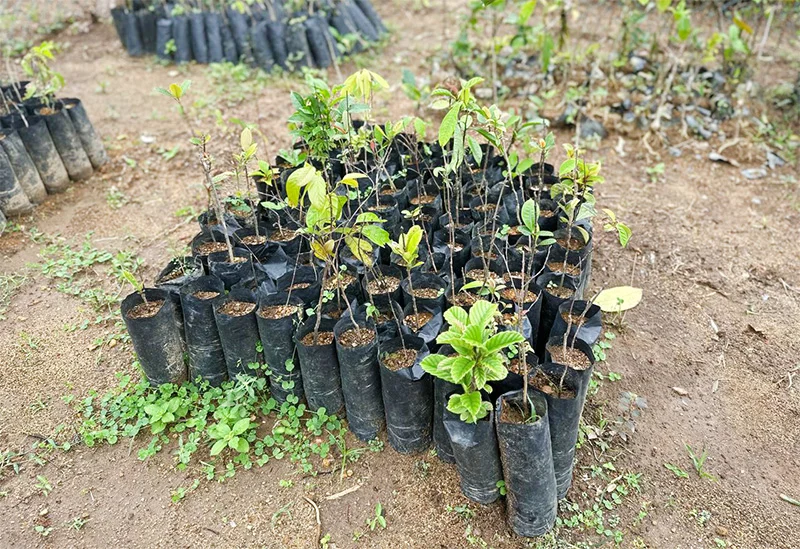
Forest plant saplings
Sri Lanka’s freshwater ecosystems are globally recognised for their remarkable biodiversity and high levels of endemism. However, despite their ecological significance, many ecological processes operating within these habitats remain poorly understood.
“Freshwater ecosystems in the tropics harbour extraordinary biodiversity, but many of the ecological relationships within these systems are still not fully documented,” researcher Janamina Bandara told The Island.
The study focused on sub-montane streams in the Sinharaja landscape, examining how varying levels of forest cover influence freshwater fish assemblages.
Researchers investigated whether fish communities differed between streams flowing through relatively undisturbed forests and those surrounded by modified vegetation resulting from agricultural activities.
Spotlight on a Critically Endangered Species
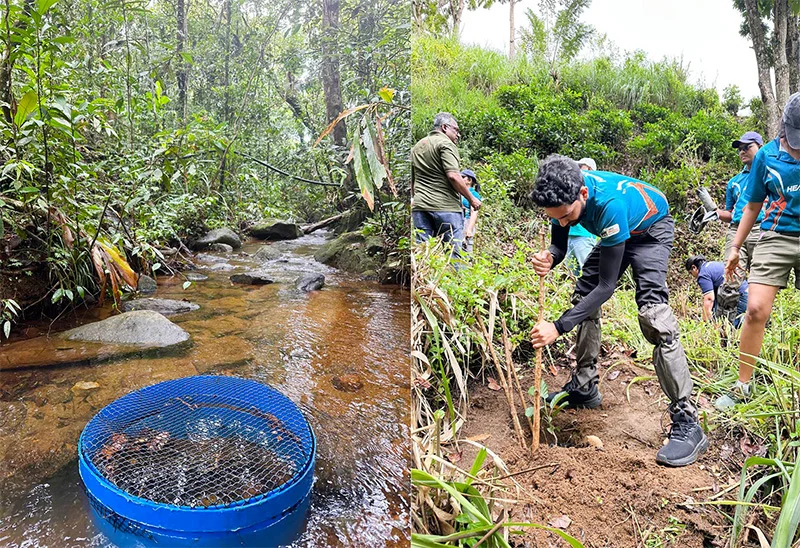
Leaf litter bay / Restoration activities
Particular attention was given to the critically endangered Rakwana loach (Schistura madhavai), a highly restricted endemic fish species first described from the Suriyakanda-Rakwana region.
Commonly referred to as a hill-stream loach, the species inhabits clear, fast-flowing streams and is considered highly sensitive to environmental disturbances.
According to Bandara, while broad community-level analyses did not reveal dramatic differences across all fish populations, species-specific responses painted a very different picture.
“Our findings show that Schistura madhavai exhibits a clear preference for streams flowing through intact forest habitats,” he explained. “The species becomes less common in areas where surrounding vegetation has been altered by human activities.”
Why Forests Matter to Fish
Forests bordering streams play multiple ecological roles. They regulate water temperature by providing shade, contribute organic matter that supports aquatic food webs, stabilise stream banks and help maintain water quality.
When these forests are removed or replaced with plantation crops, the resulting environmental changes can cascade through freshwater ecosystems.
Bandara noted that altered forest cover can influence water chemistry, microclimatic conditions, stream-bed composition and the availability of food resources.
“As riparian vegetation changes, a series of environmental conditions within the stream also change. Sensitive species such as Schistura madhavai appear particularly vulnerable to these shifts and may gradually disappear from modified habitats,” he said.
The research suggests that even subtle changes in habitat structure can have disproportionate impacts on species with narrow ecological requirements.
The Importance of Looking Beyond Numbers

Schistura madhavai
One of the most intriguing findings of the study is that ecosystem degradation may not always be apparent when scientists assess entire fish communities collectively.
In some instances, environmental variables appeared to have little effect on overall fish abundance or diversity. However, when individual species were examined separately, clear patterns emerged.
For example, variations in the amount of detritus—organic matter that accumulates on stream beds and serves as a vital food resource—did not significantly affect the overall fish assemblage. Yet for certain species, including habitat specialists, such changes proved critically important.
“This highlights a key conservation challenge,” Bandara said. “If we only look at total fish numbers or community-wide patterns, we may overlook serious declines occurring among environmentally sensitive species.”
Indicator Species as Ecological Sentinels
The findings underscore the importance of using so-called “indicator species” in environmental monitoring programmes.
Indicator species are organisms whose presence, absence or abundance reflects the health of an ecosystem. Because they respond rapidly to environmental change, they can provide early warnings of ecological degradation.
The Rakwana loach appears to fit this role exceptionally well.
“Species with narrow habitat requirements often act as ecological sentinels,” Bandara observed. “Monitoring them can provide a much clearer picture of ecosystem health than relying solely on broad biodiversity assessments.”
For conservation practitioners, this means that protecting sensitive endemic species may also help safeguard entire freshwater ecosystems.
Restoring Streamside Forests
Perhaps the study’s most important conservation message concerns the restoration of degraded riparian forests—the vegetation growing alongside streams and rivers.
Researchers argue that restoring these streamside habitats should be a priority in freshwater biodiversity conservation efforts.
Healthy riparian vegetation provides shade, reduces erosion, filters pollutants, enhances habitat complexity and supports the intricate ecological interactions upon which aquatic life depends.
“The restoration of degraded riparian forests is likely to be one of the most effective conservation measures for protecting freshwater biodiversity,” Bandara emphasised.
Such efforts could prove particularly valuable in landscapes where agricultural expansion has fragmented natural habitats.
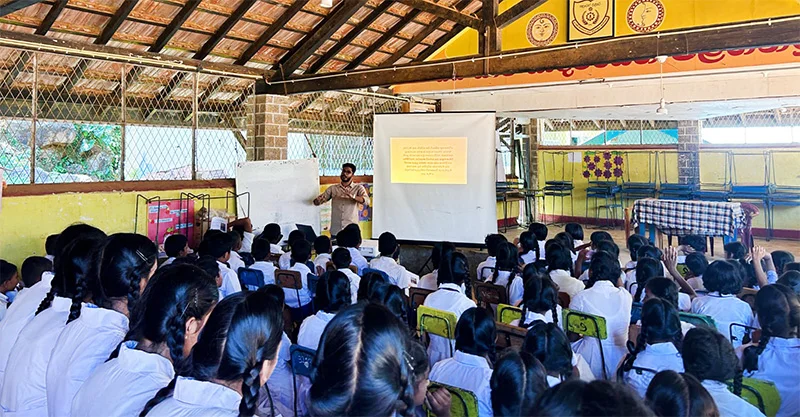
Awareness sessions
A Broader Lesson for Conservation
The study offers a timely reminder that freshwater conservation cannot be achieved by focusing exclusively on water bodies themselves. The surrounding landscape matters immensely.
From the mist-laden streams flowing down the Sinharaja foothills to the countless rivulets nourishing Sri Lanka’s river systems, the fate of freshwater biodiversity is intimately linked to the health of adjacent forests.
As conservationists grapple with accelerating habitat loss and climate-related pressures, the research demonstrates that protecting and restoring forest cover may be just as important as safeguarding the streams themselves.
In the case of the elusive Rakwana loach, the message is clear: save the forest, and you may save the fish.
For Sri Lanka’s unique freshwater biodiversity, that lesson could not be more important.
By Ifham Nizam
Sri Lankans have reason to take satisfaction in their country’s latest international achievement. Sri Lanka has climbed 14 places in the 2026 Global Peace Index to rank 67 in the world out of 163 countries that were assessed. At a time when global peacefulness is reported to be at its lowest level since the inception of the Index, and when more countries are experiencing deterioration than improvement, Sri Lanka’s progress stands out. The ranking reflects the country’s recovery from nearly three decades of war, its efforts to strengthen political stability and public security, and its resilience in overcoming the economic and political crises of recent years. The Global Peace Index assesses the strength of institutions, societal safety and security, and the capacity of societies to manage conflict peacefully.
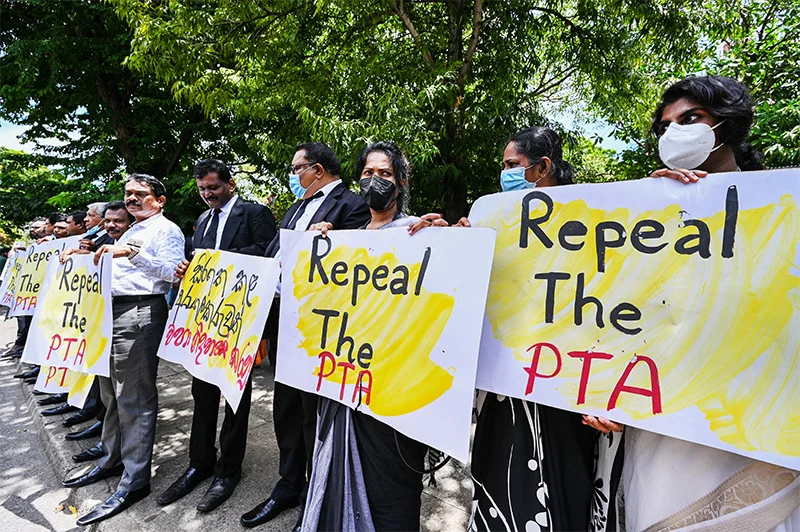
The challenge is to consolidate the gains that have been made and address those unresolved issues that continue to cast a shadow over the country’s future. It is in this context that two recent announcements by the government assume particular significance. Foreign Minister Vijitha Herath has announced that the Prevention of Terrorism Act (PTA), one of the most controversial laws in the country, will be repealed and replaced within two months. A report prepared by a committee appointed to make recommendations has already been handed over to him. According to the minister, the new legislation, to be known as the State Prevention of Terrorism Act, incorporates recommendations from civil society and is intended to comply with international standards on counter terrorism.
At the same time, Justice and National Integration Minister Harshana Nanayakkara has reaffirmed the government’s commitment to uncovering the truth about missing persons. During a visit to the Chemmani mass grave excavation site in Jaffna, he stated that the excavations should be completed expeditiously so that justice can be done and assured that the necessary resources have been allocated for the task. The excavations are taking place under judicial supervision with the participation of forensic experts, archaeologists, lawyers and representatives of the Office on Missing Persons. These commitments made by the government address two of the most contentious issues that have troubled Sri Lanka for decades. They also suggest that the government believes the country is now in a position to deal with difficult questions from its past rather than postpone them indefinitely.
After Breakthroughs
The timing of the pledge to repeal the PTA is particularly noteworthy. For many years successive governments promised to replace the law but failed to do so. Sri Lanka undertook to repeal it in 2017 as part of its commitments linked to retaining GSP Plus trade concessions by the European Union. Yet despite repeated assurances the law remained in force. The question therefore arises as to why the government now appears determined to act. One possible explanation is that the Easter Sunday investigations have reached a decisive stage. The investigation into the bombings that killed more than 260 people in 2019 appears to have made significant breakthroughs. If these investigations continue along their present course, it is possible that accountability will extend beyond those who directly carried out the attacks to those who may have facilitated, enabled or been part of a wider criminal conspiracy.
There is broad agreement within society that those who masterminded the dastardly Easter bombing must be held accountable and that the victims deserve the truth and justice. However, it is important that the process by which responsibility is determined is seen by the public to be fair, lawful and impartial. If those accused are convicted following a transparent judicial process that respects due process and the rule of law, the outcome is far more likely to gain acceptance across society. This is where the repeal of the PTA becomes important. A transition from a law associated with prolonged detention and exceptional powers to one that is more consistent with human rights standards would strengthen rather than weaken the legitimacy of the investigations. Accountability obtained through a process that is visibly fair will be more durable and less vulnerable to allegations of political motivation or selective justice.
The Chemmani excavations may also provide an example of how such credibility can be built. The process is taking place under judicial supervision and in full public view with the participation of independent experts. Whatever conclusions emerge, and follow up action is decided on, the process itself should command respect because it is transparent and accountable. The same principles can be applied to the Easter Sunday investigations. Public confidence is strengthened when investigations are conducted openly, when legal safeguards are respected and when the rights of both victims and accused persons are protected. The significance of these investigations may extend beyond the tragedy itself. There is likely to be an overlap between those who are eventually found responsible for the Easter Sunday conspiracy and elements of the state apparatus that exercised power during the final stages of the war.
Setting Precedent
For many years Sri Lanka has struggled to address allegations of wartime abuses. The issue has remained politically sensitive because it touches upon the conduct of those who were regarded by many as wartime heroes. Yet if the Easter Sunday investigations establish that senior officials can be investigated and held accountable when evidence warrants it, an important precedent will have been set. Once the deck is cleared through the Easter Sunday investigations and the judicial process that follows, it may become less difficult to address allegations relating to wartime abuses, including those connected to sites such as Chemmani where evidence is now being painstakingly uncovered. This would also strengthen Sri Lanka’s position internationally.
Since the end of the war in 2009, the country has remained under varying degrees of scrutiny by the United Nations Human Rights Council. In October 2025, the Council renewed the mandate of the Office of the High Commissioner for Human Rights to continue collecting and preserving evidence relating to past violations. The next review of Sri Lanka is due in September this year. The government now has an opportunity to demonstrate that Sri Lanka is capable of addressing difficult issues through its own institutions and according to its own democratic values. The commitments to repeal the PTA and to pursue investigations into missing persons can be seen in that light. Those who were victimized query as to what happened to their loved ones and to the information they know full well they entrusted to the government authorities and to the commissions of inquiry that were appointed. These are opportunities to show that accountability and national ownership can go hand in hand.
Reconciliation requires the difficult task of remembering truthfully. Too often Sri Lanka has sought stability by postponing difficult questions. Yet unresolved grievances do not disappear. They persist across generations and continue to shape political attitudes and communal relationships. Sri Lanka’s rise in the Global Peace Index is an achievement worth celebrating. But the true measure of peace is not only the absence of conflict. It is the presence of justice, trust and confidence in public institutions. The government’s commitments on PTA repeal, the Easter Sunday investigations and the search for truth regarding the disappeared suggest an awareness that old approaches have run their course. The government has an opportunity to break with the patterns of the past. The test now lies in implementation.
by Jehan Perera

 The biggest part of the challenge of a critical scholar in the humanities is having to engage critically with the very realities that define her existence as a social being. She cannot even begin to comment on the focus of her study without creating shock waves that would hit her own self in some form. One could argue that the scholars in the field of the humanities are part of what is being studied in one way or another. Critical scholarship in those fields entails destabilising the ground beneath their own feet.
An essential part of scholarly inquiry is being able to objectify what is being studied and examine it closely but at a distance, that, too, in a manner that scholar’s personal biases do not affect the judgement. Any failure to comply with this requirement immediately brands the study as unscientific. To try to understand this using an example situation, I would assume that a scientist who experiments with sodium and chlorine as chemical elements have the privilege of entering the experiment without any personal and emotional ties to either of the elements, placing one element in contact with the other without having to raise questions about her own existence, and observing and recording the outcome of the experiment without having to simultaneously examine what sort of implications the outcome has had for her as a person. The findings of the experiment may certainly advance her/him in the domain of science, but it is unlikely that the outcome of the study would result in any transformation within her as a social being.
The same privilege is not available for the (critical) scholars in the humanities. What chemical elements are for the scientist, the different social, political, cultural, gender, ethnic, racial, and religious identities are for those in the humanities. What the controlled, and also largely predictable, laboratory environment is for the scientist, the uncontrolled, even erratic, society is for those in the humanities. What the scientific experiments where the composition and behaviour of the individual chemical elements are explored is for the scientist, a close examination of phenomena and topics that cut across the categories of the social, the political, the cultural, and the religious is for those in the humanities.
The relatively clear differentiation or separation that is there between the scientist’s personal space and the laboratory setting where she conducts her research is not there in the case of her counterpart in the humanities. The latter does not have a separate laboratory setting that she can step into from her personal space, as the social space, which is her site of research, has her personal space already embedded in it. The freedom that the scientist has to cut herself off from what shapes her existence as a social and political being, as she enters her laboratory, is not available for her counterpart in the humanities, for the simple reason that the social and the political, which define her life outside her research, is also at the core of what they engage with in their research. Even in a setting where the latter locks herself up in a room and cuts herself off from the rest of society, the social and the political continue to define both her perspective and the object of study. Even the most effective scientist (but may not be the ideal scientist) has the option of taking her life, defined by the social, the political, the cultural and the religious, for granted, as her success is measured purely on the basis of her scholarly output; however, even the most ineffective scholar in the humanities would have to acknowledge the nexus between her personal life and her scholarly life, explicitly or implicitly, and her engagement with the chosen object of study will entail some sort of an engagement with her existence.
To use an example from the field of language studies which my work is primarily in, New Varieties of English, like what is called Sri Lankan English, is a topic that I try to engage with in both my teaching and research. Approached from a critical point of view, Sri Lankan English as a New Variety of English is more a political category than a linguistic one. The claims that you make may be based on linguistic evidence, but the conceptualisation of a separate form of English as Sri Lankan English even on the basis of objective linguistic evidence is primarily a political claim. The creation of such a category invariably results in a reconfiguration of the linguistic terrain of the country. Every claim that is made in favour of Sri Lankan English as a category results in a certain destablilisation of Sinhala and English, which are my first language and second language respectively, and the tense relations between which two languages have shaped my identity in a fundamental way. It is not only the two languages that get shaken; the broader ethnic identities that are associated with the two languages also undergo transformation, and this transformation certainly has an impact on who/what I am.
Even when I find the case for Sri Lankan English to be convincing, I feel compelled to word the arguments carefully. This feeling of compulsion to word the arguments carefully is certainly in recognition of the need to make academically-sound arguments; however, in addition to that, it has also to do with my position outside the social class which has traditionally been seen as having proprietary rights over the language. In that setting, I am less of an academic with an objective mindset than of a strategist who is enmeshed in the ethnic and class relations that define the topic of Sri Lankan English. At the same time, in a context where one’s knowledge of English is a primary determiner of her success in society and what is predominantly valued is the so-called proper forms of English, I have had to ask myself if any claims, including the most convincing, academically-sound ones, in the direction of legitimising Sri Lankan English should not be with caution.
I have also had to reconcile between two seemingly contradictory positions involved in making a case for Sri Lankan English, especially in the context of an English Honours programme, that, too, at a leading university in the country. On the one hand, making a case for Sri Lankan English entails encouraging deviation from the established norm/s of the language; on the other hand, considering the nature of the programme, the need to require the students to make that case using a normative form of English that would be recognised internationally could not be overlooked. At one level, this seeming contradiction could easily be dismissed as hypocrisy, but a closer and more serious reading of the situation would see in it a certain “maneuvering” and “negotiating” that the scholars in the discipline of English Studies stationed in peripheral contexts like ours are constrained to undertake in their engagement with the topic at hand. Although the arguments that get made have the appearance of truth, a close analysis of those arguments would indicate a certain identity politics that is being played. This identity politics has a direct bearing on the identity of the scholar who engages with the topic.
Accordingly, to make a claim in the humanities from a critical point of view is also to question in some form what defines one’s own identity, and this may not be the most comfortable undertaking for many of us in the field. This explains, at least to a certain extent, why some scholarly engagements with history results in mere glorifications of the mainstream historical narratives; why some scholarly engagements with literature and language results in a mere celebration of the mainstream literary traditions and hegemonic languages; how some scholarly engagements with the idea of culture directly subscribe to the position that culture should always be preserved and celebrated. Such approaches leave the status-quo largely untouched, and therefore the amount of unsettling that the scholars have to deal with is minimal. How much value that they are in a position to add to the existing scholarship, of course, is a question.
Any act of critical scholarship in the field of the humanities entails the scholar having to challenge in some form what defines her personal existence. This may not be the most comfortable move to make, but that is the only way the scholar could try to make a contribution of value to the field. It is important that this dilemma that the critical scholars in the humanities have to go through is recognised for what it is.
(Nandaka Maduranga Kalugampitiya is attached to the Department of English, University of Peradeniya.)
Kuppi is a politics and pedagogy happening on the margins of the lecture hall that parodies, subverts, and simultaneously reaffirms social hierarchies.
by Nandaka Maduranga
Kalugampitiya

Lionel Messi scores brace as Argentina beat Austria 2–0 at World Cup 2026

Egypt denied flight to Seattle ahead of final World Cup group match

Mbappe leads France to win over Iraq in lightning-delayed World Cup game

US partially lifts Iran oil sanctions amid ‘encouraging’ talks

England lose 12 WTC points for slow over rate at The Oval

Showers expected in the Western, Sabaragamuwa and North-western provinces and in Galle, Matara, Kandy and Nuwara-Eliya districts.

‘Dates have the highest sugar content to fight Coronavirus’

Sunday Island 27 December – Headlines

#SundayIsland 17th December – Headlines

Sunday Island – 28th March

Sunday Island Headlines – 21 March

Sunday Island – 21st February – Headlines
-
 Features6 days ago
Killing of Colombo’s ancient trees — a warning on UN’s World Desertification Day – 17 June
-

 News4 days ago
Creditor receives USD 2.5 mn as Lankan public bears loss from theft of Treasury funds
-

 News3 days ago
Creditor not yet paid
-
 News3 days ago
Consumers bearing 22% tax burden despite 18% VAT claim: Dr. Harsha de Silva
-

 Opinion5 days ago
Beyond diagnosis: A strategic design for 7% growth by 2029 (Part I)
-
 News6 days ago
India provides military stores worth USD 5.5 mn to SL
-

 Opinion4 days ago
SriLankan Airbus struck by lightning
-

 Editorial2 days ago
Fuel crisis: Beyond price debate