
Latest News
Top UN court says countries can sue each other over climate change

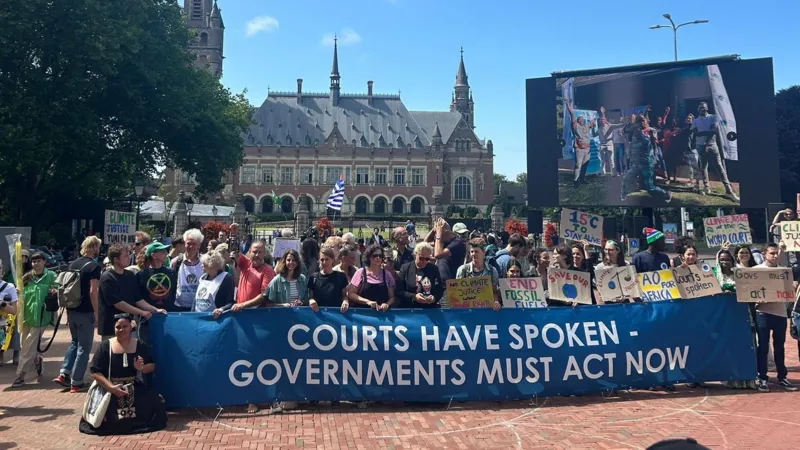
A landmark decision by a top UN court has cleared the way for countries to sue each other over climate change, including over historic emissions of planet-warming gases.
But the judge at the International Court of Justice in the Hague, Netherlands on Wednesday said that untangling who caused which part of climate change could be difficult.
The ruling is non-binding but legal experts say it could have wide-ranging consequences.
It will be seen as a victory for countries that are very vulnerable to climate change, who came to court after feeling frustrated about lack of global progress in tackling the problem.
The unprecedented case at the International Court of Justice (ICJ) was the brainchild of a group of young law students from low-lying Pacific islands on the frontlines of climate change, who came up with the idea in 2019.
One of those students, Siosiua Veikune from Tonga, was in the Hague to hear the decision.
“I’m lost for words. This is so exciting. There’s a ton of emotions rushing through us. This is a win we take proudly back home to our communities,” he told BBC News.
“Tonight I’ll sleep easier. The ICJ has recognised what we have lived through – our suffering, our resilience and our right to our future,” said Flora Vano, from the Pacific Island Vanuatu, which is considered the country most vulnerable to extreme weather globally.
“This is a victory not just for us but for every frontline community fighting to be heard.”
The ICJ is considered the world’s highest court and it has global jurisdiction. Lawyers have told BBC News that the opinion could be used as early as next week, including in national courts outside of the ICJ.
Campaigners and climate lawyers hope the landmark decision will now pave the way for compensation from countries that have historically burned the most fossil fuels and are therefore the most responsible for global warming.
Many poorer countries had backed the case out of frustration, claiming that developed nations are failing to keep existing promises to tackle the growing problem.
But developed countries, including the UK, argued that existing climate agreements, including the landmark UN Paris deal of 2015, are sufficient and no further legal obligations should be imposed.
On Wednesday the court rejected that argument.
Judge Iwasawa Yuji also said that if countries do not develop the most ambitious possible plans to tackle climate change this would constitute a breach of their promises in the Paris Agreement.
He added that broader international law applies, which means that countries which are not signed up to the Paris Agreement – or want to leave, like the US – are still required to protect the environment, including the climate system.
The court’s opinion is advisory, but previous ICJ decisions have been implemented by governments, including when the UK agreed to hand back the Chagos Islands to Mauritius last year.
“The ruling is a watershed legal moment,” said Joie Chowdhury, Senior Attorney at the Centre for International Environmental Law (CIEL).
“With today’s authoritative historic ruling, the International Court of Justice has broken with business-as-usual and delivered a historic affirmation: those suffering the impacts of climate devastation have a right to remedy for climate harm, including through compensation,” she added.
A spokesperson for the UK’s Foreign, Commonwealth and Development Office said it was “taking time” to look at the opinion before commenting in detail, but added:
“Tackling climate change is and will remain an urgent UK and global priority. Our position remains that this is best achieved through international commitment to the UN’s existing climate treaties and mechanisms.”
The court ruled that developing nations have a right to seek damages for the impacts of climate change such as destroyed buildings and infrastructure.
It added that where it is not possible to restore part of a country then its government may want to seek compensation.
This could be for a specific extreme weather event if it can be proved that climate change caused it, but the Judge said this would need to be determined on a case by case basis.
“This is a huge win for climate vulnerable states. It’s a huge win for Vanuatu, which led this case and is going to change the face of climate advocacy,” said barrister Jennifer Robinson at Doughty Street Chambers, who represented Vanuatu and the Marshall Islands.
It is not clear how much an individual country could have to pay in damages if any claim was successful.
But previous analysis published in Nature, estimated that between 2000 and 2019 there were $2.8 trillion losses from climate change – or $16 million per hour.
During the evidence sessions in December, the court heard from dozens of Pacific Islanders who have been displaced as a result of rising sea level, caused by climate change.
The Marshall Islands highlighted that the costs for their island to adapt to climate change are $9 billion.
“That is $9 billion the Marshall Islands does not have. Climate change is a problem they have not caused, but they are forced to consider relocating their capital,” said Ms Robinson.
As well as compensation, the court also ruled that governments were responsible for the climate impact of companies operating in their countries.
It said specifically that subsidising the fossil fuel industry or approving new oil and gas licenses could be in breach of a country’s obligations.
Developing countries are already exploring bringing new cases seeking compensation for historic contributions to climate change against richer, high emitting nations citing the ICJ opinion, according to lawyers the BBC spoke to.
If a country wants to bring a case back to the ICJ to make a ruling on compensation then it can only do so against countries which have agreed to its jurisdiction, which includes the likes of the UK, but not US or China.
But a case can be brought in any court globally, whether that be domestic or international, citing the ICJ opinion, explained Joie Chowdhury from CIEL.
So instead a country may choose to take their case not to the ICJ but a court where those countries are bound e.g. federal courts in the US.
But the question remains whether the ICJ opinion will be respected.
“[The ICJ] is an institution that is subject to geopolitics – and it relies on states adhering to its judgements, it doesn’t have a police force,” said Harj Narulla, a climate barrister at Doughty Street Chambers, which also represented the Solomon Islands.
When asked about the decision, a White House spokesperson told BBC News:
“As always, President Trump and the entire Administration is committed to putting America first and prioritising the interests of everyday Americans.”
(BBC)

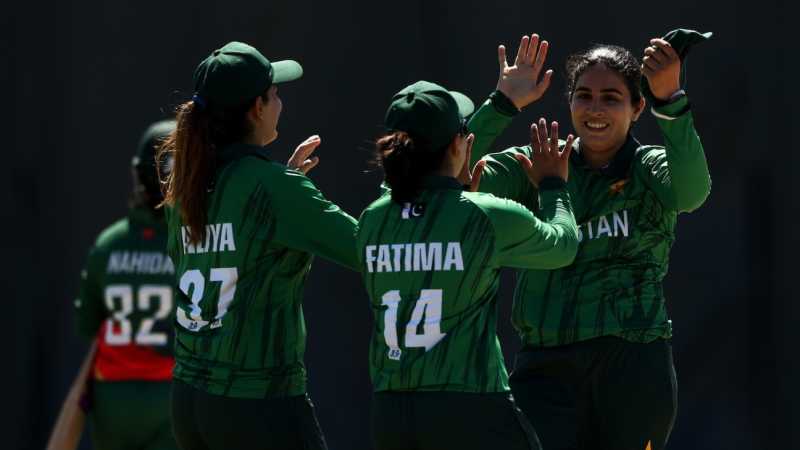
At 67 for 5 in the 12th over, Pakistan were under the cosh against Bqngladesh in their bronze-medal playoff at the Asian Games women’s competition. That’s when Fatima Sana walked out, slammed 45 in 30 balls, and gave Pakistan 145, which was 31 too many for Bangladesh, especially after Umm-e-Hani picked up three top- and middle-order wickets to end with 3 for 10 from her four overs.
Bangladesh’s big concern, of late and in general, has been the number of dot balls they play out in a typical T20 innings. In this game, it was a marginal improvement from the loss to India in the semi-final – they had 43 dot balls here compared to 61 in that game. But it was still fewer than the 48 they bowled to Pakistan in the first half. The difference was Sana, who scored at 150.00 to change the complexion of the contest.
Pakistan’s start had been decent, thanks to Gull Feroza, after they won the toss and opted to bat. Feroza and Shawaal Zulfiqar added 46 in 41 balls before being separated in the seventh over. The one to be dismissed was Feroza, who had scored 31 in 23 balls. Zulfiqar batted on before becoming the third batter to fall, having struggled to 17 off 27 balls. And the wickets kept falling, Shorna Akter picking up two of them to leave Pakistan in a mess with five batters gone.
Sana had a solid stand for the sixth wicket with Aliya Riyaz, who scored 25 in 22 balls and added 67 with Sana in just 43 balls. The control Bangladesh had was gone with the two hitting five sixes between them.
The target for Bangladesh, which looked like it might be in the region of 100, was suddenly closer to 150. And the chase never took off. Umm-e-Hani struck in the third over, then in the fifth over, and again in the 16th over. By then, Bangladesh were floundering: 77 for 5 with under five overs to go.
The resistance came from senior pro Sharmin Akther, who scored an unbeaten 46 in 45 balls, but there was nothing around her, and Pakistan ran out comfortable, 31-run victors.
Scores:
Pakistan women 145 for 8 in 20 overs (Shawaal Zulfiqar 17, Fatima Sana 45, Gull Feroza 31, Aliya Riyaz 25; Sanija Akter Meghla 1-28, Nahida Akter 2-21, Shorna Akter 2-16, Ritu Moni 2-27) beat Bangladesh women 114 for 7 in 20 overs (Dilara Akter 12, Nigar Sultana 25, Sharmin Akhter 46*, Nahida Akter 10*; Tasmia Rubab 1-25, Fatima Sana 1-25, Umm-e-Hani 3-10, Nashra Sandhu 1-19, Ayesha Zafar 1-10) by 31 runs
(Cricinfo)

India Women won the toss and chose to bat first in the Asian Games women’s cricket final in Nishin, Japan.
India: Smriti Mandhana, Shafali Verma, G Kamalini, Harmanpreet Kaur (capt), Richa Ghosh (wk), Bharti Fulmali, Deepti Sharma, Shreyanka Patil, Kranti Gaud, N Shree Charani, Nandani Sharma
Sri Lanka: Imesha Dulani, Chamari Athapaththu (capt), Hasini Perera, Kavisha Dilhari, Harshitha Samarawickrama, Hansima Karunaratne, Kaushini Nuthyangana (wk), Kawya Kavindi, Mithali Ayodhya, Chamudi Praboda, Sugandika Kumari
(Cricinfo)
The National Business Facilitation Centre (NBFC), which is being established under the Presidential Secretariat with the aim of removing administrative and regulatory barriers that exist among government institutions in relation to investment and industry and expediting these processes, will be opened tomorrow (22).
The centre is being established on the President’s initiative with the aim of bringing about a positive transformation in the industrial sector. The centre will provide solutions to issues that arise in dealing with the government machinery when starting and operating a business, while also coordinating with the relevant government institutions to provide the necessary facilities.
The “ViYASA” National Business Facilitation Centre (NBFC) has been established at Building C-80, Hector Kobbekaduwa Mawatha, Colombo 07, and is headed by Senior Additional( Secretary to the President, Seevali Arukgoda.
The centre will be opened under the patronage of Minister of Labour and Deputy Minister of Finance and Planning Dr Anil Jayantha Fernando and Minister of Industry and Entrepreneurship Development Sunil Handunnetti, with the participation of Secretary to the President Dr Nandika Sanath Kumanayake.
The website https://nbfc.presidentsoffice.gov.lk is also scheduled to be officially launched on the occasion.
President’s Media Division)

Fatima Sana and Umm-e-Hani secure bronze for Pakistan in Asian Games

India bat first in Asian games womens cricket final

Showers about 100mm will occur in the Western, Sabaragamuwa, Central and North-western provinces and in Galle and Matara Districts

Govt. confident of 2/3 majority despite NPP split speculation

Justice Corea appointed Acting President of the Court of Appeal

Protest against setting up of cement factory in highly populated area near BIA

‘Dates have the highest sugar content to fight Coronavirus’

Sunday Island 27 December – Headlines

#SundayIsland 17th December – Headlines

Sunday Island – 28th March

Sunday Island Headlines – 21 March

Sunday Island – 21st February – Headlines
-

 News5 days ago
US embassy won’t comment on IGP’s probe into joint drug raid
-

 News3 days ago
Shanakiyan urges urgent action over reported death sentence for Lankan in Saudi Arabia
-

 News4 days ago
Bid for Basil’s extradition nears final stage: Police
-

 Business5 days ago
All-new Bolero MaXX unveiled in Sri Lanka
-

 News2 days ago
Namal Rajapaksa Buddhist gambit fails, bail denied
-

 Opinion5 days ago
A journalist who wrote across the divide
-

 Editorial6 days ago
More fuel price shocks shrouded in secrecy
-

 Sports6 days ago
MAS Holdings, official clothing sponsor of Sri Lanka team at Aichi–Nagoya 2026 Asian Games