
Sports
Sri Lanka steamroll Bangladesh to take 1-0 lead in T20I series


Sri Lanka drew first blood in the three-match T20I series with a comprehensive seven-wicket win over Bangladesh at Pallekele on Thursday, coasting home with an over to spare after a belligerent start by their top order.Chasing a modest target of 155, skipper Charith Asalanka fittingly put the seal on the game by launching Tanzim Hasan straight down the ground for six, much to the delight of a holiday crowd that turned up in numbers.
The foundations for the win were laid early, with Pathum Nissanka and Kusal Mendis cutting loose from the word go. The pair added a blistering 78 runs in just 28 deliveries, making full use of the Power Play as Sri Lanka raced to 83 for one, their highest ever score in the first six overs of a T20 International, eclipsing the previous best of 75 against India in 2018.
Nissanka set the tone by dispatching the first ball of the innings to the fence, and he never looked back. The right-hander smashed five fours and three sixes in a whirlwind 42 off just 16 balls before perishing, but the damage had been done.
Mendis, fresh off a match-winning hundred in the ODI series decider at the same venue, picked up where he left off. His 73 came off 51 deliveries and featured five boundaries and three sixes. The wicketkeeper played the anchor role to perfection, ensuring the chase stayed firmly on track without resorting to high-risk strokes.
Kusal Perera added to the fireworks, reverse-sweeping Shamim Hossain into the stands and sharing a brisk 42-run stand with Mendis as Sri Lanka maintained the upper hand throughout.
Earlier, Bangladesh flattered to deceive. After being sent into bat, openers Parvez Hossain and Tanzid Hasan gave the visitors a flying start, adding 46 runs off 30 balls. But once the first wicket fell, the wheels came off. The middle order struggled to shift gears, and played into Sri Lanka’s hands.
Dasun Shanaka, recalled to side after almost a year, marked his return with a tidy spell of four overs for just 22 runs and a wicket, helping choke the flow of runs in the middle overs. Leg-spinner Jeffrey Vandersay, drafted in for the injured Wanindu Hasaranga, also made his presence felt with a disciplined four-over spell that cost just 25 runs and included a wicket.
On a flat deck that offered little for bowlers, Bangladesh’s total of 155 always looked under par. Despite a few tidy spells, the visitors lacked the firepower to contain a rampant Sri Lankan batting line-up on a batting paradise.The teams now move to Dambulla for the second game of the series on Sunday.









Imam ul Haq is unlikely to play the rest of Pakistan’s Lord’s Test against England after being diagnosed with a grade-1 tear in his left calf. He has been advised ten days of rest. Cricinfo has learned that Imam was taken for scans at stumps on day one of the ongoing Test, after which the severity of the injury became clear.
Imam remained off the field after tea on the first day and has not been in action in this Test since with Salman Agha coming in as his substitute. Imam did not come out to bat in the first innings on day two, which folded inside 38 overs as Pakistan scored only 110 in reply to England’s 290.
Before the start of the second day’s play at Lord’s, the team management had said that Imam’s participation in the match depended on his treatment from a “strain to his left calf muscle”, and fast bowler Mohammad Ali sidestepped the question after stumps on day three. “I wouldn’t be able to tell you anything about it,” he told reporters. “I am aware of his status, but the team’s medical panel is better placed to answer you better.”
Imam did come out before the start of the fourth day’s play and faced a few gentle throw-downs, with his left calf heavily strapped. He looked limited in his movements while batting and limped back after a short while with members of the support staff around him.
Imam picked up the injury while batting in the Headingley Test, which Pakistan lost by an innings and 103 runs. He needed on-field attention from the team medical panel during the first innings and had his left calf strapped over the course of his 42-run innings in which he struck a partnership worth 91 runs with Abdullah Shafique for the third wicket after which Pakistan crumbled for 171.
Imam’s likely unavailability for the second innings will be a further blow for Pakistan who are staring at a steep target to level the series with England boasting a 357-run lead after the third day. A defeat at Lord’s will give England their first Test series win since December 2024, and Pakistan’s ninth defeat in their last ten away Tests. It would also mark Pakistan’s second consecutive Test series defeat in England after the lost 1-0 on the Covid-era tour in 2020.
The third and last Test of the series begins on September 9 in Birmingham, providing enough time to Imam to recuperate from the injury.
[Cricinfo]
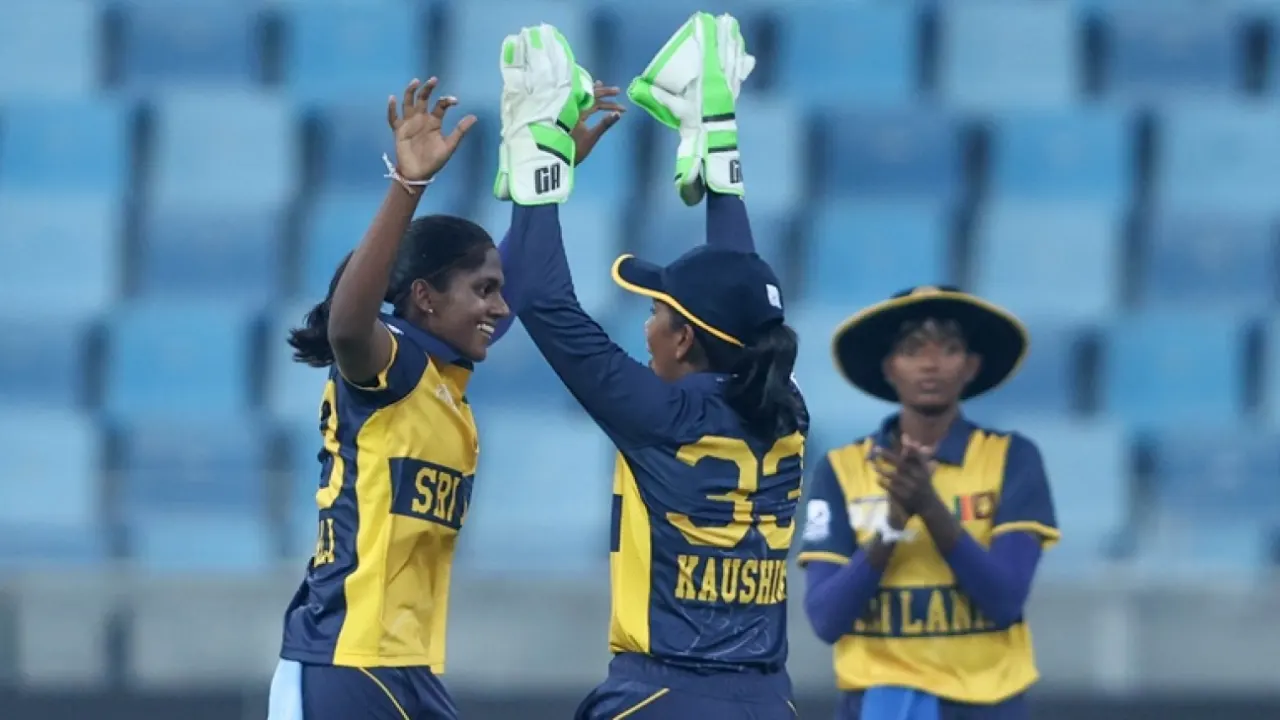
Medium pacers Chethana Vimukthi and Mithali Ayodhya starred with the ball as Sri Lanka began their 2026 Asia Cup title defence with a commanding win against UAE in Dubai.
The duo, well supported by the rest of Sri Lanka’s attack, combined to bowl UAE out for 79 with one ball remaining in the innings. In reply, Chamari Athapaththu wasted no time, blasting an unbeaten 48 off 25 balls to help Sri Lanka cruise to a nine-wicket victory with 73 balls to go.
Sri Lanka ace the conditions
With conditions offering plenty for seamers, Sri Lanka captain Athapaththu opted to bowl, handing the new ball to 19-year-old slinger Ayodhya. She made an immediate impact, striking with the fourth ball of the innings, getting one to swerve late into opener Theertha Satish, who played on to her stumps to depart for a two-ball duck.
Vimukthi, making her T20I debut, then repeatedly found movement away, beating both UAE batters’ outside edges. She continued to test them outside off in her second over as well and was rewarded with her first T20I wicket when a cross-seam delivery on off held its line, beating Lavanya Keny for pace and movement as she played inside the line. The ball crashed into the top of off stump, leaving Keny bowled for just 3 off 11.
UAE’s first boundary came in the fifth over courtesy captain Esha Oza but it was their only respite in a difficult powerplay as they struggled to 22 for 2 from the first six overs.
UAE feel the pressure
Sri Lanka continued to squeeze UAE through the middle overs, with the introduction of left-arm spinner Sugandika Kumari adding to their troubles. Her second over brought a wicket, as she dismissed Oza for 18 off 24, tempting the UAE captain into a loose shot with a tossed-up delivery just outside off.
UAE would have lost another wicket soon after as Chamudi Praboda nearly had Samaira Dharnidharka stumped with a flighted delivery on off that drifted in. Dharnidharka was beaten while attempting to drive, but she just managed to ground her back foot before the wicketkeeper could whip off the bails.
UAE’s innings never really gathered momentum as they lost their fourth wicket for just 38 runs before Rinitha Rajith provided a brief spark. She struck two boundaries and looked intent on taking the attack on, while Dharnidharka also found the fence twice before falling to a slower ball from Kavisha Dilhari for 17 off 25.
Vimukthi and Ayodhya returned at the death to take two wickets each off their respective last overs to bowl UAE out for 79.
Athapaththu does it her way
Sri Lanka opener Imesha Dulani got off the mark with a boundary, setting the tone for the chase and racing through the opening three overs. Athapaththu too chipped in with big hits as the duo plundered more than half the runs required within five overs.
Athapaththu also hit the first six of the match, dancing down the track to launch Oza over mid-off. The shot also took her to 500 runs in the Women’s Asia Cup, making her the first batter to reach the milestone.
Dulani, however, was run out in unfortunate circumstances as Athapaththu drove a full delivery straight back at the bowler, whose attempted fielding effort deflected the ball onto the stumps at the non-striker’s end, catching Dulani short of her ground. But Athapaththu made sure there were no further hiccups, smashing two fours and a six in the next nine balls to help Sri Lanka coast to a win.
Scores:
Sri Lanka Women 80 for 1 in 7.54 overs (Imesha Dulani 25, Chamari Athapaththu 48*) beat UAE Women 79 in 19.5 overs (Esha Oza 18, Heena Hotchandani 10, Samaira Dhanidharka 17, Rinitha Rajith 15; Mithali Ayodhya 3-14, Chethana Vimukthi 3-16, Sugandika Kumari 2-18, Chamari Athapaththu 1-10, Kavisha Dilhari 1-09) by nine wickets
[Cricinfo]
by Rex Clementine
In the history of Test cricket, we have witnessed some epic rearguard actions that have saved the day.
Our coach Gary Kirsten himself once batted for 14 and half hours after England enforced the follow on in Durban. Sir Garfield Sobers did something similar when he occupied the crease for many hours to save the Lord’s Test of 1963.
Then, again at Lord’s, Mahela Jayawardene led from the front in 2006. Sri Lanka were forced to follow on after conceding a first innings deficit of 359 runs, but MJ produced a masterclass. With six other Sri Lankans posting half centuries, the tourists pulled off one of their greatest escapes.
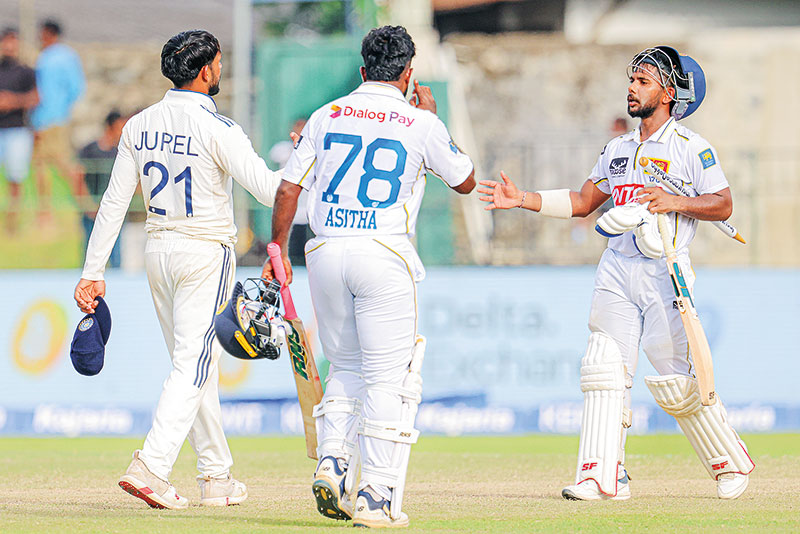
And then, this week, came Sonal Dinusha.
What truly remarkable batting that was.
There is, however, one significant difference between Dinusha and those other greats. Kirsten, MJ and Sir Garry were all seasoned campaigners. Dinusha is a rookie playing just his fifth Test.
What was so impressive about the 25-year-old was how organised he was. He didn’t lose patience. He didn’t get carried away. There was no rush of blood.
These are hardly traits we associate with young players in modern cricket. We see them flashing outside off stump. We see them charging down the track wanting to take the spinners to the cleaners. We see them engaging opponents and getting sucked into needless scraps.
Dinusha, though, is different.
But how come? In this day and age of the IPL and instant gratification, how have we unearthed a cricketer with such temperament?
There is little doubt that this is a special kid and a special talent. Hopefully, Sri Lanka can dream big. Head Coach Gary Kirsten called it one of Sri Lanka’s finest match saving knocks.
“I love the way he plays Test cricket. He understands what the bowlers are trying to do to him. This innings today will go down in history as one of the best match-saving knocks for Sri Lanka.”
Dinusha batted for seven hours in the second innings. The fact that he had also scored a hundred in the first innings, having already made another century in Galle, makes his achievement even more extraordinary. He finished the series with 420 runs in four innings.
That was some insane batting. Let’s hope the kid keeps going.
Despite the series defeat, there were other positives for Sri Lanka. The manner in which Pasindu Sooriyabandara batted and the composure young spinner Keshara Nuwantha showcased when the team was under the cosh after yet another collapse were encouraging signs.
The lower order played impressive roles too. Lahiru Kumara batted like a champion and frankly, put some of the opening batters and the captain to shame.
Several Indian players turned up at the SSC on the final morning probably thinking this would be a quick finish and they would soon be heading home. Some might even have fancied squeezing in a bit of last minute shopping.
Dinusha and Sri Lanka’s tail had other ideas.
Those plans went out of the window as the lower order showed remarkable resolve, eating up overs and frustrating an Indian attack that had arrived expecting to administer the last rites.
“Really impressed with some of the young batters who have shown their mettle in Test match cricket. Apart from Sonal Dinusha and Pasindu Sooriyabandara, everyone put their hearts together, fighting as hard as we could to save the Test match. The character shown by everyone pleased me,” Kirsten said.
The fast bowling was top notch too. Both Lahiru Kumara and Asitha Fernando had their moments and provided another useful reminder that Sri Lanka do not always have to turn to raging turners to win Test matches. Quicks can win you games too.

Petrol to cost less from midnight today (30)

Head teacher evacuated 900 children minutes before school washed away by Nepal floods

UPDATE: Seven killed and 23 missing after boat capsizes off northern Cyprus, says Turkish Cypriot PM

Iceland votes against restarting talks on joining EU

“Rathuwewi Mihimadala” Book Launched with the Participation of the Prime Minister

Turkiye, Somalia forces free cargo vessel hijacked by pirates

‘Dates have the highest sugar content to fight Coronavirus’

Sunday Island 27 December – Headlines

#SundayIsland 17th December – Headlines

Sunday Island – 28th March

Sunday Island Headlines – 21 March

Sunday Island – 21st February – Headlines
-

 News6 days ago
Missing doctor’s body found in Mahiyanganaya
-

 News6 days ago
Australia declines to release Finance Secy Suriyapperuma’s citizenship details
-

 News6 days ago
22A: BASL suggests CJ recuse himself from hearing petitions
-

 News3 days ago
Eight politicians in drug kingpin probe
-

 Editorial7 days ago
Govts. drag feet as undergrads age
-

 Business3 days ago
Sri Lanka opens up: A new season of direct connectivity
-

 Features5 days ago
Insights from Chieftains of Uva: Genealogy of two Kandyan Families – Part II
-

 Features3 days ago
Redefining ageing in Sri Lanka