
Latest News
Hazlewood’s haul of five helps Australia surge to victory inside three days

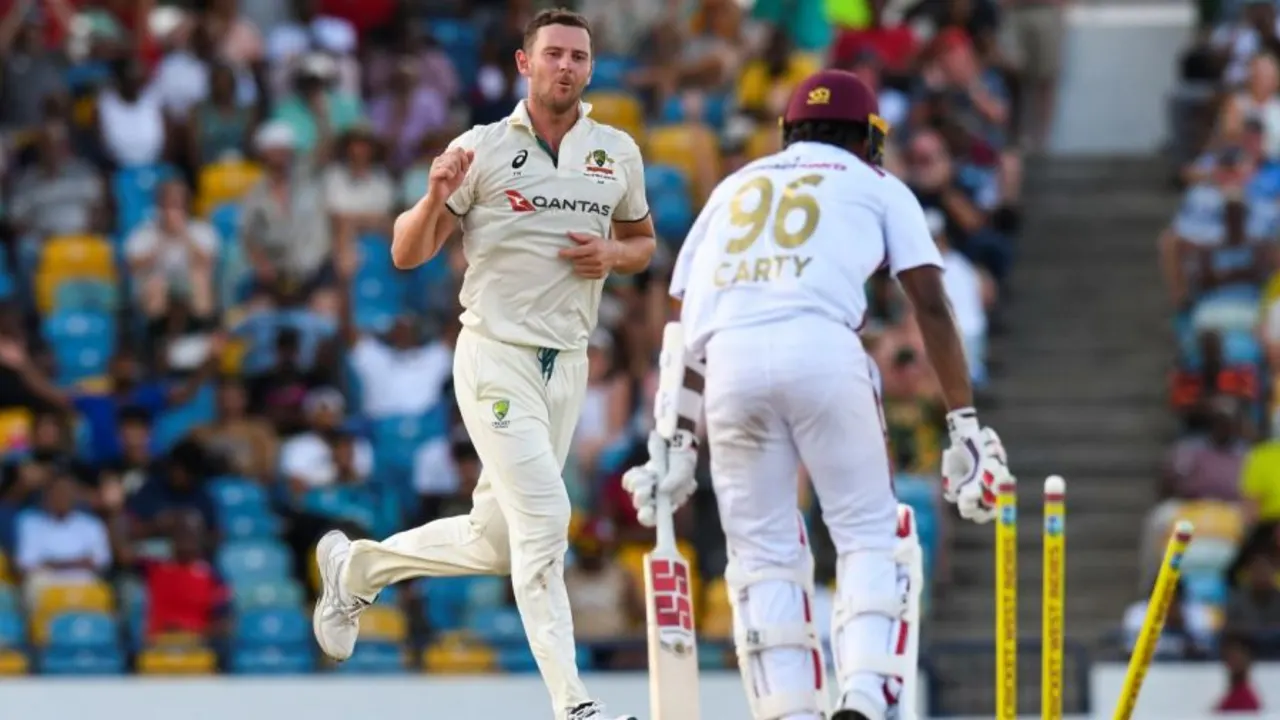
Josh Hazelwood led Australia’s surge to victory in Barbados as West Indies lost all 10 wickets in the final session of the third day, the final two falling in consecutive deliveries to Nathan Lyon in what would have been the last over the day to seal a 159-run margin.
Australia claimed the extra half an hour with West Indies seven down but with Shamar Joseph throwing the bat, having been dropped in the deep by Sam Konstas, and Justin Greaves playing solidly it appeared Australia would be forced to return on the fourth day. However, Shamar edged to slip before Jayden Seales was caught at short leg. It completed a performance where familiar Australia strengths came to the fore amid continued questions about the top order, but they were confronted by challenging conditions.
Travis Head, who was the beneficiary of West Indies’ seventh dropped catch of the match, Beau Webster and Alex Carey all played with the pro-activeness needed on this surface. Head was named player of the match for his twin half-centuries on a tricky surface. Carey’s superb strokeplay gave Australia plenty of buffer zone when it came to defending the target, meaning a repeat of what happened in the World Test Championship final was always unlikely on a surface that remained devilish at times, especially with the harder ball.
Mitchell Starc struck in the first over the chase when former captain Kraigg Brathwaite clipped loosely to backward square leg where Konstas held a low catch. However, that was followed by some adventurous strokeplay by John Campbell, including a sweep against Hazlewood, as he and Keacy Carty made encouraging process.
But innovation brought Campbell’s downfall when he attempted to lap-sweep Hazlewood again, and this time could only glove the ball to Carey. Next ball, Brandon King got an inside edge into his pads which flew high towards gully where Cameron Green, who had earlier given Carty a life on 1, used all his height to cling on. Sadly for Hazlewood, he did not make Roston Chase play at the hat-trick delivery as a packed ring of catchers awaited.
Not that he was delayed long when, two overs later, Chase got an inside edge that looped to short leg before spearing one through Carty. This was Hazlewood at his very best: hammering away back-of-a-length and giving the surface every chance to play some tricks.
Pat Cummins was then the beneficiary of those tricks when Shai Hope was cleaned up by a wicked delivery that scuttled under his bat. The run-scoring of Australia’s middle order against an older ball felt a long time ago. The only question was whether the visitors could get the job done in the evening.
Marnus Labuschagne, on as a sub, produced a direct hit run out to remove Alzarri Joseph and Hazlewood removed Jomel Warrican for his fifth wicket. Shamar Joseph launched two balls out of the stadium and some frustration was growing for Australia before Lyon sealed the job in fading light.
The game was in the balance at the start of the day, Australia ahead by 82, with plenty of eyes on how the surface would play. There was an early grubber to Head, which fortunately for him wasn’t straight, and he responded by flaying the next delivery through the off side. As Head would later find out there was always something lurking, but with a touch of fortune, runs were there to be made when intent was shown.
West Indies, though, were their own worst enemy again. On 21, Head was given a life when Greaves spilled a chance at second slip. It was the seventh they had put down for the game and had come after coach Daren Sammy had overseen the morning slips catching practice where nothing had been spilled. Head went to his second fifty of the match from 77 balls.
Webster, meanwhile, built an excellent innings, the third of his brief Test career which has come on a challenging surface following the debut half-century against India at the SCG. He used his reach to good effect to get out to the ball but was especially eye-catching off the back foot through the off side.
The stand of 102 was broken when Head received a brute of a delivery from Shamar Joseph that barely bounced, the only success for West Indies in the morning session when they would have hoped to knock over most of the remaining Australia batting.
After the break Webster brought up his fifty from 100 balls with a thick edge along the ground through gully before glancing Shamar Joseph down the leg side to Hope. An on-field not-out decision was overturned by third umpire Adrian Holdstock without any of the drama of the previous day.
By then Carey was into his stride having started positively but went up a gear in the over following Webster’s departure when he took 14 off Seales including the shot of the match: a skip down the pitch and perfectly executed lofted straight drive into the sightscreen. He went on to repeat the stroke against the lesser pace of Greaves, sending him over the stands at long-off, to motor to a 40-ball half-century as the game sped away from West Indies.
When joined by Lyon and Hazlewood he started to farm the strike as West Indies set their entire field back to him before lofting Chase into the deep. Shamar Joseph, who bowled the most overs in a match of his brief Test career, removed Hazlewood to claim the five-wicket haul which eluded him in the first innings.
Brief scores:
Australia 180 in 56.5 overs (Travis Head 59, Usman Khawaja 47; Jayden Seales 5-60, Shamar Joseph 4-46) & 310 in 81.5 overs (Alex Carey 65, Beau Webster 63, Travis Head 61, Shamar Joseph 5-87, Alzarri Joseph 2-65) beatWest Indies 190 in 63.2 overs (Roston Chase 44, Shai Hope 48; Mitchell Starc 3-65,Josh Hazelwood 2-41, Pat Cummins 2-34, Beau Webster 2-20 ) & 141 in 33.4 overs (Shamar Joseph 44, Josh Hazlewood 5-43, Nathan Lyon 2-20) by 159 runs
[Cricinfo]


Australia has confirmed that two more members of the Iranian women’s football team have received humanitarian visas, after five players were earlier granted asylum over concerns for their safety should they return to Iran, following the team failing to simg their national anthem before a recent match.
A player and a member of the team’s support staff decided to stay in Australia after seeking asylum, Minister for Home Affairs Tony Burke told reporters on Wednesday.
The pair has now joined five other team members granted humanitarian visas on Tuesday, Burke told reporters.
He said the pair sought asylum before the team departed the country late on Tuesday night, adding that all the women were taken aside individually by Australian officials and interpreters, without Iranian minders present, and offered asylum as they passed through security at Sydney airport.
“They were given a choice,” said Burke, who later posted images of the players on social media.
“In that situation, what we made sure of was that there was no rushing, there was no pressure,” he said.
Burke also said that some people linked to the team were not offered asylum, without providing details. One member of the delegation delayed boarding the departing flight from Sydney while they contacted family members and deliberated about staying in Australia, Burke said.The team’s departure from their hotel in Australia’s Gold Coast and arrival at the domestic airport in Sydney before their international departure took place amid protests, as Iranian Australians sought to prevent the women from leaving the country, citing fears for their safety in Iran.
“We weren’t sure which way that person would go,” he said. “That individual ultimately made their own decision.”
The seven team members who had requested asylum have received temporary humanitarian visas, which is a pathway to permanent residency in Australia, Burke said.
According to the Australian Broadcasting Corporation (ABC), the visas offered to the team members are valid for 12 months and are similar to those granted to applicants from Ukraine, Palestine and Afghanistan.
The team’s departure from their hotel in Australia’s Gold Coast and arrival at the domestic airport in Sydney before their international departure took place amid protests, as Iranian Australians sought to prevent the women from leaving the country, citing fears for their safety in Iran.
Concerns about the players’ safety emerged after Iranian state television labelled the team “traitors” for refusing to sing the national anthem before their first Asia Cup match in Australia. The team later sang the anthem at other matches.
However, the office of Iran’s general prosecutor said on Tuesday that the remaining members of the team were invited home “with peace and confidence”, Iranian media reported.
“These loved ones are invited to return to their homeland with peace and confidence, and in addition to addressing the concerns of their families,” the general prosecutor’s office was quoted as saying by Iran’s Tasnim news agency.
Iran’s Ministry of Foreign Affairs spokesperson, Esmaeil Baghaei, also urged the players to “come home”.
“To Iran’s women’s football team: don’t worry – Iran awaits you with open arms,” Baghaei wrote on X on Tuesday.
The Iranian team joined the Women’s Asian Cup tournament in Australia, just as the US and Israel launched their war on Iran, killing the country’s supreme leader, Ayatollah Ali Khamenei, and many senior officials.
At least 1,255 people have been killed in the US-Israeli war on Iran, which has entered its 12th day and has seen devastating air strikes on the capital, Tehran, and other cities, as well as key infrastructure and civilian sites.
The high-profile offer of asylum to the football players also comes as the Australian government has moved to introduce legislation to ban people from certain countries traveling to Australia who authorities fear might overstay their visa due to the war in the Middle East.
According to the ABC, the proposed law would allow the government to stop people from nominated countries entering Australia for up to six months, even if they already have a valid temporary visa.
The Australian Greens party said on Tuesday that the law was “clearly aimed at preventing people from Iran from seeking safety in Australia”.
“We know who this is aimed at by Labor – it’s aimed at the people of Iran, the people of Lebanon, the people of Qatar and the entire Middle East. It is clearly designed to be a Trump-like mass visa freeze,” said Greens Senator David Shoebridge, referring to the governing Australian Labor Party and US President Donald Trump, who has also banned people from certain countries from entering the US.
The Iranian team joined the Women’s Asian Cup tournament in Australia, just as the US and Israel launched their war on Iran, killing the country’s supreme leader, Ayatollah Ali Khamenei, and many senior officials.
At least 1,255 people have been killed in the US-Israeli war on Iran, which has entered its 12th day and has seen devastating air strikes on the capital, Tehran, and other cities, as well as key infrastructure and civilian sites.
The high-profile offer of asylum to the football players also comes as the Australian government has moved to introduce legislation to ban people from certain countries traveling to Australia who authorities fear might overstay their visa due to the war in the Middle East.
According to the ABC, the proposed law would allow the government to stop people from nominated countries entering Australia for up to six months, even if they already have a valid temporary visa.
The Australian Greens party said on Tuesday that the law was “clearly aimed at preventing people from Iran from seeking safety in Australia”.
“We know who this is aimed at by Labor – it’s aimed at the people of Iran, the people of Lebanon, the people of Qatar and the entire Middle East. It is clearly designed to be a Trump-like mass visa freeze,” said Greens Senator David Shoebridge, referring to the governing Australian Labor Party and US President Donald Trump, who has also banned people from certain countries from entering the US.
(Aljazeera)
Latest News
Heat Index at Caution Level in the Western, Sabaragamuwa, Southern and North-western provinces and Monaragala district
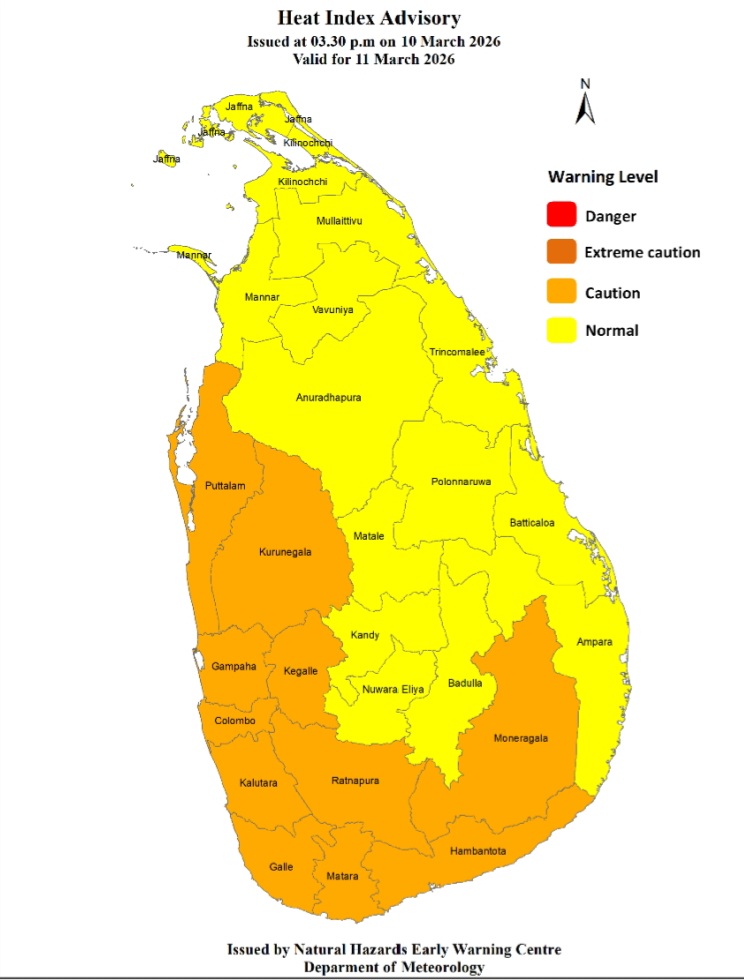
Warm Weather Advisory
Issued by the Natural Hazards Early Warning Centre of the Department of Meteorology at 3.30 p.m. on 10 March 2026, valid for 11 March 2026.
The public are warned that the Heat index, the temperature felt on the human body is likely to increase up to ‘Caution level’ at
some places in the Western, Sabaragamuwa, Southern and North-western provinces and in Monaragala district.
The Heat Index Forecast is calculated by using relative humidity and maximum temperature and this is the condition that is felt on your body. This is not the forecast of maximum temperature. It is generated by the Department of Meteorology for the next day period and prepared by using global numerical weather prediction model data.

Effect of the heat index on human body is mentioned in the above table and it is prepared on the advice of the Ministry of Health and Indigenous Medical Services.
ACTION REQUIRED
Job sites: Stay hydrated and takes breaks in the shade as often as possible.
Indoors: Check up on the elderly and the sick.
Vehicles: Never leave children unattended.
Outdoors: Limit strenuous outdoor activities, find shade and stay hydrated.
Dress: Wear lightweight and white or light-colored clothing.
Note:
In addition, please refer to advisories issued by the Disaster Preparedness & Response Division, Ministry of Health in this regard.
For further clarifications please contact 011-744649

Much of the centre of the German city of Dresden will be evacuated on Wednesday, after the discovery of a large unexploded British World War Two flying bomb.
The 250kg (551lb) device was discovered near the former Carola Bridge, which collapsed in the Elbe River in 2024.
The fire brigade in Dresden says this is the city’s largest evacuation to date for such an incident, affecting around 18,000 residents, tourists and commuters.
Much of the old town will be cordoned off by 09:00 (08:00 GMT), including some of the city’s most famous buildings – the iconic Frauenkirche Lutheran church, the Residenzschloss Palace and the Semper Opera.
The police headquarters, Saxony’s state parliament, several ministries, retirement and nursing homes, daycare centres and other social institutions are also located in the evacuated area.
The authorities are providing emergency accommodation at the Dresden Exhibition Centre from 07:00 (06:00 GMT), while additional buses and trams will be running to this location.
It is not clear how long it will take to defuse the bomb.
Dresden was attacked by British aircraft on 13 February 1945. In the days that followed, the British and their US allies dropped nearly 4,000 tons of bombs in the assault on the city.
The ensuing firestorm killed 25,000 people and ravaged the city centre, once known as the Jewel Box because of its Baroque and Rococo architecture.
Four other bombs were found during demolition work on the Carola Bridge last year.

(BBC)

Australia grants asylum to 2 more members of Iranian women’s football team

Showers are likely in the Northern, Eastern, Sabaragamuwa, Southern and Uva provinces and in Kandy and Nuwara-Eliya districts

CEBEU warns of operational disruptions amid uncertainty over CEB restructuring

Remittances up compared to last year before outbreak of war, but the economic picture is not rosy

The Netherlands alleges Russian Embassy interfering in World Press Photo Exhibition

Switzerland appreciates GoSL’s stand on ME situation

‘Dates have the highest sugar content to fight Coronavirus’

Sunday Island 27 December – Headlines

#SundayIsland 17th December – Headlines

Sunday Island – 28th March

Sunday Island Headlines – 21 March

Sunday Island – 21st February – Headlines
-

 News5 days ago
University of Wolverhampton confirms Ranil was officially invited
-

 News6 days ago
Legal experts decry move to demolish STC dining hall
-

 News5 days ago
Female lawyer given 12 years RI for preparing forged deeds for Borella land
-

 News4 days ago
Peradeniya Uni issues alert over leopards in its premises
-

 News2 days ago
Repatriation of Iranian naval personnel Sri Lanka’s call: Washington
-

 Business7 days ago
Cabinet nod for the removal of Cess tax imposed on imported good
-

 News5 days ago
Library crisis hits Pera university
-

 News4 days ago
Wife raises alarm over Sallay’s detention under PTA