
Foreign News
Investigators find cockpit voice recorder from crashed Air India flight


Investigators have recovered the cockpit voice recorder (CVR) from the crashed Air India flight, a key step in uncovering what caused last week’s deadly accident.
The London-bound Air India aircraft, a Boeing 787-8 Dreamliner, crashed soon after taking off on Thursday from the western Indian city of Ahmedabad. At least 270 people have been killed, most of them passengers.
The CVR captures audio from the cockpit, including pilot conversations, alarms and ambient sounds.
The flight data recorder (FDR), which logs crucial flight parameters like altitude, speed and engine performance, had been recovered from the debris on Friday.
Both the CVR and FDR collectively form what is commonly known as the “black box” of a plane. It is a vital tool in air crash investigations, helping experts reconstruct the flight’s final moments and determine the cause of the incident.
The black box, unlike the name suggests, is actually two bright orange devices – one for the CVR and the other for the FDR – painted with reflective strips for easier recovery after a crash. Both these devices are designed to survive a crash.
India’s Aircraft Accident Investigation Bureau (AAIB) is leading the inquiry into the cause of the crash, helped by teams from the US and the UK.
On Sunday, officials from the US National Transportation Safety Board (NTSB) surveyed the site of the plane crash.
“The AAIB has launched a detailed investigation, and the US National Transportation Safety Board (NTSB) is conducting a parallel probe under international protocols, since the aircraft is American-made,” a statement released on Sunday said.
Indian media outlets have reported, citing sources, that officials from Boeing and the Federal Aviation Administration (FAA) – the US aviation safety agency – also visited the site.
Separately, a high-level committee set up by the Indian government to examine the reasons behind the crash is expected to hold its first meeting on Monday.
The committee will submit a preliminary report within three months, the Air India radio said, and will propose new standard operating procedures (SOPs) to help prevent similar incidents in future.
As the investigation continues, families on the ground are still grappling with disbelief and trauma.
Less than a minute after taking off from Ahmedabad’s Sardar Vallabhbhai Patel International Airport, the AI171 flight crashed into a doctors’ accommodation building at the BJ Medical College and Civil Hospital.
All but one of the 242 passengers and crew members were killed. Officials have also been trying to establish how many people were killed on the ground and continuing the slow process of matching DNA samples to confirm the victims’ identities.
Over the weekend, doctors said 270 bodies had been recovered from the site of the crash.
More than 90 victims have been identified through DNA matching, Dr Rajnish Patel of Ahmedabad’s Civil Hospital said on Monday. He added that 47 of the identified bodies have been sent to their families.
Among the identified victims is Vijay Rupani, the former chief minister of Gujarat, whose funeral will be held on Monday. Rupani, whose political career spanned more than 50 years, will be laid to rest with full state honours in Rajkot city.
For many other families, the agonising wait continues.
Officials told the BBC that the identification process has been slow and painstaking, as many of the bodies were badly burned in the crash and are being processed in small batches.
Mistry Jignesh, waiting outside the hospital for updates on his niece, told the BBC on Saturday that officials told him that it might take longer for them to hand over his niece’s remains as the search for bodies is still ongoing. He had earlier been told that the body would be handed over by Sunday, after the 72 hours it normally takes to complete DNA matching.
“When people are still missing, how can they complete the DNA process by tomorrow? What if my niece’s remains haven’t even been found? The wait is killing us,” he said.
(BBC)

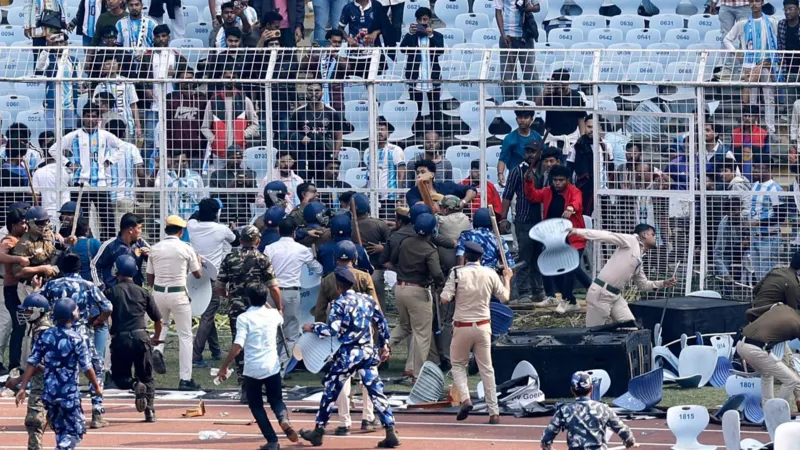
Angry fans attending Lionel Messi’s tour of India ripped up seats and threw items towards the pitch after his appearance at Kolkata’s Salt Lake Stadium.
Thousands of adoring supporters had paid up to 12,000 rupees (£100; $133) to catch a glimpse of the football star, but were left disappointed when he emerged to walk around the pitch and was obscured by a large group of officials and celebrities.
When the Argentina and Inter Miami forward was whisked away early by security after around 20 minutes, elements of the crowd turned hostile.
West Bengal’s chief minister, Mamata Banerjee, said she was “deeply disturbed and shocked” by the events.
Announcing an enquiry, Banerjee apologised to Messi and “sports lovers” for the incident at the stadium.
“The enquiry committee will conduct a detailed enquiry into the incident, fix responsibility, and recommend measures to prevent such occurrences in the future,” the chief minister said on X.
A spokesperson for Messi said that he fulfilled the time commitment that had been agreed in advance. In terms of the organisation of the event itself, he referred the BBC to the apology issued by Banerjee on social media.
A police official told reporters that the event’s “chief organiser” had been arrested, without giving any further details, AFP reports.
Authorities will look into how organisers could refund money to those who bought tickets, the official added.
The All India Football Federation (AIFF) said it was not involved in the “private event”.
Messi is in India for his ‘GOAT [greatest of all time] tour’, a series of promotional events in Kolkata, Hyderabad, Mumbai and Delhi.
His tour began with the unveiling of a 70ft [21m] statue of himself in Kolkata, which had been assembled over the course of 27 days by a 45-strong crew. Messi appeared virtually due to security concerns.
Thousands of fans travelled to the city’s stadium for a chance to see the footballer in person.
They were chanting, buying jerseys and wearing “I love Messi” headbands.
Messi initially walked out at the stadium waving to fans, but after his appearance was abruptly ended on Saturday, some frustrated fans stormed the pitch and vandalised banners and tents, as others hurled plastic chairs and water bottles.
The 2022 World Cup winner – consdered one of football’s greatest ever players – had been expected to play a short exhibition game at the stadium, the AFP news agency reports.
“Only leaders and actors were surrounding Messi… Why did they call us then? We have got a ticket for 12,000 rupees, but we were not even able to see his face,” a fan at the stadium told Indian news agency ANI.
One angry fan told the Press Trust of India news agency people had paid the equivalent of a month’s salary to see the eight-time Ballon d’Or winner.
“I paid Rs 5,000 for the ticket and came with my son to watch Messi, not politicians,” they said.
“The police and military personnel were taking selfies, and the management is to blame.”
Messi was accompanied on his brief visit by his Inter Miami teammate and Uruguay star Luis Suarez, and Argentina’s Rodrigo de Paul.
Bollywood actor Shah Rukh Khan also met Messi earlier in the day, according to the Reuters news agency.

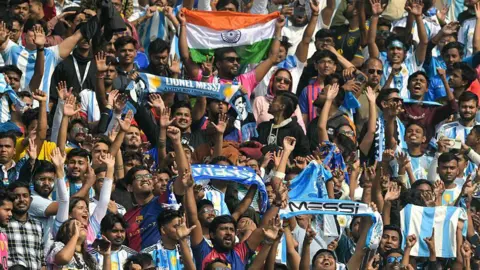
Kolkata is the capital of the Indian state of West Bengal and has a large football fanbase in an otherwise cricket-crazed country.
In the city, it is common to see hundreds of thousands of fans gather at stadiums at a derby of local clubs.
In the early hours of Saturday, thousands lined the roads and congregated outside the hotel where Messi was staying to try and catch a glimpse of him.
Hitesh, a 24-year-old corporate lawyer, flew nearly 1,900 kilometres from the south Indian city of Bengaluru.
“For me it’s personal. You can see I am quite short, and I love to play football with my friends,” Hitesh told the BBC, standing in front of the statue.
“Messi is the player I related with the most, no one can match his talent. He gives me hope that with talent you can do anything.”
[BBC]
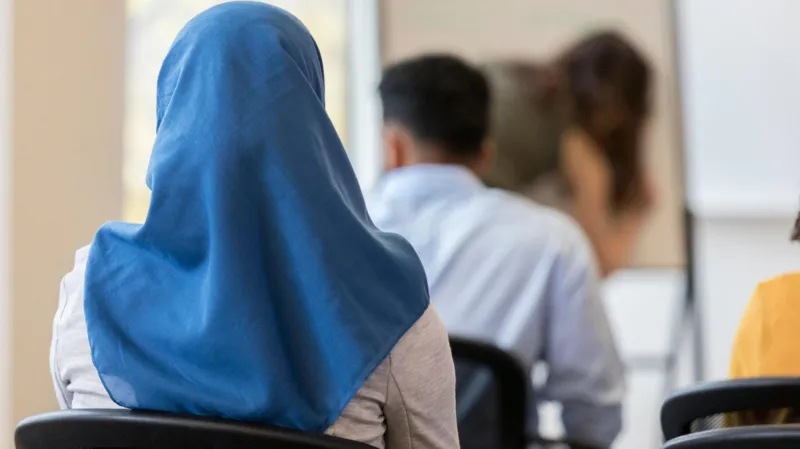
Austria has passed a law banning headscarves in schools for girls under the age of 14.
The conservative-led coalition of three centrist parties, the ÖVP, the SPÖ and the Neos, says the law is a “clear commitment to gender equality”, but critics say it will fuel anti-Muslim feeling in the country and could be unconstitutional.
The measure will apply to girls in both public and private schools.
In 2020, a similar headscarf ban for girls under 10 was struck down by the Constitutional Court, because it specifically targeted Muslims.
The terms of the new law mean girls under 14 will be forbidden from wearing “traditional Muslim” head coverings such as hijabs or burkas.
If a student violates the ban, they must have a series of discussions with school authorities and their legal guardians. If there are repeated violations, the child and youth welfare agency must be notified.
As a last resort, families or guardians could be fined up to €800 (£700).
Members of the government say this is about empowering young girls, arguing it is to protect them “from oppression”.
Speaking ahead of the vote, the parliamentary leader of the liberal Neos party, Yannick Shetty said it was “not a measure against a religion. It is a measure to protect the freedom of girls in this country,” and added that the ban would affect about 12,000 children.
The opposition far-right Freedom Party of Austria, the FPÖ, which voted in favour of the ban, said it did not go far enough.
It described the ban as “a first step”, which should be widened to include all pupils and school staff.
“There needs to be a general ban on headscarves in schools; political Islam has no place here”, the FPÖ’s spokesperson on families Ricarda Berger said.
Sigrid Maurer from the opposition Greens called the new law “clearly unconstitutional”.
The official Islamic Community in Austria, the IGGÖ, said the ban violated fundamental rights and would split society.
In a statement on its website, it said “instead of empowering children, they will be stigmatised and marginalised.”
The IGGÖ said it would review “the constitutionality of the law and take all necessary steps.”
“The Constitutional Court already ruled unequivocally in 2020 that such a ban is unconstitutional, as it specifically targets a religious minority and violates the principle of equality,” the IGGÖ said.
The government says it has tried to avoid that.
“Will it pass muster with the Constitutional Court? I don’t know. We have done our best,” Shetty said.
An awareness-raising trial period will start in February 2026, with the ban fully going into force next September – the beginning of the new school year.
[BBC]
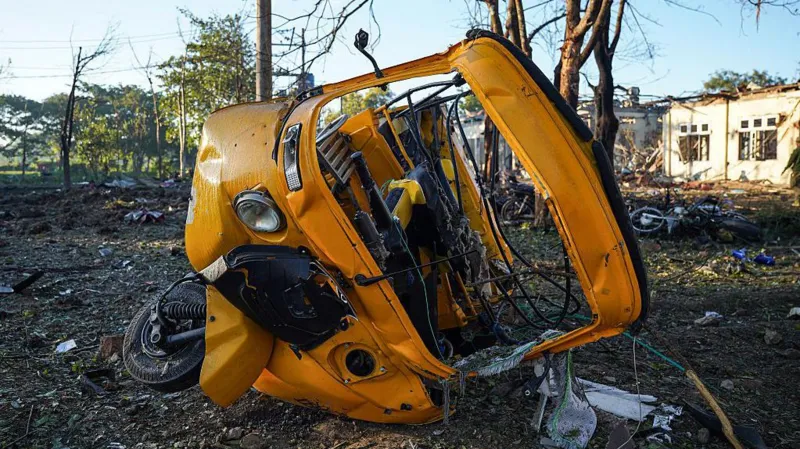
At least 34 people have died and dozens more are injured after air strikes from Myanmar’s military hit a hospital in the country’s west on Wednesday night, according to ground sources.
The hospital is located in Mrauk-U town in Rakhine state, an area controlled by the Arakan Army – one of the strongest ethnic armies fighting the country’s military regime.
Thousands have died and millions have been displaced since the military seized power in a coup in 2021 and triggered a civil war.
In recent months, the military has intensified air strikes to take back territory from ethnic armies. It has also developed paragliders to drop bombs on its enemies.
The Myanmar military has not commented on the strikes, which come as the country prepares to vote later this month in its first election since the coup.
However, pro-military accounts on Telegram claim the strikes this week were not aimed at civilians.
Khaing Thukha, a spokesperson for the Arakan Army, told the BBC that most of the casualties were patients at the hospital.
“This is the latest vicious attack by the terrorist military targeting civilian places,” he said, adding that the military “must take responsibility” for bombing civilians.
The Arakan Army health department said the strike, which occurred at around 21:00 (14:30 GMT), killed 10 patients on the spot and injured many others.
Photos believed to be from the scene have been circulating on social media showing missing roofs across parts of the building complex, broken hospital beds and debris strewn across the ground.
The junta has been locked in a years-long bloody conflict with ethnic militias, at one point losing control of more than half the country.
But recent influx of technology and equipment from China and Russia seems to have helped it turn the tide. The junta has made significant gains through a campaign of airstrikes and heavy bombardment.
Earlier this year, more than 20 people were killed after an army motorised paraglider dropped two bombs on a crowd protesting at a religious festival.
Civil liberties have also shrunk dramatically under the junta. Tens of thousands of political dissidents have been arrested, rights groups estimate.
Myanmar’s junta has called for a general election on 28 December, touting it as a pathway to political stability.
But critics say the election will be neither free nor fair, but will instead offer the junta a guise of legitimacy. Tom Andrews, the United Nations’ human rights expert on Myanmar, has called it a “sham election”.
In recent weeks the junta has arrested civilians accused of disrupting the vote, including one man who authorities said had sent out anti-election messages on Facebook.
The junta also said on Monday that it was looking for 10 activists involved in an anti-election protest.
Ethnic armies and other opposition groups have pledged to boycott the polls.
At least one election candidate in in central Myanmar’s Magway Region was detained by an anti-junta group, the Associated Press reported.
[BBC]

Nine killed in shooting at Australia’s Bondi Beach, police say

Angry fans throw chairs and bottles at Messi event in India

Landslide early warnings in force in the Districts of Badulla, Kandy, Kegalle, Kurunegala, Matale, Nuwara Eliya and Ratnapura

The rights of the fishing community will never be compromised – President

Prioritize rebuilding the livelihoods of disaster-affected communities – President

A few showers may occur in the Northern, North-Central, Eastern, Uva and Central provinces

‘Dates have the highest sugar content to fight Coronavirus’

Sunday Island 27 December – Headlines

#SundayIsland 17th December – Headlines

Sunday Island – 28th March

Sunday Island Headlines – 21 March

Sunday Island – 21st February – Headlines
-
 Features5 days ago
Finally, Mahinda Yapa sets the record straight
-

 News7 days ago
Over 35,000 drug offenders nabbed in 36 days
-
 News6 days ago
Cyclone Ditwah leaves Sri Lanka’s biodiversity in ruins: Top scientist warns of unseen ecological disaster
-

 News7 days ago
Rising water level in Malwathu Oya triggers alert in Thanthirimale
-

 Features5 days ago
Handunnetti and Colonial Shackles of English in Sri Lanka
-
 Business3 days ago
Cabinet approves establishment of two 50 MW wind power stations in Mullikulum, Mannar region
-

 Business7 days ago
Sri Lanka betting its tourism future on cold, hard numbers
-

 News6 days ago
Jetstar to launch Australia’s only low-cost direct flights to Sri Lanka, with fares from just $315^