
Latest News
Australia ahead after Cummins, Rabada and Ngidi dominate pulsating second day


For two hours in the middle of day two, Australia had one hand on the WTC mace after taking a 74-run first-innings lead at Lord’s. For the next two, South Africa did their utmost to prise their fingers from it, and for the one after that, Alex Carey and Mitchell Starc fought them off with a 61-run eighth-wicket partnership. As things stand, Australia still have a few fingers on the mace after a gripping day of Test cricket.
It was, once again, a day for bowlers. Fourteen wickets fell on day two, the same number as the first day, for a total of 28 wickets in six sessions.
Pat Cummins stole the early headlines when he became the first visiting captain to take a five for at Lord’s and then went on to pluck his 300th Tet wicket. Then it was over to Kagiso Rabada and Marco Jansen, who had Australia 44 for 3 before Lungi Ngidi, back in the Test side after ten months and coming off a poor first innings, redeemed himself with three wickets in a nine-over spell that broke Australia open.
Where things stand at the end of the day is that South Africa will already have to pull off the fourth-highest sucessfyl chase at Lord’s, and do it against Australia’s unrelenting attack. That means it’s probably still advantage Australia after a breathless seven-and-half-hours in a final that has hit fast-forward.
South Africa resumed the day on 43 for 4, 169 runs behind Australia’s 212, and on a go-slow. Temba Bavuma had laboured his way to 3 off 37 overnight as South Africa’s innings ground yo a halt. but he showed more initiative on the second morning. He struck two glorious lofted drives in Mitchell Starc’s second over of the day and looked to be finding his touch. Bavuma was on 17 before he was given out lbw off a Josh Hazlewood delivery that nipped in and struck his back pad, and he reluctantly reviewed. To everyone’s disbelief including Bavuma’s, Snicko showed an inside-edge. Bavuma went on to drive Hazlewood and Starc over the covers and pull Cummins into the stands for six in what looked like an increasingly authoritative stay at the crease.
His partnership with David Bedingham grew to 64 and it took a moment of magic in the field to separate them. Bavuma drove Cummins in the air and to the right of Marnus Labuschagne, who dived full length at cover and pouched it with both hands.
Bavuma’s dismissal sent South Africa back into their shell. Bedingham and Kyle Verreynne scored 17 nervy runs in the next 52 balls and both looked vulnerable: Bedingham was drawn into a false stroke by Hazlewood and Verreynne was on 1 when he edged Beau Webster just short of Smith at second slip. But the moment of controversy came when Bedingham edged Webster onto the flap of his pad. Alex Carey moved towards him in an attempt to take a catch and the ball bobbled into and then out of Bedingham’s pad flap. At that moment, Bedingham reached for the ball and dropped it close to his foot. Usman Khawaja and Steven Smith began appealing for obstructing the field, and there was some excitement before it was decided the ball was dead. Bedingham responded by hitting the next ball, a half-volley, for four and South Africa went to lunch on 121 for 5, 91 runs behind.
More drama ensued after the break when Cummins hit Verreynne on the pad as he shuffled across, and the ball deflected to fine leg. Verreynne attempted a run, Cummins turned to appeal, and the pair collided, by which point a throw had come in and there was also the chance of a run-out. Cummins asked for a review on the lbw and replays suggested the ball would have gone on to hit leg stump. Three balls later, Jansen handed Cummins a simple return catch, and at 126 for 7, South Africa were in disarray.
Cummins completed his five-for when he had Bedingham caught behind off a thin edge three overs later and then got his 300th when Rabada nailed a pull to Webster at deep square. Cummins finished with 6 for 28 in a final analysis that included six maiden overs out of 18.1 and barely a bad ball. Crucially, he gave Australia an important lead that could still have a decisive say on this game.
The same could be said of South Africa’s collapse. They lost 5 for 12 in 35 balls; Australia had lost 5 for 20 at around the same time on day one.
South Africa came out looking flat as Labuschagne took Rabada’s opening over for seven. Rabada and Jansen bowled three no-balls in the first four overs, but started to find their rhythm when Rabada hit Labuschagne on the pad in his third over and then induced an outside edge.
In the next over, Jansen thought he had Khawaja caught behind and Bavuma burned a review to see daylight between bat and ball. It took until the 11th over for things to start happening for South Africa. For the second time in the match, Rabada struck twice in an over, against the same two batters. Khawaja was caught behind poking outside off and Cameron Green edged to third slip. Smith sought to restore order with a straight drive that went for four. Australia went to tea on 32 for 2, 106 ahead.
As was the case on day one, the evening session could only be described with one word: mayhem. Jansen bowled a marathon spell either side of the break and was into his eighth over when he offered Labuschagne a full one that was just short of driving length, and he nicked off.
Khawaja, Labuschagne and Green had collectively scored 49 runs in this match, the worst return by an Australian top three since 1890.
Then came Ngidi. After three unspectacular overs post-tea, he went fullish and straight. Smith missed and was hit on the back pad and Bavuma was convinced to review again and was successful this time. Ngidi then hit Webster on the back pad with a ball that tailed in and the No. 6 reviewed unsuccessfully. In the next over, Wiaan Mulder beat Travis Head’s inside-edge and the ball ricocheted off his pads onto the stumps, and then came the delivery of the evening: Ngidi’s yorker to Cummins. It thudded into middle and off and Australia were 73 for 7.
But just as South Africa may have started to sniff something special, their momentum drained away. Carey and Starc put on 61 for the eighth wicket at a good clip – 4.31 runs an over – before Rabada had one last word on the day. He got the ball to move back into Carey from around the wicket and had him out lbw in an over peppered with no-balls. All told, Rabada bowled five on the day and six in the match and South Africa have overstepped 19 times.
They’ll worry about that as much as what could have been in the final over when Jansen dropped Starc at gully, off Mulder, off the third-last ball of the day. By then, South Africa had moved the fielders behind the bat closer in, as several balls had dropped short, and Jansen’s attempts to juggle were not as successful as they had been on the first day. Australia go into the third day with a lead of 218 runs and two wickets in hand.
Brief scores:
Australia 212 in 56.4 overs and 144 for 8 in 40 overs (Marnus Labuschagne 22, Alex Carey 43; Lungi Ngidi 3-35, Kagiso Rabada 3-44) lead South Africa 138 in 57.1 overs (David Bedingham 45, Temba Bavuma 3; , Pat Cummins 6-28, Mitchell Starc 2-41) by 218 runs
[Cricinfo]

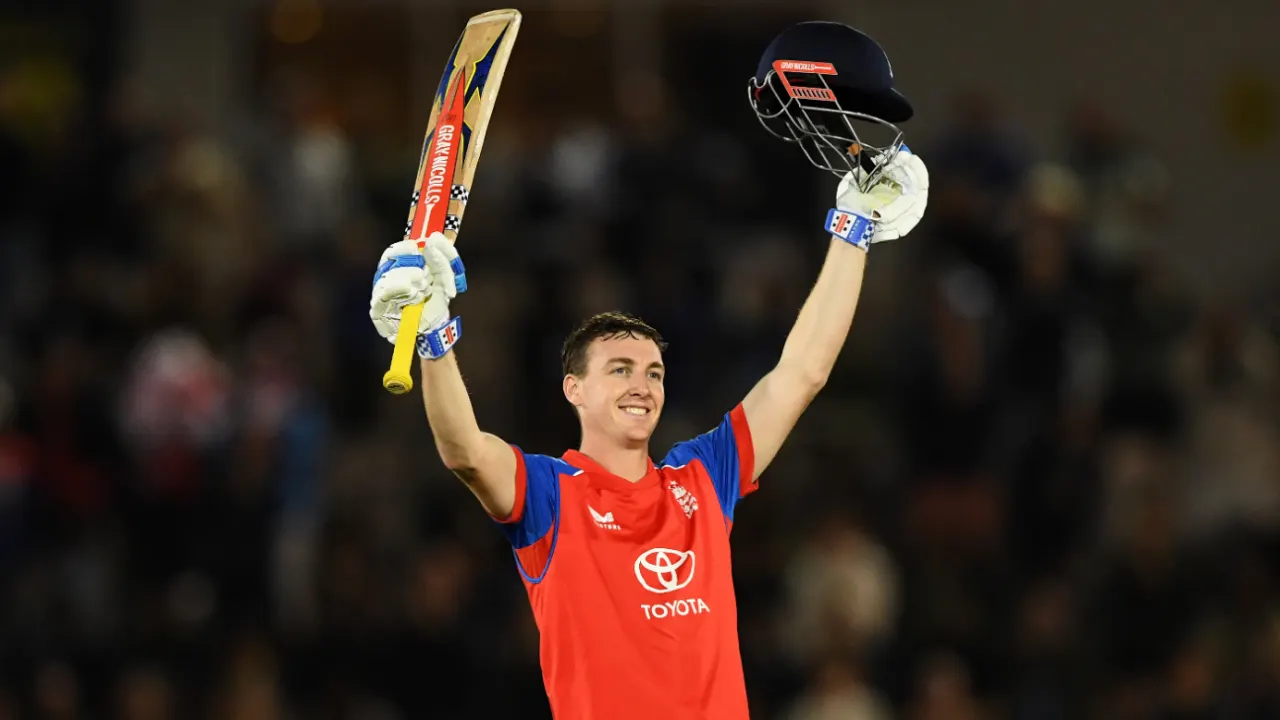
Harry Brook led from the front with his second and fastest T20I century as England sent Sri Lanka swirling down the Utilita Bowl with victory by 119 runs in the first T20I.
The limited-overs skipper’s 42-ball effort – quicker than every Englishman bar Phil Salt’s 39 baller almost a year ago to the day against South Africa – took England to 254 for 4, compelling former Test captain Ben Stokes to wax lyrical on social media.
Stokes’ post sounded as confused as Sri Lanka’s bowling plans. But the underlying sentiment was that Brook’s unbeaten 114 showed he possesses more genius than Kevin Pietersen.
It is a sketchy claim. But perhaps tonight, England’s new mentor will happily cede to the 27-year old after his third white-ball century of the year, and second in T20Is after his maiden effort against Pakistan at the T20 World Cup. In reply, Sri Lanka mustered just 21 more than Brook’s new career-best between them, bowled out for 135 with an over to spare.
England’s first innings fell three runs short of the total they made in their last T20I against India on this very ground. The similarities between this evening and that July afternoon included the opposition skipper – on this occasion, Charith Asalanka – inserting England after winning the toss.
Shreyas Iyer had made that mistake two months earlier, and likewise, he was also made to pay by Brook and Jos Buttler, who this time had to settle for 80 from 44 deliveries, rather than consecutive hundreds.
Captain and former captain combined in a stand of 128 from 60 deliveries, the first part of which included England’s second-highest powerplay of 90 for 1. That was kicked off by a breezy 12 from 5 for debutant Aneurin Donald, who became the first Glamorgan product to feature for England since Simon Jones in 2005.
Things were getting away from Sri Lanka as early as the fifth over when Dunith Wellalage was taken for 30 by Brook. And when Buttler was dropped on 45 three overs later, by Eshan Malinga – over-running a sliced heave down the ground at long off – it was clear, not even a quarter of the way through, that this match was only going one way.
England’s superior power and fitness was never going to be matched. More impressive than their total of 19 fours and 12 sixes were the number of twos. Brook did most of the running; nine of his own along with 12 for his three partners.
Sri Lanka’s chase began with a maiden, bowled by Sonny Baker who went on to take 3 for 12. After struggling on debut across all three formats – including a Test bow earlier this summer against New Zealand – the 23-year old polished his overall numbers with his first limited-overs dismissals at his home ground.
The Hampshire quick got off the mark with a 90mph rasper that beat opener Kamil Mishara, before adding Lahiru Udara four deliveries later when the right-hander’s attempted scoop found Adil Rashid at short backward square. A return from the Pavilion End then saw a 92mph delivery nip away and knock back Theekshana’s off stump.
All six of England’s bowlers registered in the wicket column, feasting on a line-up that – barring Wellalage’s 33 from 21 at No.8 – were all utterly woeful.
In Aneurin Donald, England may well have their answer to Vaibhav Sooryavanshi when it comes to monster strike-rates. Perhaps the quirkiest aspect about that is Donald, as the follower, is technically old enough to be Sooryavanshi’s father.
The 14-year age gap speaks to a difference of cultural attitudes towards the game, particularly in the T20 format: more venerated in India, reluctantly accepted over here. At the age of 29, Donald is England’s oldest T20I debutant in nine years, and was playing his first international match after 112 regular T20s.
With Phil Salt out injured, Donald had big boots to fill, but Brendon McCullum believed he had found the right understudy when watching Donald carve a remarkable 31 from eight deliveries for England Lions at Chelmsford in Sri Lanka’s first warm-up.
The man who capped his assault then – Wellalage – did so here for a more contained 12 off 5. Donald, though, had done his job in his first four balls, closing the the first over of the match by smashing Maheesh Theekshana’s offspin over the midwicket fence, then through cover, and setting England on course for a mammoth score.
The Utilita Bowl is the most criticised of England’s international venues, and it has come under greater scrutiny with the “hows” and “whys” of its allocation of an Ashes Test next year at the expense of Headingley (or anywhere else north of Nottingham).
It is not the easiest ground to get to. And visiting players note how quickly it has aged since opening in 2001. But if there is anyone who will espouse its virtues, it is Buttler.
Following his 131 against India, Buttler now has 211 runs across his last two T20I innings, both in Southampton. By comparison, he had managed a grand total of 212 runs across his first 14 innings in the format at the start of the year.
That run included a torturous T20 World Cup campaign, the kind that made many wonder if we were in the end days for one of English cricket’s most gifted batters.
This time, Buttler was closed to his devastating best. The four boundaries off Dushmantha Chameera to end the second over – the usual stride-and-thwacks over the bowlers’ heads and the trademark wristy, top-spin carve through cover off wide yorkers – were all very familiar.
Buttler turned 36 this time last week. But, as the team around him continues to push the envelope, the chance to focus on his own game, at his own pace – which today meant bringing up 50 from 29 deliveries as the anchor! – should ensure he and England get the most out of what time he has left.
Sri Lanka lacking Plan B
Everyone’s got a plan until they get Brook-ed and Buttler-ed in the face. And unfortunately for Sri Lanka, the plan thumped out of them was leaning on Theekshana to close out a chaotic innings
Few bowlers, let alone slow ones, take as much pride as Theekshana in their thankless tasks in the powerplay and at the death. But after Donald got hold of his first over, and then Buttler found 13 from his second, Asalanka seemingly forgot about the 26-year-old.
You could understand why the stand-in captain would look beyond someone conceding 13.5 an over. The problem, however, was his attempt to make up the difference proved more expensive. Wellalage’s last over (the 14th) went for 16, and Dasun Shanaka’s (17th) 19.
Wellalage looked particularly wayward, his slowness through the air – whether deliberate or not – left him exposed on an ugly surface that skidded rather than gripped. His economy rate of 17 from three overs was comfortably the worst of his career.
Scores:
England 254 for 4 in 20 overs (Jos Buttler 80, Aneurin Donald 12, Harry Brook 114*, Tom Banton 10, Will Jacks 21; Dushmantha Chameera 1-53, Dunith Wellalage 1-51, Eshan Malinga 1-41, Wanidu Hasaranga 1-34) beat Sri Lanka 135 in 19 overs (Pathum Nissanka 12, Kamil Mishara 10, Charith Asalanka 10, Dasun Shanaka 24, Dunith Wellalage 33, Eshan Malinga 13*; Sonny Baker 3-12, Josh Tongue 1-25, Will Jacks 1-21, Liam Dawson 2-23, Adil Rashid 1-31, Jamie Overton 2-20) by 119 runs
[Cricinfo]
Latest News
Cabinet approves aditional Rs. 2,500 million to the Paddy Marketing Board to purchase 2026 Yala harvest

The Cabinet of Ministers has approved the resolution furnished by the Minister of Agriculture, Livestock, Land and Irrigation to provide an additional Rs. 2,500 million to the Paddy Marketing Board on a reimbursable basis from the Rs. 7,500 million additional allocations granted to the Ministry to implement
the expedited paddy purchasing program for the 2026 Yala harvest.
Latest News
Cabinet nod to host the 8th Asian Regional Conference of the Commonwealth Parliamentary Association and the 3rd Joint Asian and South-East Asian Regional Conference of the Commonwealth Parliamentary Association
The 8th Asian Regional Conference of the Commonwealth Parliamentary Association (CPA) and the 3rd Joint Asian and South-East Asian Regional Conference of the CPA are planned to be held over three days in Colombo during April/May 2027.
Approximately 90 delegates including speakers, Deputy Speakers, Member of Parliamentarians, and Parliamentary officers representing member countries of the Commonwealth Parliamentary Association, in the Asian and South-East Asian regions, are expected to participate in these conferences.
The Cabinet of Ministers has approved the resolution furnished by the Prime Minister of the Parliament of Sri Lanka to host the said conferences considering the opportunities to strengthen parliamentary diplomacy and regional cooperation, as well as to enhance international recognition of the Parliament of Sri Lanka within the Commonwealth Parliamentary Association.

Showers about 75 mm are likely at some places in the Western, Sabaragamuwa, Central and Southern provinces

Brook, Buttler, Baker star as Sri Lanka slump to 119-run rout

Where is Gnanasara Thera?Police pass buck to court

Russian citizens in Lanka to vote in State Duma elections

Euro 110,000 research drive to tackle plastic waste in food sector

New SAU-RCSS pact to boost South Asian dialogue

‘Dates have the highest sugar content to fight Coronavirus’

Sunday Island 27 December – Headlines

#SundayIsland 17th December – Headlines

Sunday Island – 28th March

Sunday Island Headlines – 21 March

Sunday Island – 21st February – Headlines
-

 Sports5 days ago
DDS set to lose Test captaincy
-

 News5 days ago
Sri Lanka faces new grid challenge as rooftop solar surges: former CEB GM
-

 Latest News5 days ago
Shafali, Deepti power India into sixth T20 Asia Cup final
-

 Latest News4 days ago
Sri Lanka thwart Fatima Sana challenge to secure Asia Cup final spot
-

 News3 days ago
Gnanasara Thero absconding after SC ruling
-

 Features6 days ago
Lost for 90 years: Rare Goby resurfaces in Jaffna
-

 News4 days ago
Ammunition cache found in old Kandy bungalow
-

 Latest News6 days ago
Italian Naval Vessel ‘ITS Giuseppe Garibaldi’ arrives in Colombo