
Latest News
Shanto banks on Bangladesh’s away form, squad flexibility for fresh WTC campaign

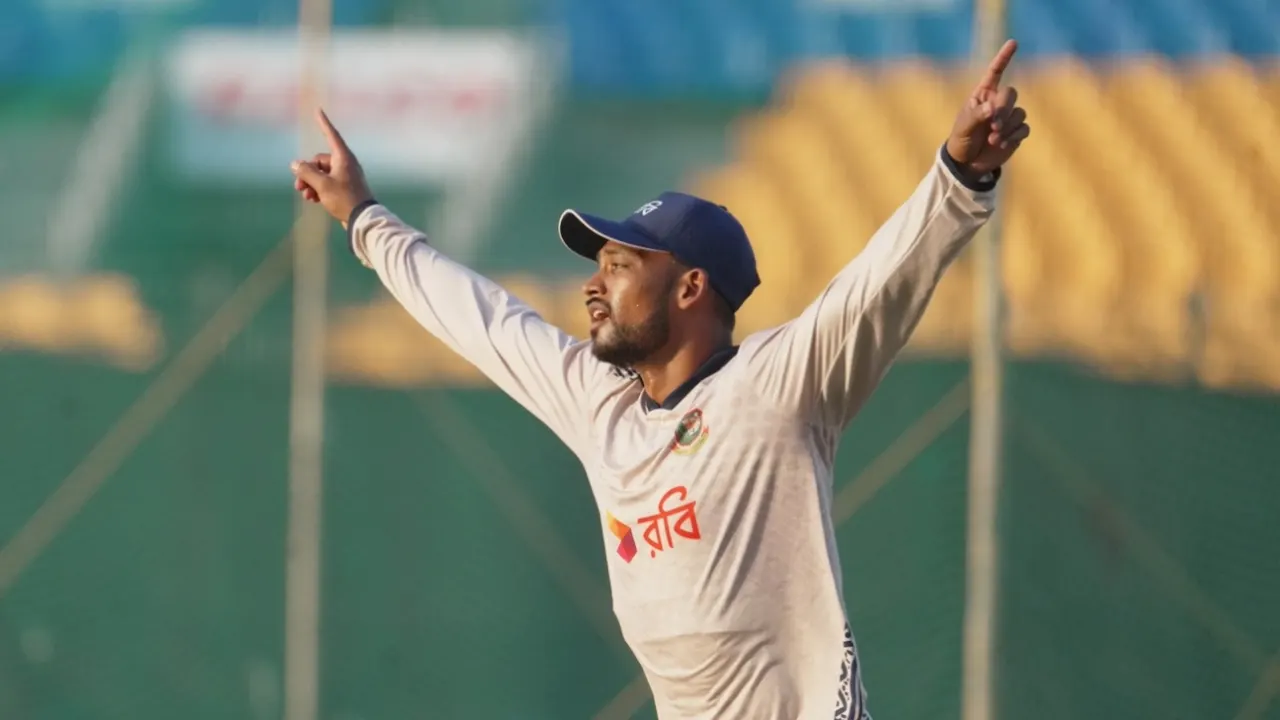
Bangladesh captain Najmul Hossain Shanto is tight-lipped about his batting position even as curiosity is growing around their opening combination for the upcoming Test series against Sri Lanka. Shanto opened in the two-day practice match in Dhaka prior to their departure for the two-match Test series, fueling speculation that he could do the same in the Galle Test from June 17. Shanto said that they will reveal their combination at the match, which will also kick off the World Test Championship’s fourth cycle.
In the previous WTC cycle, however, Bangladesh’s openers struggled to put up runs. They have largely rotated between Shadam Islam, Zakir Hasan and Mahmudul Hasan Joy, but the trio averaged second-lowest among teams in the WTC’s 2023-25 cycle. Shadman recovered somewhat with a century against Zimbabwe in April. He also added a century stand with Anamul Haque, their first in two years in the opening partnership. Joy and Zakir have now been dropped from the Bangladesh side.
Shanto has opened in six innings for Bangladesh, falling for a duck in his last outing in the position against Ireland two years ago. He has just one half-century, while averaging 18.83 as an opener. Given his own drought of runs – Shanto has scored just two fifties in his last 20 innings – it is a big call for the captain to resurrect the top order.
“I am happy with the Test squad,” Shanto said. “I got the players that I wanted. Regarding the lack of opening options, you will get an idea what we are thinking once we get into the first Test. You will understand the combination. We also have four fast bowlers and four spinners, so we have tried to balance the bowling attack too. We can go with different combinations. I am prepared to bat in any position. We have other top-order batters so we have options.”
Shanto said that the lack of runs from the openers cost Bangladesh dearly in the 2023-25 WTC cycle, but Bangladesh’s middle order did not contribute regularly either. Mehidy Hasan Miraz was their top run-getter, but he mostly bats at No 7. Their bowling unit, though, offers variety. Taijul Islam and Mehidy are his main spin-bowling choices, although Naveem Hasan has been a capable understudy, while uncapped left-arm spinner Hasan Murad comes with a good first-class record.
“The first Test is in Galle where the ball spins,” Shanto said. “They can also have a good batting track there, so we are preparing ourselves accordingly. We saw that the ball spun a bit in their Tests against Australia (earlier this year). Murad is a performer in first-class cricket in the last few seasons. I think Murad is prepared to step up to the role if we need a second left-arm spinner in the XI. We will decide on it looking at the conditions. He is mentally ready for the opportunity.”
Bangladesh have also welcomed back fast bowler Edabot Hossain who hasn’t played international cricket for two years due to an ACL tear. He returned to domestic cricket in the 2024-25 season and looked in good form in this week’s two-day practice match too, bowling Mushfiqur Rahim among his wickets.
“I think we have missed Ebadot for a long time. I think he got injured at the peak of his form at the time,” Shanto said. “We fell into a hard time despite having other bowlers around. I am happy to see him coming back into the squad. It is an additional strength for the team. He bowled well in the practice match. He looks fit, so he has to stay fit to contribute to the team.”
Shanto also said Bangladesh want to improve from their seventh place finish in the 2023-25 cycle, in which they won four Tests out of 12. He said they will have the confidence of doing well overseas as they registered three of those four wins in Pakistan and the West Indies last year.
“I think if we can raise our winning percentage to 55 or 60%, I will be happy as a captain. We are a more confident unit after winning four Tests in the last WTC cycle. We need that extra confidence against Sri Lanka who are a strong team. If we can play up to our capability, we can start well in this cycle,” he said. “We didn’t do well against Zimbabwe. We should have won that series. We have to do very well in this new cycle. We will be playing against strong sides in the 12 Tests in the 2025-27 cycle. We have to go through a lot of challenges. I think if we work hard together, we can get a better result.”
Shanto also felt that being given the Test captaincy for another year will help him plan better. He was appointed captain of all three formats in May 2024 but quit the T20I captaincy in January this year. Shanto wanted to give more time to his batting which led him to the decision, but he was happy to lead in the other formats.
“I informed the BCB that I didn’t want to continue the captaincy in T20Is. I wanted to give my batting a bit more time. We have a lot of T20s, so it was becoming hard to give my batting some time,” he said. “A longer term is always helpful for the captain. I got it previously and now I got the captaincy for another year. Planning becomes easy if a captain is appointed with a World Cup or a WTC cycle in mind. I am happy with my conversation with the cricket board. They are also on the same page about giving a captain a longer rope.
Bangladesh will be off to Sri Lanka on Friday, four days before the start of the first Test. The second Test is in Colombo from June 25, followed by three ODIs and as many T20Is, with the tour concluding on July 16 in Colombo.

Latest News
Cabinet approves aditional Rs. 2,500 million to the Paddy Marketing Board to purchase 2026 Yala harvest
The Cabinet of Ministers has approved the resolution furnished by the Minister of Agriculture, Livestock, Land and Irrigation to provide an additional Rs. 2,500 million to the Paddy Marketing Board on a reimbursable basis from the Rs. 7,500 million additional allocations granted to the Ministry to implement
the expedited paddy purchasing program for the 2026 Yala harvest.
Latest News
Cabinet nod to host the 8th Asian Regional Conference of the Commonwealth Parliamentary Association and the 3rd Joint Asian and South-East Asian Regional Conference of the Commonwealth Parliamentary Association
The 8th Asian Regional Conference of the Commonwealth Parliamentary Association (CPA) and the 3rd Joint Asian and South-East Asian Regional Conference of the CPA are planned to be held over three days in Colombo during April/May 2027.
Approximately 90 delegates including speakers, Deputy Speakers, Member of Parliamentarians, and Parliamentary officers representing member countries of the Commonwealth Parliamentary Association, in the Asian and South-East Asian regions, are expected to participate in these conferences.
The Cabinet of Ministers has approved the resolution furnished by the Prime Minister of the Parliament of Sri Lanka to host the said conferences considering the opportunities to strengthen parliamentary diplomacy and regional cooperation, as well as to enhance international recognition of the Parliament of Sri Lanka within the Commonwealth Parliamentary Association.
Latest News
SAARC Training Workshop on Financial Modeling for Renewable Energy Projects from 5th to 7th October in Colombo
The Energy Centre of the South Asian Association for Regional Cooperation (SAARC) has planned to conduct a training workshop under the theme ‘Financial Modelling for Renewable Energy Projects’ in Colombo from 2026-10-05 to 2026-10-07.
It is expected that two persons from each member country,
including Sri Lanka, will participate in this workshop. The Energy Centre of the South Asian Association for Regional Cooperation (SAARC) will provide all local hospitality facilities and transport, excluding airfare.
Taking into consideration the resolution furnished by the Minister of Energy regarding this workshop, which is vitally important for the capacity building of public officers and other related parties regarding project evaluation and financial modeling in the renewable energy sector, the Cabinet of
Ministers has decided to grant its consent to hold this workshop and extend Sri Lanka’s hospitality for this event.

Draft of the Appropriation Bill for the Financial Year 2027 su mitted to the Parliament
Cabinet approves aditional Rs. 2,500 million to the Paddy Marketing Board to purchase 2026 Yala harvest
Cabinet nod to host the 8th Asian Regional Conference of the Commonwealth Parliamentary Association and the 3rd Joint Asian and South-East Asian Regional Conference of the Commonwealth Parliamentary Association

SAARC Training Workshop on Financial Modeling for Renewable Energy Projects from 5th to 7th October in Colombo
National Children’s Week from 25th September to 01st October

Nairobi and Munich to host 2029 and 2031 World Athletics Championships

‘Dates have the highest sugar content to fight Coronavirus’

Sunday Island 27 December – Headlines

#SundayIsland 17th December – Headlines

Sunday Island – 28th March

Sunday Island Headlines – 21 March

Sunday Island – 21st February – Headlines
-

 Sports5 days ago
DDS set to lose Test captaincy
-

 News5 days ago
Sri Lanka faces new grid challenge as rooftop solar surges: former CEB GM
-

 Latest News5 days ago
Shafali, Deepti power India into sixth T20 Asia Cup final
-

 Opinion7 days ago
Navigating Sri Lanka’s Israeli Dilemma
-

 Latest News4 days ago
Sri Lanka thwart Fatima Sana challenge to secure Asia Cup final spot
-

 News3 days ago
Gnanasara Thero absconding after SC ruling
-

 Features6 days ago
Lost for 90 years: Rare Goby resurfaces in Jaffna
-

 News4 days ago
Ammunition cache found in old Kandy bungalow