
News
Proprietary Planters Alliance is catalyst Lanka’s plantation sector urgently needs


In the lush hills and tropical lowlands of Sri Lanka, a quiet revolution is stirring—one that seeks not just to revive but to radically transform the plantation sector. The Proprietary Planters Alliance (PPA) has emerged as a game-changing force with a clear mission: to give voice, vision, and viability to proprietary planters—Sri Lanka’s underrepresented yet vital stakeholders in agriculture.
At a time when global markets demand traceability, value-chain efficiency, environmental stewardship, and ethical labour practices, the plantation sector remains burdened by archaic structures and fragmented representation. This is the void the PPA is built to fill. With this intention in mind, PPA inaugurated its operations on 01st June 2025 at a simple ceremony held at the Orient Club – Colombo. The Office Bearers appointed are: Founder -Dammika Kobbekaduwa, Chairperson- Dr. Janaki Kuruppu, Directors- Dr. Dilhan Sampath Jayatilleke, Upananda Karunaratne, Dr. R A D Kumarawickrama, Dr. W G Somaratne, Rehan Jayathilake, S M P Jayantha, Arjun Dharmadasa, Dr. Nadaraja Rejendran, amd Dyan Seneviratne.
The Gap: A Fragmented Sector Without a Unified Voice
For decades, proprietary planters—those who own and operate small to mid-sized tea, rubber, coconut, spice, and fruit estates—have lacked a centralized platform to lobby for policy, access finance, and leverage innovations. Unlike corporate plantations, these planters rarely benefit from R&D, climate adaptation schemes, digital agri-tools, or direct trade exposure.
Meanwhile, national goals like doubling the GDP to $160 billion and making Sri Lanka a smart agricultural hub are simply unattainable without tapping into the true potential of these grassroots actors.
PPA bridges this divide by acting as:
A policy think-tank
A technical innovation platform
A channel for climate finance and ESG compliance
A collaborative hub for agri-tourism, value addition, and sustainable exports
Vision, Mission, and Purpose
Vision:
To create a resilient, sustainable, and globally competitive proprietary plantation sector in Sri Lanka that leads in innovation, value addition, and ethical agricultural practices.
Mission:
To empower proprietary planters through unified representation, advanced agronomy, policy advocacy, climate-smart innovations, and integrated value-chain management—enabling prosperity from plot to port.
Strategic Goals:
1. Policy Reform: Influence national agricultural, trade, and labour policy to favour modern proprietary estate models.
2. Value Chain Integration: Promote vertically integrated models from cultivation to retail, including tea-based wellness products and processed spices.
3. Innovation & Digitalization: Provide members access to precision agriculture, remote sensing, and AI-driven analytics.
4. Climate Resilience & ESG: Implement globally aligned climate-smart practices and position members for green financing.
5. Market Access: Enable direct links with exporters, supermarkets, and buyers for improved farm-gate pricing.
6. Capacity Building: Facilitate continuous training, certification, and professional development.
7. Youth & Gender Equity: Encourage new generations and women to become plantation entrepreneurs.
The Colombo Declaration: A Defining Milestone
On June 1st, 2025, the PPA took a bold step forward by ratifying the Colombo Declaration at the Orient Club, Colombo 07—a formal charter of unity, purpose, and transformation for Sri Lanka’s proprietary plantation community. This Declaration is not just a ceremonial pledge; it is the institutional backbone of a national movement toward a climate-smart, value chain-driven, and people-first plantation model.
The Declaration reinforces key commitments including ESG-driven agriculture, HRM-centered workforce transformation, policy engagement, and access to global green finance. By aligning proprietary planters around these shared objectives, the Colombo Declaration directly contributes to closing the productivity and market access gaps that have historically limited the sector’s GDP contribution.
In essence, the Colombo Declaration positions PPA as a strategic national instrument to unlock the latent economic value in Sri Lanka’s plantation economy—potentially adding billions to the country’s agri-GDP through inclusive, sustainable growth.
Why Every Proprietary Planter Must Join
1. Power in Numbers:
Alone, a planter is a commodity producer. As a member of PPA, you become part of a national movement with lobbying power, donor engagement, and export linkages.
2. Tools of the Future:
Access the latest in satellite crop monitoring, regenerative soil tech, and climate insurance models.
3. Policy Access:
Be at the decision-making table—on issues ranging from subsidy allocation to land reform and smart agri-investments.
4. Climate & ESG Compliance:
Get certified, get recognized, and get financed. PPA’s alignment with global standards allows members to qualify for carbon credits, green loans, and sustainability-linked certifications.
5. Shared Prosperity:
PPA offers a space for collaboration—not competition—among fellow planters, innovators, and financiers.
A Tropical Model for the Global South
While rooted in Sri Lanka, PPA offers a scalable model for tropical countries across Asia, Africa, and Latin America—regions with similar plantation legacies and rural enterprise structures. Whether it’s nutmeg in Kerala, coffee in Ethiopia, or cacao in Ecuador, the proprietary planter model remains a potent but under-leveraged development tool.
Final Word: From Marginal to Mainstream
The time for waiting is over. Whether you’re a third-generation tea grower in Kandy, a cinnamon cultivator in Matara, or a fruit planter in Monaragala, the PPA is your passport to relevance, resilience, and returns. Don’t let another season pass by under outdated systems. Stand up, sign up, and scale up.
Because the future of plantations is proprietary.
Optional Technical Appendix
Colombo Declaration KPIs:
Net income per hectare (? by 20–30%)
Youth participation in plantation ownership (? by 50% in 3 years)
% of estates adopting traceability tools
% of members accessing green finance or ESG-linked investment
Macro Impact to GDP:
If even 30% of Sri Lanka’s 200,000+ proprietary holdings align with PPA’s Colombo Declaration framework, it could conservatively add LKR 300–500 billion annually in value-added export earnings and Agri-tourism—boosting national GDP by over 1.5 percentage points within five years.
By Dr Dilhan Sampath Jayatilleke – Director : Brand, Communications & Stakeholder Development – PPA ✍️


By PRIYAN DE SILVA
The government’s position on the abolition of the Executive Presidency and the future of the Provincial Council system will be set out in a new Constitution, NPP General Secretary Dr. Nihal Abeysinghe has said.
Abeysinghe made the remarks when a delegation from the Campaign for Free and Fair Elections (CaFFE) met him at the NPP headquarters in Pelawatte on Friday evening. Former NPP General Secretary and MP Laxman Nipunarachchi also participated in the discussion.
Dr. Abeysinghe said the JVP, the main constituent of the NPP, had consistently advocated the abolition of the Executive Presidency and that it was also a key pledge in the NPP election manifesto.
Responding to calls for the Provincial Council elections to be held under the existing electoral system, Nipunarachchi said the system was being changed to introduce the new electoral system.
He stressed that conducting the elections under the old system was therefore not acceptable.
CaFFE Executive Director Manas Makeen suggested that the Election Commission should be vested with adequate financial authority to ensure that elections are held on time.
Dr. Abeysinghe also requested CaFFE and other stakeholders to submit any proposals for constitutional amendments for consideration.
The NPP made the abolition of Sri Lanka’s executive presidency and the adoption of a new Constitution a central constitutional pledge in its 2024 presidential election manifesto, A Thriving Nation, A Beautiful Life. It promised to draft and enact a new Constitution after public discussion and a referendum, abolish the executive presidency and replace it with a president without executive powers elected by Parliament, while introducing a new parliamentary electoral system.
However, in June 2026, Public Administration Minister Chandana Abayaratne was quoted by the media as having said that although this remained an electoral promise, the Government did not regard it as a priority at that point, saying other constitutional and electoral reforms were being considered first.
The Opposition has accused the goverment of trying to retain the executive presidency by delaying the constitution making project.

By Chaminda Silva
The National Building Research Institute (NBRI) has issued a Level 3 (Red) landslide early warning for several areas in the Kandy, Kegalle and Nuwara Eliya districts amidst continuing heavy rainfall.
The warning, issued at 2 p.m. yesterday (20), will remain in effect until 2 p.m. today (21).
In Kandy District, the red alert covers the Pasbage Korale Divisional Secretariat Division and surrounding areas.
In Kegalle District, red-level warnings have been issued for the Dehiowita, Aranayake, Deraniyagala, Mawanella and Yatiyanthota Divisional Secretariat divisions and surrounding areas.
In Nuwara Eliya District, the warning covers the Kothmale West, Kothmale East, Ambagamuwa and Norwood Divisional Secretariat divisions and surrounding areas.
Meanwhile, a Level 2 (Amber) landslide warning remains in effect for selected areas of Colombo, Galle, Kalutara, Kandy, Kegalle, Matara, Nuwara Eliya and Ratnapura districts.
The affected areas include Padukka; Nagoda, Thawalama and Neluwa; Bulathsinhala, Palindanuwara, Walallawita and Agalawatta; Ganga Ihala Korale; Bulathkohupitiya and Kegalle; Akuressa and Pitabeddara; Thalawakele; and several Divisional Secretariat divisions in Ratnapura District, including Pelmadulla, Ratnapura, Ayagama and Kuruwita.
Residents in the affected areas have been urged to remain vigilant for signs of landslides and follow instructions issued by local authorities, particularly during periods of heavy rainfall.
By SK Samaranayake
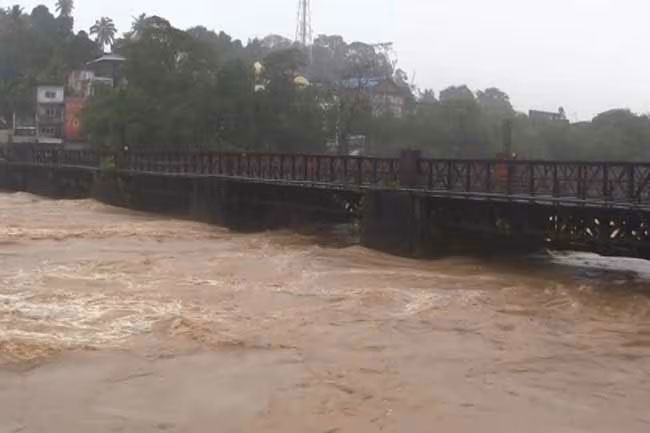
Heavy rainfall across the Central Highlands has triggered flood and landslide warnings, with the Mahaweli Ganga reaching spill level in Nawalapitiya and several roads and low-lying areas already affected.
The Kandy District Disaster Management Unit has urged residents living along the Mahaweli River in Nawalapitiya, Gampola, Gelioya and Peradeniya to remain on high alert as heavy rain continues on the western slopes of the Central Hills.
The Irrigation Department has warned that the Mahaweli Ganga, in the Nawalapitiya area, is nearing spill level. The river level at the Peradeniya Black Bridge, which is under repair, is also continuing to rise.
A senior official said the University of Peradeniya was taking precautionary measures in anticipation of a possible flood situation.
Meanwhile, five spill gates of the Polgolla Mahaweli Reservoir had also been opened yesterday (20) due to the heavy rainfall, Executive Engineer Thisara Bandara said.
Around 21,000 cubic feet of water per second is being released towards the Victoria Reservoir through the five gates.
Bandara warned that all spill gates may have to be opened if rainfall intensifies and urged communities downstream of the Polgolla Dam, on both sides of the river, to remain vigilant.
The threat has already translated into flooding and displacement in several areas.
Nearly 100 families have been displaced in the Pasbage Korale Divisional Secretariat area of Nawalapitiya after the Mahaweli River overflowed and inundated homes in low-lying areas, following heavy rainfall since yesterday (20), a Divisional Secretariat official said.
Kithulkote, Labuwelkotuwa and Jayasundara Ovita were among the areas affected.
The Irrigation Department has separately warned of a risk of major flooding in low-lying areas along the Mahaweli River in the Pasbage Korale area, urging residents and motorists to exercise extreme caution.
Meanwhile, roads have also been hit by the adverse weather.
The Road Development Authority (RDA) has closed the Poojapitiya–Medawela road until further notice after a section of the road at Madadeniya collapsed. The section had reportedly already been weakened during the Ditwah disaster and has now completely given way.
The RDA has closed the road from Poojapitiya town and advised motorists travelling towards Medawela to use alternative routes.
Traffic on the Hatton–Bogawantalawa–Maskeliya–Balangoda main road also came to a complete standstill yesterday after a landslide occurred near the Wanraraja Estate area in Dikoya at around 11 a.m.
Hatton Police officers and residents began clearing the earth from the road, while the local RDA office was informed to assist with the operation.
In another warning, the Disaster Management Centre (DMC) said a potentially dangerous situation had developed at Dabagolla Mountain in Yalagamuwa, Uvaparanagama.
Police said about 700 metres of the mountain had developed cracks measuring between 10 and 12 inches wide. In some locations, the ground had subsided to depths of seven to eight feet.
The DMC said the cracks had widened with the recent rainfall, while water flowing through them had begun loosening the soil and increasing the risk of a landslide.
Police said there were no houses or settlements around the affected mountain, which is located near a forest reserve. Several acres of pepper cultivation are, however, situated in the vicinity.
Meanwhile, heavy rain has also caused flooding in Bogawantalawa.
Several buildings in the low-lying section of Merys Estate National School have been inundated after the Keselgamu Oya, a major tributary feeding the Castlereigh Reservoir, overflowed.
A retaining wall above a house in the lower section of Kotiyagala Estate also collapsed amid the heavy rainfall, causing extensive damage to the house. Bogawantalawa Police said no one inside was injured.
Authorities have urged residents in flood-prone and landslide-prone areas to remain alert as further rainfall could worsen conditions, while motorists have been advised to avoid affected roads and use alternative routes where possible.

Kenya’s Ngetich breaks women-only half-marathon world record by a second

Showers about 100 mm are likely at times in the Western, Sabaragamuwa and North-western provinces and in Galle, Matara, Kandy and Nuwara-Eliya Districts

New Constitution to decide fate of executive presidency, PCs: NPP

NBRI issues landslide warning for three districts

Mahaweli rises as heavy rain triggers flood, landslide fears

SC determination on 22A to be conveyed to Speaker shortly

‘Dates have the highest sugar content to fight Coronavirus’

Sunday Island 27 December – Headlines

#SundayIsland 17th December – Headlines

Sunday Island – 28th March

Sunday Island Headlines – 21 March

Sunday Island – 21st February – Headlines
-

 News4 days ago
US embassy won’t comment on IGP’s probe into joint drug raid
-

 Features6 days ago
The emptying university: why are academics leaving?
-

 News3 days ago
Bid for Basil’s extradition nears final stage: Police
-

 Business4 days ago
All-new Bolero MaXX unveiled in Sri Lanka
-

 News2 days ago
Shanakiyan urges urgent action over reported death sentence for Lankan in Saudi Arabia
-

 Opinion6 days ago
Who committed genocide and created mass graves in Sri Lanka?
-

 Opinion4 days ago
A journalist who wrote across the divide
-

 Weather6 days ago
Showers above 100 mm expected at times in the Western, Sabaragamuwa, Central, Uva and Southern provinces, and in Ampara and Batticaloa districts