
Foreign News
Crowds overrun US-backed group’s new aid distribution site in Gaza

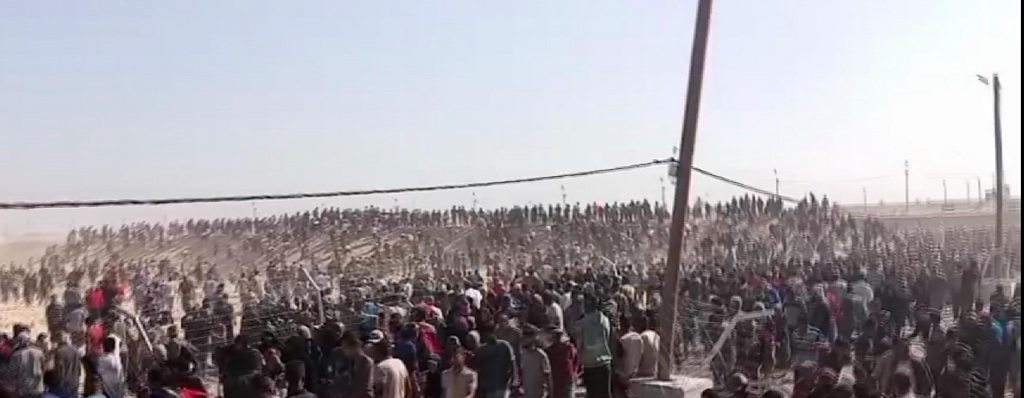
Thousands of Palestinians have overrun an aid distribution site in Gaza set up by a controversial US and Israeli-backed group, a day after it began working there.
Videos showed crowds walking over torn-down fences and earth berms at the Gaza Humanitarian Foundation’s (GHF) compound in the southern city of Rafah.
The group said that at one point its team fell back because the numbers seeking aid were so great. The Israeli military said troops nearby fired warning shots.
The GHF, which uses armed American security contractors, aims to bypass the UN as the main supplier of aid in Gaza, where experts have warned of a looming famine after an 11-week Israeli blockade that was recently eased.
The UN said the videos from Rafah were “heartbreaking” and that it had a detailed plan ready to get enough aid to the “desperate population” of 2.1 million.
The UN and many aid groups have refused to co-operate with GHF’s plans, which they say contradict humanitarian principles and appear to “weaponise aid”.
They have warned that the system will practically exclude those with mobility issues, force further displacement, expose thousands of people to harm, make aid conditional on political and military aims, and set an unacceptable precedent for aid delivery around the world.
Israel has said an alternative to the current aid system is needed to stop Hamas stealing aid, which the group denies doing.
The GHF announced on Monday that it had “commenced operations in Gaza” and begun giving out supplies to Palestinians at its distribution sites.
On Tuesday afternoon, the Israeli military confirmed two sites located in the Tal al-Sultan neighbourhood of Rafah and the Morag Corridor – an east-west military zone that separates the city from the rest of Gaza – had begun distributing food to families.
At around the same time, Israeli and Palestinian media shared pictures showing long queues of Palestinians at the Tal al-Sultan site.
But just over an hour later, they began posting videos showing thousands of men, women and children streaming into the compound. In one clip, some people are seen running and ducking as what appear to be gunshots ring out.
Witnesses described a scene of chaos as people seized food parcels and other aid from the site. They also said Israeli troops stationed nearby had opened fire.
“The situation was extremely difficult. They only allowed 50 people to cross at a time,” one man told BBC Arabic’s Middle East daily radio programme. “In the end, chaos broke out – people climbed over the gates, attacked others, and took all the [aid].”
“It was a humiliating experience,” he added. “We’ve suffered greatly from hunger. We’re just looking for a bit of sugar to make a cup of tea, and a piece of bread to eat.”
A woman said hunger and poverty had “overwhelmed everyone”.
“People are exhausted – willing to do anything, even risk their lives – just to find food and feed their children.”
A statement from the GHF acknowledged that “the needs on the ground are great” and said it had so far handed out about 8,000 food boxes – equivalent to 462,000 meals – through a partnership with local non-governmental organisations.
However, it said Palestinians had experienced several hours of delays in accessing one site “due to blockades imposed by Hamas”, without providing evidence.
“At one moment in the late afternoon, the volume of people at the SBS [Secure Distribution Site] was such that the GHF team fell back to allow a small number of Gazans to take aid safely and dissipate. This was done in accordance with GHF protocol to avoid casualties. Normal operations have resumed,” it added.
The Israel Defense Forces (IDF) said its troops had fired “warning shots in the area outside the compound”.
“Control over the situation was established, food distribution operations are expected to continue as planned, and the safety of IDF troops was not compromised,” it stated.
Gaza’s Hamas-run Government Media Office said Israel’s efforts to distribute aid had “failed miserably”. It also denied that Hamas had tried to stop civilians reaching the GHF’s sites.
At a news conference in New York, UN spokesman Stéphane Dujarric said: “We have been watching the video coming out of Gaza around one of the distribution points set up by the Gaza Humanitarian Foundation. And frankly, these videos, these images, are heartbreaking.”
“We and our partners have a detailed, principled, operationally sound plan supported by member states to get aid to a desperate population. We continue to stress that a meaningful scale-up of humanitarian operations is essential to stave off famine and meet the needs of all civilians wherever they are,” he added.
The US state department’s spokeswoman called the UN’s criticism “the height of hypocrisy”.
“It is unfortunate, because the issue here is giving aid to Gaza, and then suddenly it moves into complaints about style or the nature of who’s doing it,” Tammy Bruce told reporters.
Challenged by the BBC about the independence and neutrality of the GHF, Bruce acknowledged there are “some disagreements” about how the distribution of food and aid into the region is “being implemented”.
But she added: “I think that most of us would agree that this is good news… the real story here is that there’s food aid going in.”
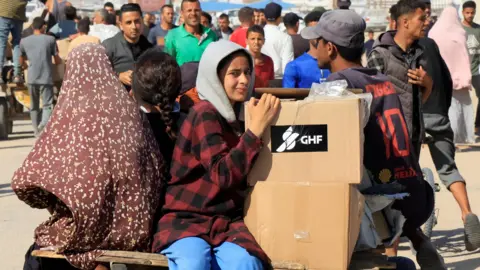
The GHF initially plans to set up four distribution sites in southern and central Gaza where Palestinians will be able to collect food and other aid for their families. It says it aims to feed a million people – just under half the population – by the end of this week.
The sites are meant to be secured by American contractors, with Israeli troops patrolling the perimeters. To access them, Palestinians are expected to have to undergo identity checks and screening for involvement with Hamas.
UN and other aid agencies have insisted they will not co-operate with any scheme that fails to respect fundamental humanitarian principles of humanity, impartiality, independence and neutrality.
On Sunday night, Jake Wood resigned as the GHF’s executive director, saying the group’s system could not work in a way that would be able to fulfil those principles.
The GHF’s board rejected the criticism and accused “those who benefit from the status quo” of being more focused on “tearing this apart than on getting aid in”.
The group also alleged on Monday that Hamas had made death threats to NGOs supporting its distribution sites and attempted to block civilians from accessing the aid.
Hamas has publicly warned Palestinians not to co-operate with GHF’s system.
Israel imposed a total blockade on humanitarian aid and commercial supplies to Gaza on 2 March and resumed its military offensive two weeks later, ending a two-month ceasefire with Hamas. It said the steps were meant to put pressure on the armed group to release the 58 hostages still held in Gaza, up to 23 of whom are believed to be alive.
On 19 May, the Israeli military launched an expanded offensive that Prime Minister Benjamin Netanyahu said would see troops “take control of all areas” of Gaza. The plan reportedly includes completely clearing the north of civilians and forcibly displacing them to the south.
Netanyahu also said Israel would temporarily ease the blockade and allow a “basic” amount of food into Gaza to prevent a famine, following pressure from allies in the US.
Since then, Israeli authorities say they have allowed at least 665 lorry loads of humanitarian aid, including flour, baby food and medical supplies, into Gaza.
However, more than 400 loads were on the Gazan side of the Kerem Shalom crossing awaiting distribution by the UN as of Tuesday evening, according to the Israeli military body in charge of aid co-ordination, Cogat. It called on the UN to “do its job”.
There was no immediate comment from the UN, but it said last week that its teams faced significant challenges in collecting supplies due to insecurity, the risk of looting and co-ordination issues with Israeli forces.
The head of the UN’s World Food Programme warned on Sunday that the aid was only a “drop in the bucket” of what was needed in the territory to reverse the catastrophic levels of hunger, amid significant shortages of basic foods and skyrocketing prices.
Half a million people face starvation in the coming months, according to an assessment by the UN-backed Integrated Food Security Phase Classification (IPC).
Israel launched a military campaign in Gaza in response Hamas’ cross-border attack on 7 October 2023, in which about 1,200 people were killed and 251 others were taken hostage.
At least 54,056 people have been killed in Gaza since then, including 3,901 over the past 10 weeks, according to the territory’s Hamas-run health ministry.
[BBC]


A guitar used by David Gilmour on six of Pink Floyd’s albums has sold for a record $14.6m (£10.9m), making it the most expensive guitar ever sold, auction house Christie’s has said.
Gilmour played the 1969 Fender Stratocaster, nicknamed the ‘Black Strat’, on all of the British rock band’s albums between 1970 and 1983, including The Dark Side of the Moon, Wish You Were Here, and The Wall.
The guitar sold to an unnamed buyer after 21 minutes of bidding, as part of a rock memorabilia auction in New York on Thursday.
A piano owned by the Beatles’ John Lennon also sold at the auction for $3.2 (£2.5m), believed to be the highest fee ever paid for a piece of Beatles memorabilia.
(BBC)

China has approved a sweeping new law which claims to help promote “ethnic unity” – but critics say it will further erode the rights of minority groups.
On paper, it aims to promote integration among the 56 officially recognised ethnic groups, dominated by the Han Chinese, through education and housing. But critics say it cuts people off from their language and culture.
It mandates that all children should be taught Mandarin before kindergarten and up until the end of high school. Previously students could study most of the curriculum in their native language such as Tibetan, Uyghur or Mongolian.
The law was approved on Thursday as the annual rubber-stamp parliamentary session drew to an end.
“The law is consistent with a dramatic recent policy shift, to suppress the ethnic diversity formally recognised since 1949,” Magnus Fiskesjö, an associate professor of anthropology at Cornell University said in a university report.
“The children of the next generation are now isolated and brutally forced to forget their own language and culture.”
However, Beijing argues that teaching the next generation Mandarin will help their job prospects.
It also says the law for “Promoting Ethnic Unity and Progress” is crucial for promoting “modernisation through greater unity”.
The law was voted and passed on Thursday at the National People’s Congress in Beijing, which has never rejected an item on its agenda.
The law also provides a legal basis to prosecute parents or guardians who may instil what it described as “detrimental” views in children which would affect ethnic harmony and it calls for “mutually embedded community environments” which some analysts believe could result in the break up of minority-heavy neighbourhoods.
The Chinese government started to push for what it describes as the “sinicisation” of minority groups in the late 2000s and create a more unified national identity by assimilating ethnic groups into the dominant Han culture.
Han Chinese make up more than 90% of the country’s 1.4 billion people.
Beijing has long been accused of restricting the rights of minority ethnic groups in regions like Tibet, Xinjiang and Inner Mongolia.
Critics say assimilation has often been forced on people in these places – a state-led policy that has accelerated under Chinese leader Xi Jinping who has taken a harder line on dissent and protests, especially in areas home to minority ethnic groups,
In Tibet, the authorities have arrested monks, and taken control of monasteries to ensure they do not worship the Dalai Lama.
When the BBC visited a monastery that had been at heart of Tibetan resistance in July last year, monks spoke of living under fear and intimidation.
“We Tibetans are denied basic human rights. The Chinese government continues to oppress and persecute us. It is not a government that serves the people,” one of them told us.

In Xinjiang, human rights groups have documented the detention of a million Uyghur Muslims in what the Chinese government calls camps for “re-education”, while the UN has accused Beijing of grave human rights violations.
The BBC’s reporting from 2021 and 2022 found evidence supporting the existence of detention camps, and allegations of sexual abuse and forced sterilisation, which Beijing denies.
In 2020, ethnic Mongolians in northern China staged rare rallies against measures to reduce teaching in the Mongolian language in favour of Mandarin.
Parents even held children back in protest at the policy as some ethnic Mongolians viewed the move as a threat to their cultural identity. Authorities moved quickly to crackdown on what it saw as dissent.
The Communist Party says it embraces different ethnicities. The country’s constitution states that “each ethnicity has the right to use and develop their own language” and “have the right to self-rule”.
But critics believe this new law will cement Xi’s push toward assimilation.
“The law makes it clearer than ever that in Xi Jinping’s PRC non-Han peoples must do more to integrate themselves with the Han majority, and above all else be loyal to Beijing,” Allen Carlson, an associate professor of government at Cornell University said, referencing China by the initials of its official name.
This focus on development and prosperity is “telling”, Professor Ian Chong of the National University of Singapore told the BBC.
“It is easy to read this language as meaning that minority languages and cultures are backward and impediments to advancement.”
Xi’s approach towards minorities is “consistent with his idea of creating a great and strong Chinese nation with a northern Han core… minorities are seen as branching off from that core, and hence in some ways derivative,” he adds.
“In practice, this has prompted concerns about further rounds of increasing control, diminution, and even crackdowns on minority cultures and languages.”
[BBC]

A Chinese national has been arrested in Kenya’s main airport accused of attempting to smuggle more than 2,000 queen garden ants out of the country.
Zhang Kequn was intercepted during a security check at Jomo Kenyatta International Airport (JKIA) in the capital Nairobi after authorities discovered a large consignment of live ants in his luggage bound for China.
He has yet to respond to the accusation but investigators said in court that he was linked to an ant-trafficking network that was broken up in Kenya last year.
The ants are protected by international bio-diversity treaties and their trade is highly regulated.
Last year, the Kenya Wildlife Service (KWS) warned of a growing demand for garden ants – scientifically known as Messor cephalotes – in Europe and Asia, where collectors keep them as pets.
A state prosecutor told the court on Wednesday that Zhang had packed some ants in test tubes, while others were concealed in tissue paper rolls hidden in his luggage.
“Within his personal luggage there was found 1,948 garden ants packed in specialised test tubes,” prosecutor Allen Mulama told the court.
“A further 300 live ants were recovered concealed in three rolls of tissue paper within the luggage,” he added.
The prosecutor asked the court to allow the suspect’s electronic devices – phone and laptop – to be forensically examined.
Duncan Juma, a senior KWS official, told the BBC that more arrests were expected as investigators widen their probe into other Kenyan towns where ant harvesting was suspected to be ongoing.
Last May, a Kenyan court sentenced four men to one year in prison or a fine of $7,700 for trying to smuggle thousands of live queen ants out of the country, in a first-of-its kind case.
The four suspects – two Belgians, a Vietnamese and a Kenyan – had pleaded guilty to the charges after their arrest in what the KWS described as “a co-ordinated, intelligence-led operation”.
The Belgians told the court that they were collecting the highly sought-after ants as a hobby and didn’t think it was illegal.
Investigators now say Zhang was the mastermind behind this trafficking ring but apparently escaped Kenya last year using a different passport.
On Wednesday, the court allowed prosecutors to detain him for five days to enable detectives to conduct further investigations.
The KWS, which is more used to protecting larger creatures, such as lions and elephants, described last year’s ruling as a “landmark case”.
The ants seized last year were giant African harvester ants, which KWS said were ecologically important, noting that their removal from the ecosystem could disrupt soil health and biodiversity.
It is believed that the intended destinations were the exotic pet markets in Europe and Asia.
[BBC]
Showers will occur at several places in the Western, Sabaragamuwa, Central, North-western and Uva provinces and in Galle, Matara, Mannar and Anuradhapura districts after 2.00 pm.

Lanka discovers largest groundwater source

Lanka’s commercial legacy preserved in National Archives

Bodies of 84 Iranian sailors flown home

Kirsten brings pedigree, but Sri Lanka must fix the system

Barrels vs bombs

‘Dates have the highest sugar content to fight Coronavirus’

Sunday Island 27 December – Headlines

#SundayIsland 17th December – Headlines

Sunday Island – 28th March

Sunday Island Headlines – 21 March

Sunday Island – 21st February – Headlines
-

 News6 days ago
Repatriation of Iranian naval personnel Sri Lanka’s call: Washington
-

 Features6 days ago
Winds of Change:Geopolitics at the crossroads of South and Southeast Asia
-

 News5 days ago
Prof. Dunusinghe warns Lanka at serious risk due to ME war
-

 Sports4 days ago
Royal start favourites in historic Battle of the Blues
-

 Sports3 days ago
The 147th Royal–Thomian and 175 Years of the School by the Sea
-

 News3 days ago
Historic address by BASL President at the Supreme Court of India
-

 News4 days ago
CEBEU warns of operational disruptions amid uncertainty over CEB restructuring
-

 Business4 days ago
BOI launches ‘Invest in Sri Lanka’ forum