
Features
The hidden costs of parcel clearance in Sri Lanka


 Last week, I received a registered letter with a bundle of forms informing me that an overseas parcel addressed to me had arrived but was being held by Customs. I immediately knew it was a journal containing one of my research articles. Hoping to avoid the usual trouble, I contacted a few Customs officials and explained how difficult it had been the last time I collected a parcel — that one was a text book I had authored and published by Springer Singapore/Netherlands. I asked if they could release this new parcel without me having to show up in person. Unfortunately, all my requests were in vain.
So once again, I had to make the journey in person — this time from Malabe — with an official vehicle and a driver who had to wait as I navigated the process. It took about an hour, which wasn’t too bad compared to my previous experience, but I couldn’t help thinking about those who might have to come all the way from Jaffna, Rajarata, or the East. The time, cost, and inconvenience involved are simply unnecessary.
What follows is my attempt to break down and analyze the outdated procedure we’re forced to follow to collect something as simple as a journal from abroad (see Figure 1).

Parcel Release Procedure
This analysis examines the current procedure for releasing overseas parcels (e.g., journals) managed by the Postal Department and Customs. Based on the provided flowchart and user observations, the system is plagued by redundancies, inefficiencies, and outdated practices that significantly increase customer wait times and misuse available human resources.
The procedure illustrated involves four main counters and redundant bureaucratic loops, exacerbated by idle staff, poor workflow design, and unnecessary customer effort. Let’s examine each stage:
* START – Car Park: The process begins with a customer being turned away from an already full car park, followed by interaction with security personnel. No digital queue, no reservation system, and no customer support kiosk — all signs of a pre-digital era mindset. The unavailability of parking for legitimate customers signals poor planning.
* Counter No. 01 – Form Filling and issuing a token/number: The first counter requires manual form filling, often involving data that the Postal or Customs authorities already possess (e.g., tracking number, consignee name). This is an archaic duplication of information already available in the parcel’s digital record. Requiring customers to write this again shows a lack of data integration.
* Counter No. 02 – Custom Inspection and More Form Filling – Book entries (by them): After the first form, customers are sent to customs for physical inspection and yet another round of form filling. If physical inspection is needed, why is another form not integrated into the first? It’s a classic example of siloed operations—each unit guarding its turf, creating delays.
* Counter No. 03 – Cashier (Form Filling -Book entries + Payment): Another book entry by the cashier (accept only cash – no electronic payments) for Custom Clearing Fees (CCF), taxes or duties and handling charges, etc:
* Counter No. 04 – Parcel Release: Only after enduring all prior steps and queueing again does the customer receive the parcel. This could be the only necessary counter, provided that the earlier steps are digitised and synchronised.
A Museum of Bureaucracy
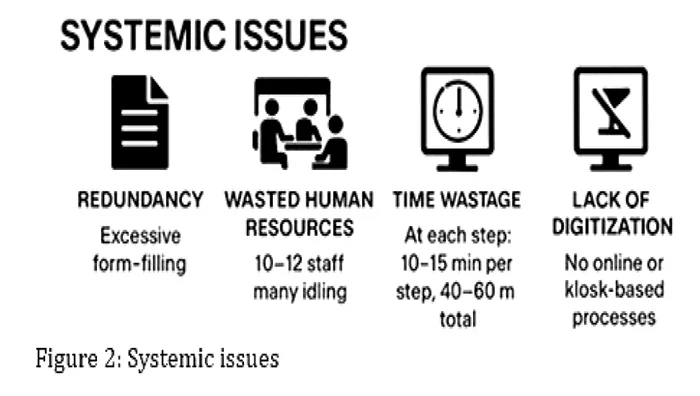
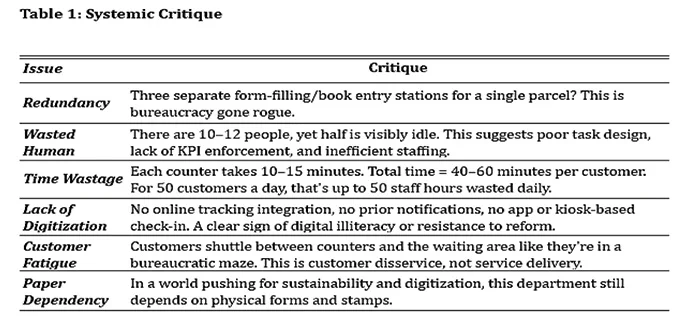
This system is a relic — a functioning fossil of red tape. It does not serve the citizen, the environment, or the government’s own productivity goals. Its persistence suggests institutional inertia, lack of accountability, and fear of automation (Figure 2 and Table 1).
Recommendations
1. End All Redundant Form Filling: Develop a single, consolidated digital form that captures all necessary information at once. Implement accessible online before arrival or via self-service kiosks at the facility. Include form fields relevant to customs, payments, and parcel. Utilise dropdowns, auto-fill from national databases, and OCR scanning to simplify input. Store data securely with cloud backup and ensure compliance with data protection standards.
2. Digitize Inspection Records: Manual recording of inspection results leads to inconsistency, data loss, and time delays. Equip customs officers with tablet-based data entry systems for real-time logging of inspection results.
Technical Infrastructure: All terminals (inspection desks, cashier, parcel release points) should be connected via a secured intranet. Implement role-based access controls and password-protected logins to maintain data integrity. Audit trails and timestamps should be logged for every entry. Results should instantly sync to other stages of the process (e.g., payment terminal, release terminal).
3. Integrate Payment Systems: Manual payment with separate form-filling causes bottlenecks. Develop a QR-code or Parcel ID-based payment system.

Workflow: System auto-calculates duties and taxes based on the digitised inspection data and parcel information. Customers scan the QR code via a kiosk, mobile device, or present printed code. Payments made via mobile apps, online banking, or kiosks. Customs officers can review and approve online, and system issues a digital receipt that flows to the release terminal. Optional: integrate e-wallets or card payments on-site.
4. Streamline Staffing: 10–12 staff members are present, with several remaining idle due to inefficient task distribution. Conduct a workforce analysis and redeploy underutilised personnel to roles such as: Customer guidance assistants, Technical support for kiosks, Queue and flow management, Back-office data validation Benefits include improved efficiency, morale, and productivity. And enhanced customer satisfaction through better support services.
5. Allow Parcel Pre-Clearance: All parcels undergo inspection, including low-risk items such as journals or documents. Implement automated pre-clearance for specific low-risk categories.
Suggested Mechanism: Customers declare parcel type online during form-filling. System flags eligible parcels (e.g., books, documents, university transcripts) for automatic clearance. Bypasses manual inspection and proceeds directly to parcel release. Reduces congestion and prioritises resources for high-risk or dutiable goods.
These recommendations, when implemented together, create a leaner, faster, and tech-enabled parcel processing system that reduces customer waiting time, optimises resource use, and improves transparency and accountability.
This outdated model must evolve to align with modern standards of public service and technology. A well-designed digital workflow would save time, resources, and customer frustration, while enhancing service delivery and institutional credibility. This parcel release system is reminiscent of a pre-digital bureaucratic model that serves neither operational efficiency nor public satisfaction. Institutional resistance to modernisation and lack of accountability perpetuate these inefficiencies. As a final note, as demonstrated in Figure 3, we must look forward to;
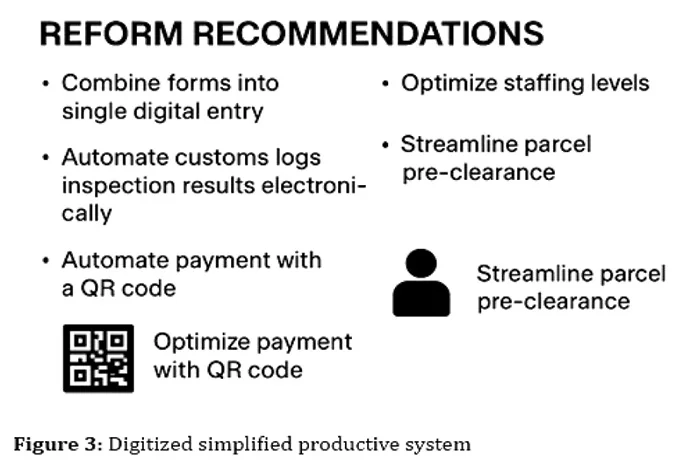
* Eliminate redundant form-filling with a single digital entry point.
* Digitise customs inspection outcomes using tablets or terminals.
* Integrate a centralised payment system linked to parcel IDs.
* Introduce self-check-in kiosks or an online pre-clearance system.
* Reassign idle staff to meaningful support and customer-facing roles.
* Allow digital pre-clearance for document-type parcels such as journals
(The writer, a senior Chartered Accountant and professional banker, is Professor at SLIIT , Malabe. He is also the author of the “Doing Social Research and Publishing Results”, a Springer publication (Singapore), and “Samaja Gaveshakaya (in Sinhala). The views and opinions expressed in this article are solely those of the author and do not necessarily reflect the official policy or position of the institution he works for. He can be contacted at saliya.a@slit.lk and www.researcher.com)

The legal processes are steadily closing in on some of the most controversial cases that have remained as open questions without closure for many years. These include the Easter Sunday bombings of 2019, the Treasury bond scam that erupted in 2015, and a range of corruption allegations that became synonymous with successive governments over the past two or more decades. What once appeared to be stalled investigations are now showing signs of movement through the courts and investigative agencies. Recent developments suggest that these long running cases are entering a decisive phase. In the Easter Sunday attacks investigation, new arrests and investigations have brought renewed attention to allegations that extend beyond the immediate perpetrators and into questions of intelligence failures and possible political complicity. The arrest and detention of former intelligence chief Suresh Sallay under the Prevention of Terrorism Act has intensified public interest in uncovering the full truth behind the attacks.
The Treasury bond scam has also re-entered the spotlight. The Supreme Court has recently overturned legal obstacles that had prevented prosecutions from proceeding and directed that the case moves forward expeditiously. This has reopened one of the most sophisticated financial scandals in the country’s recent history and brought several prominent political and financial figures back under legal scrutiny. As those implicated in these unresolved cases are leading figures from previous governments, which have spanned both sides of the political divide since Independence, it can well be imagined that there is tremendous opposition to the gradually enveloping legal processes that is both seen and unseen.
These cases that are now being investigated cut across political camps and involve individuals who occupied some of the highest offices in the country. The result is that resistance to accountability is likely to emerge from many quarters. Still to be opened are the thousands of cases of persons gone missing during the war. Presidential Commissions have been appointed with regard to them, but there has been no serious investigations of the type now taking place.
In these circumstances, it can be surmised that the government led by those who are new to power would wish to retain a maximum of power to face the pushback that is bound to emerge from those in the opposition who have wielded power for generations. The government may calculate that this is not the time to disperse authority or reduce the instruments of state power available to it. Instead, it may believe that a period of centralised control is necessary if investigations, prosecutions and reforms are to proceed without interference.
Provincial Elections
It appears that the opposition’s efforts to mobilise the people and public opinion against the government have not been successful so far. One such instance was the attempt to generate opposition to price increases. Although people have undoubtedly been affected by rising prices and economic difficulties, these efforts failed to gather significant momentum. Another attempt came when President Dissanayake predicted that opposition politicians would face imprisonment in the month of May as legal cases progressed, though this has not happened. Critics claimed that such remarks suggested an intention to influence judicial outcomes. Yet this criticism also failed to gain traction among the public. The likely reason is that public memory remains fresh. Many people continue to associate previous governments with economic mismanagement, corruption scandals, abuse of power and the eventual economic collapse. In comparison, the present government continues to enjoy a reservoir of public goodwill and credibility. As long as legal action appears to be based on evidence and proper process, the public seems prepared to give the government the benefit of the doubt.
The government’s deliberate and cautious approach to political reform that would reduce its centralised power needs to be seen in this context. The monthly approval by Parliament of the emergency regulations is justified by the government as due to the continuing need to respond to the devastation caused by Cyclone Ditwah. However, when viewed together with the reluctance to hold provincial council elections on the grounds of electoral reform, the failure to repeal the Prevention of Terrorism Act and the postponement of constitutional reform, they all appear to reflect a preference for retaining maximum control at a politically sensitive moment. There is a logic to this approach. Governments facing major legal and political confrontations often seek stability and control. So does every despot. However, there is also a downside.
When political competition is denied to legitimate outlets, it often finds expression in confrontation, obstruction and polarisation. The advantage of prioritising the conduct of provincial council elections at this time is that it could reduce the political pressures that are building up. The main opposition parties are united in calling for these elections to be held. Conducting them would provide an opportunity for opposition political parties to obtain a measure of democratic representation and political authority at the provincial level. This would be especially true in the northern and eastern provinces, in which the ethnic and religious minorities predominate. It cannot be forgotten that the provincial council system was developed as a constructive response to the ethnic conflict. Elections at the provincial level would create opportunities for a new generation of political leaders to emerge through democratic competition rather than patronage. Many of those now facing legal scrutiny belong to an older generation to whose needs the younger may be less deferential.
Two Pillars
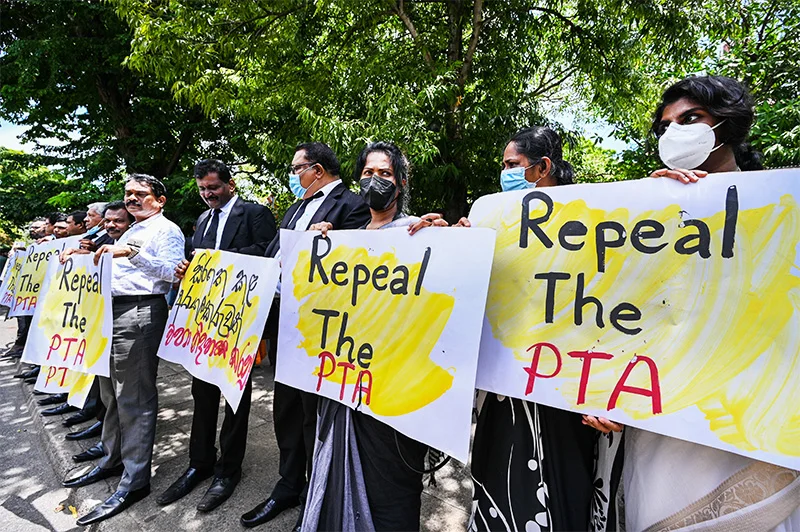
Another reform that could command bipartisan support is the repeal of the Prevention of Terrorism Act. The PTA has once again become controversial because it is being used in situations that extend beyond its original purpose. The detention of former intelligence chief Suresh Sallay under the Act, the continued incarceration of some Tamil detainees from the war period, and the arrest of individuals accused of speech related offences have all revived concerns regarding prolonged detention without trial and excessive executive power. The reason the PTA has been difficult to repeal is that it is closely associated with concerns regarding national security and territorial integrity. Introduced in 1979 as a temporary measure to confront the emerging separatist conflict, it survived through decades of war and has remained on the statute books long after the conflict ended.
At the same time, history shows that extraordinary powers are likely to be misused. Laws that permit detention without trial or broad executive discretion are rarely confined to their original purpose. Governments of different political parties have used such powers against opponents and critics. The temptation to do so is inherent in the possession of unchecked authority. The way forward could therefore be a combination of accountability and reform. The government should continue to support independent investigations and prosecutions in major corruption and security related cases. Demonstrating political will in this regard would strengthen public confidence in the rule of law and reinforce the principle that no individual is above the law. The PTA could be replaced with legislation that amends the Criminal Procedure Code and Penal Code in a manner that addresses legitimate security concerns while complying with democratic norms and human rights standards.
There are also international dimensions to consider. The European Union has repeatedly linked governance and human rights reforms, including reform of the PTA, to Sri Lanka’s continuing access to the GSP Plus trade concession. Progress on these issues would strengthen Sri Lanka’s international standing at a time when economic recovery remains a national priority. The government has a rare opportunity. It possesses a strong electoral mandate, public goodwill and a reputation for integrity that previous governments lacked. It can combine the pursuit of justice in long delayed cases with meaningful democratic reforms that reduce political resistance and broaden public support. At this time, accountability and power sharing are the two pillars which Sri Lankans need to be committed to build a just and democratic society for a better future without delay. Failure now would make for a long period of waiting for the next time.
by Jehan Perera

 A public university relies on its teachers in fulfilling its responsibilities to the wider community. While teaching remains the chief responsibility of the academic staff, they also conduct research and play a central role in keeping the university a vibrant space where they and students can freely participate in conversations that concern not just routine classroom education but also society at large. The broader intellectual culture and intellectual integrity of a university thus depend on how its academics perform their functions. Therefore, universities should take the task of recruiting their academics seriously. It is important to ensure that this task is done responsibly, transparently and credibly through a fair, thorough and multi-phased evaluation process.
As both an applicant and a member of selection panels for recruitment, I hold that the recruitment procedures, currently in place in our university system, require radical reforms. Echoing some of the concerns raised by Kaushalya Perera in her Kuppi article on recruitment in March 2026, I focus on the limitations I have observed and experienced, specifically in the recruitment of Lecturer (Probationary) and Senior Lecturer positions. The article also aims to explore how these shortcomings could be addressed.
The Advertisement
Recruitment for Lecturer (Probationary) and Senior Lecturer positions is done through an open-advertisement which also involves an interview with shortlisted candidates. Advertisements are finalised in line with a template issued by the Registrar’s Office. Generally, an initial draft, prepared by the Registrar’s Office, is sent to the relevant academic departments for revisions. The revisions have to be made within the template provided, which allows space for the mention of only specialisation requirements.
It should be noted that not all revisions to the advertisement, suggested by the Department Head, are accepted in the next round. Deans, Vice Chancellors and Registrars, who have very little understanding of the disciplines associated with the position, sometimes reject the changes proposed by the Department. Technocratic in their thinking, they don’t recognise that an academic programme can be taught by persons with specialisation in another overlapping discipline. For instance, a position in English, at a university in Sri Lanka, is very well suited to not just those who have postgraduate qualifications in literary studies but also those who are from the disciplines of Applied Linguistics, Cultural Studies or Translation Studies, as these areas are taught as sub-fields of English studies at most universities in the country. These disciplinary overlaps, even when pointed out by Heads, are often overlooked by our administrators.
In place of this process, dominated by academic administrators and registrars, the advertisement should ideally emerge, from the relevant department, in the form of a comprehensive job description. It should mention the nature of the position advertised, the kind of teaching (and research) expected, how the position relates to other positions in the department, in terms of specialisation and workload, and the ways in which the recruited candidate would contribute to overall institutional development.
There can be no one-size-fits-all model when it comes to recruitment. Individual departments vary in size, strength and specialisation requirements. Departments with sizable academic staff may want to emphasise specialisation during recruitment, whereas smaller departments may prefer generalists who can handle a wide-array of courses. Specifying the rationale for the requirements included in the job description may help potential applicants get an understanding of the position advertised and the selection panel to conduct the evaluation process in a fair manner.
Review of Applications
Once applications are received, we sometimes find promising candidates but with qualifications that don’t carry in their title the name of the discipline or the department in which the position is advertised. Sometimes the disciplines or fields of specialisation that appear in the advertisement and the ones that appear in the qualifications are not identical in nomenclature, even though the research undertaken by the applicant during their graduate studies is strongly relevant to the position advertised. Even when such applications are accompanied by strong and relevant publications, our system does not view them positively. Instead, nomenclatural differences are used to reject promising candidates. Such differences are also used as a pretext when universities want to exclude a candidate for their cultural background, political beliefs or other reasons. Even if academic departments recognise such applications, at the next stage, the administrators of the university try to veto them. We lose inter-disciplinary scholars of high academic standing because of the high-handedness of university administrators.
Selection Panels
Selection panels for academic positions typically comprise the Vice Chancellor, the Dean of the Faculty, the Head of the Department, two academics nominated by the Senate and two members of the University Council. In the case of programmes/disciplines jointly housed under a single department, if the Head comes from a discipline other than the one in which the position is advertised, they may not be able to contribute in an informed manner to the recruitment process. However, some Heads refuse to appoint nominees from the relevant discipline in their place as they view sitting on selection panels as their exclusive privilege.
Sometimes university Senates do not take the appointment of Senate nominees seriously. These appointments are decided in a hurry without serious deliberations at senate meetings packed with numerous agenda items. Sometimes even if the relevant department has suitable academics to serve as Senate nominees, the Senate chooses academics from other departments or disciplines who do not have a nuanced understanding of the requirements of the position advertised and its disciplinary parameters. Sometimes specialists in the relevant discipline may not be available at a university. On such occasions, Senates tend to fill up the positions with academics from other disciplines, instead of inviting external nominees from other universities. At a state university in Sri Lanka, I was interviewed thrice for academic positions by selection panels that comprised not even one specialist from the relevant discipline.
The Marking Scheme
The marking schemes used in recruitment have their own drawbacks. Publications are sometimes evaluated for their quantity rather than quality. The opinion of the subject specialist is not sought or taken seriously when a candidate’s research is evaluated. This is why our universities are saddled with academics who engage in plagiarism or predatory publishing. The evaluation process should be tightened in such a way to bar the entry of those who lack academic integrity.
It is worrying to see that marking schemes and schemes of recruitment penalise applicants who have excelled in their graduate studies and are well-reputed for their recent research and publications just because they did not earn a first-class or second-class upper-division pass at the undergraduate level. Our narrow focus on a candidate’s first degree prevents us from giving due recognition to how that person has gained intellectual depth over the years. Some marking rubrics, which allocate points for eye-contact and posture during the interview, dilute the seriousness associated with the academic position, de-prioritise scholarship and turn the interview process into a stage performance.
Cultural Credibility
In recruitment, many universities look for cultural credibility (a term that I borrow from the work of Sulaxana Hippisley) as an unwritten requirement. Some departments are reluctant to hire applicants who are not their alumni. Some selection panels discriminate against candidates from certain ethnic or religious backgrounds. In some departments, women are rejected because they are likely to go on maternity leave or have more domestic responsibilities than men. Gender and sexual minorities have to mute and censor their identities at interviews because they are likely to face rejection if they openly declare their orientation. We have no policies and procedures in place to ensure recruitment is conducted in an inclusive way that sees diversity as a strength.
The Way-forward
When recruitment fails, the entire intellectual culture of that university takes a hit, and several generations of students are affected. Some of the current problems, related to quality in our higher education system, stem from bad recruitment policies and practices. Instead of trying to address these issues through rigorous and inclusive recruitment practices, we try to seek solutions via band-aids like quality assurance and workshops on curriculum writing and pedagogy for university academics.
In developing alternative recruitment policies and practices, we have to demand that the needs and expectations of individual departments are heard. Our selection panels should include more subject specialists than administrators and council nominees. Most of the evaluation should be completed before the interviews, and interviews should be treated as opportunities to get to know candidates in person and pose clarifying questions rather than as occasions for full-scale evaluation. We have to be open and receptive to new, inter-disciplinary scholarship and cultural, ethnic and gender diversity. If we are unwilling to introspect and bring about these reforms and revise our marking schemes, we will continue to recruit the wrong candidates and thereby fail our students and the wider community.
Mahendran Thiruvarangan is a Senior Lecturer attached to the Department of Linguistics & English at the University of Jaffna.
(Kuppi is a politics and pedagogy happening on the margins of the lecture hall that parodies, subverts, and simultaneously reaffirms social hierarchies.)
by Mahendran Thiruvarangan

 Chitral ‘Chity’ Somapala, now based in Sweden, has been active in the music scene for many years, and is known for his hard rock work with European bands like Firewind, Power Quest, and Avalon.
In Sri Lanka, he’s a household name and that’s the reason why he checks out the local scene, on a regular basis, keeping rock music lovers in the groove.
His shows are invariably ‘full house’’ events.
Sri Lanka’s rock star is now ready to do the needful … in Japan, and rock fans in that part of the world are already gearing themselves up for a rock explosion, with Chitral in the spotlight.
The show is scheduled for 03rd October, 2026, at the Hattori Ryokuchi Park, in Osaka, with Wayo.
The blast off is from 1.00 pm onwards.
However, before he checks out the Osaka scene, Chitral has another important date in his itinerary – a spectacular Sri Lankan musical extravaganza at the Sydney Opera House, in Australia.
The concert is titled Rhythms of Sri Lanka and will be held on 23rd August, 2026.

Back in Colombo soon to oblige local rock fans
Although Chitral Somapala is, indeed, a big name, as a rock artiste, he also revives the music of his parents, as well, often performing their music, along with his own songs, at live programmes.
In fact, the album ‘Dambulugale’, released in 2018, which is a tribute to his parents, famous Sri Lankan musicians P. L. A. Somapala and Chitra Somapala, turned out to be a massive hit, not only in Sri Lanka, but with Sri Lankans the world over.
The album, a compilation of various cover songs, previously written and performed by his parents, was dedicated to Chitral’s parents, and released on the 70th anniversary of Sri Lanka’s independence.
He also dropped ‘Chitral Somapala Live In Concert’, in 2023, with 22 tracks, and has several other releases to his credit.
Besides his rocking career, Chitral was asked by veteran film directors Chandran Rutnam, Asoka Handagama, Priyantha Colombage, Udayakantha and Shameera Naotunna to contribute his talent for their soundtracks, and he won a Presidential award and an International award for the movie ‘Let Her Cry’ by Asoka Handagama.
Chitral will be back in Colombo soon with another rocker for his fans, so watch out for Rock Meets Reggae.

Sri Lanka claim ODI series 1-0 after another washout in Kingston

Showers or thundershowers will occur at times in the Western, Sabaragamuwa and North-western provinces and in Galle, Matara, Kandy and Nuwara-Eliya districts.

Sallay refuses to end hunger strike unless probe is taken out of CID led by Shani

Lanka joins US-led Indo-Pacific Ports Forum

Vehicle imports remain steady despite surcharge – Customs

EU supports launch of Sri Lanka’s Revised National Green Reporting System Guidelines in partnership with UNIDO

‘Dates have the highest sugar content to fight Coronavirus’

Sunday Island 27 December – Headlines

#SundayIsland 17th December – Headlines

Sunday Island – 28th March

Sunday Island Headlines – 21 March

Sunday Island – 21st February – Headlines
-

 Latest News5 days ago
Kusal Mendis, Pathum Nissanka, bowlers put Sri Lanka 1-0 up
-
 News5 days ago
New US tariffs proposed on 60 countries, including Sri Lanka
-

 Features4 days ago
Power crept into the Sangha and is now tearing it apart
-

 Features4 days ago
Kondachchi wind farm and battery storage project to boost energy security, says Power Ministry Secretary
-

 Features4 days ago
Saudi Arabia sets new benchmark in Hajj management as 1.7 million pilgrims complete sacred journey
-

 News3 days ago
Asst. Manager, security officer arrested over Rs 30 mn snatch at Horana PB branch
-

 News2 days ago
Women’s T20 World Cup 2026 warm-up: Chamari Athapaththu’s 94 helps Sri Lanka beat Pakistan
-

 Editorial1 day ago
Probe Sallay’s complaint