
News
Prof Mohan Munasinghe honoured at Global Nobel Peace Summit in Dubai


Mohan Munasinghe co-winner of the 2007 Nobel Peace Prize (Vice Chair, IPCC), and recipient of the 2021 Blue Planet Prize, was honoured with a major award for exceptional contributions to World Peace at the Global Nobel Peace Summit in Dubai, 13-14 April 2025. He gave two keynote speeches at the opening and closing sessions, and also signed the Global Peace Charter, together with 12 other Nobel Peace Prize Laureates, a news release from the Munasinghe Institute of Development said.
He said by 2030, humanity would require the resources of two planets to sustain itself. “There is so much inequality. The richest people on Earth consume a hundred times more than the poorest. It’s not fair. The more we destroy the planet’s resources, the more we will fight over what is left. To bring peace and harmony to the world, we must first find peace and harmony within ourselves.”
Nations must harmonize the ‘sustainable development triangle’ (including economy, society and environment), which leads to balanced inclusive green growth (BIGG). He advocated supporting the UN’s Sustainable Development Goals, which he called humanity’s final opportunity to right its course and achieve the earth civilization of the 21st century.
Munasinghe recommends integrating climate change into national sustainable development strategy. He said that human beings are the cause of climate change, while the poor will be the ones who suffer the worst impacts. This is a gross injustice because the problem was caused by the excessive greenhouse gas emissions of the rich.
He apologized to future generations, because his generation was leaving them a world that is damaged, divided, and dangerous. “I am sorry we let it come to this.” Finally, Prof. Munasinghe offered hope, expressing faith in the youth to lead the way forward — if they learn from the past. “Don’t repeat our mistakes. Don’t ignore science,” he urged.
The sustainability implementing triangle requires business and civil society to work with government to achieve the 17 SDG. He stressed that “Business is part of the solution, and not necessarily the problem”. Ethical managers are essential for business sustainability, while methods like value-chain, life cycle analysis can help firms achieve win-win outcomes that reduce both costs and natural resource use.” Digital technology will facilitate both sustainable production and consumption. He stressed that cities are the starting point for a digital technology-led, smart sustainability transformation focusing on better infrastructure and governance.
He noted that world leadership is weak and incapable of tackling the many sustainable development issues, including climate change, which only makes other threats worse. He explained how the BRICS countries (Brazil, Russia, India, China and South Africa) have overtaken the G7 countries in terms of global gross domestic product in PPP terms. The BRICS+ led Global Majority (85% of the global population) are shifting away from the Western-led unipolar world order to a more balanced, multilateral world, with priorities focusing on sustainable development, poverty eradication, peaceful trade, cultural links, etc. Now, with digital, green and other new technologies, there are more opportunities for poor countries to level the playing field and restore their dignity and self-respect. While issuing the Global Peace Charter, he also called for the Peace Community to bridge the gap between BRICS+ and the west, to build a more prosperous world, and especially to avoid nuclear World War 3.
Professor Munasinghe is Chairman of the MIND Group in Colombo, which includes the non-profit Munasinghe Institute for Development (MIND), a UN recognized centre of excellence on sustainable development, and MIND AM focusing on data analytics and management. He is Chairman of the Board of Climate & Conservation Consortium (CCC). He is also Board Director of Eureka Group, Distinguished Guest Professor at Peking Univ., China, and Chairman of the Presidential Expert Committee on Sustainable Sri Lanka 2030 Vision.


By Shamindra Ferdinando
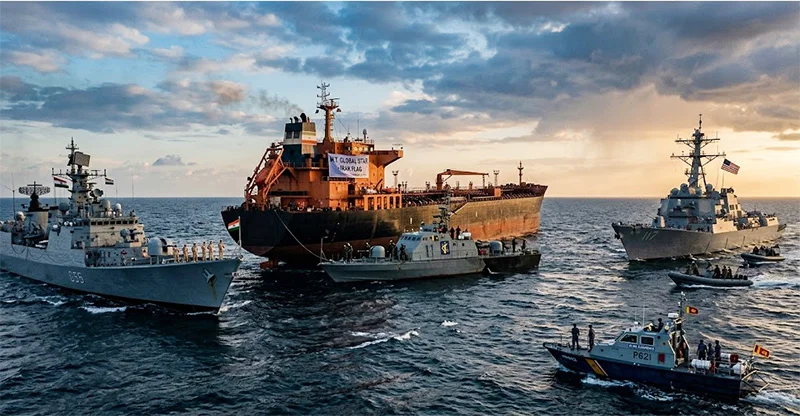
Iran has sought the Indian intervention, at the highest level, to provide lifesaving support to the crews of empty Iranian vessels stranded just outside Sri Lanka’s 12-nautical mile territorial waters off Galle.
Sources familiar with the issue said that Iran had brought the developing situation to the attention of New Delhi as the crews of almost 20 vessels, included Indian nationals. Sources stressed that the group of vessels that unloaded crude oil a couple of months back were now stranded within Sri Lanka’s Exclusive Economic Zone (EEZ).
The US Navy torpedoed an unarmed Iran frigate, returning from India, on 04 March, 2026, about 19 nautical miles off the Galle coast. The unprovoked attack killed nearly 100 Iranians.
The Iranian Embassy in Colombo has inquired from the Indian High Commission of their response to the situation, sources said. The US has issued a global warning against providing food, water, medicine and other services to the Iranian vessels. The outcome of Iran-India talks on the issue at hand was not known, though sources asserted India may not throw its weight behind Iranian efforts to address the issue.
Responding to The Island queries, sources said both Sri Lanka and India were in a dilemma due to the US warning. India couldn’t ignore the plight of the Indian crew members and the Iranian vessels in its backyard.
The Sri Lankan government remains tight-lipped about the vessels stranded in its EEZ. Our efforts to elicit a response from relevant authorities were in vain. In addition to Indians, there are Bangladeshis among the crew members. Iran has explicitly stated the responsibilities of the countries concerned to provide assistance in terms of international law.
The Iranian position was articulated by its Ambassador to Sri Lanka, Dr.Alireza Delkhosh, recently. In a special statement, Ambassador Delkhosh emphasised that in terms of the Convention on the Law of the Sea (Article 98) as well as SOLAS and SAR
Conventions, Sri Lanka couldn’t refrain from providing the needs of the Iranian vessels stranded in its EEZ.
SLMC leader Rauff Hakeem lambasted the NPP government in Parliament for failing to provide assistance to the Iranian ships. The former Minister alleged that the government was simply carrying out dictates of the US. He strongly criticised the way Foreign Minister Vijitha Herath was handling the issue.
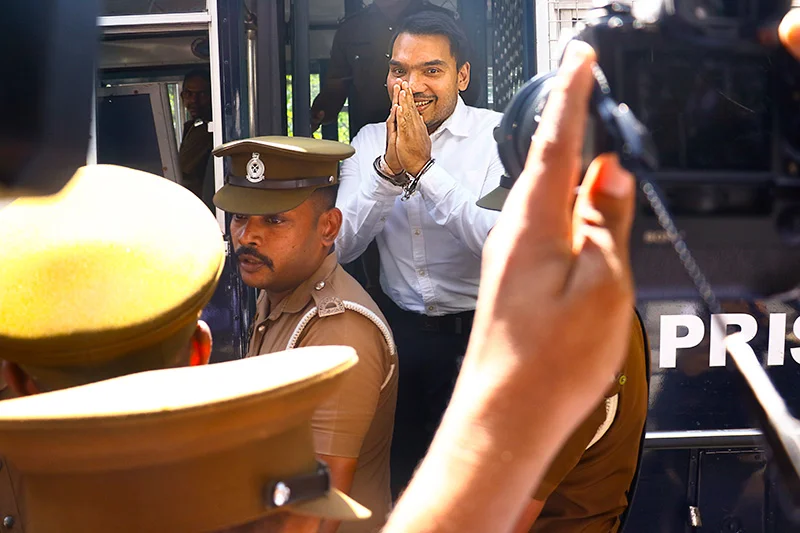
MP Namal Rajapaksa, who is in remand custody over the controversial Airbus deal, was further remanded until October 27 by the Colombo Magistrate’s Court yesterday (13).
Colombo Chief Magistrate Asanga S. Bodaragama made the order after considering submissions by officers of the Commission to Investigate Allegations of Bribery or Corruption and lawyers representing Rajapaksa.

Sri Lanka’s economy is expected to sustain its recovery over the next two years, although growth is projected to moderate amid mounting global uncertainties, according to the International Monetary Fund’s (IMF) latest World Economic Outlook.
In its World Economic Outlook 2026: Resilience Under Strain, Urgent Choices, the IMF projects Sri Lanka’s economy to expand by 4% in 2026, slowing to 3.7% in 2027, following estimated growth of 5% in 2025.
Inflation, meanwhile, is forecast to rise to 5.3% in 2026 and 5.4% in 2027, reversing the average deflation rate of 0.5% recorded in 2025.
Unemployment is expected to remain steady at 3.9% throughout the forecast period.
The projections come amid growing pressure on the global economy from the ongoing conflict in the Middle East, elevated energy prices, geopolitical tensions and trade disruptions.
Sri Lanka’s external position is also expected to weaken, with the current account balance projected to shift from a surplus of 1.6% of gross domestic product (GDP) in 2025 to deficits of 0.5% in 2026 and 0.3% in 2027.
The IMF’s outlook points to continued economic expansion in Sri Lanka, but with slower growth, rising inflation and a narrowing external surplus giving way to current account deficits over the forecast period.

Heavy showers above 100 mm are likely at some places in the Western, Sabaragamuwa, Southern, Central, and North-western provinces and in Anuradhapura district.

Sri Lanka, India caught in US-Iran ship crisis

Namal further remanded

IMF projects Lankan economic growth to moderate amidst mounting global uncertainties

Major Gen Pushpakumara assumes command of 56 Infantry Division

Dickwella axed, Bandara earns maiden Test call up

‘Dates have the highest sugar content to fight Coronavirus’

Sunday Island 27 December – Headlines

#SundayIsland 17th December – Headlines

Sunday Island – 28th March

Sunday Island Headlines – 21 March

Sunday Island – 21st February – Headlines
-

 Features7 days ago
The Sri Lankan who made Scottish history
-

 Sports7 days ago
Nissanka absence opens door for Sri Lanka’s young guns
-

 News6 days ago
NDB fraud Rs 60mn more than reported
-

 News6 days ago
Removing monk’s robes matter for Sangha to decide: Mahanayake Theras
-

 News7 days ago
Shiranthi R remanded until 13 Oct.
-

 News4 days ago
Sri Lanka escalates anti-graft drive with Shiranthi’s jailing
-

 Features7 days ago
Future of Sri Lanka’s state university system: Should it be shut down and reopened?
-

 News5 days ago
NPP govt. reminded of its responsibilities as US warship leaves Colombo