
Midweek Review
Sri Lanka: Quest for Justice, Rule of Law and Democratic Rights

By Shamindra Ferdinando
With an eye on the 46th session of the Geneva-based United Nations Human Rights Council (UNHRC) later this month, the highly influential Global Tamil Forum (GTF), Centre for Human Rights and Global Justice, New York University, Sri Lanka Campaign for Peace and Justice and The Canadian Tamil Congress have brought in ‘big guns’ for a combined onslaught on Sri Lanka this week.
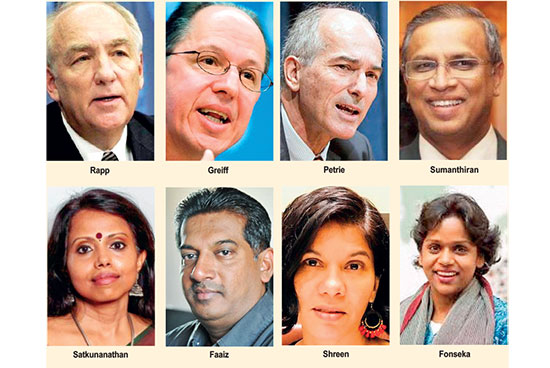
Among the participants, at a two-hour webinar, titled ‘Sri Lanka: Quest for Justice, Rule of Law and Democratic Rights’, scheduled for Friday, Feb. 12 (UK 1:30 pm; Europe/South Africa 3.30 pm; India/Sri Lanka 7:00 pm IST; Canada/US 8:30 am; Australia 12.30 am) are former UN Assistant Secretary General, Charles Petrie, former Special Rapporteur on the promotion of truth, justice, reparation and guarantee of non-recurrence, Pablo de Greiff and former US Ambassador-at-Large for Global Criminal Justice, Stephen J. Rapp.
The panelists includes Tamil National Alliance (TNA) lawmaker M.A. Sumanthiran, PC, former Commissioner of HRCSL Ambika Satkunanathan, Centre for Policy Alternatives (CPA) representative Attorney-at-Law Bhavani Fonseka, civil society activist. Shreen Saroor, and Sri Lanka Muslim Congress (SLMC) representative, Attorney-at-Law, Ameer Faaiz. Melissa Dring, of the Sri Lanka Campaign for Peace and Justice, is the moderator.
Their project has received a tremendous boost with the US returning to the Geneva body. The US quit UNHRC in June 2018.
The TNA, in late 2001, recognized the LTTE as the sole representative of the Tamil community. The LTTE held that privileged status in the eyes of the TNA, until Sri Lanka brought the war to a successful conclusion, in May 2009. The TNA is a direct beneficiary of the LTTE’s demise. Of course, Sumanthiran cannot be entirely held responsible for TNA’s actions as he joined the one-time LTTE mouthpiece, as a National List MP, in April 2010.
Why back Fonseka?
Sumanthiran entered Parliament a couple of months after the TNA wholeheartedly backed war-winning Army Commander Gen. Sarath Fonseka’s presidential candidature. Perhaps, Sumanthiran should explain on Feb 12, as to why the TNA, having accused the Army, Fonseka led with such efficiency, till the crushing of the formidable Tigers militarily, of genocide and then backed him to the hilt at the presidential poll that came soon afterwards. The TNA cannot conveniently ignore the fact that all Northern and Eastern electoral districts overwhelmingly voted for Fonseka though he lost the overall contest by a staggering 1.8 mn votes. Why did Tamils vote for Fonseka after accusing him, and his men, of genocide after they crushed the LTTE, which many pundits repeatedly claimed the Lankan security forces were incapable of achieving?
Participation of Petrie, Pablo de Greiff and Rapp, in Friday’s webinar, is of extreme importance. Petrie headed an ‘Internal Review Panel on UN actions in Sri Lanka’ that dealt with the final phase of the conflict, in his capacity as Special Rapporteur; De Greiff visited Sri Lanka on four occasions, between 2015 and 2019, and Rapp visited Colombo twice, in 2012 and 2014.
The Petrie report conveniently forgot how India formed half a dozen armed groups in the ‘80s to terrorize Sri Lanka, just to teach the then JRJ a lesson for being overtly pro-West and perhaps for derogatively comparing Mrs. Bandaranaike and her son, Anura with Mrs Gandhi and her son Sanjay. The Indian intervention was meant to pave the way for the deployment of her Army in the Northern and Eastern regions. The Indian project went awry. India ended up losing nearly 1,500 officers, and men, here, in less than three years. In addition, double that number received injuries. The military mission was aborted in March 1990. A year later, the LTTE assassinated Rajiv Gandhi, who, in his capacity as the Indian Prime Minister authorized the deployment of the Indian Army here. Can India ever absolve herself of the crime of causing massive chaos and destruction to this country as a result of her diabolical project here? The Petrie report also ignored how the LTTE scuttled the last bid to negotiate a settlement by quitting peace talks in April 2003. The LTTE’s abrupt move jeopardized the survival of UNP leader Ranil Wickremesinghe’s government and paved the way for its ouster in the following year.
Those who really value justice, rule of law, as well as democratic rights, should examine the Indian intervention here, too. Petrie and de Greiff should use the opportunity to explain the UN’s failure in the ‘80s to thwart the murderous Indian project. The UN played along in a devious plot to destabilise Sri Lanka, over the years. The UN’s response to the LTTE, during the Vanni offensive is no exception. The issue is whether the use of ‘human shields’, by the LTTE, could have been averted if the UN took tangible measures against the LTTE, especially in the wake of its detention of Tamil UN employees, accused of helping civilians to flee the Vanni west.
Did Petrie probe abductions of
UN workers?
Did Petrie inquire into the abductions after the revelation of secret UN powwow with the LTTE, led to the UN confirmation of the incident at daily UN media briefings, in New York, by the Secretary General’s Spokesperson Montas (The Island expose of UN employees abducted by LTTE: UN HQ admits Colombo Office kept it in the dark – The Island, April 28, 2007) Beginning April 20, 2007 (LTTE detains UN workers). The Island published several news items on the issue. The TNA, or those who issued media statements at the drop of a hat, remained conveniently silent. The TNA’s decision to remain quiet is understandable due to its close working relationship with the LTTE. Many an eyebrow was raised when the European Union election monitors openly accused the Tigers of helping the TNA to win 22 seats in the North and East, in 2004, by stuffing ballot boxes on its behalf. In the following year, the TNA, on behalf of the LTTE, ordered Northern Tamils to boycott the November presidential election. CPA’s Executive Director, Dr. Paikiasothy Saravanamuttu, is the only civil society leader to criticize the LTTE-TNA move.
The LTTE and the TNA set the stage for an all-out war. The LTTE commenced claymore attacks, in early Dec 2005. In January 2006, the LTTE blasted a Navy Fast Attack Craft (FAC) off Trincomalee; in late, April 2006 they made an abortive bid to assassinate Fonseka, and in early Oct 2006 an attempt was made on Defence Secretary Gotabaya Rajapaksa’s life. The LTTE lost the Eastern Province, eight months later.
The TNA, as well as some sections of the international community remained strongly confident of the LTTE’s military superiority, until it was evicted from Kilinochchi. The LTTE lost Kilinochchi in early January, less than two weeks after Canada-based veteran political and defence analyst D.B.S. Jeyaraj asserted that the LTTE was on the verge of reversing territorial gains made by the Army. The rest is history.
None of those who are harping today about the loss of civilian life bothered to publicly appeal to the LTTE to let go of its human shields. The TNA certainly owed an explanation why it remained silent over the LTTE taking cover behind the civilian population. Against the backdrop of the UN mollycoddling the LTTE, Prabhakaran forced Tamil civilians to follow the retreating LTTE fighting cadre from the western part of the Vanni region across the Kandy-Jaffna A9 road towards the Mullaitivu coast.
Oslo’s missive to Basil
The then Norwegian Ambassador, Tore Hattrem, acknowledged the rapidly developing crisis in the eastern part of the Vanni region, in a letter to Presidential Advisor, Basil Rajapaksa, as the Army stepped-up operations. Hattrem’s missive to Rajapaksa revealed their serious concerns over Prabhakaran’s refusal to give up human shields. The Island, some time ago, published the hitherto unknown Norwegian note, headlined ‘Offer/Proposal to the LTTE’, and personally signed by Ambassador Hattrem. The Norwegian envoy was writing to Basil Rajapaksa on behalf of those countries trying to negotiate a ceasefire between the government and the LTTE, to facilitate the release of civilians, held hostage by the latter.
The following is the text of Ambassador Hattrem’s letter, dated Feb. 16, 2009, addressed to Basil Rajapaksa: “I refer to our telephone conversation today. The proposal to the LTTE on how to release the civilian population, now trapped in the LTTE controlled area, has been transmitted to the LTTE through several channels. So far, there has been, regrettably, no response from the LTTE and it doesn’t seem to be likely that the LTTE will agree with this in the near future.“
How many civilians perished during the Vanni offensive? The UN Secretary General’s Panel of Experts (PoE) report, released on March 31, 2011, having faulted the Army, on three major counts, alleged the massacre of at least 40,000 civilians. Let me reproduce the relevant paragraph, bearing no 137, verbatim: “In the limited surveys that have been carried out in the aftermath of the conflict, the percentage of people reporting dead relatives is high. A number of credible sources have estimated that there could have been as many as 40,000 civilian deaths. Two years after the end of the war, there is no reliable figure for civilian deaths, but multiple sources of information indicate that a range of up to 40,000 civilian deaths cannot be ruled out at this stage. Only a proper investigation can lead to the identification of all of the victims and to the formulation of an accurate figure for the total number of civilian deaths.”
The PoE arrived at the figure on the basis of information provided by persons whose identities would remain confidential till 2031 (20 years since the release of POE report in March 2011). The UN has strangely guaranteed confidentiality of ‘sources’ even after the lapse of the mandatory 20-year period. Perhaps, Petrie and Pablo de Greiff should explain how the UN pushed ahead with subsequent actions against Sri Lanka, based purely on still unverified accusations made by ghost accusers. In other words, Sri Lanka was convicted by the PoE report after a kangaroo court trial. How convenient?
Having failed to obtain the anticipated response to its public call for submissions, the PoE had no option but to extend the deadline to Dec 31, 2010. The PoE posted a notice in English on the UN website on Oct 27, 2010 calling for submissions on or before Dec 15, 2010. Sinhala and Tamil versions of the notice too, were subsequently posted. The PoE received 4,000 submissions from 2,300 persons. None of them were verified at any stage of the Geneva process, leading to yet bizarre Sri Lanka co-sponsoring of the Geneva Resolution on Oct 1, 2015 against itself.
When the writer raised the issue with the UN, as well as the then UNDP Resident Representative in Colombo, Subinay Nandy, whether the UN would do away with the confidentiality clause to facilitate the UNHRC probe, the Colombo mission issued the following statement after having consulted UN headquarters. The UN said: “The High Commissioner for Human Rights will now be making arrangements for a comprehensive investigation requested by the UNHRC and the issue of the confidentiality clause will need to be considered at a later stage,” (UN to revive 20-year confidentiality clause ‘at a later stage’- The Island April 7, 2014). The UN never did. Sri Lanka never exploited the matter.
The US, the British, as well as the EU, too, in spite of their push for an international war crimes probe, recently ruled out the possibility of them calling for a review of the confidentiality clause (EU, too, won’t call for review of 20-year UN confidentiality clause – The Island April 9, 2014).
Successive governments, and even those interested in defending the country, never really bothered to examine undisputed facts that were in Sri Lanka’s favour. The incumbent administration is no exception to this type of inexcusable lapses at great cost to the country.
PoE contradicts own claims
Interestingly, the PoE report contradicted its own claim of 40,000 killings. Unlike the unsubstantiated claim of 40,000 deaths, the paragraph bearing No 134 dealt with the issue on the basis of reliable sources acceptable to the UN.
It would be pertinent to reproduce the relevant section verbatim: “The United Nations Country Team is one source of information; in a document that was never released publicly, it estimated a total figure of 7,721 killed and 18,479 injured from August 2008 up to 13 May 2009, after which it became too difficult to count. In early February 2009, the United Nations started a process of compiling casualty figures, although efforts were hindered by lack of access. An internal ‘Crisis Operating Group’ was formed to collect reliable information regarding civilian casualties and other humanitarian concerns. In order to calculate a total casualty figure, the group took figures from RDHS as the baseline, using reports from national staff of the United Nations and NGOs, inside the Vanni, the ICRC, religious authorities and other sources to cross-check and verify the baseline. The methodology was quite conservative: if an incident could not be verified by these sources or could have been double counted, it was dismissed. Figures emanating from sources that could be perceived as biased, such as Tamil Net, were dismissed, as were Government sources outside the Vanni.”
Amnesty International (AI) in Sept. 2011, launched its own report, titled: ‘When will they get justice? Failures of Sri Lanka’s Lessons Learnt and Reconciliation Commission.’ The report estimated the number of civilian deaths, due to military action, as over 10,000. AI based its assertion on eyewitness testimony and information from aid workers.
AI, too, guaranteed confidentiality of its ‘sources.’ Perhaps for want of close cooperation among those who had wanted to drag Sri Lanka before an international tribunal, they contradicted themselves in respect of the primary charge. Interestingly, none of those, except British Labour Party MP Siobhan McDonagh (Mitcham and Morden-Labour) propagating lies, regarding civilian deaths, dared to blatantly lie in Parliament about losses suffered by the LTTE. McDonagh estimated the number of LTTE cadres killed, in fighting, from January 1, 2009, to May 19, 2009, at 60,000. Successive governments didn’t even bother to raise the Labour MP’s lie with the UK though The Island pointed out the need to clarify matters. The absurd claim was made during the third week of Sept 2011, in Parliament. Sri Lanka never realized the need to inquire into the possibility of British parliamentarians’ relationship with the Tamil Diaspora. In fact, some politicians had benefited from their relationship. The GTF hired former MP for Enfield, North Joan Ryan, as its policy advisor. Of course, the GTF had the backing of all major political parties, with key politicians participating in its inauguration in the UK Parliament, in Feb 2010, in the wake of the LTTE’s demise.
Let us hope Friday’s webinar responds to Lord Naseby disclosure pertaining to loss of lives, based on confidential cables from British High Commission in Colombo (January-May 2009) and US Defence Advisor Lt. Col. Lawrence Smith’s declaration in June 2011 (two months after the release of the PoE report). Both contradicted the position taken by British and the US. Sri Lanka never made a genuine effort to build-up a proper defence in Geneva. Sri Lanka shirked high profile opportunities to exploit startling revelations made by Wikileaks. The British are yet to release all confidential cables that dealt with the Vanni offensive, though Lord Naseby managed to secure some, following legal intervention made by him. That took over two years as the UK tried to withhold information which could have helped the UNHRC to ascertain the truth and Sri Lanka being absolved of these totally exaggerated accusations by interested parties against her.
A cable from Geneva
A cable, dated July 15, 2009, signed by the then Geneva-based US Ambassador Clint Williamson cleared the Army of crimes against humanity during the Vanni offensive. The cable, addressed to the US State Department, had been based on a confidential conversation between Ambassador Williamson and the then ICRC head of operations for South Asia, Jacque de Maio, on July 9, 2009. Ambassador Williamson wrote: “The Army was determined not to let the LTTE escape from its shrinking territory, even though this meant the civilians being kept hostage by the LTTE were at an increasing risk. So, de Maio said, while one could safely say that there were ‘serious, widespread violations of international humanitarian law,’ by the Sri Lankan forces, it didn’t amount to genocide. He could cite examples of where the Army had stopped shelling when the ICRC informed them it was killing civilians. In fact, the Army actually could have won the military battle faster, with higher civilian casualties, yet they chose a slower approach which led to a greater number of Sri Lankan military deaths. He concluded, however, by asserting that the GoSL recognized its obligation to protect civilians, despite the approach leading to higher military casualties.”
The Army lost 2,400 personnel during the January-May 2009 period. The losses were the worst suffered by the Army during the Eelam War IV (Aug 2006-May 2009). Frontline fighting formations lost a further 70 personnel, who were categorized as missing in action, in 2009. Deaths due to reasons other than combat during the same period were placed at 334. Thousands were injured. The losses suffered on the Vanni east front, during the first five months of 2009, was over 100 per cent, when compared with battlefield losses in the previous year. For the whole of 2008, the Army lost 2,174 killed and 43 missing in action.
Army Chief General Shavendra Silva told the writer that the Sri Lankan military had the wherewithal to decimate the LTTE in a far shorter period, if not for the human shields. “We paid a heavy price for being mindful of the civilian presence among the LTTE cadres. Restricted use of long range weapons, as well as air support on the Vanni east front, caused quite a bit of problems.”
The US slapped a travel ban on General Silva, in Feb 2020, over his role as the GoC of the celebrated 58 Division (which started as Task Force 1). The US move is an affront to the war-winning armed forces, who achieved their arduous task against all odds and the political leadership that backed them to the hilt, irrespective of threats to try them, too, for war crimes. Unfortunately, even the utterly unsubstantiated action against Gen. Shavendra Silva hadn’t jolted the government, as well as those genuinely interested in defending the country, to re-examine the accountability issue.
Sri Lanka’s pathetic and continuing failure has allowed Western powers to use the LTTE rump and Tamil Diaspora in a high profile project to overwhelm the country.

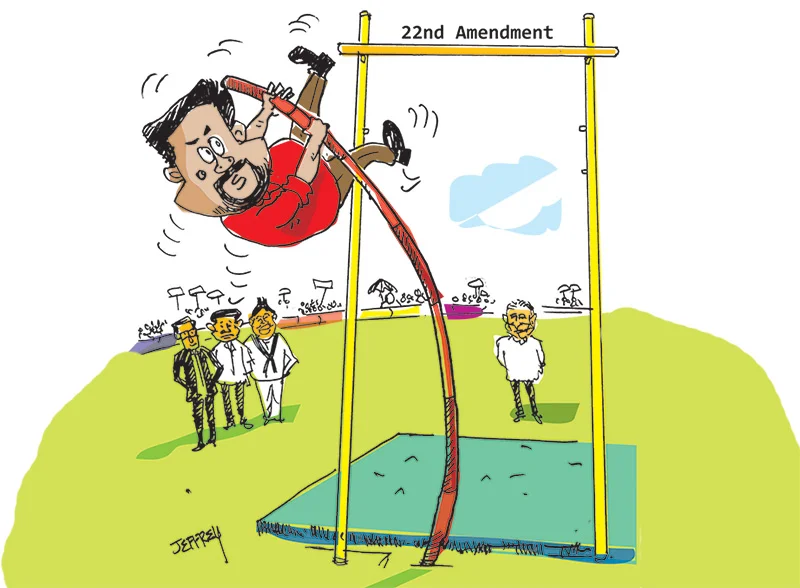
The government’s high profile project to enact the 22nd Amendment failed to secure any tangible support from anyone outside the NPP, in Parliament or outside. In a statement, the Illankai Thamil Arasu Kadchi (ITAK) noted that the proposed amendment concerned the sovereignty of the people and, therefore, required approval through a referendum. The ITAK, a key member of the six-party Political Council of Tamil-Speaking people (PCTSP) and the second largest party in the Northern and Eastern Provinces, other than the NPP, is opposed to President Dissanayake’s move. Tamil Progressive Party (TPA) leader and former Minister Mano Ganeshan, also of the PCTSP, has rejected the 22nd Amendment. The Island learns that all political parties, represented in the PCTSP, are opposed to the proposed Amendment.
The NPP obtained the most seats at the Parliamentary General Election 2024. Other parties that managed to gain seats in Parliament are the Samagi Jana Balawegaya (SJB/40 seats), Ilankai Tamil Arasu Kadchi (ITAK/8 seats), New Democratic Front (NDF/5 seats), Sri Lanka Podujana Peramuna (SLPP/3 seats), Sri Lanka Muslim Congress (SLMC/1), Sarvajana Balaya (SB/1), United National Party (UNP/1), Democratic Tamil National Alliance (DTNA/1), All Ceylon Tamil Congress (ACTC/1), All Ceylon Makkal Congress (ACMC/1), Jaffna – Independent Group 17 (IND17-1) and the Sri Lanka Labour Party (SLLP/1).
Timeline
* March 30, 2026, BASL wrote to Justice and National Integration Minister Harshana Nanayakkara seeking a meeting to discuss 22A
* May 25, 2026, BASL wrote to President Dissanayake seeking a meeting to discuss the same
* July 16, 2026, BASL wrote again to the Justice Minister underscoring the failure on his part and the President to respond to previous letters
* July 27, 2026, NPP executive committee member advocate Lal Wijenayake declared opposition to the government move
* July 29, 2026, BASL met the Justice Minister, sought a meeting with President Dissanayake
* July 31, 2026, Mahanayakes of four Chapters (Nikayas) wrote a joint letter to President Dissanayake urging him not to go ahead with the 22nd Amendment. But, the Mahanayakes refrained from releasing the letter to the media
* August 3, 2026, BASL disclosed the Mahanayakes’ letter to the President. Justice Minister Nanayakkara, accompanied by Health and Media Minister Dr. Nalinda Jayathissa, visited the Mahanayakes to explain the government stand. But, they denied receiving the crucial letter
* August 7, 2026, UN requested President Dissanayake, in no uncertain terms, to abandon the move.
* August 11, 2026, Government admitted receiving the Mahanayakes letter
* August 18, 2026, 22nd Amendment Bill presented in Parliament. Those opposed to the constitutional amendment began filing petitions. The BASL led the way. By 24 August, 21 petitions were filed.
* August 20, 2026, Catholic Bishops’ Conference urged the government not to proceed without adequate consultations.
* August 24, 2026, BASL, in a motion filed in the Supreme Court, suggested that Chief Justice Preethi Padman Surasena recuse from hearing the petitions
By Shamindra Ferdinando
In support of the ruling National People’s Power (NPP) government’s highly contentious move to enact the 22nd Amendment to the Constitution despite worldwide condemnation by eminent jurists, meant to extend the retirement ages of superior court judges, NPP leader and President Anura Kumara Dissanayake will address a series of countrywide meetings.
Dissanayake is also the leader of the Janatha Vimukthi Peramuna (JVP), the main constituent of the governing party.
Justice and National Integration Minister and Attorney-at-Law Harshana Nanayakkara, on 18 August, 2026, tabled the controversial 22nd Amendment Bill in Parliament. Nanayakkara also tabled the Judicature (Amendment) Bill on the same day. That will pave the way for the increase of the retirement ages of High Court judges to 63 years, and District Court and Magistrate Court judges to 62 years. The government wants to increase the retirement ages of Supreme Court and Court of Appeal judges to 67 and 65, respectively.
However, the government has proposed a six-year term for the Chief Justice but he/she will have to retire at the new mandatory retirement age of 67.
Health and Media Minister, as well as Cabinet spokesman Dr. Nalinda Jayathissa, recently announced the decision to launch the high profile propaganda campaign on 5 September. The NPP and JVP leader has vowed to enact the 22nd Amendment, come what may.
Dissanayake, who took over the party leadership on 2 February, 2014, at the 17th convention of the JVP, and formed the NPP in 2019, has indicated that he wouldn’t, under any circumstances, give up the 22nd Amendment. Dissanayake didn’t mince his words when he received a top level delegation of the Bar Association of Sri Lanka (BASL) at the Presidential Secretariat, on 12 August, to discuss the burning issue wracking the country. It would be pertinent to mention that the BASL raised the issue with Dissanayake, on 25 May, after Nanayakkara ignored their first request, made on 31 March.
The Supreme Court will hear over 20 petitions challenging the constitutionality of the 22nd Amendment Bill. Now that the matter is before the Supreme Court, the main opposition Samagi Jana Balawegaya (SJB) shouldn’t have sought to involve the BASL in a futile attempt to educate the NPP parliamentary group. The BASL, too, should know better. The BASL and SJB are among those who moved the Supreme Court. Against that background it would be unthinkable that the NPP parliamentary group wants to listen to BASL. Government activists, on Monday (24), organised a protest outside BASL Secretariat, NO. 153, Mihindu Mawatha, Colombo 12 demanding the resignation of BASL President Rajeev Amarasuriya.
SJB and Opposition Leader Sajith Premadasa clashed in Parliament with the leader of the House Bimal Rathnayake over his bid to bring in the BASL team to address the whole Parliament. NPP National List lawmaker Najith Indika declared on X that “the Opposition Leader couldn’t call all MPs for meetings. BASL either does not follow parliamentary procedure or knows how to manipulate public perception.”
The Supreme Court will receive petitions during two weeks, after the tabling of the Amendment. The Court should inform the Speaker of its determination within three weeks. Parliament will receive that determination ahead of President Dissanayake completing his second year in Office. The last presidential election was held on 21 September 2024.
Dissanayake won a five-year term and in November, the same year, led the party to a resounding victory at the parliamentary poll. The NPP/JVP position is that both Bills can be enacted with a 2/3 majority. With a mammoth 159 seats in Parliament, the government is confident that its political project can be easily achieved. But, the NPP operation has run into significant opposition with the United Nations, throwing its weight behind the BASL-led campaign.
Tabling of the two Bills on 18 August coincided with the 39th anniversary of the JVP grenade attack on the UNP parliamentary group, in the wake of the signing of the Indo-Lanka peace accord in 1987. Ajith Kumara, at that time a minor parliamentary employee, lobbed a hand grenade at the UNP group meeting, chaired by President J.R. Jayewardena. Prime Minister Ranasinghe Premadasa, too, was present. The then National Security Minister Lalith Athulathmudali narrowly escaped death in the attack that took place in the Committee Room 1 of Parliament. Deniyaya MP and Matara District Minister Keerthi Abeywickrema was killed. The writer covered the funeral, held on 22 August, 1987, at the playground of the Morawaka Maha Vidyalaya. Then the young Minister in charge of Youth Affairs and Employment, Ranil Wickremesinghe, was among those who represented the government at the funeral.
Kumara had been recruited as a sweeper by no less a person than the then Secretary General of Parliament, Nihal Seneviratne. Had Kumara been a member of the proscribed JVP at the time he joined the parliamentary staff or did the JVP approach him later?
The Colombo High Court acquitted Ajith Kumara on 12 October, 1990, and released him from custody on 6 August, 1993. Subsequently, the JVP accommodated Ajith Kumara on the party’s politburo and paved the way for him to contest the Sabaragamuwa Provincial Council poll on the JVP ticket. With fat hopes the JVP named him their chief ministerial candidate.
Key Opp demands
Pointing out that the matter before the Supreme Court judges related to them, the BASL requested that a bench consisting of a full court, comprising all the judges, be constituted to determine the constitutionality of the 22nd Amendment Bill. The BASL also requested the Supreme Court to determine that the Bill is inconsistent with Article 3 of the Constitution and required approval by the people at a referendum.
In the alternative, the BASL sought determination that Clause 2 of the Bill is inconsistent with Article 3 of the Constitution and required approval by the people at a referendum and Clause 3 of the Bill is inconsistent with Article 3 of the Constitution and required approval by the people at a referendum.
Essentially, all petitioners have requested for a full court, comprising all Supreme Court judges and a referendum, if ordered, it’ll be the second instance. The first referendum was held in December 1982. The UNP that won an unbeatable 5/6 majority in a 168-member Parliament, at the 1977 parliamentary election, obtained a mandate of the people to extend the life of Parliament by six years. That utterly undemocratic, unreasonable and treacherous act contributed to the overall deterioration of the country. By the time the 1989 parliamentary poll was held, the police, backed by the armed forces, were fighting the JVP in the South, and the Indian Army, deployed in the Northern and Eastern regions, in terms of the Indo-Lanka Accord.
Former External Affairs Minister Prof. G. L. Peiris, convenor of the Joint Opposition grouping, too, moved the Supreme Court against the 22nd Amendment, and General Secretary of the SJB Ranjith Maddumabandara did the same. Altogether there were nearly two dozen petitioners
Ex-Law Professor Peiris has vigorously campaigned against the government move, and the weekly media briefing. held at former President Wickremesinghe’s Flower Road Office, has become the focal point of the Opposition campaign. Peiris insists that the Supreme Court shouldn’t hear the petitions as justices were direct beneficiaries of the proposed Amendment. Therefore, determination should be made at a referendum. In case the Supreme Court decides to hear the petitions, the full court consisting of all judges should be constituted to determine the constitutionality of the 22nd Amendment Bill, the former parliamentarian has asserted.
As repeatedly stressed by Prof. Peiris, two previous determinations by the Supreme Court that the alteration of superior court judges’ retirement ages should be subject to a referendum cannot be disregarded, under any circumstances. One of the determinations is of crucial importance as former Chief Justice Murdhu Fernando (December 2024 to July 2025) served on the three-member bench that made the far reaching announcement in 2022.
But, the BASL made an unexpected move on Monday. Close on the heels of its petition against the 22nd Amendment to the Constitution, the BASL filed a motion in the Supreme Court suggesting that Chief Justice Preethi Padman Suresena recuse from hearing petitions.
Petitioners BASL President Rajeev Amarasuriya and its Secretary Nalin de Silva cited Attorney General as the respondent in a motion filed in terms of Article 121 read with Article 120 of the Constitution to determine whether the Bill, titled “Twenty Second Amendment to the Constitution,” or any part thereof, is required to be passed by a Referendum in terms of Article 83 of the Constitution.
The BASL pointed out that the first Judge of the Supreme Court, who would benefit if this Bill is enacted into law without the process of a referendum, is the Chief Justice, and further that if a referendum is mandated, then that there is a possibility that the Chief Justice may retire before its completion, and if for those reasons, the Chief Justice wished to recuse from hearing this matter, then the petitioners have requested the Chief Justice to constitute a bench comprising of all other judges in Supreme Court.
The maximum number of Supreme Court and Court of Appeal judges are 17, including the CJ and 20 judges ,including the President of the Court of Appeal, respectively. The NPP caused controversy by not filling vacancies among the superior court judges with the Opposition alleging there were four vacancies each. There’ll be another vacancy among the Court of Appeal judges in the first week of September.
The warning issued by the UN following a spate of other statements from various local and international bodies has brought tremendous pressure on the government. Having initially denied any knowledge of a joint letter, dated July 31, addressed to President Dissanayake by the Malwatta, Asgiriya, Amarapura and Ramanna chapters, the government, on 11 August, admitted the President received the letter.
However, the Catholic Bishops Conference publicly commented on this issue, only on 20 August, after all other concerned parties censured the government over the move. A section of the civil society that portrayed the 22nd Amendment as the panacea for a mountain of cases held up in courts had no option but to sing a different tune after the UN warned the NPP government over the pet project that seemed to have backfired. The UN’s position rattled the government and its backers.
18A and 20A
War-winning President Mahinda Rajapaksa enacted 18th Amendment to the Constitution in early September 2010. That despicable political project did away with a two-term time limit for the executive president and expanded presidential powers over independent commissions. That Bill received 161 votes, two more than the NPP parliamentary group. But, 18A didn’t do any good for President Rajapaksa or his party. Maithripala Sirisena, General Secretary of Mahinda Rajapaksa’s party, betrayed him, won the 2015 presidential election, and created an utterly undesirable political environment that, over a period of 10 years, ruined the country’s major political parties.
The emergence of the NPP as the dominant power should be examined taking into consideration the deterioration of the UNP, SLFP and the SLPP. The UNP and SLFP are no longer represented in Parliament while the SLPP that won a commanding 145 seats at the 2020 parliamentary poll was reduced to just three lawmakers in Parliament. SLPP’s National Organiser Namal Rajapaksa was so concerned about the transformation of the political environment he took refuge in the National List. Had he not taken that precaution, he wouldn’t be in Parliament today. While the SLPP deteriorated from 145 seats to just three, the NPP, whose 2020 parliamentary group consisted of just three, including one National List member (Dr. Harini Amarasuriya) ended up taking 159 seats, the best results achieved under the Proportional Representation system introduced in 1989.
Having handsomely won the 2019 presidential election, Gotabaya Rajapaksa brought in the 20th Amendment aimed at further consolidating his hold on power. Basil Rajapaksa, a dual citizen of Sri Lanka and the US, wanted to enter Parliament through the National List. The Rajapaksas removed a particular clause through the 19th Amendment to enable Basil Rajapaksa to enter Parliament. Subsequently, the SLPP accommodated Basil Rajapaksa in the Cabinet as the all-powerful Finance Minister. He succeeded Mahinda Rajapaksa in July 2021. But by then, the national economy had suffered irreparable damage and the 20th Amendment, meant to consolidate executive power, seemed irrelevant. Public protest campaign that received overt and covert US and Indian backing was launched in March 2022, leading to President Gotabaya Rajapaksa’s unceremonious ouster in July of same year due to India and Western backed violent protests.
The 18th Amendment and the 20th Amendment were enacted at the expense of particularly the 17th and 19th Amendments, respectively.
The Frontline Socialist Party (FSP) has alleged that the 22nd Amendment would enable the government to implement its neoliberal programme. The breakaway JVP group has asserted that the government’s sinister project is intended to remove whatever obstacles to its neoliberal strategy.
FSP’s Education Secretary Pubudu Jayagoda said: “A new Fisheries Act will divide the ocean into plots, lease the fish-rich areas to multinational corporations, and deprive local fishermen the opportunity to catch fish in the deep sea. The biggest obstacle to this is the fishermen. A Quality Assurance and Accreditation Commission Act is being drafted to grant state recognition and legality to degree mills. Three thousand schools are going to be closed, depriving children of the fundamental right to education. To do that, every pillar of the state must be brought under government control. A long list can be given: privatising hospital laboratory services, selling off state institutions, bringing forward new repressive laws like the PSTA (Protection of the State from Terrorism Act), and a new Cooperatives Act that snatches away people’s funds—many things like that. Taking the arbitrary power required to execute these into the hands of the executive is the true objective of this constitutional amendment.”
Displaying Gender-Based Issues that Resonate with Our Times
by Dr. Siri Galhenage
Psychiatrist [Retd]
In most of William Shakespeare’s plays, the protagonists are male. He created such memorable characters as Hamlet, Othello, King Lear, Macbeth, Julius Caesar, Prospero, Coriolanus, the monarchs of history plays and many others – heroes as well as villains. This was a reflection of the societal values of the time. Women were not permitted to perform on stage, and all female roles were played by young males – a practice that continued for nearly half a century after Shakespeare’s death. This was so even though Elizabeth 1, the learned female monarch of England and Ireland and a humanist, occupied the throne during most of Shakespeare’s writing life [1580–1613], and extended her patronage to his plays.
Nevertheless, compared with his contemporaries Christopher Marlowe and Ben Jonson, Shakespeare wrote a greater number of plays featuring prominent female characters that drove the narratives, providing insights into intra-psychic, interpersonal, social and moral aspects of life.
I have selected two such female characters from Shakespeare’s plays and another from one of his narrative poems to illustrate this idea, focusing primarily on gender based violence – emotional, physical and sexual – that continues to resonate in our own times. I have also chosen another female character who challenged the gender constraints that imposed by contemporary society.
DESDEMONA in Othello –
A Victim of Morbid Jealousy
A scene from As You Like It
Jealousy, as a human experience, has many nuances of meaning, ranging from the harmless to the morbid, including delusional forms, with many variations in between. The object of concern in jealousy is the suspicion of unfaithfulness or infidelity on the part of a loved one, commonly a female partner in a marital relationship. In its morbid form, accompanied by intense passion, jealousy has the potential to be destructive and even dangerous, placing the spouse at risk. It is not an uncommon presentation in clinical practice attracting the diagnosis of ‘Othello Syndrome’ although there is disagreement among clinicians about the application of the term.
Othello, a valiant soldier of African heritage in the state of Venice, had no difficulty winning the heart of Desdemona, the attractive young daughter of a prosperous senator. He took her away in defiance of her father’s wish for her to marry into the Venetian nobility. At this point, the Turks were preparing to regain Venetian-held territory in Cyprus, and Othello, recognised for his military prowess, was selected to lead the defence of the territory.
Despite the imminent Turkish attack on Cyprus, Desdemona preferred to remain with her husband rather than stay in Venice. The attack did not eventuate, however, because a violent storm dispersed and destroyed the invading Turkish fleet. The Venetian forces rejoiced, and the occasion provided an added opportunity to celebrate the marriage of Othello and Desdemona.
Casio, a close confidant of Othello, who had been recently promoted to lieutenant, was delegated to supervise the festivities. Cassio’s promotion caused great offence to Iago, who strongly believed that he was better suited to the position. He plotted to take revenge on Othello and Cassio by planting the seed of doubt in Othello’s mind through innuendo and trickery, casting suspicion on Desdemona’s fidelity and on her relationship with good-looking Cassio. Desdemona, a woman of exuberance and humour, became the unwitting focus of Iago’s manipulation.
The dissonance that arose in Othello’s mind eventually reached a climax when he accused his wife of infidelity and became convinced that she should die. Despite Desdemona’s plea for compassion, Othello strangled her to death. On finally gaining insight into the whole saga, Othello fell on his sword beside his wife.
OPHELIA in Hamlet – A Case of Manic Defence in response
to emotional abuse
Hamlet, the Prince of Denmark, takes centre stage in the play of the same name, and his mental processes have been the focus of scrutiny by successive generations of critics.
Young Prince Hamlet is faced with a complex emotional challenge following the sudden death of his father, King Hamlet, he idolised. The late king’s brother, usurper to the throne, hastily marries the widowed queen, denying the young prince his lawful right to sovereignty. Hamlet’s grief is compounded by his outrage towards his mother and his lingering doubts about the circumstances of his father’s death. He lapses into a state of melancholy.
But the impact of Hamlet’s emotional instability and the displacement of his anger onto Ophelia, to whom the prince had professed his love, receive less attention by critics, despite the significant psychological issues raised by her predicament. The episode in which Hamlet directs his anger towards Ophelia – often referred to as the ‘nunnery scene’ – is considered one of the most vicious in all Shakespeare.
Get thee to a nunnery. Why wouldst thou be a breeder of sinners?”…. “If thou dost marry, I’ll give this plague for thy dowry, be thou as chaste as ice, as pure as snow, thou shall not escape calamity. Get thee to a nunnery; go, farewell. Or if thou wilt needs marry, marry a fool, for wise men know well enough what monsters you make of them. To a nunnery go, quickly too. Farewell
Her love for Prince Hamlet was forbidden from the outset by her father, the scheming counsellor, Polonius, and by her brother Laertes; she was obedient to them. With her dignity destroyed by the very person she loved and her father killed, albeit inadvertently by the hand of her lover, she nevertheless reacted with compassion. With her brother away in France, Ophelia is bereft of any meaningful relationships.
With no one left to confide in, her mind had no alternative but to escape reality. She lapsed into a state of mania – a state of ‘fragile happiness’ with underlying deep sorrow; an unconscious defensive operation of the mind known as ‘manic defence’, as described by Melanie Klein [1882-1960], the renowned Austrian Psychoanalyst.
In this state of mind, Ophelia presents herself before the king and queen, singing snatches of song concerning love, death and betrayal. Her behaviour is totally out of character to her formerly demure self. Here are a few excerpts from her verses illustrating what might be described as a ‘flight of ideas’.
How should I your true love know/ From another one? / By his cockle hat and staff/ And his sandal shoon…”
“He is dead and gone, lady/ He is dead and gone/ At his head a grass green turf/ At his heels a stone…
They say the owl was a baker’s daughter. Lord we know what we are, but know not what we may be. God be at your table …
Hey non nonny, nonny, hey nonny/ And in his grave rained many a tear …” “You must sing ’Adown adown’ and you call him adown-a.”
Later, Queen Gertrude, Hamlet’s mother, announced that Ophelia ‘Fell in a weeping brook while making garlands from crow-flowers, nettles, daisies and long purples’, and had made no attempt to save herself. At the graveyard two gravediggers discussed whether she deserves a Christian burial as she appeared to have taken her own life.
LUCRECE – in Shakespeare’s narrative poem The Rape
of Lucrece
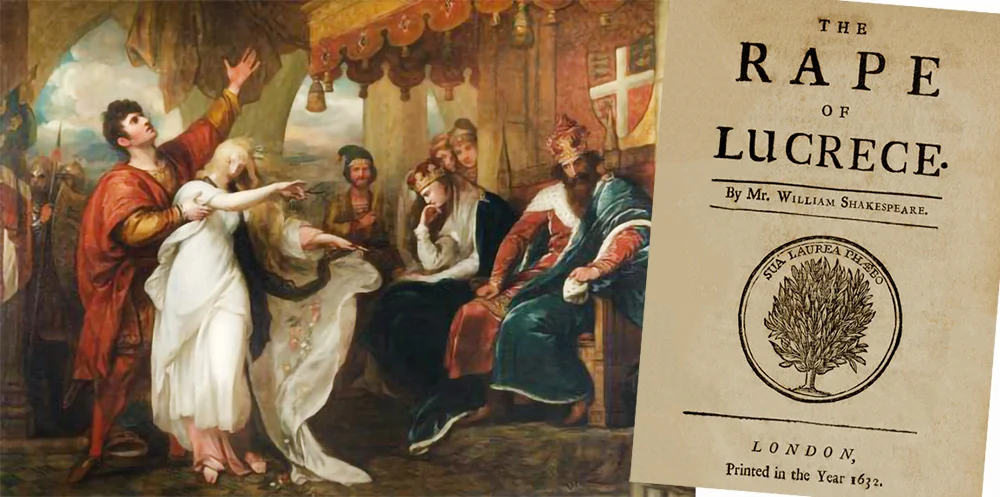
Reworked from a story by the Roman historian Livy, Shakespeare’s innovative narrative poem, first published in 1594, gives access to the mind of a victim of sexual assault. Set in ancient Rome, the poem gives expression to the agony of Lucrece, the gracious wife of a nobleman, following a savage attack upon her by Sextus Tarquinius, the son of the brutal king Lucius Tarquinius of Rome.
During a joyous conversation, a group of young noblemen were commenting on the virtues of their wives when Collatinus extolled the incomparable beauty and chastity of his beloved Lucrece. Aroused by the description of her elegance, young Sextus makes a covert exit, ‘borne by the trustless wings of desire’ in pursuit of his prey –the peerless dame’, ‘weakly fortressed from a world of harm.
Lucrece warmly welcomes her royal guest, who shows no inward ill or outward harm. He praises her husband’s military prowess, ‘pawning his honour to obtain his lust. During the conversation he scans her beauty and burns with sexual desire, yet ‘is madly toss’d between desire and dread. His ambivalence finally gives way to desire. ‘Desire my pilot, beauty my prize/ ‘Then who fears sinking where such treasure lies?’ This said, he advances upon her, ‘like a falcon towering in the skies, that ‘Coutcheth the fowl with his wings’ ‘So under his insulting falcon lies/ Harmless Lucretia’ shade’, trembling with fear, ‘as fowl hear falcon’s bells’. She ‘lies at the mercy of his moral sting’ and finally succumbs ‘To the rough beast that knows no gentle right/ Nor aught obey but his foul appetite’.
Lucrece is shattered, perplexed and grief-stricken by the unexpected assault on her by her honoured guest. ‘I alone must sit and pine/ Seasoning the earth with showers of silver brine’. She weeps, ‘O unseen shame, invisible disgrace/ O unfelt sore, crest wounding private scar’. Her anguish is further expressed through the image of the violated hive. ’My honey lost, and I, a drone – like bee, have no perfection of my summer left/ But robb’d and ransack’d by injurious theft./ In thy weak hive a wand’ring wasp hath kept/ And suck’d the honey which thy chaste bee kept’.
In this state of mourning, Lucrece despatches two messengers: one to her father in Rome and the other to her husband on the battlefield. On their arrival, she reveals the circumstances of her agony and names the individual responsible. She then stabs herself to death.
Their entourage carry her body through Rome and vow to avenge the death of this ‘incomparable woman of chaste’. By public acclaim the reign of Tarquins is overthrown, and the rule of Rome handed over to the consuls.
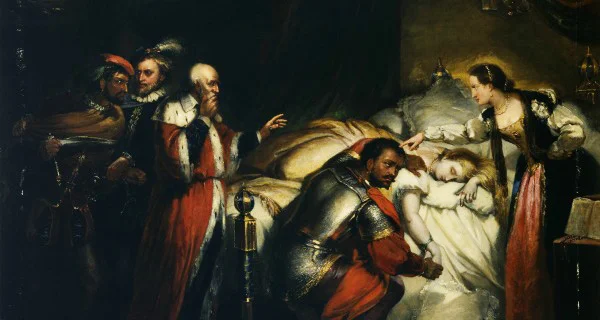
A scene from Othello
ROSALIND in ‘As You Like It’ – Challenging the Gender Constraints
One of the few female characters to play a leading role is Rosalind in ‘As You Like It’. She remains much to the liking of many a theatre goer because of her wit, wisdom and inner strength. Rosalind transcends the constraints imposed on women during the Shakespearean era – constraints that continue to resonate in certain cultures even today.
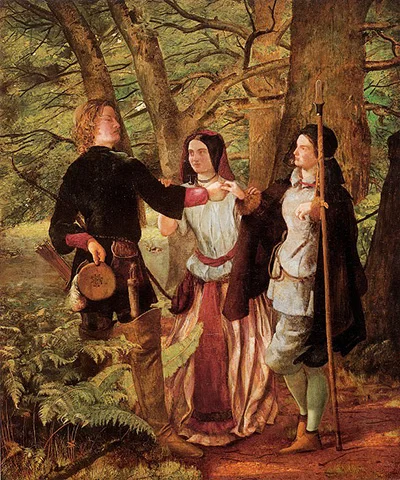
Two young women of noble birth flee the oppressive court in disguise and seek refuge in the Forest of Arden. Rosalind disguised as a young man, Ganymede, while her devoted cousin Celia adopts the name Aliena. As they depart Celia declares, “Now go we in content/ To liberty, and not to banishment.” Orlando, the object of Rosalind’s affection, also escapes to the forest to evade the hostility of his brother. Unaware of Rosalind’s disguise, he expresses his love by hanging verses in her praise upon the trees. Although Rosalind discovers these poems, she chooses to maintain her disguise, using it as an opportunity to test Orlando’s devotion and explore the nature of love, courtship, and the differing gender expectations. The play reaches a conclusion by Rosalind dropping her disguise, and the two uniting in love.
*****
Gender-based violence is recognised globally as a pervasive violation of human rights and a significant social, cultural and public health concern. Violence against women, including emotional, physical and sexual, varies across societies in form and prevalence, and is often rooted in unequal power relations and social structures that perpetuate male dominance. Gender-based violence requires collective action through education, legal protection, economic empowerment, accessible support services and changes in attitudes and cultural practices. Power and influence should not be allowed to shield the perpetrators.
Art, including dramatic and literary art, serves to illuminate human experience. It allows us to explore emotions, ideas and moral dilemmas that may otherwise remain beyond ordinary expression. Art can entertain and inspire, but it can also challenge our assumptions, evoke empathy, and offer new ways of seeing ourselves and the world around us. In this sense, art is not merely a form of aesthetic pleasure; it is a means of understanding what it means to be human.
Desdemona, Ophelia, Lucrece and Rosalind are among Shakespeare’s more prominent female characters. The first three are innocent victims of male violence in different forms, evoking our empathy and compassion; the fourth challenges the gender assumptions and constraints of the time. Together, they illuminate gender-based issues that are both universal and timeless. In this sense, Shakespeare remains ‘our contemporary’, as Jan Kott, Polish-American literary critic, famously observed.

By Lynn Ockersz
Nature’s not on any vengeance trail….
Rather, from dense forests of the West,
Now all aflame in parts as if in rage,
To South-East Asia’s savaging floods,
And Sri Lanka’s fierce dry spells,
Where man and beast are imperiled,
Nature’s signaling she’s distressed,
Over her custodian’s ravenous lust,
Which unceremoniously gobbles-up,
Her graciously bestowed riches;
‘Take warning; slow down at least now’,
She seems to be chiding her wayward son,
‘Be gentle with me and all my treasures,
And I’ll look to your continuing wellness,
But rein-in your self-destructive fire,
Lest it consumes your willful self in full,
And all I have left in your custodial care.’

Amendment of the Quarantine and Prevention of Diseases Ordinance No. 3 of 1897
Cabinet approves donation of USD One Million to the Government of Nepal

Nahida, Marufa help Bangladesh brush aside Indonesia

Showers will occur in the Western, Sabaragamuwa, Southern and Uva provinces and in Kandy and Nuwara-Eliya districts

Sun directly overhead Kalpitiya, Talawa, Sinharagama, Galkadawala, Nachchaduwa, Padikaramaduwa, Gomarankalla and Verugal about 12.10 noon today (01)

SJB asks what Speaker intended to do about allegations against CJ

‘Dates have the highest sugar content to fight Coronavirus’

Sunday Island 27 December – Headlines

#SundayIsland 17th December – Headlines

Sunday Island – 28th March

Sunday Island Headlines – 21 March

Sunday Island – 21st February – Headlines
-

 News5 days ago
Eight politicians in drug kingpin probe
-

 Features3 days ago
“Wrap Me Up in My Blazer”— A Gentlemanly Bradby Reminiscence
-

 Business5 days ago
Sri Lanka opens up: A new season of direct connectivity
-

 Features5 days ago
Redefining ageing in Sri Lanka
-
 Features7 days ago
Insights from Chieftains of Uva: Genealogy of two Kandyan Families – Part II
-
 Latest News5 days ago
Nepal-Tibet floods: What happened, what caused them and who is missing?
-

 Editorial7 days ago
Warning of power cuts: El Niño and corruption
-

 Features7 days ago
Export diversification: Missing the wood for the trees – Part I