
Sports
Promising Lahiru shines bright with 1500m bronze


St. Aloysius’ College, Rathnapura athlete Lahiru Achintha accomplished a rare achievement as he clocked sub four minutes to win a bronze medal in the 1500 metres at the Asian Youth Athletics Championship in Dammam, Saudi Arabia.
He became the first youth athlete from Sri Lanka to have won a medal in the challenging discipline at the six editions old championship when he returned a time of 3:59.47 seconds to finish third.
Qatar’s Mubarak Abdi Said and Lebanon’s Mahmoud Abou Zeid finished first and second respectively. The 16-year-old Achintha was the youngest on the podium as he continues to shine as a clear future prospect for Sri Lanka.
Not many Sri Lakan athletes have clocked sub four minutes in the 1500 metres in the Under 18 age category. The national youth (U18) record of the distance remained 4:00.14 seconds from 2019 to 2024.
At the first selection trial held in February, both Achintha and Shavindu Awishka bettered the Under 18 youth record. While Awishka clocked 3:58.24 seconds to establish a new youth record, Achintha came up with a feat of 3:59.24 seconds to better the previous record.
Achintha also established a national youth record in the 3000 metres before the Asian event, prompting Sri Lanka Athletics to pick him for the team.
Achintha showed promise as a 14 year old when he turned tables on athletes in the Under 20 age category to win the cross country race held in January 2024.
Achintha’s bronze victory was a huge consolation for the Sri Lakan team in Dammam after the country’s two female athletes missed the corresponding girls event due to a faux pas.
Sri Lanka also won a silver medal on Wednesday when Lyceum International Wattala sprinter Dananjana Fernando finished second in the girls 100 metres.She clocked 11.92 seconds to beat India’s Aarti to the third place.
by Reemus Fernando


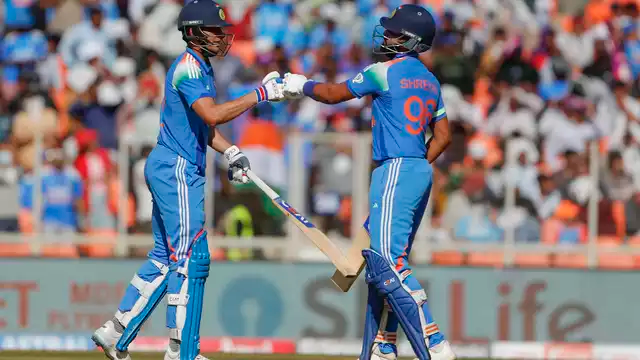
Squad for the first three ODIs: Shubman Gill [C], Rohit Sharma, Virat Kohli, Shreyas Iyer [VC], KL Rahul [WK], Nitish Kumar Reddy, Axar Patel, Naman Dhir, Anshul Kamboj, Gurnoor Brar, Ruturaj Gaikwad, Arshdeep Singh, Ishan Kishan [WK], Mohammed Siraj, Prasidh Krishna*, Kuldeep Yadav
Squad for fourth and fifth ODIs: Shreyas Iyer [C], Rohit Sharma, Virat Kohli, Tilak Varma, Ishan Kishan [WK, VC], Nitish Kumar Reddy, Axar Patel, Naman Dhir, Auqib Nabi, Gurnoor Brar, Ruturaj Gaikwad, Arshdeep Singh, Kumar Kushagra [WK], Mohammed Siraj, Yash Thakur, Kuldeep Yadav
[Cricbuzz]

Football’s Asian Cup, hosted by Saudi Arabia, could be moved back a year to 2028 following a series of attacks on the country by Yemen’s Houthis.
The continental tournament will be rescheduled “if we need to” but the organisers are in “no hurry” to make a decision, Asian Football Confederation President Sheikh Salman bin Ebrahim Al Khalifa said on Thursday.
The 2027 Asian Cup is supposed to kick off on January 7 in the Saudi cities of Jeddah, Riyadh and al-Khobar.
The kingdom has in recent days come under sustained attack in a dramatic escalation from the Houthis.
“We can wait until the end of November,” Al Khalifa told reporters in Zurich on Wednesday about a decision on the fate of the Asian Cup.
“Things can change very quickly for better or worse in the region, and it is a question of seeing what happens,” he added.
“If we need to make a decision then we will, but we could move back a year to 2028 if we need to.
“But at the moment we are monitoring the situation and everything is on schedule.”
Cristiano Ronaldo’s Al-Nassr saw their Asian Champions League match delayed by an hour on Monday after Saudi Arabia’s Civil Defence said it had intercepted a missile fired towards Riyadh.
Three matches in Saudi domestic football, including one involving Al-Nassr, were postponed this week.
(Aljazeera)

All Island Schools Games Athletics Championships
by Reemus Fernando
The Under 18 boys’ shot put meet record will be under severe threat today, when the most talked-about thrower of the last All Island Schools Games Athletics Championships takes to the field on the opening day at Diyagama.
Mayon Rajasinghe, now competing for his third school in four years, has shown steady progress this season and appears to be peaking at the right time to attempt another record-breaking performance on the junior circuit.
Having recently set a new meet record of 17.31m at the Western Province Schools Games, Mayon will now try to surpass the All Island Schools Games Under 18 record of 17.15m.
The first two age-category records in the Games’ shot put event already bear his name. He set the current Under 14 record of 15.13m while representing Prince of Wales College, Moratuwa. Last year, while attending St. Joseph’s College, Darley Road, he shattered the Under 16 meet record with a throw of 18.57m using the 4kg shot. It is the furthest any Sri Lankan has thrown in the Under 16 category at any meet, from the Junior National Championships to the Sir John Tarbat Senior Championships to the Schools Games.
Yet the outstanding performance did not receive the recognition it deserved. His father, who also trains him, was adamant that the then 16-year-old deserved the meet’s Best Athlete title. The organisers disagreed, citing the differing weights of implements across age categories as their reason for setting the performance aside. No clear criteria had been announced before the meet, which made such disappointment all but inevitable. Senior Rajasinghe’s outburst after the presentation ceremony, and the social media backlash that followed, have had an effect: the Ministry of Education has now published criteria for selecting the meet’s best athlete. However, it remains doubtful whether the criteria in the competition manual can offer athletes in different age categories and disciplines an equal opportunity to have their performances assessed fairly.
This year Mayon represents Holy Cross College, Kalutara. He has picked up where he left off last year, breaking record after record, and is poised to make an impact once again.
The championship begins with a card of eight finals. Around 5,000 athletes in the Under 14, 16, 18 and 20 age categories, representing all nine provinces, will take part in the five-day event after qualifying through house, divisional, zonal and provincial competitions.

Iyer to lead in last two New Zealand ODIs, Kushagra earns maiden call-up

Pope pictured for first time since surgery and cancer diagnosis

Qatar announces ‘massive’ solar plant project in Lebanon

Samagi Spice Exports to launch Ceylon Cinnamon based beverage range

Asian Cup in Saudi Arabia could be postponed by a year amid Houthi attacks

Houthi missile attack on Yemeni presidential palace kills five, minister says

‘Dates have the highest sugar content to fight Coronavirus’

Sunday Island 27 December – Headlines

#SundayIsland 17th December – Headlines

Sunday Island – 28th March

Sunday Island Headlines – 21 March

Sunday Island – 21st February – Headlines
-

 News6 days ago
Sri Lanka escalates anti-graft drive with Shiranthi’s jailing
-

 News7 days ago
NPP govt. reminded of its responsibilities as US warship leaves Colombo
-
 Latest News7 days ago
Farhan, Sadaqat help Pakistan ace 183 chase to go 1-0 up
-

 Latest News5 days ago
Farhan and Sadaqat help Pakistan seal series in style
-

 News6 days ago
Iranian ships stranded, Lanka fears US sanctions
-

 Latest News3 days ago
Nissanka’s return headlines Sri Lanka’s Test squad against Pakistan
-
 News7 days ago
Interdicted top House official Kularatne receives special recognition in Mexican Parliament
-
 Features5 days ago
Intake 16: 45 years of duty and honour