
Latest News
Scientists find ‘strongest evidence yet’ of life on distant planet


Scientists have found new but tentative evidence that a faraway world orbiting another star may be home to life.
A Cambridge team studying the atmosphere of a planet called K2-18b has detected signs of molecules which on Earth are only produced by simple organisms.
This is the second, and more promising, time chemicals associated with life have been detected in the planet’s atmosphere by Nasa’s James Webb Space Telescope (JWST).
But the team and independent astronomers stress that more data is needed to confirm these results.
The lead researcher, Prof Nikku Madhusudhan, speaking at his lab at Cambridge University’s Institute of Astronomy said that he hopes to obtain the clinching evidence soon.
“This is the strongest evidence yet there is possibly life out there. I can realistically say that we can confirm this signal within one to two years.”
K2-18b is two-and-a-half times the size of Earth and is 700 trillion miles, or 124 light years, away from us – a distance far beyond what any human could travel in a lifetime.
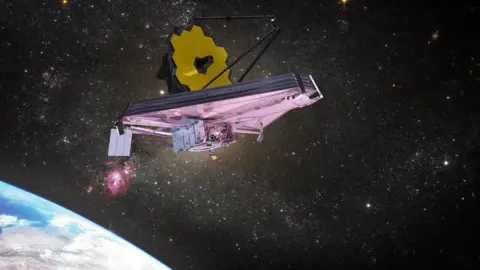
JWST is so powerful that it can analyse the chemical composition of the planet’s atmosphere from the light that passes through from the small red Sun it orbits.
The Cambridge group has found that the atmosphere seems to contain the chemical signature of at least one of two molecules that are associated with life: dimethyl sulphide (DMS) and dimethyl disulphide (DMDS). On Earth, these gases are produced by marine phytoplankton and bacteria.
Prof Madhusudhan said he was surprised by how much gas was apparently detected during a single observation window. “The amount we estimate of this gas in the atmosphere is thousands of times higher than what we have on Earth,” he said. “So, if the association with life is real, then this planet will be teeming with life,” he added.
Prof Madhusudhan went further: “If we confirm that there is life on K2-18b, it should basically confirm that life is very common in the galaxy.”
He told BBC Radio 5Live on Thursday: “This is a very important moment in science, but also very important to us as a species. “If there is one example, and the universe being infinite, there is a chance for life on many more planets.”
Dr Subir Sarkar, a lecturer in astrophysics at Cardiff University and part of the research team, said the research suggests K2-18b could have an ocean which could be potentially full of life – though he cautioned scientists “don’t know for sure”.
He added that the research team’s work will continue to focus on looking for life on other planets: “Keep watching this space.”
There are lots of “ifs” and “buts” at this stage, as Prof Madhusudhan’s team freely admits.
Firstly, this latest detection is not at the standard required to claim a discovery.
For that, the researchers need to be about 99.99999% sure that their results are correct and not a fluke reading. In scientific jargon, that is a five sigma result.
These latest results are only three sigma, or 99.7%. Which sounds like a lot, but it is not enough to convince the scientific community. However it is much more than the one sigma result 0f 68% the team obtained 18 months ago. which was greeted with much skepticism at the time.
But even if the Cambridge team obtains a five sigma result, that won’t be conclusive proof that life exists on the planet, according to Prof Catherine Heymans of Edinburgh University and Scotland’s Astronomer Royal, who is independent of the research team.
“Even with that certainty, there is still the question of what is the origin of this gas,” she told BBC News.
“On Earth it is produced by microorganisms in the ocean, but even with perfect data we can’t say for sure that this is of a biological origin on an alien world because loads of strange things happen in the Universe and we don’t know what other geological activity could be happening on this planet that might produce the molecules.”
That view is one the Cambridge team agree with. They are working with other groups to see if DMS and DMDS can be produced by non-living means in the lab.
“There is still a 0.3% chance that it might be a statistical fluke,” Prof Madhusudhan said.
Suggesting life may exist on another planet was “a big claim if true”, he told BBC Radio 4’s Today programme, adding: “So we want to be really, really thorough, and make more observations, and get the evidence to the level that there is less than a one-in-a-million chance of it being a fluke.”
He said this should be possible in “maybe one or two years”.
Other research groups have put forward alternative, lifeless, explanations for the data obtained from K2-18b. There is a strong scientific debate not only about whether DMS and DMDS are present but also the planet’s composition.
The reason many researchers infer that the planet has a vast liquid ocean is the absence of the gas ammonia in K2-18b’s atmosphere. Their theory is that the ammonia is absorbed by a vast body of water below.
But it could equally be explained by an ocean of molten rock, which would preclude life, according to Prof Oliver Shorttle of Cambridge University.
“Everything we know about planets orbiting other stars comes from the tiny amounts of light that glance off their atmospheres. So it is an incredibly tenuous signal that we are having to read, not only for signs of life, but everything else,” he said.
“With K2-18b part of the scientific debate is still about the structure of the planet.”
Dr Nicolas Wogan at Nasa’s Ames Research Center has yet another interpretation of the data. He published research suggesting that K2-18b is a mini gas giant with no surface.
Both these alternative interpretations have also been challenged by other groups on the grounds that they are inconsistent with the data from JWST, compounding the strong scientific debate surrounding K2-18b.
Prof Chris Lintott, presenter of the BBC’s The Sky at Night, said he had “great admiration” for Prof Madhusudhan’s team, but was treating the research with caution.
“I think we’ve got to be very careful about claiming that this is ‘a moment’ on the search to life. We’ve [had] such moments before,” he told Today.
He said the research should be seen instead as “part of a huge effort to try and understand what’s out there in the cosmos”.
Prof Madhusudhan acknowledges that there is still a scientific mountain to climb if he is to answer one of the biggest questions in science. But he believes he and his team are on the right track.
“Decades from now, we may look back at this point in time and recognise it was when the living universe came within reach,” he said.
“This could be the tipping point, where suddenly the fundamental question of whether we’re alone in the universe is one we’re capable of answering.”
The research has been published in The Astrophysical Journal Letters.
[BBC]

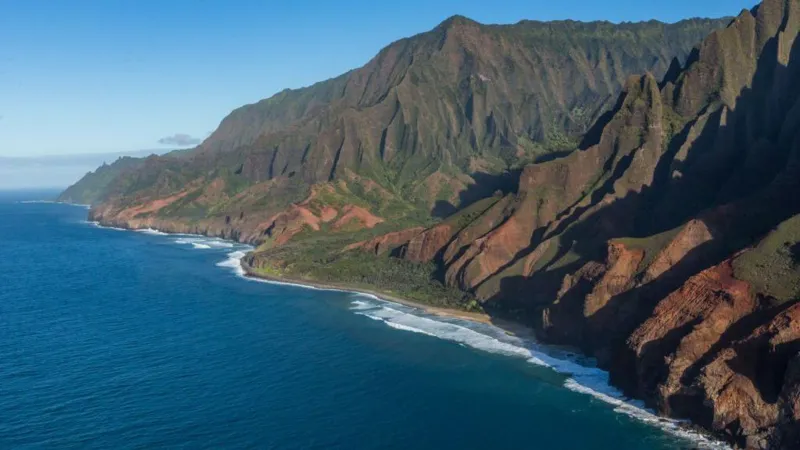
Three people have died after a helicopter crashed off the Hawaiian island of Kauai, police said.
The helicopter was carrying one pilot and four passengers, police said in a statement. Two survivors were taken to a hospital for treatment.
Police said the helicopter was operated by Airborne Aviation, a company whose website advertises “a doors-off thrill seekers adventure tour” of the picturesque island’s waterfalls, canyons, and beaches.
The US Coast Guard said the helicopter crash-landed about 100 yards off Kalalau beach. Authorities have not yet identified the victims.
Police said they responded to an alert of the crash at around 15:45 local time (01:45 GMT), along with the Coast Guard and fire department.
Kauai’s Mayor Derek Kawakami praised the recovery effort, telling local media: “Here on Kaua’i, whenever somebody puts their feet on our soil, they are one of ours.
“We treat them like one of ours, they are a part of our family, and our first responders respond with that spirit in mind.”
Andrew Williams, search and rescue mission co-ordinator for the Coast Guard in Honolulu, said: “We are greatly saddened by the loss of three lives in this helicopter crash and thinking of those individuals’ families and friends.”
Helicopter tours are a popular way for visitors to tour the island, which is where the blockbuster film Jurassic Park was shot.
Airborne Aviation’s 50-minute tour of the island offered a maximum of four passengers and costs $348 (£262) per passenger, according to its website.
BBC News has contacted Airborne Aviation for comment.
The incident is the latest fatal crash in Kauai involving a tour helicopter. Three people were killed when a helicopter operated by a different tour company crashed in July 2024.
The 2024 crash was caused by “an encounter with turbulence due to downdraft winds that resulted in mast bumping and an inflight breakup”, a report by the National Transportation Safety Board said.
[BBC]
Tiger Woods has been charged with driving under the influence after rolling his car in a crash in Florida, police have confirmed.
The Martin County Sheriff’s Office said the 15-time major champion was also charged with property damage and refusal to submit to a lawful test.
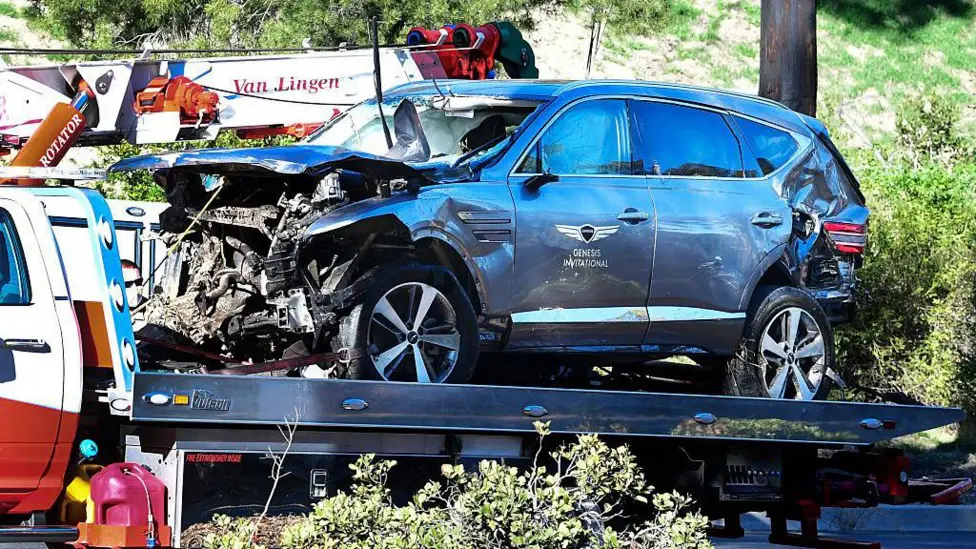
Woods, 50, rolled his Land Rover after clipping a pressure cleaner truck while trying to overtake it at “a high rate of speed”, according to Sheriff John Budensiek.
The golfer, who had to crawl out of the passenger door of his vehicle, passed a breathalyser test after the crash but refused a urine test.
No-one sustained any injuries in the incident which took place on Beach Road in Jupiter Island just before 14:00 local time on Friday (about 19:00 GMT).
Sheriff Budensiek told a news conference: “The DUI investigators came to the scene and Mr Woods did exemplify signs of impairment.
“They did several tests on him. He did explain the injuries and surgeries that he’s had and we did take that into account, but they did some in-depth roadside tests.
“When it was determined, he was placed under arrest and taken to the Martin County jail.
“At the Martin County jail, and even on scene, we were really not suspicious of alcohol being involved in this case and that proved to be true.
“Mr Woods did a breathalyser test with triple zeros, but when it came time for us to ask for a urinary analysis test, he refused.”
Budensiek also said Woods had been “co-operative but was trying not to incriminate himself”.
“He has a right to refuse that test,” added the sheriff. “There is a statute which he will be charged with for refusing to take that test, but we will never get definitive results as to what he was impaired on at the time of the crash.”
US president Donald Trump was asked about the crash on Friday, saying: “I feel so badly. [Woods has] got some difficulty. There was an accident. That’s all I know.
“He’s a very close friend of mine, he’s an amazing person, an amazing man.”
Sheriff Budensiek said Woods would remain in jail for eight hours then be released on bond. The charges are misdemeanours, not felonies.
The BBC has contacted the golfer’s representatives for comment.
This is not the first time Woods has been involved in a car accident – he has played a limited schedule since the serious crash in 2021 that left him with extensive injuries and fortunate to be alive.
In 2017 police officers also found him slumped at the wheel of his parked Mercedes-Benz not far from his Florida home.
A toxicology report found Woods had several legal medications in his system and marijuana’s active ingredient, and he was sentenced to a year’s probation after pleading guilty to reckless driving.
In 2009 Woods hit a fire hydrant, a tree, and several hedges in a bizarre collision outside his home.
The incident sparked accusations of extramarital affairs which led to the end of his seven-year marriage and the loss of lucrative sponsorship deals.
[BBC]
Latest News
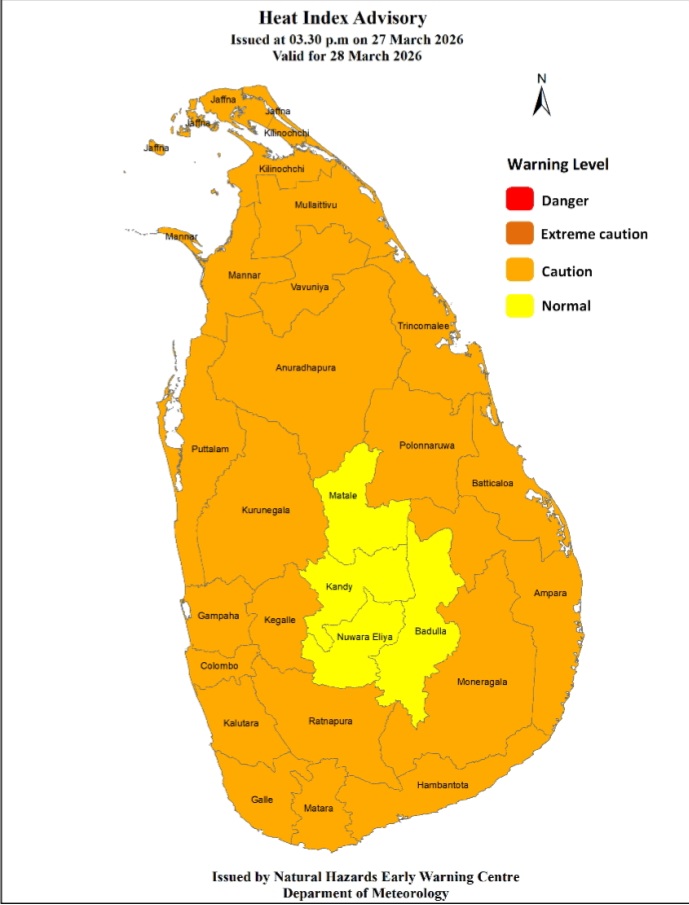
Heat Index at Caution Level in the Western, Sabaragamuwa, Southern, Eastern, North-western, Northern and North-central provinces and in Monaragala district
Warm Weather Advisory
Issued by the Natural Hazards Early Warning Centre of the Department of Meteorology
Issued at 3.30 p.m. on 27 March 2026, valid for 28 March 2026.
The ‘Heat index‘, the temperature felt on human body is likely to increase up to ‘Caution level’ at some places in the Western, Sabaragamuwa, Southern, Eastern, North-western, Northern and North-central provinces and in Monaragala district
The Heat Index Forecast is calculated by using relative humidity and maximum temperature and this is the condition that is felt on your body. This is not the forecast of maximum temperature. It is generated by the Department of Meteorology for the next day period and prepared by using global numerical weather prediction model data.

Effect of the heat index on human body is mentioned in the above table and it is prepared on the advice of the Ministry of Health and Indigenous Medical Services.
ACTION REQUIRED
Job sites: Stay hydrated and takes breaks in the shade as often as possible.
Indoors: Check up on the elderly and the sick.
Vehicles: Never leave children unattended.
Outdoors: Limit strenuous outdoor activities, find shade and stay hydrated.
Dress: Wear lightweight and white or light-colored clothing.
Note:
In addition, please refer to advisories issued by the Disaster Preparedness & Response Division, Ministry of Health in this regard as well. For further clarifications please contact 011-7446491.

Courtesy call by the Heads of Mission- Designate on Prime Minister

Three dead after helicopter crash in Hawaii

Woods charged with driving under influence after crash

Showers may occur at a few places in the Rathnapura, Kaluthara, Galle, and Matara districts during the evening or night

SC finds Keheliya, others, guilty of violating FRs of public through corrupt drug procurement deal

Sajith nudges govt. to follow India’s example in giving relief to consumers by slashing taxes on fuel

‘Dates have the highest sugar content to fight Coronavirus’

Sunday Island 27 December – Headlines

#SundayIsland 17th December – Headlines

Sunday Island – 28th March

Sunday Island Headlines – 21 March

Sunday Island – 21st February – Headlines
-

 News3 days ago
Senior citizens above 70 years to receive March allowances on Thursday (26)
-

 Features5 days ago
Trincomalee oil tank farm: An engineering marvel
-

 Features10 hours ago
A World Order in Crisis: War, Power, and Resistance
-

 News1 day ago
Energy Minister indicted on corruption charges ahead of no-faith motion against him
-

 News2 days ago
US dodges question on AKD’s claim SL denied permission for military aircraft to land
-

 Features5 days ago
The scientist who was finally heard
-

 Business2 days ago
Dialog Unveils Dialog Play Mini with Netflix and Apple TV
-

 Sports1 day ago
SLC to hold EGM in April