
Business
Trump tariffs trigger steepest US stocks drop since 2020 as China, EU vow to hit back

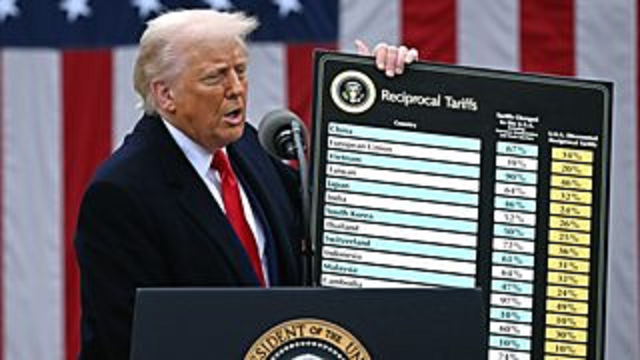
Global stocks have sunk, a day after President Donald Trump announced sweeping new tariffs that are forecast to raise prices and weigh on growth in the US and abroad.
Stock markets in the Asia-Pacific region fell for a second day, hot on the heels of the US S&P 500, which had its worst day since Covid crashed the economy in 2020.
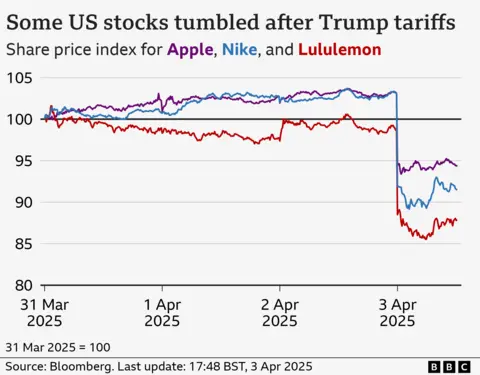
Nike, Apple and Target were among big consumer names worst hit, all of them sinking by more than 9%.
At the White House, Trump told reporters the US economy would “boom” thanks to the minimum 10% tariff he plans to slap on imports in the hope of boosting federal revenues and bringing American manufacturing home.
The Republican president plans to hit products from dozens of other countries with far higher levies, including trade partners such as China and the European Union. China, which is facing an aggregate 54% tariff, and the EU, which faces duties of 20%, both vowed retaliation on Thursday.
Tariffs are taxes on goods imported from other countries, and Trump’s plan that he announced on Wednesday would hike such duties to some of the highest levels in more than 100 years.
The World Trade Organization said it was “deeply concerned”, estimating trade volumes could shrink as a result by 1% this year.
Traders expressed concern that the tariffs could stoke inflation and stall growth.
In early trading on Friday, Japan’s benchmark Nikkei 225 index fell by 1.8%, the Kospi in South Korea was around 1% lower and Australia’s ASX 200 dipped by 1.4%.
On Thursday, the S&P 500 – which tracks 500 of the biggest American firms – plunged 4.8%, shedding roughly $2tn in value.
The Dow Jones closed about 4% lower, while the Nasdaq tumbled roughly 6%. The US shares sell-off has been going on since mid-February amid trade war fears.
Earlier, the UK’s FTSE 100 share index dropped 1.5% and other European markets also fell, echoing declines from Japan to Hong Kong.
On Thursday at the White House, Trump doubled down on a high-stakes gambit aimed at reversing decades of US-led liberalisation that shaped the global trade order.
“I think it’s going very well,” he said. “It was an operation like when a patient gets operated on, and it’s a big thing. I said this would exactly be the way it is.”
He added: “The markets are going to boom. The stock is going to boom. The country is going to boom.”
Trump also said he was open to negotiating with trade partners on the tariffs “if somebody said we’re going to give you something that’s so phenomenal”.
On Thursday, Canada’s Prime Minister Mark Carney said that country would retaliate with a 25% levy on vehicles imported from the US.
Trump last month imposed tariffs of 25% on Canada and Mexico, though he did not announce any new duties on Wednesday against the North American trade partners.
Firms now face a choice of swallowing the tariff cost, working with partners to share that burden, or passing it on to consumers – and risking a drop in sales.
That could have a major impact as US consumer spending amounts to about 10% – 15% of the world economy, according to some estimates.
While stocks fell on Thursday, the price of gold, which is seen as a safer asset in times of turbulence, touched a record high of $3,167.57 an ounce at one point on Thursday, before falling back.
The dollar also weakened against many other currencies.
In Europe, the tariffs could drag down growth by nearly a percentage point, with a further hit if the bloc retaliates, according to analysts at Principal Asset Management.
In the US, a recession is likely to materialise without other changes, such as big tax cuts, which Trump has also promised, warned Seema Shah, chief global strategist at the firm.
She said Trump’s goals of boosting manufacturing would be a years-long process “if it happens at all”.
“In the meantime, the steep tariffs on imports are likely to be an immediate drag on the economy, with limited short-term benefit,” she said.
On Thursday, Stellantis, which makes Jeep, Fiat and other brands, said it was temporarily halting production at a factory in Toluca, Mexico and Windsor, Canada.
It said the move, a response to Trump’s 25% tax on car imports, would also lead to temporary layoffs of 900 people at five plants in the US that supply those factories.
On the stock market, Nike, which makes much of its sportswear in Asia, was among the hardest hit on the S&P, with shares down 14%.
Shares in Apple, which relies heavily on China and Taiwan, tumbled 9%.
Other retailers also fell, with Target down roughly 10%.
Motorbike maker Harley-Davidson – which was subject of retaliatory tariffs by the EU during Trump’s first term as president – fell 10%.
In Europe, shares in sportswear firm Adidas fell more than 10%, while stocks in rival Puma tumbled more than 9%.
Among luxury goods firms, jewellery maker Pandora fell more than 10%, and LVMH (Louis Vuitton Moet Hennessy) dropped more than 3% after tariffs were imposed on the European Union and Switzerland.
“You’re seeing retailers get destroyed right now because tariffs extended to countries we did not expect,” said Jay Woods, chief global strategy at Freedom Capital Markets, adding that he expected more turbulence ahead.
[BBC]


By Hiran H. Senewiratne
The government is yet to address fully the needs of the Cyclone Ditwah affected populace though one year has elapsed. The devastation cost the country more than US $ 4.1 billion, an Australia-based Chartered Engineer of Sri Lankan origin said.
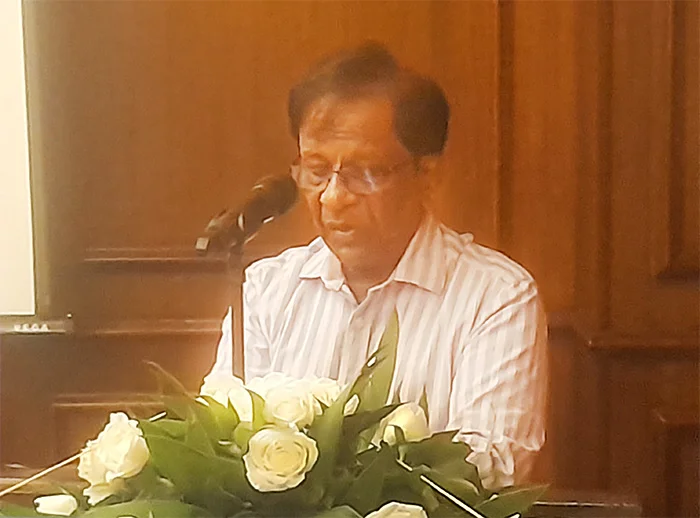
‘Cyclone Ditwah affected more than 2.2 million people in 25 districts, which is considered to be one tenth of the population. However, only 39 percent of the allocated funds have been spent to date, the speaker, a one-time General Secretary of the JVP, now living in Australia Lionel Bopage said.
He made these comments at a Rotary Club Colombo South monthly meeting held at the Kingsbury Hotel, Colombo recently.
Bopage quoted from a Loughborough University research report published in February to the effect that Sri Lanka has under invested in prevention but over invested in recovery.
Bopage added: ‘The largest single economic category affected were not buildings but the agriculture sector which provides livelihoods for the majority of affected persons. Therefore agricultural livelihoods have been hit most.
‘More than 58,000 hectares of paddy lands were flooded in the Eastern districts alone, while 46 reservoirs reached critical spill level or failed outright following the disaster.
‘A rapid education sector assessment found that 1,682 schools were affected and more than 555,000 children were unable to attend schools. Further, 622 water supply schemes had been left non-functional and apart from that 11300 homes were damaged or destroyed. But reconstruction is happening at a very slow pace.
‘Tens of thousands of households in the hill country and in the East are still living in damaged properties and on unstable slopes drawing water from schemes that have not been restored.
‘ A Post Disaster Needs Assessment put the cost of resilience at US$ 3.4 billion but restoration work is happening at a slow pace even with foreign donor assistance.’

By Hiran H. Senewiratne
The CSE yesterday kicked off on a positive note due to a World Bank forecast that Sri Lanka could achieve 4.4 percent economic growth this year but later lost momentum due to weak investor participation.
Amid those developments both indices moved upwards. The All Share Price Index went up by 132 points while S and P SL20 rose by 21.02 points.
Turnover stood at Rs 1.97 billion with three crossings. Those crossings were; Lanka IOC 2.7 million shares crossed to the tune of Rs 470 million; its shares traded at Rs 127, CCS 2.7 million shares crossed to the tune of Rs 315 million; its shares sold at Rs 118 and JKH five million shares crossed for Rs 91.5 million; its shares traded at Rs 18.30.
In the retail market companies that mainly contributed to the turnover were; Commercial Credit and Finance Rs 126 million (1.3 million shares traded), Lanka IOC Rs 98 million (775,000 shares traded), Asiri Surgical Hospitals Rs 77 million (7.6 million shares traded), Commercial Bank Rs 51.3 million (307,000 shares traded), Sampath Bank Rs 46 million (325,000 shares traded), HNB Rs 37 million (98000 shares traded) and Tokyo Cement Rs 31 million (393,000 shares traded). During the day 50 million share volumes changed hands in 14547 transactions.
It is said that the petroleum sector performed well, especially Lanka IOC, while in the banking sector counters, especially Commercial Bank and Sampath Bank performed well. In the manufacturing sector, JKH impressed.
TAL Lanka Hotels announced that it has scheduled an Extraordinary General Meeting on October 29 to obtain shareholder approval for a proposed Rs 1.87 billion rights issue. The proceeds will be utilized for the repayment of bank borrowings, part refurbishment of the Taj Samudra Hotel in Colombo, settlement of vendor liabilities, and general corporate requirements.
Yesterday the rupee was quoted at Rs 330.95/331.05 to the US dollar in the spot market, weaker from Rs 330.85/95 the previous day, while bond yields were quoted broadly steady, dealers said.
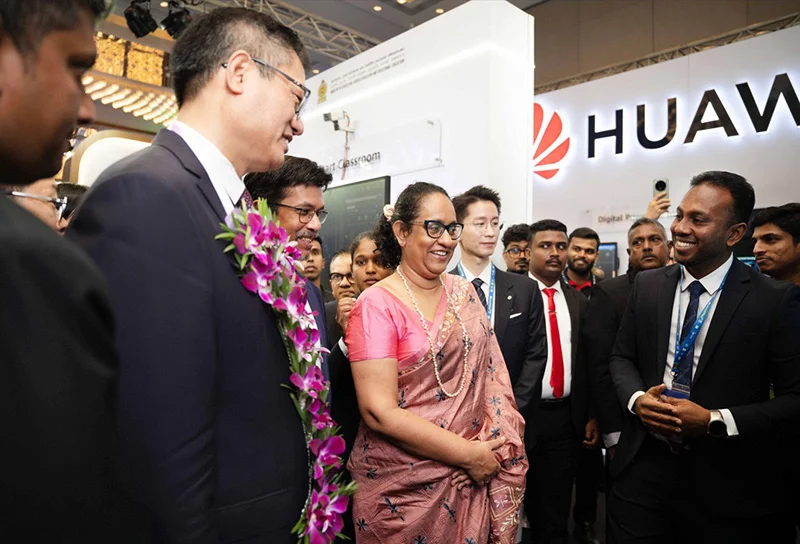
Sri Lanka AI Week 2026 continued into its second day bringing together government, industry, academia and technology partners to explore practical applications of artificial intelligence. As the AI Technology Partner for the second consecutive year, Huawei showcased 18 use cases spanning government, education, finance, industry, green energy and everyday life, demonstrating how AI can be applied to real-world needs.
Prime Minister Dr. Harini Amarasuriya visited the Huawei exhibition together with officials from the Ministry of Education, Higher Education and Vocational Education, experiencing the Smart Classroom, AI in Education and MindGraph by Beijing Normal University demonstrations. The Smart Classroom demostration highlighted how connected technologies can bring teachers and students in different locations into a shared learning environment, while the AI in Education showcase demonstrated how AI can support teachers, enhance learning and enable more personalised education. The Prime Minister praised the efforts of the Ministry of Education, Higher Education and Vocational Education, Huawei and their partners to demonstrate practical applications of AI in education, noting the role of technology in supporting teachers, expanding learning opportunities, and advancing a more inclusive, equitable and future-ready education system.
Later in the day, Deputy Minister of Digital Economy Eng. Eranga Weeraratne, Deputy Minister of Industry and Entrepreneurship Development Chathuranga Abeysinghe, Secretary to the Ministry of Digital Economy Waruna Sri Dhanapala, and Chinese Ambassador Wei Huaxiang visited the Huawei exhibition and explored the AI Hands-On Classroom AI Empowering Industry, AI in Education and Smart Classroom demonstrations. Deputy Minister Weeraratne praised Huawei’s practical approach to showcasing AI applications, noting their relevance to Sri Lanka’s digital transformation across education, industry and skills development. The engagement also extended across the wider AI ecosystem, with industry professionals, technology partners, academics and other visitors engaging with the demonstrations and expressing appreciation for Huawei’s practical approach to applying AI across different areas of society and the economy.
Daniel Wu, CEO of Huawei Sri Lanka, said that Huawei will continue bringing global experience, technology and ecosystem resources to Sri Lanka, while working side by side with local partners to build local capabilities, develop local talent and create real value for the country. “I believe that by working together, we can make AI not only more intelligent, but also more local, more inclusive, and more meaningful for everyone,” he said.

Showers above 100 mm are likely at some places in the Western, Sabaragamuwa, Central, Uva and Southern provinces and in Anuradhapura district

PSTA worse than PTA: FSP

Shiranthi R remanded until 13 Oct.

Former NSB Chairman Kariyawasam granted bail

Katchatheevu row: India SC urges fishermen to avoid Sri Lankan waters

Remembering Juvenal, Coke, Acton and Machiavelli

‘Dates have the highest sugar content to fight Coronavirus’

Sunday Island 27 December – Headlines

#SundayIsland 17th December – Headlines

Sunday Island – 28th March

Sunday Island Headlines – 21 March

Sunday Island – 21st February – Headlines
-

 Editorial6 days ago
Colombo Port drug bust: The plot thickens
-

 Features4 days ago
The first woman in the foreign service or Ceylon Overseas Service it was then called
-

 Editorial5 days ago
Fuelling discontent and protest
-

 News3 days ago
Geneva takes up Sallay’s case and govt. ignores opportunity to answer accusations
-

 Latest News5 days ago
Tharindu Rathnayake, bowlers secure Asian Games Bronze for Sri Lanka
-

 Foreign News5 days ago
Ten injured after car crashes into rugby supporters in Australia
-

 Features3 days ago
Sri Lanka Cricket Bill: Governance reform is not yet a cricket strategy
-

 News4 days ago
Nearly 20 Iranian tankers stranded off Lanka amid US sanctions