
News
New study finds 33 species of butterflies at Maduru Oya National Park

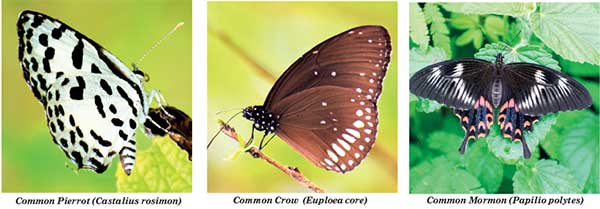
It could be a butterfly destination as well in the long-term
by Ifham Nizam
(Pics courtesy Praneeth Silva)
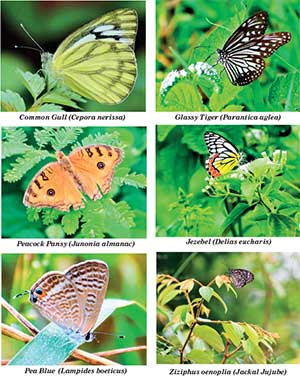
An ongoing new study has discovered 33 species of butterflies at the Maduru Oya National Park, which is better known for its wildlife and aquatic birds.
The new discovery could lead to the national park being identified also as a bird location in the long-term.
The research team comprising Prof. Dharshani Mahaulpatha, Praneeth Silva, Tharanga Dassanayake, Dulan Jayasekara, Chamara Prabhath, Wathmini De Silva and Hiranthi Dilrangi Praneeth Silva, a graduate research assistant of the University of Sri Jayewardenepura, expressed optimism that with further research the number of species could increase.
 “We have already asked the Wildlife Department to take action against noise pollution as vehicles entering the park frequently is increasing”, the team said.
Though elephants and aquatic birds are popular in the park, it could also be made a popular destination for butterflies, which are fascinating flying insects among lepidopterans and essential bio indicators of ecology and evolutionary studies, the researchers said.
“There are about 19,000 species of butterflies distributed around the world. The Western Ghats and Sri Lanka are a global biodiversity hotspot characterized by a large number of endemic species. With respect to butterfly fauna which harbors 331 species, Sri Lanka has 248 species, including 26 endemics.
Of the total butterfly species in the island, 21 are categorized as critically endangered, while 38 are endangered, 40 vulnerable and 21 near threatened. Furthermore, the conservation status of 29 species of butterflies has not been evaluated due to the lack of adequate data, Praneeth Silva said.
The Maduru Oya National Park extends to the Eastern, Uva and North Central provinces. The national park provides habitats for displaced wildlife and provides refuge to many other native fauna and flora particularly elephants. It is also home to thousands of aquatic birds.
The new study discovered 33 species of butterfly fauna representing five families. The commonest butterfly species is the Common Mormon (Papilio polytes). The butterfly count is high during the wet season (October-February) and low in the dry season (March-September).
Distinct differences in butterfly individual and species counts may be governed by climatic conditions of the area. As butterflies are poikilothermic organism, their biological cycle, activity, distribution and abundance are influenced by monthly temperature and rainfall patterns of the locality.
As the park is situated in the dry zone, the climax community of the area is tropical dry mixed evergreen forests characterized by large trees. However, high butterfly diversity can be observed in shrubs and bushes in the Maduru Oya National Park other than roads, water banks and extensive grassland habitat types. Availability of diverse shrubs and bushes in the park is the main reason for occurring high numbers of butterflies.
They act as host plants for butterflies by fulfilling the main living functions of butterflies to sustain their survival in the environment: facilitate laying of eggs, ensure nourishment and shelter for caterpillars, act as nectar sources for adults.
Praneeth de Silva said a higher number of ‘road kills’ of butterflies was observed due to the impact of vehicular traffic. High speed driving, lack of awareness of foreign and local visitors and poor law restrictions of wildlife authorities are the major governing factors for this critical issue.
The research team appreciated the cooperation of the Maduru Oya National Park staff, especially former park warden M. R. Mohamed and the incumbent warden J. Rathnayake and the Department of Wildlife Conservation for granting permission for the research.
The team also thanked the “Wildlife Circle” Association (Department of Zoology, University of Sri Jayewardenepura) for helping with their field work.


Under Articles 7 and 13 of the UNESCO 1970 Convention on the Means of Prohibiting and Preventing the Illicit Import, Export and Transfer of Ownership of Cultural Property, rights are conferred upon a state to request the return of cultural property belonging to it that is currently held abroad.
According to a proposal presented by the then Minister of Buddhasasana, Religious and Cultural Affairs, Phase 1 of the
restitution of Sri Lankan cultural heritage was executed in 2023, where 06 artifacts—including the Lewke Disawa’s Cannon, 02 large cannons, 02 Kasthanes (swords) with scabbards, and a knife with scabbard kept at the Rijksmuseum in Amsterdam, Netherlands—were officially handed back to Sri Lanka.
It has been recognized as appropriate to appoint a steering committee to directly exchange views further with the Dutch committee regarding the artifact restitution process and to advise the Government of Sri Lanka on restitution work regarding cultural property taken from Sri Lanka during the colonial era.
Accordingly, the Cabinet of Ministers has approved the resolution furnished by the Minister of Buddhasasana, Religious and Cultural Affairs to appoint a committee titled the “Committee for the Restitution of Sri Lankan Cultural Heritage Held Abroad”, chaired by the Additional Secretary (Cultural Promotion and Foreign Affairs) of the Ministry of Buddhasasana, Religious and Cultural Affairs, to provide necessary advice to the Government of Sri Lanka during the restitution process of artifacts taken from Sri Lanka.
Approval has been granted at the Cabinet meeting held on 22-07-2024 for Sri Lanka’s National Social Protection Policy.
The National Social Protection Strategy was presented to the Cabinet meeting held on 2025-09-15 to practically implement the aforementioned policy, and the Cabinet of Ministers has
determined to order all secretaries to the ministries to take necessary steps to act in accordance with the aforementioned strategy.
The mentioned National Social Protection Strategy is based on four main pillars: social subsidies, social protection, social insurance, the labor market, and productive inclusion.
Accordingly, the National Action Plan (2026-2035) on the social protection sector has been prepared as a tool for the practical implementation of the said strategy. Accordingly, the Cabinet of Ministers has approved the joint resolution furnished by the Minister of Labour, Minister of Women and Child Affairs,
and Minister of Rural Development, Social Protection, and Community Empowerment to implement the National Action Plan on the Social for the Social Protection Sector (2026-2035) in line with the National Social Protection Strategy.
Approval has been granted at the cabinet meeting held on 01-03-2023 for the National Curriculum Framework and the methodology for implementing the aforementioned framework, which was initiated by the National Institute of Education in 2019 under the education reform process.
However, considering the modules relevant to Grades 1, 6, and 10 that have been prepared by the National Institute of Education for the implementation of the new education reforms by the time the new government comes into power in 2024, it was planned to implement the new National Curriculum Framework only for Grades 1 and 6 in 2026, ensuring appropriate adjustments to the new government’s policies.
Further, it has also been planned to introduce vocational subjects from grade 10 onwards.
Accordingly, the concept paper required for ‘Transformational Change in Sri Lanka’s General Education’, which has been prepared to inform and make relevant parties aware of the proposed adjustments, has also been submitted to the Parliamentary Subcommittee on Education Reforms on 22-10-2025.
Subsequently, as decided at the Cabinet Meeting held on 13-01-2026, steps have been taken to postpone the implementation of education reforms for grade 6, which had been planned under the first phase of the comprehensive reform agenda for general
education, up to the year 2027, and only to implement new curriculum reforms for grade 1 in the year 2026.
Subsequently, the Ministry of Education, Higher Education, and Vocational Education has followed these steps.
• preparing a new concept paper with policy recommendations after reviewing the concept paper prepared related to bringing about transformational change in Sri Lanka’s general education
by the National Education Commission.
• Having reviewed the revised concept paper by the National Steering Committee established as per the cabinet decision dated 23-03-2026 and subcommittees established under 5 pillars
relevant to the education reforms-namely Curriculum Reform, Human Resource Development, Education Administrative Reforms & Infrastructure Development, Evaluation & Assessment, and Public Awareness & Promotion-and obtaining further observations and recommendations.
• Based on those observations and recommendations, further revising the National Curriculum Framework prepared by the National Institute of Education in 2023 and obtaining approval
from the Academic Affairs Board of the National Institute of Education.
• Obtaining approval from the Council of the National Institute of Education for the National Curriculum Framework approved by its Academic Affairs Board.
• Obtaining concurrence from the National Steering Committee for New Education Reforms on 2026-08-13 for the National Curriculum Framework approved by the Council of the National Institute of Education.
• Printing and preparing activity books and teacher guides for all 3 terms of Grade 1 and Grade 2 for the year 2027, so as to continue carrying forward the primary education reforms
commenced in the year 2026.
• Preparing Grade 6 modules for Terms I, II, and III, as well as teacher guides for all 3 terms.
• Master trainers have been trained by the National Institute of Education for all primary and secondary subjects, and all plans related to teacher training at the provincial level have been
prepared.
• Formulating the policy guidelines on school-based evaluation and assessment—prepared for practical implementation while managing available resources within the school system by the
Evaluation and Assessment Sub-Committee and obtaining the approval of the National Steering Committee.
Accordingly, the Cabinet of Ministers has approved the resolution furnished by the Hon. Prime Minister in her capacity as the Minister of Education, Higher Education, and Vocational Education to further implement the education reform process for grade 1, which has been initiated in the year 2026,
and to further initiate the education reform process for grade 2 and grade 6 in the year 2027, based on the concept paper prepared by the National Education Commission, the National Curriculum Framework approved by the National Steering Committee for New Education Reforms, and the School-Based
Evaluation and Assessment Guideline.

Appointment of a Committee for the Restitution of Sri Lankan Cultural Heritage Held Abroad
Ten-Year National Action Plan on the Social Protection Sector (2026–2035)
Implementation of Revised National Curriculum Framework under the Education Reforms

Sri Lanka to face India in semi-finals after washout

Bangladesh to take on Pakistan in semis after another washout

OpenAI scraps rollout of new model over safety concerns

‘Dates have the highest sugar content to fight Coronavirus’

Sunday Island 27 December – Headlines

#SundayIsland 17th December – Headlines

Sunday Island – 28th March

Sunday Island Headlines – 21 March

Sunday Island – 21st February – Headlines
-

 News6 days ago
Mastermind Naufer Moulavi among 15 found guilty
-
 Midweek Review6 days ago
Thileepan’s fast unto death: An authentic narrative that many missed
-

 Latest News5 days ago
Showers above 100 mm are likely at some places in the Western, Sabaragamuwa, Central and North-western provinces and in Galle and Matara Districts
-

 Editorial6 days ago
Big Bad Bills
-
Editorial5 days ago
Crimes punished and unpunished
-

 Features4 days ago
Beyond traditional jobs: Why Sri Lanka needs to facilitate the gig economy
-
 News6 days ago
One clause in Anti-Corruption (Amendment) Bill requires referendu: SC
-

 News6 days ago
No referendum needed for passage of 22 A: SC