
Latest News
Nawaz slams maiden ton as Pakistan chase 205 in 16 overs

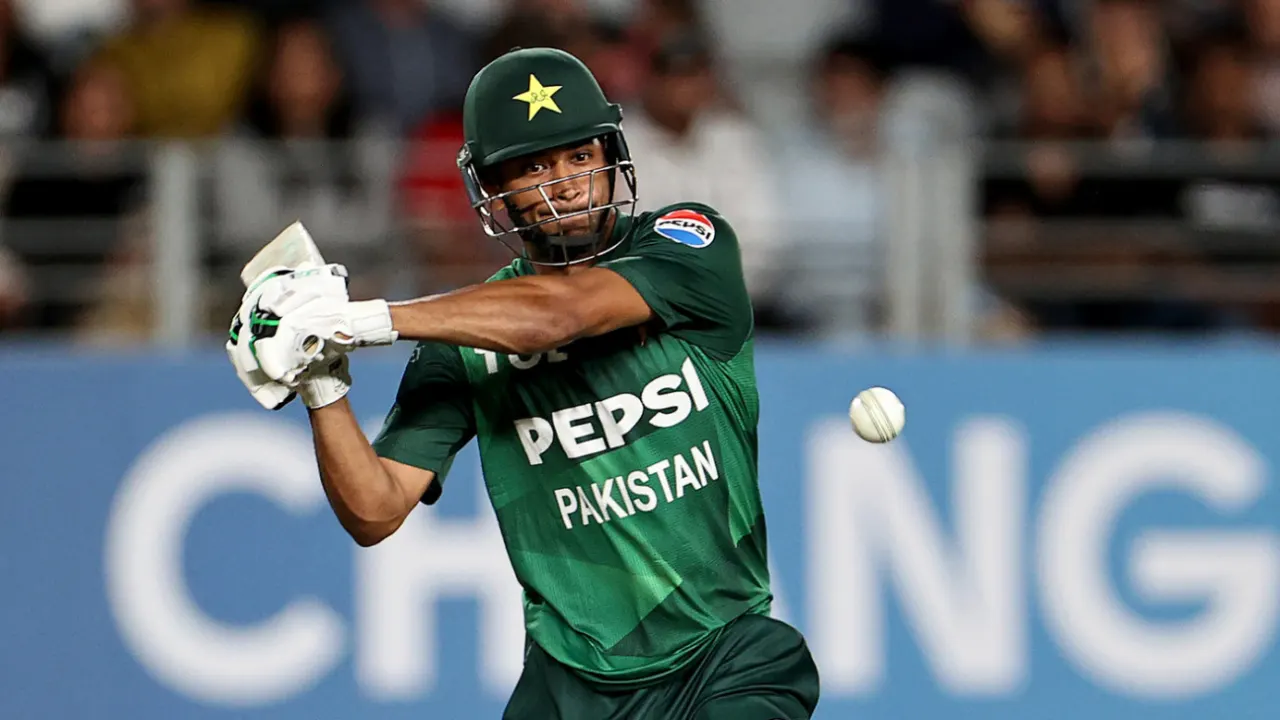
Pakistan’s high-risk, high-reward tactics finally bore fruit after two failed attempts as the Salman Agha led side stormed to a nine-wicket victory against New Zealand in an enthralling battle that saw 411 runs being amassed at Eden Park Hasan Nawaz’s maiden T20I century outplayed Mark Chapman’s 94 as Pakistan chased down 205 in just 16 overs and kept the five-match series alive at 1-2.
Pakistan backed their new openers Nawaz and Mohammed Haris in the post Mohammed Rizwan-Babar Azam era and they repaid the faith by putting up a 74-run opening stand off just 35 balls to lay the perfect foundation for the chase. Salman capitalised on the flying start to score 51 not out and was involved in an unbroken 133-run second-wicket stand. Nawaz, who was coming off two successive ducks, blazed away the fastest hundred by a Pakistan batter in T20Is, off just 44 balls, in a sensational chase.
Chapman’s blistering knock off just 44 balls set New Zealand up for what seemed like an above-par total at the innings break. After losing Finn Allen for a three-ball duck in the first over by Shaheen Shah Afridi, Tim Seifert (19 off nine) and Chapman pushed New Zealand past early jitters. Seifert fell to Haris Rauf in the fifth over but Chapman didn’t slow down.
He pulled and hooked the short balls, brought out beautiful cover drives against seamers and punished loose deliveries from Abrar Ahmed and Shadab Khan. He brought up his fourth half-century against Pakistan off 29 balls. This was also his first T20I fifty in almost a year.
Pakistan got the much-needed breakthrough in the tenth over when Daryl Mitchell (17 off 11) chased a wide delivery of Shadab and miscued to Rauf. Chapman kept finding boundaries, however, even when Pakistan captain Agha brought himself on and leaked 13 runs off his only over.
His strong bottom-hand and exceptional placement saw him smash 11 fours and four sixes. He was eventually deceived by an Afridi slower ball in the 13th over.
Pakistan fought back with quick wickets including two double-wicket overs from Rauf and Abrar but Michael Bracewell’s 31 off 18 ensured New Zealand crossed 200.
After two disappointing outings, Haris and Nawaz gave the visitors a dream start. Haris began with two sixes off Kyle Jamieson’s first over of the innings and followed it up with two fours against Jacob Duffy. Nawaz had a tough time early on with his timing but still found boundaries through streaky edges. Pakistan reached their joint-fastest team fifty in men’s T20Is, in four overs.
Duffy removed Haris for a 20-ball 41 with a bouncer in the sixth over and Pakistan ended the phase with 75 for 1, their highest powerplay total in men’s T20Is, moving past the 73 they scored against England in 2016.
Nawaz rode his luck but made sure to hang around. He was not particularly convincing against short balls early on but he was able to see the balls more clearly as the innings progressed. Though he started the chase playing second fiddle to Haris, Nawaz took charge after the powerplay.
His first confident strike came against Ish Sodhi in the seventh over, when he picked a loopy googly and clubbed it over long-on for a six. He brought up his maiden T20I fifty off 26 balls in the ninth over and propelled Pakistan to 124 for 1 at the halfway stage.
Nawaz was dropped on 68 by Sodhi off Ben Sears’ bowling but New Zealand couldn’t do much on a batting-friendly pitch with dew also making the task hard for the bowlers. Nawaz eventually hammered ten fours and seven sixes in his 45-ball stay.
Unlike Nawaz, Agha was precise and clever in his batting that fetched him six fours and two sixes. The duo scored 65 runs in the last four overs of the chase to take the team home early.
Nawaz brought up his century off the penultimate ball, before Pakistan completed the fastest 200-plus chase in men’s T20Is.
Brief scores:
Pakistan 207 for 1 in 16 overs (Hasan Nawaz 105*, Salman Agha 51*, Mohammad Haris 41, Jacob Duffy 1-37) beat New Zealand 204 in 19.5 overs (Tim Seifert 19, Mark Chapman 94,Daryl Mitchell 17, Michael Bracewell 31, Ish Sodhi 10; Shaheen Shah Afridi 2-36, Abrar Ahmed 2-43, Haris Rauf 3-29, Abbas Afridi 2-24, Shadab Khan 1-33) by nine wickets
[Cricinfo]


“Obviously, it depends on the team management… what we plan to do in this match. That is a different thing. But I think it is a very thin line between trying to give somebody an opportunity and you being unfair to some other player.”

Seattle Orcas had won just one of their first three games in MLC 2026, but it all came together beautifully for them against Washington Freedom on Thursday. The 88-run win was enough for them to jump straight to No. 2 on the points table, behind the unbeaten Los Angeles Knight Riders.
Orcas got the sort of start they wanted, reaching 59 for no loss after the powerplay even as they slowed down to get to 79 for 2 at the halfway stage. But then they really turned in on thanks to Shimron Hetmyer and Marcus Stoinis. Matthew Breetzke had given the innings some momentum in partnership with Hetmyer, but when Breetzke got out in the 15th over, Orcas were solid without being spectacular at 138 for 3. Around 200 was expected, but not the 227 they got.
And that was down to Stoinis, their captain. Hetmyer was already on 44 off 20 balls and got to his half-century off 24 deliveries soon after, but Stoinis almost caught up with Hetmyer in a blaze of sixes. He hit five of them in one over, the 17th, bowled by medium pacer Ian Holland. From 4 off six balls, Stoinis was on 34 off 12, and though there was another big one in the next over, bowled by Marco Jansen, Stoinis fell for 42 off 16 deliveries the next ball.
Hetmyer, meanwhile, left it till the last over, which started with Orcas on 208 for 5. Jack Edwards was the bowler, and Hetmyer went 6, 6, 6 off the first three balls. That was enough to take Orcas to a huge total, and for Hetmyer to finish on 79 not out off 33 balls.
With that many runs to chase down, Freedom needed a solid start. Instead, they were 42 for 5 after the powerplay, having lost most of the big guns: Steven Smith, Mitchell Owen, Andries Gous, Glenn Maxwell and Edwards. Jasdeep Singh had four of the five wickets, including three in his second over – the fifth of the innings – where he got Gous first ball, Maxwell off the next, and Edwards off the fifth. Smith was already in the bag from his first over, and Jasdeep came back in the 14th to complete his five-for with Jansen’s wicket.
At one point, it looked like the record for the biggest victory margin (by runs) in MLC – currently 123 from when San Francisco Unicorns beat Freedom last season – would be broken. That it wasn’t was thanks to runs from Freedom’s Nos. 8, 9 and 10. Amila Aponso top-scored for Freedom with 31 not out from 13 balls from No. 10, and the men before him, Holland and Jansen, contributed 46 from 39 deliveries between them.
The latest defeat, their second in three games, left Freedom at the bottom of the table.
Scores:
Seattle Orcas 227 for 6 in 20 overs (Tim Seifert 37, Shayan Jahangir22, matthew Breetzket 32, Shimron Hetmyer 79*, Marcus Stoinis 42, Ali Sheikh 11; Marco Jansen 3-33, jack Edwards 1-56, Ian Holland 2-49) beat Washington Freedom 139 in 16.2 overs (Andries Gous 18.Obus Pienaar 10, Marco Jansen 20, Ian Holland 26, Amila Aponso 31*; Marcus Stoinis 1-20, Jasdeep Singh 5-24, ottneil Baartman 1-11, Cameron Gannon 2-16, Harmeet Singh 1-40) by 88 runs
[Cricinfo]

Over 40 persons have been injured (some critically) as two buses one travelling from Galle to Ampara and the other from Tangalle to Matara crashed head on at Talalla Matara this morning.
The injured have been admitted to the Matara General Hospital and Bathhegama District Hospital.

FSP complains of irregularities in a Guinness World Record event held in Sri Lanka

Opposition MPs sign motion demanding debate on prolonged failure to fill vacancies in superior courts

Another Lankan desperado deported from Malaysia arrested at BIA

SJB swift justice!

Hoarded relief goods brought to light after audit officers force open locked storerooms at Udapalatha DS

Sri Lanka Retailers’ Association unveils strategic roadmap for the future at 9th AGM

‘Dates have the highest sugar content to fight Coronavirus’

Sunday Island 27 December – Headlines

#SundayIsland 17th December – Headlines

Sunday Island – 28th March

Sunday Island Headlines – 21 March

Sunday Island – 21st February – Headlines
-

 Features6 days ago
Nanda Pethiyagoda Wanasundara as three generations of family saw her
-

 Features5 days ago
Sri Lanka developing independent hydrographic capabilities
-

 Editorial6 days ago
Fuel crisis: Beyond price debate
-

 Opinion4 days ago
Ranasinghe Premadasa: The man who would not take ‘No’ for an answer
-

 Latest News5 days ago
Sooryavanshi thumps fastest List A fifty as India A win tri-series
-

 News4 days ago
US Assistant Secretary of State for South and Central Asian Affairs meets President
-

 Business5 days ago
University of West London opens Sri Lanka’s first full UK university branch campus
-

 Features6 days ago
The Sirisena – Ranil conflict and events leading to MR’s return as PM