
Foreign News
Europe ‘at turning point in history’, French president warns

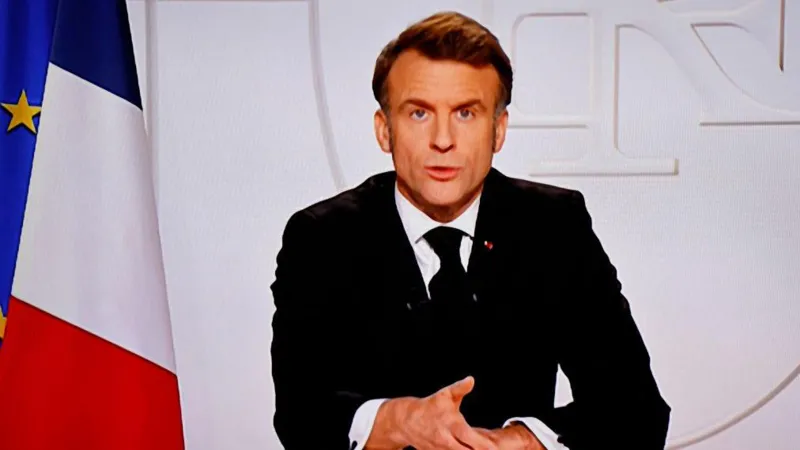
EU leaders are gathering in Brussels today [06] for a special council on defence, as France’s President Emmanuel Macron warned that the continent was at a “turning point of history”.
As well as rearmament, leaders are expected to discuss how the body can further support Kyiv in the face of US President Donald Trump’s announcement on Monday that he would suspend aid to Ukraine. Ukrainian President Volodymy Zelensky is invited to the summit.
Nerves have grown increasingly frayed across Europe since Trump and Zelensky’s showdown at the White House last week, and the rhetoric around Thursday’s summit leaves no doubt about the importance EU officials are ascribing to it.
Three years on since Russia’s full scale invasion of Ukraine, the Trump administration’s overtures to Russian President Vladimir Putin have left many in Europe concerned the continent would not be able to rely on US support for its security.
Washington’s decision on Wednesday topause intelligence sharing with Ukraine did nothing to allay those worries.
In a sign of the depth of concern, President Macron said France was open to discussing extending the protection offered by its nuclear arsenal to its European partners, during an address to the nation on Wednesday.
That followed a call from Friedrich Merz, likely to be Germany’s next chancellor, to discuss increased nuclear sharing.
Europe was facing a “clear and present danger on a scale that none of us have seen in our adult lifetime”, European Commission chief Ursula von der Leyen said, while European Council President António Costa said this was a “defining moment for Ukraine and European security”.
In a letter to European leaders, von der Leyen also said the continent had to “meet the moment” and “unleash our industrial and productive power and direct it to the goal of security”.
On Monday, von der Leyen announced an unprecedented defence package – dubbed ReArm Europe – and said that Europe was ready to “massively” boost its defence spending “with the speed and the ambition that is needed”.
Von der Leyen said the three proposals outlined in the ReArm Europe plan would both support Ukraine and “address the long-term need to take much more responsibility” for European security – likely referring to the fact many Europeans feel the continent can no longer automatically rely on the US to come to its aid.
The proposals include:
- Allowing countries to increase national deficit levels to give room for more defence spending
- €150bn (£125bn) in loans for defence investment in domains that could benefit the defence of the EU as a whole – for example, air and missile defence, anti-drone systems, and military mobility – helping pool demand, and reduce costs through joint procurement
- Allowing countries to redirect funds earmarked for cohesion policy programmes (policies aimed at levelling the differences between more and less advantaged regions) to defence spending
The European Investment Bank would also be allowed to finance military projects.
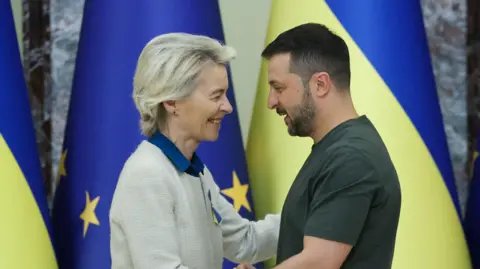
According to von der Leyen, the plan could free up a total of €800bn ($860bn; £670bn) in defence expenditure.
Many European leaders have signalled their support for swift, decisive action in regards to the continent’s security.
Donald Tusk, Poland’s prime minister, said the Commission’s plan represented “a fundamental shift”, while Lithuanian President Gitanas Nauseda said that the summit would give Europe the opportunity to show “whether it’s just a debate club or whether we can make decisions”.
But dissent from certain European leaders sympathetic to Moscow is expected.
Earlier this week, Slovakian Prime Minister Robert Fico said the EU’s “peace through strength” approach was “unrealistic”.
And in a letter to Costa, Hungary’s Viktor Orban demanded that Ukraine not be mentioned in any written conclusions following the summit.
Orban – who has repeatedly attempted to block EU aid to Ukraine and has praised Trump for “standing bravely for peace” – said there was now a “strategic divide… between the majority of Europe and the USA”.
“One side insists on prolonging the war in Ukraine, while the other seeks an end to the conflict,” he added.
Yet Orban left the door open for a “greater probability for cooperation” with other leaders over issues of common security and defence.
While Thursday’s crisis summit is taking place in Brussels, UK Defence Secretary John Healey will be in Washington for discussions with his counterpart Pete Hegseth on the US decision to pause intelligence sharing with Ukraine.
Their bilateral meeting will focus on a possible peace plan while efforts continue to bridge a transatlantic rift over Kyiv’s future security.
Perhaps in a final bid to try and achieve unity ahead of the summit, Emmanuel Macron – who has positioned himself at the centre of the EU’s efforts to bridge the gap between Kyiv and Washington – invited Orban to have dinner in Paris on Wednesday evening.
The two leaders met immediately after the French president gave a sombre address to the nation in which he said that France and Europe needed to be ready if the US was no longer by their side.
“We have to be united and determined to protect ourselves,” Macron said. He added that the future of Europe could not be tied to Washington or Moscow, and said that while he “wanted to believe that the US will stay by our side, we have to be ready for this not to be the case”.
The French president plans to hold a meeting of European army chiefs in Paris next week.
Macron said that “decisive steps” would be taken in Brussels, leaving European countries “more ready to defend and protect themselves”.
“The moment calls for unprecedented decisions,” he concluded.
[BBC]


A strong magnitude 7.5 earthquake has struck off northern Japan, prompting authorities to issue a tsunami warning for waves of up to 3 metres (10 feet).
The quake hit on Monday at 4:53pm local time (07:53 GMT) in waters off Iwate prefecture on Japan’s Pacific coast, according to the Japan Meteorological Agency (JMA). It was felt across a wide area, shaking buildings in Tokyo, hundreds of kilometres (miles) to the south.
The JMA warned that the first tsunami waves could reach parts of the northern coastline immediately. “Evacuate immediately from coastal regions and riverside areas to a safer place such as high ground or an evacuation building,” the agency said.
“Tsunami waves are expected to hit repeatedly. Do not leave safe ground until the warning is lifted.”
Live footage from public broadcaster NHK showed no immediate signs of damage at several ports in Iwate.
Prime Minister Sanae Takaichi said the government had set up a crisis management team and was working to assess the impact of the earthquake.
“For those of you who live in areas for which the warnings have been issued, please evacuate to higher, safer places such as higher ground,” Takaichi told reporters.
[Aljazeera]

Thousands of prisoners in Myanmar have been granted amnesty or had their sentences reduced. The pardon order by Min Aung Hlaing is one of his first official acts since the coup leader became president this month.
The move comes as the lawyer for jailed former leader Aung San Suu Kyi told the Reuters news agency that her sentence has been reduced. Former president Win Myint, detained since the 2021 coup, was also pardoned of his convictions, a statement from the presidency said.
Min Aung Hlaing approved an amnesty for 4,335 prisoners, Myanmar’s state television MRTV reported.
A communique on behalf of Min Aung Hlaing said “those serving death sentences shall have their sentences commuted to life imprisonment”, without naming specific prisoners.
“The President has pardoned Win Myint,” said another statement from Min Aung Hlaing’s office. Win Myint was “granted a pardon and the reduction of his remaining sentences under specified conditions”, MRTV said.
Suu Kyi, 80, is serving a 27-year sentence on charges her allies describe as politically motivated. Her sentence was cut by one-sixth, her lawyer told Reuters, but it remains unclear whether the Nobel Peace Prize winner will be allowed to serve the rest of her sentence under house arrest. Min Aung Hlaing placed Suu Kyi under arrest after the coup.
Amnesties typically happen as Myanmar marks Independence Day in January and its New Year in April.
Among those to be released are 179 foreign nationals, who will be deported. The amnesty also includes the commutation of all death sentences to life imprisonment, life sentences reduced to 40 years, and a one-sixth reduction in term lengths for all other prisoners.
[Aljazeera]

Several armed men robbed a bank in broad daylight in Naples, holding 25 people hostage before making their escape via a tunnel.
Police surrounded a branch of Crédit Agricole in the southern Italian city shortly after the robbery began around midday local time (10:00 GMT).
Local outlets reported that they negotiated with the robbers before the hostages could be released, about two hours into the robbery.
Firemen could be seen smashing in a window with battering rams and helping people climb out from inside in videos shared on social media.
Some hostages simply shook off the shards of glass and walked on.
But others looked visibly shaken, crying and hugging their relatives. Six people, who were in a state of shock, were offered medical assistance.
One man later told local news site Fanpage.it that the robbers had locked them into a room and that, while they were armed, “they did not use violence”.
Nobody was seriously injured. “Thanks to the swift response… all the hostages were freed shortly after 13:30 without serious injuries,” regional official Michele di Bari said in a statement.
A large crowd of bystanders, local residents and firefighters gathered in the square waiting for developments, while ten of thousands of people tuned into a livestream from the scene of the crime.
Members of the special forces of the carabinieri armed police were urgently flown in from Tuscany.
It was not until several hours later that they stormed the bank by breaking a window.
Several shots and the loud noises of stun grenades could be heard on the live feed shortly after.
But by then, the robbers had reportedly escaped through a tunnel, local media reported. It was thought they could have vanished into the sewer system.
The video feed later showed a number of carabinieri and firefighters peering into a manhole nearby as a crowd continued to mill about the square.
Fanpage.it reported that it was not yet possibly to quantify the value of the loot taken because the robbers had seized personal safety deposit boxes rather than cash.
(BBC)

INS NIREEKSHAK makes port call in Colombo

Advisory for Severe Lightning issued to the Western, Sabaragamuwa, Central, North-western, North-central, Southern, Uva provinces, and Mannar, Vavuniya, Ampara, Batticaloa districts

US, Iran exchange threats as fragile ceasefire set to expire

Six Foreign Envoys Present Credentials to President Dissanayake

Tilak ends Mumbai Indian’s losing streak with 45-ball century

Showers or thundershowers will occur at most places of the island after 1.00 pm

‘Dates have the highest sugar content to fight Coronavirus’

Sunday Island 27 December – Headlines

#SundayIsland 17th December – Headlines

Sunday Island – 28th March

Sunday Island Headlines – 21 March

Sunday Island – 21st February – Headlines
-

 Business4 days ago
Harnessing nature’s wisdom: Experts highlight “Resist–Align” path to resilience
-

 News6 days ago
PNS TAIMUR & ASLAT set sail from Colombo
-

 News4 days ago
Gratiaen Trust announces longlist for the 33rd Annual Gratiaen Prize
-

 News3 days ago
From Nuwara Eliya to Dubai: Isha Holdings markets Agri products abroad
-

 News22 hours ago
Rs 13 bn NDB fraud: Int’l forensic audit ordered
-

 Opinion2 days ago
Shutting roof top solar panels – a crime
-
 News4 days ago
Heroin haul transported on 50-million-rupee contract
-

 Latest News5 days ago
Singapore Zoo’s first Sri Lankan leopard cubs make their public debut